July 16, 2026
The Strategic Risk Behind Every Frontier Mine: Labour Governance in the World's Most Critical Iron Ore Project
When a new mining project enters its ramp-up phase in a frontier jurisdiction, operational continuity is rarely guaranteed by technical capacity alone. The integrity of labour agreements, the speed at which multinational operators adapt to host-nation regulatory frameworks, and the institutional maturity of government oversight mechanisms all shape whether a project delivers on its promise. These forces converged in early May 2026 at one of the most closely watched resource developments on earth, offering a case study in how labour risk can intersect with geopolitical strategy, seaborne commodity markets, and the governance ambitions of resource-rich nations.
The Baowu Simandou mine strike ends chapter that closed on May 7, 2026, carries far more analytical weight than a single operational disruption resolved. It marks a visible moment in the broader recalibration of how Guinea intends to govern its resource wealth, and how multinational mining consortia must respond.
When big ASX news breaks, our subscribers know first
Why the Simandou Labour Dispute Matters Beyond Guinea's Borders
The Strategic Weight of Blocks 1 and 2 in the Global Iron Ore Equation
The global seaborne iron ore market is structurally concentrated. Australia and Brazil together account for the overwhelming majority of seaborne iron ore exports, with Australian producers such as BHP, Rio Tinto, and Fortescue dominating supply to Asian steel markets. This concentration creates persistent counterparty risk for steel producers seeking to diversify upstream supply chains, particularly as geopolitical tension between consuming and producing nations introduces new sourcing anxieties.
Simandou, located in the Nimba Range of southeastern Guinea, occupies a singular position in this supply picture. The deposit has long been described in geological and industry literature as containing one of the largest known concentrations of high-grade iron ore on earth. Understanding the broader iron ore market and deposits helps contextualise why Simandou's ore quality is not simply a financial consideration but an environmental compliance asset for Chinese steel mills operating under intensifying emissions scrutiny.
Blocks 1 and 2, now under the operational leadership of the Baowu Winning Simandou Consortium (BWCS), represent the project's newest supply node under active development. Any disruption at this stage of the ramp-up carries implications extending well beyond Guinea's national accounts. Iron ore market analysts, steel producers, and infrastructure investors tracking Guinea's development trajectory were all watching the April–May 2026 work stoppage with considerable attention.
How a Nine-Day Work Stoppage Exposed Structural Governance Gaps
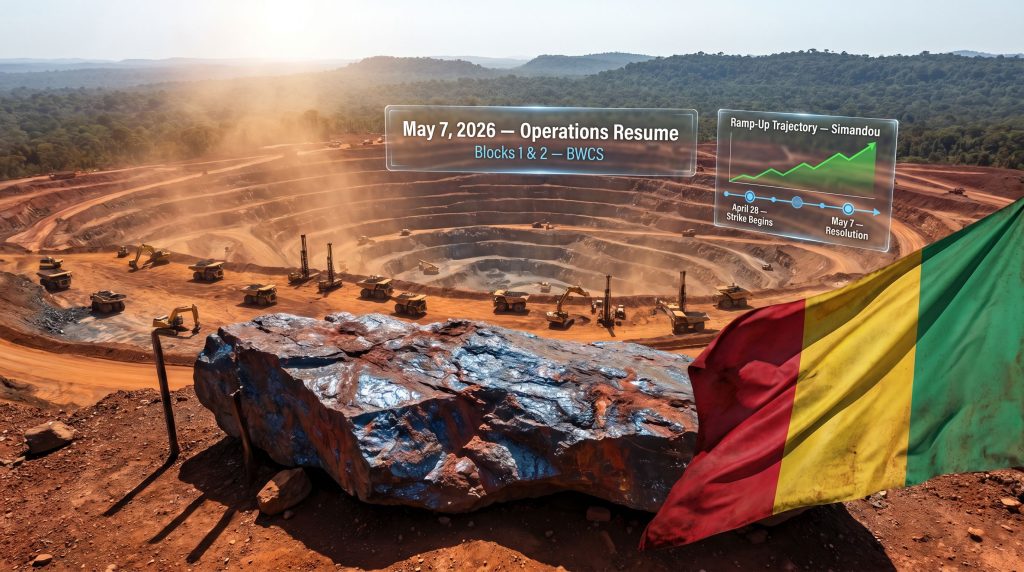
Workers at BWCS initiated a strike halting mining operations on April 28, 2026, suspending core mining face activities. According to reporting by Reuters, the workforce involved numbered approximately 3,000 workers, a scale sufficient to halt production advancement at one of the world's most anticipated iron ore development projects.
The central grievance was not a novel wage demand. Workers alleged that BWCS had failed to implement Guinea's 2025 unified mining pay framework, a nationally codified collective agreement signed in February 2025 that established standardised compensation structures across the country's extractive sector. The practical consequence of this alleged non-compliance was a reported wage differential of 2 to 3 times between BWCS workers and their counterparts employed at the adjacent Simfer joint venture operating blocks 3 and 4 of the same deposit.
Critically, rail and port infrastructure continued functioning throughout the nine-day stoppage, confirming that the disruption was isolated to the mine face itself rather than the broader logistics chain. This distinction matters for assessing the full economic impact of the work stoppage on the project's near-term output trajectory.
The strike was not simply a wage grievance rooted in individual pay dissatisfaction. It reflected a structural tension between a multinational operator's internal compensation frameworks and the formal regulatory expectations of a host nation actively asserting its labour governance authority over foreign-led mining consortia.
What Was Actually Agreed? Breaking Down the May 7 Resolution Framework
The Three-Party Settlement Structure
Operations at BWCS blocks 1 and 2 formally resumed on the morning of Thursday, May 7, 2026, following a tripartite accord signed the previous day between BWCS management, union representatives, and officials from Guinea's labour and mining ministries. The involvement of both government ministries in the signing process is structurally significant. Rather than a bilateral management-union negotiation resolved through internal corporate channels, the settlement was executed under active state supervision.
This model, where the government functions as a co-signatory rather than a passive observer, signals a deliberate institutional posture by Guinea's administration toward foreign-operated extractive projects. It is, furthermore, a meaningful departure from the arm's-length approach that characterised earlier phases of Simandou's development history.
Core Commitments Under the Wage Agreement
The terms of the settlement, as reported by Reuters from a document they reviewed, established the following framework:
| Agreement Component | Detail |
|---|---|
| Applicable Pay Framework | Guinea's national collective agreement for the mining sector (signed February 2025) |
| Worker Classification | Existing job grade classifications to be maintained without downward revision |
| Pay Entitlements | No reduction in existing pay levels permitted under the settlement |
| Pay Increases | Fixed increments established across defined job grades |
| Outstanding Issues Deadline | Classification disputes to be resolved through further negotiation by May 20, 2026 |
| Compliance Pledge | Both management and workers committed to observe Guinea's strike governance laws |
The commitment to maintaining existing worker classifications without downward revision is particularly notable. In many multinational mining operations in frontier jurisdictions, reclassification exercises have historically been used as indirect mechanisms for reducing effective compensation without breaching nominal wage floors. The BWCS settlement explicitly closes this pathway, at least in its current formulation.
What Remains Unresolved: The May 20 Classification Deadline
The agreement defers complete resolution of worker classification disputes to a subsequent negotiating round, to be conducted under Guinea's labour inspectorate supervision, with a May 20, 2026 deadline for conclusion.
This creates what is best characterised as a structured but conditional resolution. Operations have resumed, the immediate production disruption has ended, and BWCS has formally committed to Guinea's national pay framework. However, the underlying classification framework remains subject to further negotiation. If those talks stall or produce outcomes workers consider inequitable, the conditions for a second work stoppage remain structurally present.
The May 20 classification deadline is the single most important near-term operational milestone for anyone assessing whether the Simandou BWCS resolution genuinely holds or whether it represents only a temporary de-escalation of an unresolved structural dispute.
How Does the BWCS Dispute Compare to the Simfer JV Next Door?
A Tale of Two Consortiums Operating the Same Deposit
One of the more analytically revealing dimensions of this dispute is the wage comparison that workers themselves drew between BWCS and the neighbouring Simfer joint venture. Blocks 3 and 4 of Simandou are operated by Simfer, a joint venture led by Rio Tinto, with Chinalco and the Guinean state as additional partners. No labour disruptions were reported at Simfer during the BWCS strike period.
| Dimension | BWCS (Blocks 1 and 2) | Simfer JV (Blocks 3 and 4) |
|---|---|---|
| Lead Operator | Baowu Resources | Rio Tinto |
| Other Partners | Winning Consortium | Chinalco, Guinean State |
| Strike Status (April–May 2026) | 9-day work stoppage | No reported disruption |
| Reported Wage Differential | Significantly lower vs. Simfer | Benchmark comparator for workforce |
| Pay Framework Compliance | Disputed by workers | Not publicly contested |
The contrast between the two consortiums operating within the same regulatory environment illuminates how different governance cultures within multinational partnerships can produce materially different labour relations outcomes. For investors tracking African mining governance risk, this comparison carries a broader lesson. Operator identity and internal HR governance philosophy are project-specific risk variables that cannot be assumed to be uniform even within a single deposit.
Baowu's Position in the Global Steel and Iron Ore Landscape
Why the World's Largest Steelmaker Needs Simandou to Work
Baowu Resources took operational control of Simandou blocks 1 and 2 in early 2026, making this one of its most strategically visible international resource investments. Baowu's parent, China Baowu Steel Group, is widely recognised as the world's largest steelmaker by output, a position it has consolidated through a series of domestic mergers encouraged by Chinese industrial policy over the past decade.
For a company of Baowu's scale, upstream iron ore security is both a cost management imperative and a strategic hedge. The dynamics shaping China steel and iron ore markets mean that Chinese steel producers have historically been price-takers in the seaborne iron ore market, purchasing the majority of their ore from Australian and Brazilian producers at prices set by global spot market dynamics. Vertical integration into a deposit of Simandou's quality changes that equation fundamentally.
By controlling its own upstream supply at Simandou, Baowu reduces its exposure to seaborne price volatility and secures access to high-grade feedstock outside the Australian and Brazilian duopoly. Any reputational or operational setback at Simandou consequently carries consequences well beyond Guinea's iron ore export timetable. It tests Baowu's credibility as a competent and compliant international mine operator at the precise moment it is expanding its frontier footprint.
Guinea's Leverage in the Relationship
Guinea's direct participation in the tripartite settlement demonstrates that the government views itself as an active regulatory participant in its own resource development. The February 2025 national collective agreement for the mining sector, now formally embedded in BWCS's operational commitments, establishes a compliance precedent with implications for every foreign-led mining consortium operating in Guinea.
The message embedded in the settlement structure is functionally clear: Guinea's domestic pay frameworks will be enforced regardless of operator nationality, corporate scale, or strategic project significance. This is consistent with a broader pattern across resource-dependent African nations where governments are increasingly using labour regulation as both a workforce protection mechanism and a tool for asserting greater sovereignty over the terms of resource extraction.
What This Strike Resolution Signals for African Mining Labour Relations
Emerging Patterns in Host-Nation Workforce Governance
The Simandou dispute does not exist in isolation. It reflects an emerging pattern across African resource jurisdictions where host governments are moving beyond passive permitting roles to actively codify minimum labour standards specifically tailored to the extractive sector. The introduction of a unified mining pay structure in Guinea in 2025, and its enforcement through the BWCS settlement, is consistent with similar legislative directions being explored in other mining-intensive African economies.
For multinational mining operators, the operational implications of this trend are significant:
- Regulatory compliance at the wage and classification level is no longer a discretionary best-practice consideration in jurisdictions with maturing mining governance frameworks
- Host-nation pay frameworks are increasingly being embedded into operating agreements as binding conditions rather than aspirational targets
- Government ministries are positioning themselves as co-signatories and enforcement agents in labour disputes rather than neutral mediators
- Workforce reference points now exist across adjacent operations within the same deposit, making wage disparities visible and politically actionable
- Labour inspectorate oversight is becoming a formalised mechanism in dispute resolution architecture, not an exceptional intervention
Three Risk Factors That Remain Elevated Post-Resolution
-
Classification Ambiguity: The deferred May 20 deadline on job grade classifications leaves a structural gap that could reignite grievances if talks between management and union representatives stall or produce outcomes the workforce considers regressive.
-
Wage Parity Expectations: Workers at BWCS now have a formal, documented reference point in Simfer's compensation structure against which all future pay negotiations at blocks 1 and 2 will be benchmarked. This creates a persistent upward pressure dynamic on BWCS compensation that did not exist in the same form before the Baowu Simandou mine strike ends episode.
-
Ramp-Up Pressure vs. Workforce Relations: The commercial imperative to accelerate Simandou's production timeline creates a structural tension with the slower pace required for genuine labour relations reform. Operators who prioritise production velocity over workforce governance quality tend to create the conditions for recurring disputes rather than durable settlements.
Mining operators entering frontier African jurisdictions with complex host-nation regulatory environments should treat labour regulation compliance not as an HR function but as a project execution risk factor requiring the same rigour applied to geological, infrastructure, and permitting risk assessment.
The next major ASX story will hit our subscribers first
Iron Ore Market Implications: Short-Term Relief, Longer-Term Questions
How Nine Days of Halted Production Affects the Supply Picture
In isolation, a nine-day halt at a project still in its production ramp-up phase does not materially alter global iron ore supply volumes. Simandou is not yet producing at a scale where short-term interruptions register significantly against the seaborne market's overall supply balance. However, the symbolic and signalling dimension of the disruption carries its own market weight.
Iron ore market participants who have been monitoring Simandou's output trajectory will now incorporate labour relations stability as an explicit assessment criterion when modelling when BWCS blocks 1 and 2 will reach commercially meaningful production scale. A project that experiences a workforce stoppage during ramp-up introduces a category of operational risk that did not previously appear in many analyst frameworks for this deposit.
The project's broader strategic significance intensifies as production scales. Simandou's eventual full-production contribution to seaborne iron ore supply is expected to represent a meaningful addition to a market currently shaped primarily by Australian and Brazilian output. Australia's iron ore dominance in Asian supply chains means that Simandou's high-grade ore characteristics position it as a premium-quality diversification source with particular relevance to Chinese steel producers operating under carbon intensity reduction targets.
The Seaborne Iron Ore Pricing Dynamic to Watch
The quality premium commanded by high-iron-content ore in seaborne markets is a structural feature of iron ore price trends that is particularly relevant to Simandou. Steel mills optimising for emissions intensity increasingly value higher-grade feedstocks because they reduce the energy required per tonne of steel produced. This creates a pricing premium for Simandou-grade ore that sits above benchmark pricing for standard-grade material.
Baowu's direct operational control of the deposit, however, means that much of Simandou's output will not enter the open seaborne market at all. Vertically integrated supply chains that route ore directly from mine to affiliated steel mills bypass spot market pricing mechanisms entirely, meaning the premium quality of Simandou's ore benefits Baowu's internal cost structure rather than flowing through to seaborne benchmark prices.
Furthermore, any additional operational interruptions — including a breakdown in May 20 classification negotiations — would delay the point at which Simandou ore begins meaningfully influencing the global supply mix. This would consequently extend the period during which iron ore surplus pressures and Australian and Brazilian supply continue to dominate seaborne pricing dynamics.
Frequently Asked Questions: Baowu Simandou Mine Strike Ends
What caused the Simandou mine strike in April 2026?
Workers at the Baowu Winning Simandou Consortium initiated a work stoppage on April 28, 2026, after alleging that BWCS management had not applied Guinea's 2025 unified mining pay framework. The workforce reported compensation levels substantially below those received by workers at the neighbouring Simfer joint venture, which operates blocks 3 and 4 of the same deposit under a Rio Tinto-led consortium structure.
When did mining resume at Simandou blocks 1 and 2?
Mining operations at BWCS-operated blocks 1 and 2 resumed on the morning of May 7, 2026, following a tripartite settlement agreement signed the previous day between BWCS management, union representatives, and officials from Guinea's labour and mining ministries.
What did the BWCS wage agreement include?
The settlement committed BWCS to applying Guinea's national mining sector collective agreement from February 2025, maintaining existing worker job grade classifications without downward revision, ensuring no reduction in current pay entitlements, and establishing fixed pay increases across defined job grades. Remaining classification disputes were referred to further negotiations under Guinea's labour inspectorate, with a resolution deadline of May 20, 2026.
Is the Simandou dispute fully resolved?
Not entirely. While operations have resumed and BWCS has formally committed to Guinea's national pay framework, outstanding worker classification disputes remain subject to further supervised negotiation. The settlement is more accurately characterised as a structured interim resolution, with the May 20 classification deadline representing the next critical test of whether the accord holds under commercial pressure.
Who operates the other half of the Simandou project?
Blocks 3 and 4 of Simandou are operated by Simfer, a joint venture led by Rio Tinto with Chinalco and the Guinean state as additional partners. No labour disruptions at Simfer were reported during the BWCS work stoppage period covering late April and early May 2026.
How significant is Simandou to global iron ore supply?
Simandou is widely regarded as one of the largest known untapped concentrations of high-grade iron ore anywhere in the world. Its eventual full-scale production capacity is expected to introduce a meaningful new supply source to a seaborne market currently dominated by Australian and Brazilian producers, with particular strategic relevance to Chinese steel mills seeking higher-quality feedstock to reduce emissions intensity per tonne of steel produced.
Key Takeaways: What the Simandou Resolution Framework Tells Us
The nine-day BWCS work stoppage and its May 7 resolution offer a compressed but instructive case study in how labour risk, regulatory authority, and strategic project execution interact in frontier mining jurisdictions. Several durable insights emerge from this episode:
- The resolution was achieved through a government-supervised tripartite agreement, not bilateral management-union negotiation, reflecting Guinea's deliberate posture as an active regulatory authority over foreign-led extractive operations
- Guinea's February 2025 national mining pay framework is now formally embedded in BWCS's operational commitments, establishing a compliance precedent with implications for other consortium operators across the country
- The wage comparison with Simfer has created a permanent reference benchmark that will shape all future pay negotiations at blocks 1 and 2, introducing an ongoing upward compensation pressure dynamic into BWCS's labour cost structure
- The May 20 classification deadline represents the next material test of whether the resolution framework holds or whether it was merely a de-escalation mechanism that deferred rather than resolved the underlying structural dispute
- For iron ore market participants, Simandou's operational stability is an increasingly important variable as the project progresses toward production scales capable of influencing seaborne supply balances and premium ore pricing dynamics
- The broadest lesson for multinational mining operators is that host-nation labour regulation compliance in jurisdictions with maturing governance frameworks must be treated as a front-line project execution risk, not a secondary operational consideration
This article is based on reporting from Reuters dated May 7, 2026, and publicly available information regarding the Simandou iron ore project. It does not constitute financial or investment advice. Readers should conduct independent research before making any investment decisions related to companies or projects referenced in this analysis. Forward-looking statements regarding production timelines, market impacts, and negotiation outcomes involve uncertainty and may not reflect actual results.
Want to Stay Ahead of the Next Major Mineral Discovery Before the Market Moves?
Discovery Alert's proprietary Discovery IQ model delivers real-time alerts on significant ASX mineral discoveries — cutting through complex data across more than 30 commodities to surface actionable opportunities the moment they are announced. Explore Discovery Alert's dedicated discoveries page to see how historic finds have generated exceptional returns, and begin your 14-day free trial today to position yourself ahead of the broader market.