
May 22, 2026
The Chokepoint That Changed Everything: How a Single Waterway Reshaped Global Oil Pricing
There is a useful thought experiment for understanding how fragile the global oil system truly is. Imagine removing, in a single stroke, the transit capacity that moves approximately one-fifth of the world's seaborne crude oil through a passage barely 33 kilometres wide at its narrowest navigable point. The downstream consequences would cascade across refineries in Asia, fuel terminals in Europe, and consumer prices in economies that have never sent a ship anywhere near the Persian Gulf. That thought experiment is no longer hypothetical. It describes the structural reality confronting global energy markets in 2026, and it is precisely the framework that underpins the Barclays $100 oil price forecast that has commanded attention from institutional investors and energy analysts alike.
When big ASX news breaks, our subscribers know first
From Demand Pessimism to Supply Shock: How the Analytical Framework Shifted
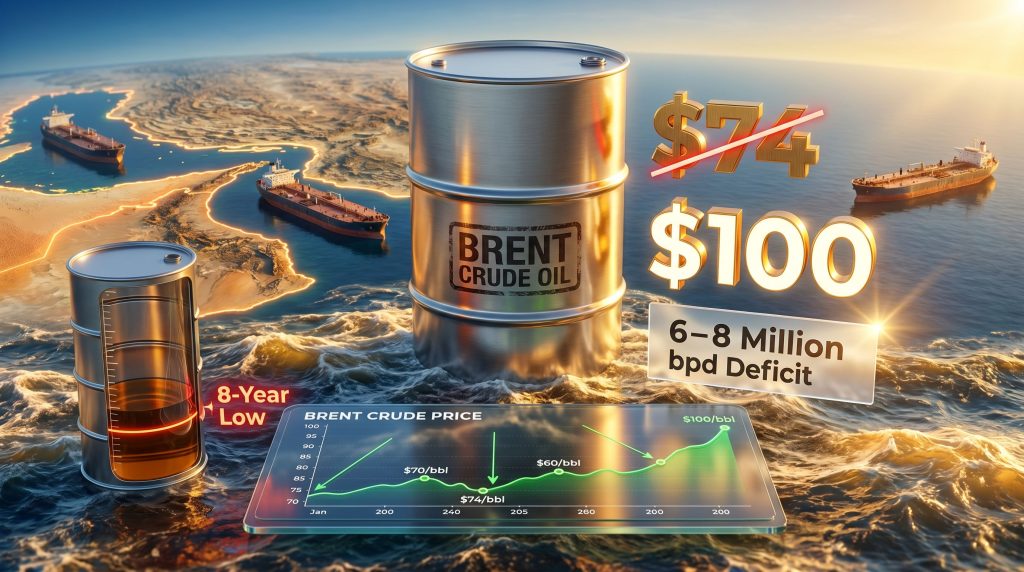
Earlier in 2026, major investment banks including Barclays were operating within a demand-pessimism framework. Economic softness, consumption headwinds, and uncertain growth trajectories in key importing nations had pushed the bank's Brent crude outlook down to approximately $74 per barrel. The analytical lens was oriented toward the demand side of the equation, asking whether global consumption growth could sustain elevated prices.
That framework was overtaken by events. The effective closure of the Strait of Hormuz triggered what can only be described as a complete analytical pivot, forcing banks to reprice oil not as a demand-cycle story but as a geopolitical risk premium story. The resulting revision represents one of the most dramatic intra-year forecast changes from a major investment bank in recent memory. Furthermore, the oil geopolitical risks now embedded in forward pricing curves reflect a structural repricing rather than a temporary sentiment shift.
| Timeframe | Barclays Brent Forecast | Primary Driver |
|---|---|---|
| Early 2026 | ~$74/bbl | Demand softness, economic uncertainty |
| May 2026 | ~$100/bbl | Strait of Hormuz closure, inventory depletion |
| Upside scenario | Above $100/bbl | Prolonged disruption, accelerating draws |
The key analytical insight from Barclays is not simply that prices are higher, but that inventory trends are now signalling a supply deficit of between 6 and 8 million barrels per day, with U.S. stockpiles approaching their lowest recorded levels since 2020. According to Barclays analysts, even under the most optimistic reopening scenario, global inventories would begin any recovery effort from a starting position approximately 20 million barrels below the tightest threshold seen in recent years. That is not a market that can absorb additional disruption with ease.
Understanding the Strait of Hormuz: Why Thirty Miles of Water Controls Trillions in Trade
The Strait of Hormuz connects the Persian Gulf to the Gulf of Oman and functions as the primary export corridor for crude oil produced across the entire Gulf region, including Saudi Arabia, Iran, Iraq, Kuwait, the UAE, and Qatar. At peak operational capacity, the strait facilitates the movement of roughly 17 to 21 million barrels of crude oil and petroleum products per day, accounting for a disproportionately large share of global seaborne energy trade. In addition, global crude shipments through this corridor represent a critical pressure point for the entire supply chain.
What makes the strait uniquely vulnerable is its geography. The navigable shipping lanes are confined to two narrow channels, each only a few kilometres wide, passing through Iranian and Omani territorial waters. There is no cost-effective alternative route that can absorb the full volume of Gulf exports. While pipeline infrastructure does exist across Saudi Arabia and the UAE, combined alternative capacity falls far short of replacing strait-dependent flows at anything approaching normal volumes.
The disruption now underway has compressed exports through the strait to approximately 5% of normal volumes, according to Goldman Sachs analysts. The phrase historically unprecedented does not overstate the severity of what that figure represents for global supply availability.
Three supertankers carrying an estimated 6 million barrels in combined cargo have been reported exiting the strait in recent days, illustrating both the constrained nature of current flows and the degree to which physical market participants are closely monitoring every vessel movement as a real-time indicator of whether normalisation is occurring.
The Inventory Crisis: Why Goldman Sachs and Barclays Are Both Raising Alarms
The convergence of multiple major financial institutions around a shared alarm signal on inventory depletion is analytically significant. Institutions of this scale rarely reach identical conclusions simultaneously, and when they do, it typically reflects an observable reality in physical markets that has moved beyond the range of normal modelling.
| Institution | Key Assessment | Critical Metric |
|---|---|---|
| Barclays | U.S. inventories nearing lowest since 2020 | 6-8 million bpd deficit signalled |
| Goldman Sachs | Global inventories near an eight-year low | Draws running at 8.7 million bpd since early May |
| Goldman Sachs (April data) | April draw rate doubled March's pace | Accelerating depletion trajectory confirmed |
Goldman Sachs has specifically highlighted that since the beginning of May 2026, global oil stockpiles have been drawing down at a rate of 8.7 million barrels per day, a figure the bank described as the highest ever recorded. April's draw rate ran at double March's pace, indicating the depletion curve is accelerating rather than flattening.
Why Do Inventory Levels Matter More Than Spot Prices?
Spot prices reflect current sentiment and positioning. Inventory levels, however, reveal the structural supply buffer available to absorb future shocks. When stockpiles fall below critical thresholds, markets lose the cushion that normally dampens the price response to incremental disruptions. A market with depleted inventories is a market where even a minor additional shock can produce an outsized price reaction.
The earlier Goldman Sachs assessment, released weeks prior, had already described global inventories as crashing toward an eight-year low, with depletion occurring at a pace that left the market structurally exposed. The May update confirmed that this trajectory had accelerated rather than moderated.
Three Scenarios for Brent Crude Through the Second Half of 2026
Understanding where oil prices go from here requires thinking in scenarios rather than point forecasts, because the critical variable is not the peak price reached but the duration of the underlying supply disruption. Consequently, the interplay between oil trade and geopolitics will remain the dominant pricing framework for the remainder of 2026.
Scenario One: Diplomatic Resolution
- Strait of Hormuz reopens within weeks following a diplomatic breakthrough in U.S.-Iran negotiations
- Inventory rebuilding commences but begins from a position 20 million barrels below recent tightness thresholds
- The recovery process itself becomes a source of price support, as markets price in the time required to rebuild buffers
- Brent likely consolidates in the $85-$95 range as war risk premium partially deflates but structural tightness persists
- Demand destruction at elevated price levels partially offsets supply normalisation, creating a natural ceiling
Scenario Two: Prolonged Disruption (Barclays Base Case)
- Strait remains severely constrained through the second half of 2026
- Brent sustains around the $100 per barrel level as the structural supply deficit of 6-8 million bpd remains intact
- U.S. inventories remain near their lowest point since 2020, with limited buffer against further shocks
- War risk premium becomes embedded in forward pricing curves across all tenor points
- This represents the Barclays base case, which the bank maintained as of late May 2026
Scenario Three: Escalation (Upside Risk Case)
- Additional geopolitical flashpoints emerge concurrently with the Hormuz closure
- Inventory depletion rate accelerates beyond the already unprecedented 8.7 million bpd pace
- Brent breaks materially and sustainably above $100 per barrel
- Barclays explicitly identified this as the direction toward which price risks are skewed, rather than a low-probability tail event
What the Bloomberg Intelligence Survey Reveals About Market Positioning
A Bloomberg Intelligence survey of asset managers and energy market professionals produced a consensus expectation that Brent crude will average between $81 and $100 per barrel over the coming 12-month period. This range is analytically instructive because it brackets the Barclays base case at its upper bound while treating $81 as a credible floor given structural supply constraints.
Several interpretive points emerge from the survey findings:
- Demand destruction is expected to function as a natural price ceiling, with elevated fuel costs gradually suppressing consumption in price-sensitive sectors and markets
- The war risk premium is being treated as persistent but not permanent, meaning the professional consensus has not fully priced in the Barclays upside scenario
- The $81 floor reflects an acknowledgement that structural tightness will persist even under moderately optimistic supply normalisation scenarios
- Market participants appear to be pricing in demand destruction as a self-correcting mechanism that prevents sustained moves well above $100
Live market pricing as of late May 2026 trading sessions told a different story. Brent Crude was trading at approximately $105-$106 per barrel, while WTI Crude was near $98-$99 per barrel. The OPEC Basket was quoted at approximately $115 per barrel, reflecting the additional premium applied to Middle Eastern grades given supply uncertainty. These figures suggest markets had already moved beyond the Bloomberg consensus range and were partially pricing in the Barclays upside scenario.
The next major ASX story will hit our subscribers first
The Geopolitical Risk Matrix Surrounding the Hormuz Disruption
The Barclays $100 oil price forecast does not exist in isolation. It sits within a broader and compounding geopolitical environment that has introduced multiple simultaneous risk factors across energy markets. However, OPEC market influence remains a critical structural variable that interacts with these geopolitical pressures in ways that could amplify or moderate the ultimate price outcome.
U.S.-Iran diplomatic uncertainty has been a primary driver of intraday price movements. Traders have repeatedly reassessed the probability of a diplomatic resolution, with growing scepticism providing incremental price support. Oil prices rose by approximately 2% in Asian trade during Friday's session as traders grew more doubtful that negotiations would produce a near-term breakthrough.
Iran's floating oil stockpile represents a less-discussed but analytically important dimension of the supply picture. Reports indicate that Iran's offshore stored crude volumes have increased by approximately 65% as naval constraints tightened, meaning significant volumes are effectively withheld from global markets. This overhang is a double-edged consideration: it represents potential supply that could re-enter markets following a diplomatic resolution, which would complicate inventory recovery expectations under a bullish scenario.
Saudi export dynamics add another layer of complexity. JODI data reported Saudi Arabia's crude exports have sunk to record lows, while Saudi oil export income reportedly reached a multi-year high in March 2026 as prices surged. This creates an unusual dynamic where the kingdom is earning record revenues on substantially reduced volumes, raising questions about incentive structures around any push for market normalisation.
Secondary supply disruptions are compounding the primary Hormuz shock:
- Nigeria has targeted a production increase of 100,000 barrels per day as one of several attempts by producers outside the disruption zone to partially offset global shortfalls
- The UAE's exit from OPEC has introduced uncertainty into the cartel's production coordination framework, adding a structural dimension to the supply outlook beyond the immediate Hormuz situation
- Industrial action at two Australian LNG facilities has added further tension to global energy markets, with the Woodside CEO publicly stating that markets are badly underestimating the scale of the LNG supply shock
Duration Is the Defining Variable: Macro Consequences of Sustained High Oil Prices
Barclays economists have drawn a distinction that is often lost in headline-level oil market commentary: the difference between a brief price spike and a sustained period of elevated prices is not merely a matter of degree, it is a matter of economic kind.
Brief spikes to $100 per barrel, even sharp ones, carry limited macroeconomic consequence if they resolve within weeks. Markets can absorb the psychological shock without the price level transmitting meaningfully into inflation indices, corporate cost structures, or consumer spending patterns. The critical threshold is duration measured in months rather than days.
When elevated prices persist across a multi-month window, the transmission effects become significantly more consequential across several downstream pressure points:
- Aviation and transport sectors face direct exposure through jet fuel and diesel cost escalation, compressing operating margins and creating pressure on ticket pricing that ultimately reaches consumers
- Petrochemical industries experience feedstock cost inflation that moves in lockstep with crude, squeezing the margins of manufacturers across plastics, fertilisers, and specialty chemicals
- Consumer price indices capture the passthrough from gasoline and heating oil, embedding energy-driven inflation into broader CPI readings that influence central bank policy settings
- Emerging market economies that import the majority of their energy face the sharpest fiscal and currency pressure, as dollar-denominated import costs rise while domestic revenue bases remain constrained
The IEA has warned that oil markets could enter what it described as a red zone by July and August 2026 if current depletion rates continue without meaningful supply restoration. This aligns with the structural trajectory that both Barclays and Goldman Sachs have identified in their inventory analysis.
Furthermore, OPEC demand forecasts for the second half of 2026 will play a significant role in shaping whether the market's supply deficit widens or narrows from current levels.
What the Simultaneous Analyst Convergence Means for Energy Investors
Disclaimer: The following section contains forward-looking analysis and scenario-based interpretation. Nothing in this article constitutes financial advice. Energy markets involve significant uncertainty, and forecasts from investment banks carry no guarantee of accuracy.
The simultaneous alignment of Barclays, Goldman Sachs, and the Bloomberg Intelligence survey consensus around structural market tightness is an unusual configuration. Each institution approaches oil market analysis from a different methodological angle, and agreement across all three frameworks suggests the underlying supply-demand imbalance is sufficiently large to be visible regardless of modelling approach.
For investors monitoring energy sector positioning, the key variables to track are not the spot price itself but the rate of inventory change, the pace of supertanker movements through and around the strait, and the credibility of diplomatic progress in U.S.-Iran negotiations. These are the leading indicators that will determine whether the Barclays $100 base case holds or whether the upside scenario Barclays has explicitly flagged begins to materialise.
The structural insight embedded in the Barclays $100 oil price forecast is that even optimism carries a price tag in this environment. A rapid diplomatic resolution would be unambiguously positive for the global economy, but the inventory starting point is so depleted that recovery itself will sustain price pressure for longer than markets may currently anticipate. As Hellenic Shipping News has noted, $100 per barrel may represent less a ceiling than a gravitational centre around which 2026 oil pricing will orbit, regardless of how the geopolitical situation ultimately resolves.
Want To Stay Ahead of the Next Major Resource Discovery Driven by Commodity Shifts Like These?
When macro forces reshape energy and commodity markets this dramatically, the opportunities for investors who move early can be substantial — Discovery Alert's proprietary Discovery IQ model delivers real-time alerts on significant ASX mineral discoveries, translating complex market signals into actionable investment insights for both short-term traders and long-term investors. Explore how historic discoveries have generated exceptional returns and begin your 14-day free trial today to position yourself ahead of the market.