July 19, 2026
The Hidden Economics of Arctic Resource Development
For decades, the relationship between mineral wealth and mineral production has been poorly understood by markets and policymakers alike. The existence of a deposit does not create economic value. What creates value is the ability to move that deposit from the ground to a buyer, at a cost that makes the entire exercise worthwhile. In the Canadian Arctic, Canada Arctic critical minerals infrastructure investment is not an academic distinction — it is the defining constraint of an entire resource frontier.
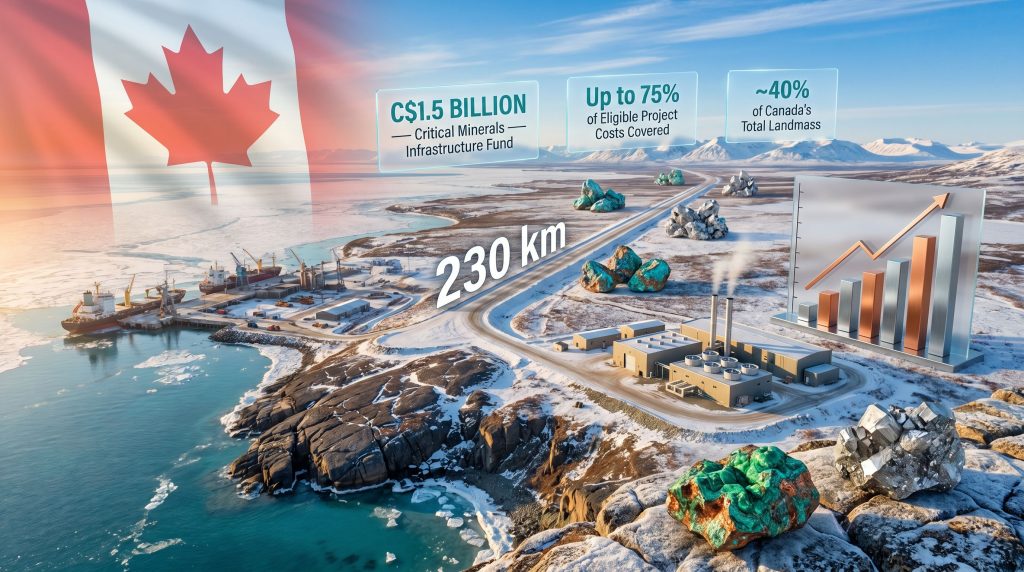
Canada's northernmost territories collectively span roughly 40% of the nation's total landmass, covering Yukon, the Northwest Territories, Nunavut, and the northern reaches of Québec and Labrador. Yet this vast expanse remains among the least connected regions on Earth in terms of all-season transport corridors, reliable energy supply, and export-capable port infrastructure. The minerals are there. The question has always been whether the infrastructure to reach them ever will be.
That question is now being answered, and the scale of Canada's commitment to unlocking its Arctic potential is beginning to come into focus.
When big ASX news breaks, our subscribers know first
Why Stranded Resources Define the Arctic Mining Problem
The Logistics Barrier No Grade Can Overcome
The mining industry uses the term stranded resources to describe deposits that are technically defined and geologically understood but economically unreachable due to the absence of enabling infrastructure. In conventional mining jurisdictions, this problem is usually solvable through private capital. In the Arctic, however, the infrastructure deficit is so foundational that private capital alone cannot bridge it.
Consider what operating a mine in a fly-in/fly-out Arctic environment actually requires:
- All fuel, equipment, food, and personnel must be airlifted or transported via ice road, which is only viable for a limited seasonal window each year
- Heating and ventilation systems run continuously in temperatures that can reach below -40°C, consuming diesel at rates that can represent the single largest operational cost line item on a northern mine's budget
- There is no grid electricity, no permanent road, and in many cases no nearby port capable of handling bulk commodity exports
- Every tonne of ore that leaves the mine must travel via a supply chain designed around absence, not presence
This cost structure is not merely inconvenient. It is the reason that dozens of well-characterised copper, zinc, and rare earth deposits across Nunavut and the Northwest Territories remain undeveloped despite decades of exploration. The infrastructure-resource paradox dictates that in remote northern latitudes, infrastructure investment must precede mine development, not follow it. No mine developer will commit capital to production-stage planning when the logistics of actually shipping product remain unresolved.
Furthermore, the Northwest Territories as a strategic mining jurisdiction demonstrates precisely how this challenge plays out across Canada's north, where geological promise consistently outpaces logistical capability.
Infrastructure in the Arctic functions less like a service and more like a prerequisite. Without it, resource wealth is a geological fact rather than an economic one.
Canada's Critical Minerals Infrastructure Fund: Architecture of a Nation-Building Instrument
Policy Design and Funding Parameters
Canada's national response to this infrastructure-resource paradox has taken shape through the Critical Minerals Infrastructure Fund (CMIF), a program allocating up to C$1.5 billion toward clean energy and transportation infrastructure that enables critical minerals development. What distinguishes the CMIF from earlier resource development programs is not merely its scale but its coverage thresholds.
For projects in Arctic, northern, or Indigenous-led contexts, the CMIF covers up to 75% of eligible project costs. This is a deliberately asymmetric design. The federal government recognised that the standard investment calculus that applies to resource projects in southern Canada simply does not transfer to the north. Higher capital requirements, longer lead times, thinner margins, and compressed seasonal operating windows all combine to suppress private capital formation in these regions. The 75% coverage rate is a structural correction to that market failure.
The 2026 Spring Economic Update elevated Canada Arctic critical minerals infrastructure investment to the status of a nation-building priority, connecting mineral development to economic diversification, supply chain resilience, and broader Arctic sovereignty objectives. This framing matters because it signals long-term policy continuity rather than a single budget cycle initiative.
The First and Last Mile Fund: Targeting the Most Underfunded Stage
Within Canada's broader infrastructure toolkit, the First and Last Mile Fund addresses a specific and chronic failure point in northern project development: pre-construction planning. Across the industry, the planning and permitting phase is consistently the hardest stage to finance. Institutional investors typically require demonstrated project economics before committing capital, but demonstrating project economics requires spending on studies, assessments, and logistics modelling.
By providing federal capital at the pre-construction stage, this mechanism de-risks the foundational work that determines whether a northern mine project is viable at all. In doing so, it creates the conditions under which downstream private investment becomes rational. This approach mirrors the logic of a definitive feasibility study in conventional project development — spending early to validate long-term viability.
Grays Bay Road and Port: A Deepwater Gateway to the Kitikmeot's Hidden Resource Base
Project Fundamentals and Federal Commitment
The most consequential single project to emerge from Canada's Arctic infrastructure push is the Grays Bay Road and Port project, proposed by the West Kitikmeot Resources Corporation, an Indigenous-led development entity. Through the First and Last Mile Fund, planning and pre-construction work for this project has been conditionally approved for up to $50 million in federal funding.
The project centres on two infrastructure elements:
- A deepwater Arctic port at Grays Bay, Nunavut, capable of handling bulk commodity exports year-round
- A 230 km all-season road connecting that port to the interior of the western Kitikmeot Region
The project's referral to the Major Projects Office by Prime Minister Mark Carney in March 2026 confirmed federal prioritisation of the corridor, though the conditional nature of the funding approval means the project remains subject to ongoing review processes.
| Infrastructure Element | Current Status | Post-Investment Capability |
|---|---|---|
| Grays Bay Port | Proposed deepwater facility | Year-round Arctic bulk export terminal |
| All-Season Access Road | No permanent route exists | 230 km connected corridor to interior |
| Primary Minerals Unlocked | Economically inaccessible | Zinc and copper development viable |
| Project Oversight Stage | Pre-construction planning | Major Projects Office referral confirmed |
What the Road Actually Unlocks: The Kitikmeot's Zinc and Copper Endowment
The western Kitikmeot Region of Nunavut contains a concentration of base metal mineralisation that has been explored intermittently since the mid-twentieth century but never developed at scale. The reason is simple: without all-season road access and export-capable port infrastructure, there is no economic pathway from ore body to market.
Zinc and copper are the primary commodities this corridor targets. Both are central to the global energy transition. Copper is essential for electrical wiring, motors, and grid infrastructure. Zinc is critical for galvanising steel used in wind turbines and construction. The Kitikmeot's deposits are not marginal — they are simply stranded, and the Grays Bay corridor is designed to unstrand them.
The shift from fly-in/fly-out operations to road and port-accessible logistics fundamentally transforms project economics. Operating cost reductions, improved workforce logistics, and the ability to use bulk shipping rather than air freight can convert a marginal deposit into a commercially viable one almost entirely through infrastructure provision rather than geological discovery. Consequently, the critical minerals energy security dimension of these deposits becomes increasingly significant to allied trading partners.
Indigenous Economic Leadership in Arctic Development
West Kitikmeot Resources Corporation represents an important structural feature of Canada's Arctic minerals strategy: the deliberate positioning of Indigenous entities as project proponents rather than stakeholders. The CMIF's elevated 75% coverage rate for Indigenous-led projects is not incidental. It is a recognition that capital access barriers are compounded for northern Indigenous organisations that lack the balance sheet depth of established mining companies.
This model has long-term implications beyond the Grays Bay project. If successful, it establishes a replicable framework for Indigenous-led infrastructure and resource development across the Canadian north, with federal funding mechanisms specifically calibrated to lower the barriers that have historically kept northern communities as observers of resource development rather than participants in it.
Glacies Technologies and the Hidden Cost Driver in Arctic Mining
The $5 Million Pilot and What It Targets
Parallel to the Grays Bay infrastructure investment, Canada committed $5 million to Glacies Technologies to pilot a low-emissions alternative to diesel for mine heating and ventilation systems. The pilot will operate at a B2Gold gold mining operation in the western Kitikmeot Region of Nunavut.
This investment addresses what is arguably the least visible but most persistent cost problem in Arctic mining. In extreme cold climates, mine heating and ventilation systems do not merely support worker comfort. They are safety-critical infrastructure that must operate continuously regardless of production status. They heat underground workings, maintain equipment operability, and manage air quality in enclosed excavations.
In Arctic mining environments, heating and ventilation systems can account for a disproportionate share of total energy consumption, making clean technology pilots at this stage strategically significant for both cost reduction and emissions compliance.
Diesel dependency in remote northern mines creates compounding problems:
- Every litre of diesel must be transported to site, often via ice road during the seasonal window when ground transport is possible
- Diesel price volatility passes directly through to operating costs with no hedging mechanism available to small and mid-sized operators
- Emissions intensity from diesel combustion in heating applications is high relative to the energy delivered, given combustion inefficiencies in cold conditions
- Regulatory pressure on emissions performance is increasing across the Canadian mining sector, creating future compliance risk for diesel-dependent operators
In addition, the broader adoption of renewable energy in mining operations is increasingly being recognised as a structural competitive advantage rather than merely a compliance exercise. A successful Glacies Technologies pilot that demonstrates cost-competitive, lower-emissions heating and ventilation would have implications well beyond the single B2Gold site, establishing a proof of concept applicable across dozens of northern mine sites.
Canada's Arctic Strategy in Global Context: A Comparative Framework
How Allied Nations Are Approaching the Same Problem
Canada Arctic critical minerals infrastructure investment does not exist in isolation. It is one expression of a broader geopolitical reconfiguration in which allied nations are restructuring critical minerals supply chains away from concentrated dependencies and toward trusted supplier diversity.
| Country | Primary Strategy Driver | Key Infrastructure Focus | Critical Minerals Emphasis |
|---|---|---|---|
| Canada | Economic development and sovereignty | Roads, ports, clean energy | Copper, zinc, rare earths, lithium |
| United States | Defence and supply chain security | Military logistics, Alaska corridors | Rare earths, cobalt, nickel |
| Norway | Green industry leadership | Offshore and onshore integrated systems | Nickel, cobalt, phosphate |
| Russia | Resource export maximisation | Northern Sea Route, rail | Oil, gas, palladium, nickel |
What distinguishes Canada's approach from that of comparable Arctic nations is the integration of three objectives that are typically treated as separate: economic development, Indigenous partnership, and clean energy transition. Norway pursues green integration vigorously but within a very different Indigenous rights framework. The United States prioritises defence logistics but has been slower to incorporate Indigenous economic participation as a structural design feature. Russia maximises export capacity but within a governance framework that has triggered significant international sanctions.
Canada's combination of Indigenous-led project structures, federal cost-sharing mechanisms calibrated for northern conditions, and clean technology integration creates a model that aligned trading partners in Europe, the United States, and the Asia-Pacific region can engage with confidently.
Arctic Trade Routes and the Changing Logistics Calculus
One dimension of the Grays Bay investment that is frequently underweighted is its relationship to Arctic sea lane accessibility. Reduced seasonal ice coverage has extended the window during which Arctic maritime routes are navigable, gradually improving the economics of Arctic port infrastructure. Furthermore, prioritising Arctic infrastructure investment has been identified by allied policy analysts as critical to long-term sovereignty and supply chain resilience.
A deepwater port at Grays Bay, designed for Arctic conditions, would be positioned to take advantage of these extended shipping windows in ways that landlocked mineral deposits simply cannot. This does not mean the Arctic is becoming a routine shipping corridor — ice conditions remain variable and unpredictable. But the directional trend toward extended navigability is clear, and infrastructure built today will operate across a multi-decade horizon during which those conditions continue to evolve.
The next major ASX story will hit our subscribers first
Key Statistics: Canada's Arctic Critical Minerals Investment at a Glance
| Metric | Detail |
|---|---|
| Critical Minerals Infrastructure Fund | Up to C$1.5 billion |
| Cost coverage for Arctic, Northern, Indigenous projects | Up to 75% of eligible expenses |
| Grays Bay Road and Port federal funding (conditional) | Up to $50 million |
| Proposed all-season access road length | 230 km |
| Glacies Technologies clean energy pilot | $5 million |
| Arctic landmass share of Canada | ~40% of total national territory |
| Territories covered | Yukon, Northwest Territories, Nunavut, northern Québec and Labrador |
Infrastructure Gaps That Still Define the Development Horizon
The Limiting Factors That Remain
Even with the investments announced, substantial structural barriers to Arctic mining development remain. Understanding these gaps is essential for investors and policymakers assessing the realistic timeline for production-stage outcomes.
- Energy access: The majority of northern mine sites remain entirely diesel-dependent with no grid connection and no near-term prospect of one
- Transport connectivity: Large portions of the Canadian Arctic have no all-season road access, and the Grays Bay corridor addresses only one regional gap
- Port capacity: Even with Grays Bay developed, export bottlenecks in other Arctic corridors will persist
- Housing and community services: Workforce attraction and retention in remote regions depends on liveable community infrastructure that mining investment alone does not provide
- Regulatory processing timelines: Northern regulatory frameworks involve multiple jurisdictional layers, and processing timelines remain a material constraint on project advancement speed
The Major Projects Office, which now has oversight of the Grays Bay project, functions as a coordination mechanism designed to reduce some of these administrative friction points. Its role is to align federal departmental timelines, reduce duplication across regulatory processes, and provide a single point of accountability for complex multi-jurisdictional projects. The practical effect on approval timelines will be closely watched by the broader industry.
The Investment Outlook: Near, Medium, and Long-Term Structural Shifts
Near-Term Catalysts Through 2028
The immediate investment-relevant developments centre on the Grays Bay pre-construction planning process and the Glacies Technologies pilot. Pre-construction planning for a project of this scale and complexity typically takes two to four years, meaning that concrete engineering outcomes from the current funding commitment would be expected between 2027 and 2029. The Glacies Technologies pilot, being a technology demonstration rather than a capital construction project, could yield commercially relevant results on a shorter timeline.
CMIF project approvals across the broader northern mining landscape will also function as a barometer of federal policy execution. Each conditional approval that progresses to full funding commitment signals that the policy framework is operational, not merely aspirational, and that downstream private capital mobilisation is warranted.
Medium-Term Structural Changes: 2028 to 2035
The most significant medium-term shift would be the transformation of the Kitikmeot Region's risk profile for institutional mining investors. Today, the region's deposits are classified by most institutional investors as too early-stage and too infrastructure-deficient for portfolio inclusion. All-season road access and a functional deepwater port changes that classification fundamentally. Projects that were previously unbankable become financeable.
The compounding effect of clean energy integration on mine operating economics is a parallel development worth monitoring. If the Glacies Technologies pilot achieves its objectives, and if similar technologies are adopted across multiple northern sites, the aggregate effect on sector-wide emissions performance and operating cost structures could be substantial by the mid-2030s.
Long-Term Geopolitical Positioning
Canada's trajectory as a preferred critical minerals supplier to allied industrial ecosystems is a decade-long positioning exercise. The investments being made today in pre-construction planning and technology pilots are not production-stage commitments — they are the foundational work that makes production-stage commitments possible in the future.
For investors assessing Canada Arctic critical minerals infrastructure investment thesis, the key analytical question is whether today's pre-construction capital creates durable optionality for production-stage projects in the 2030s and beyond. The infrastructure being planned at Grays Bay, the technology being piloted by Glacies, and the federal policy architecture being established through the CMIF collectively suggest that the answer is yes, subject to the many execution, regulatory, and commodity market variables that will shape outcomes across that timeframe.
Disclaimer: This article contains forward-looking analysis and scenario projections related to mining development timelines, infrastructure investment outcomes, and commodity market dynamics. These projections involve inherent uncertainty and should not be construed as financial advice. Past investment patterns and policy commitments do not guarantee future project outcomes. Readers should conduct independent due diligence before making investment decisions related to any of the sectors, projects, or companies referenced in this article.
Want to Stay Ahead of the Next Major Mineral Discovery on the ASX?
Discovery Alert's proprietary Discovery IQ model delivers real-time alerts the moment significant mineral discoveries — including critical minerals such as copper, zinc, and rare earths — are announced on the ASX, turning complex data across 30+ commodities into clear, actionable insights for investors at every level. Explore how historic discoveries have generated substantial returns by visiting Discovery Alert's dedicated discoveries page, and begin your 14-day free trial today to position yourself ahead of the broader market.