May 21, 2026
The Geology of Value: Why Jurisdictional Purity Commands a Premium in Modern Gold Markets
The mining investment landscape has undergone a fundamental reorientation over the past decade. Institutional capital, once willing to tolerate sovereign risk in exchange for resource scale, has progressively re-rated stability as a core valuation input. The result is a structural bifurcation in how global gold producers are valued: those concentrated in low-risk, infrastructure-rich jurisdictions increasingly trade at a persistent premium over geographically diversified peers carrying elevated political or regulatory exposure. Understanding this dynamic is essential before examining the Barrick North American Gold Assets IPO, which represents one of the most significant exercises in jurisdictional value isolation the gold sector has seen in years.
When big ASX news breaks, our subscribers know first
The Strategic Case for Separating North American Gold Production
Barrick Mining Corporation's decision to pursue a public listing of its North American gold operations reflects more than opportunistic timing. It represents a deliberate thesis: that a focused, geographically coherent gold producer, operating exclusively within some of the world's most established mining jurisdictions, will be valued more generously by capital markets than an equivalent portfolio buried inside a sprawling global conglomerate.
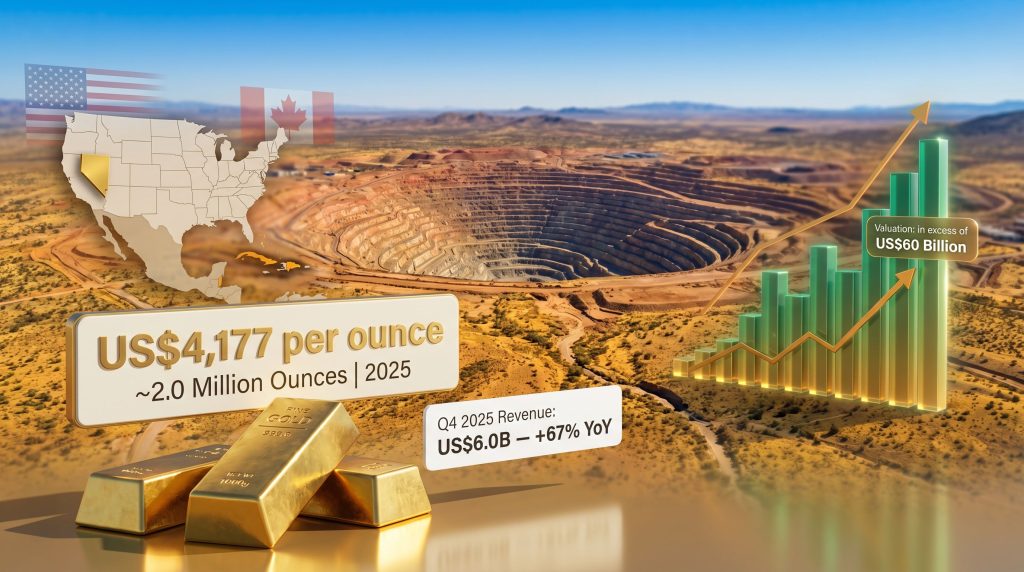
The financial conditions underpinning this logic are difficult to ignore. Barrick's revenue expanded from US$3.6 billion in Q4 2024 to US$6.0 billion in Q4 2025, a 67% year-over-year increase driven substantially by gold prices reaching US$4,177 per ounce. At that price environment, revenue from approximately 2.0 million ounces of attributable annual production implies a gross revenue base exceeding US$8.3 billion annually. A portfolio generating that level of cash flow, concentrated in Nevada and the Dominican Republic, naturally invites a revaluation exercise.
Barrick's concurrent decision to repurchase US$1.5 billion in its own shares prior to the IPO announcement is a meaningful signal. Share buybacks of that magnitude at elevated gold prices communicate that management viewed the parent company's intrinsic value as underappreciated, setting the stage for a structural unlocking event. Furthermore, the gold price and mining equities relationship has rarely been more favourable for a transaction of this scale.
The combination of record revenue performance, elevated gold prices, and pre-IPO buyback activity creates a constellation of conditions that mining analysts typically associate with major corporate restructuring events designed to surface embedded asset value.
A Tier One Portfolio: What North American Barrick Actually Holds
The assets being consolidated into the new entity span two jurisdictions but share a common characteristic: they are among the most operationally proven gold mines in the world.
| Asset | Location | Jurisdiction Risk Profile | Role in NewCo Portfolio |
|---|---|---|---|
| Carlin | Nevada, USA | Very Low | Core production asset |
| Cortez | Nevada, USA | Very Low | Core production asset |
| Turquoise Ridge | Nevada, USA | Very Low | Core production asset |
| Pueblo Viejo | Dominican Republic | Low to Medium | International diversifier |
| Fourmile | Nevada, USA | Very Low | High-grade growth catalyst |
The Nevada Gold Mines (NGM) complex, where Barrick operates alongside joint venture partner Newmont Corporation, sits within two of North America's most historically productive gold corridors: the Carlin Trend and the Cortez Trend. These geological belts are characterised by sediment-hosted gold deposits where oxidised near-surface ores transition into deeper, often higher-grade sulphide material.
Decades of mine development have created infrastructure density that new entrants cannot replicate, which materially compresses operating costs relative to greenfield alternatives. Pueblo Viejo in the Dominican Republic adds geographic diversification while maintaining a relatively favourable operating environment by Latin American standards.
Collectively, these four Tier One assets delivered approximately 2.0 million ounces of gold production in 2025 attributable to Barrick's interests, according to the company's April 2026 announcement. That output scale positions North American Barrick as a substantial standalone producer capable of benchmarking against the world's largest pure-play gold companies.
Fourmile: The Asset That Changes the Growth Equation
Among all the components of the Barrick North American Gold Assets IPO, Fourmile commands disproportionate investor attention, and for technically sound reasons.
Why Is Fourmile So Significant?
Unlike the Nevada Gold Mines assets, which are held within a joint venture structure, Fourmile is wholly owned by Barrick. Its location directly adjacent to the NGM complex is geologically significant: it sits within the same broader mineralised system that hosts Carlin and Cortez, benefiting from structural controls and alteration patterns consistent with high-grade gold concentrations.
Barrick has described Fourmile as one of the most important gold discoveries of this century. That characterisation carries weight in an industry where genuinely new, large-scale discoveries in established mining districts are exceptionally rare. The Carlin Trend, where Fourmile is located, has been explored intensively for over six decades. A discovery of material significance within that corridor at this stage of exploration history is a geological anomaly, which is precisely why it commands a growth premium.
The planned mechanics involve eventually contributing Fourmile into the NGM joint venture in accordance with the existing JV agreement. This vend-in structure creates a sequenced value release: Barrick develops the asset within North American Barrick's wholly-owned balance sheet, de-risking it through drilling and development milestones, before integrating it into the shared JV framework.
For prospective IPO investors, Fourmile functions as a built-in optionality instrument: a pre-production, high-grade asset whose full economic contribution to the portfolio has not yet been priced into any operating metrics, but whose geological credentials are already established.
How the IPO Structure Is Designed to Work
The Barrick North American Gold Assets IPO is structured as a minority float, a corporate architecture that differs meaningfully from both a full demerger and a straight asset sale.
| Transaction Type | Control Retained | Market Access | Valuation Driver |
|---|---|---|---|
| Full Demerger (e.g., South32 from BHP) | No | Independent listing | Standalone asset quality |
| Minority Float IPO (Barrick model) | Yes | NYSE and TSX dual listing | Portfolio premium plus growth assets |
| Asset Sale | No | Not applicable | Transaction price only |
| Joint Venture Restructure | Partial | Not applicable | Operational synergies |
Under this structure:
- Barrick retains a significant controlling stake in the new entity
- A minority stake is offered to public investors through the IPO
- The primary listing will be on the New York Stock Exchange (NYSE)
- A secondary listing is planned on the Toronto Stock Exchange (TSX)
- Both listings are subject to SEC registration and Canadian prospectus qualification processes
- The transaction is expected to complete by the end of 2026, subject to market conditions and regulatory approvals
- The portfolio has been assessed at a potential value in excess of US$60 billion
The NYSE primary listing is strategically deliberate. New York-listed equity vehicles attract the deepest pool of institutional precious metals investors globally, including exchange-traded fund (ETF) managers, gold-focused equity funds, and sovereign wealth vehicles. A TSX secondary listing captures Canadian institutional flows and the significant retail investor base that has historically supported gold equity investments.
Goldman Sachs is serving as lead financial advisor on the transaction, with M. Klein & Co., led by Michael Klein, providing strategic advisory services. The combination reflects a capital markets execution team with broad institutional reach and experience in large-scale corporate separations.
The Leadership Architecture: Seven Executives, One Mandate
One of the more operationally significant aspects of the Barrick North American Gold Assets IPO is that its leadership team was not assembled in anticipation of the announcement. The seven-person executive group had already been functioning collaboratively for several months before the IPO was formally disclosed, a detail that signals organisational readiness rather than aspirational restructuring.
| Executive Role | Name | Strategic Function |
|---|---|---|
| Chief Operating Officer | Tim Cribb | Operational execution across all assets |
| Chief Financial Officer | Wessel Hamman | Capital allocation and investor relations |
| Chief Legal Officer and Corporate Secretary | Joe Heckendorn | Regulatory compliance and governance |
| Chief Technical Officer | Megan Tibbals | Technical standards and project delivery |
| Chief HR Officer | Richard Barley | Talent strategy and workforce development |
| VP Exploration | Javier Ortuzar | Discovery pipeline and resource growth |
| VP Sustainability | Amanda Steensen | ESG strategy and community engagement |
The team reports to Mark Hill, Barrick's President and CEO, and comprises individuals with deep operational histories within Barrick's existing asset base. This institutional familiarity with the specific geological, regulatory, and community dynamics of each operation is a practical advantage that external management hires could not replicate quickly.
The inclusion of a dedicated VP of Exploration (Javier Ortuzar) within the leadership structure is noteworthy. For a portfolio that already includes a discovery of Fourmile's calibre, maintaining an independent exploration capability signals that organic resource growth through the drill bit remains a strategic priority rather than an afterthought.
The next major ASX story will hit our subscribers first
The Newmont Dimension: Joint Venture Complexity as a Structural Variable
The Nevada Gold Mines joint venture introduces governance complexity that investors should understand clearly. Barrick has confirmed it retains the legal right to proceed with the IPO independently. However, the company has been engaged in direct dialogue with Newmont, its JV partner, to align on the proposed structure, Fourmile's contribution timeline, and the broader objective of maximising value for both parties.
This proactive coordination matters for several reasons:
- Capital allocation within NGM requires agreement between both JV partners, meaning the growth trajectory of the Nevada assets is not unilaterally controlled by North American Barrick post-IPO
- Fourmile's vend-in timing is subject to the terms of the existing NGM Joint Venture Agreement, introducing a timeline variable that falls partially outside Barrick's sole discretion
- Operational improvement initiatives at NGM, which Barrick's leadership has been pursuing in dialogue with Newmont, will influence the revenue profile that public shareholders ultimately receive
The cooperative engagement approach, rather than a unilateral proceeding, reduces the risk of JV-level friction that could otherwise create governance uncertainty during the IPO process and in the entity's early years as a listed company.
Gold at US$4,177: What the Price Environment Means for Valuation
The macro backdrop against which the Barrick North American Gold Assets IPO is being launched is extraordinary by historical standards. Gold's ascent to US$4,177 per ounce reflects a convergence of structural forces: persistent geopolitical fragmentation, central bank reserve diversification away from US dollar assets, inflation hedging behaviour, and constrained new mine supply growth globally. The broader gold market outlook reinforces why this timing is particularly compelling for a transaction of this nature.
For IPO valuation mechanics, elevated gold prices compound through multiple layers:
- Revenue multiples expand because gold miners operating at low all-in sustaining costs generate operating margins that widen non-linearly with rising gold prices
- Net asset values increase because long-dated reserve economics are discounted at rates that make near-surface ounces significantly more valuable at US$4,177 than at historical price assumptions
- Comparable company multiples re-rate upward as equity markets price in sustained elevated commodity environments
At approximately 2.0 million ounces of attributable annual production and a gold price of US$4,177 per ounce, the gross revenue potential attributable to North American Barrick's interests exceeds US$8.3 billion annually. The assessed portfolio value of more than US$60 billion implies a revenue multiple that reflects both the asset quality premium and the current price environment.
Investors should note that gold price sensitivity works in both directions. A sustained reversal in precious metals prices would compress revenue multiples and potentially reduce the assessed portfolio value materially below current estimates. All valuations referenced here reflect conditions as of the April 2026 announcement and should not be treated as guaranteed outcomes.
Key Risks Worth Understanding Before the IPO Completes
A disciplined assessment requires weighing several risk dimensions alongside the clear strategic rationale:
- Gold price sensitivity: A portfolio generating US$8.3 billion in annual revenue at US$4,177 per ounce would generate materially less at US$3,000 per ounce, with valuation multiples contracting simultaneously
- JV governance complexity: Shared ownership of the NGM assets with Newmont introduces capital allocation and operational decision-making processes that require consensus, potentially slowing execution
- Regulatory timeline risk: SEC registration and Canadian prospectus qualification are sequential processes with review timelines that are partially outside Barrick's control
- Fourmile development uncertainty: Pre-production assets carry inherent capital expenditure and timeline risk that cannot be fully de-risked until production commences
- Minority float governance: Public shareholders will hold a minority position in an entity where Barrick retains controlling interest; consequently, protecting shareholder rights through careful charter design will be essential
What This IPO Signals for the Broader Gold Mining Sector
The Barrick North American Gold Assets IPO is likely to accelerate a trend already visible among gold majors: the deliberate separation of stable-jurisdiction, high-quality assets from broader diversified portfolios to surface hidden value. The precedents from other sectors, including BHP's petroleum demerger and the creation of South32 from BHP's non-core metals businesses, demonstrated that investors consistently reward focused, pure-play vehicles with valuation premiums.
For competing gold producers carrying mixed-jurisdiction portfolios, Barrick's move creates a reference point. Indeed, gold M&A activity more broadly has been intensifying as majors seek to streamline and unlock value within their portfolios. Furthermore, producers carrying similar quality assets within conglomerate structures may face increasing shareholder pressure to execute comparable separations, particularly given how undervalued gold miners have historically traded relative to the underlying metal.
Barrick's IPO of its North American assets, expected to complete by the end of 2026 pending regulatory clearance and market conditions, represents more than a single corporate transaction. It is a real-time test of whether capital markets are willing to assign structural premiums to geographic purity, management focus, and jurisdictional clarity in gold mining — and the early evidence from Barrick's financial performance and the prevailing gold price environment suggests the answer will be affirmative.
This article is intended for informational purposes only and does not constitute financial advice. All financial projections, valuations, and timelines referenced are subject to change and are dependent on market conditions, regulatory outcomes, and corporate decisions that have not yet been finalised. Readers should conduct their own due diligence before making investment decisions.
Want to Catch the Next Major Gold Discovery Before the Market Does?
Discovery Alert's proprietary Discovery IQ model delivers real-time alerts on significant ASX mineral discoveries, transforming complex geological data into actionable investment insights for both short-term traders and long-term investors — explore the historic returns major discoveries have generated and begin your 14-day free trial today to position yourself ahead of the broader market.