June 29, 2026
Europe's Critical Mineral Deficit and the Race to Produce Domestically
The European Union has spent the better part of a decade confronting an uncomfortable structural reality: its green energy transition depends almost entirely on raw materials sourced from outside its borders. Lithium, the foundational element of modern battery chemistry, flows predominantly from South America and Australia, processed overwhelmingly in China before reaching European gigafactories. This dependency is not merely an economic inconvenience. It represents a strategic vulnerability of the first order, one that policymakers have increasingly treated with the urgency typically reserved for energy security crises.
Against this backdrop, the Savannah Resources Portugal lithium project at Barroso has become one of the most closely watched mineral development stories on the continent. Its scale, its complexity, and its contested status make it a lens through which the entire debate about domestic critical mineral production can be examined.
When big ASX news breaks, our subscribers know first
What Makes the Barroso Deposit Geologically Significant
Spodumene as a Battery-Grade Lithium Source
Not all lithium deposits are created equal. The Barroso resource is hosted in spodumene, a lithium aluminium inosilicate mineral that belongs to the pyroxene group. Understanding spodumene lithium extraction is essential here, as it can be converted into lithium hydroxide monohydrate — the preferred feedstock for high-nickel cathode chemistries used in next-generation EV batteries.
This distinction matters enormously. Lithium hydroxide commands a processing premium over lithium carbonate in applications requiring high energy density, and Europe's gigafactory pipeline is heavily oriented toward nickel-manganese-cobalt (NMC) and nickel-cobalt-aluminium (NCA) chemistries that specifically demand hydroxide-grade inputs.
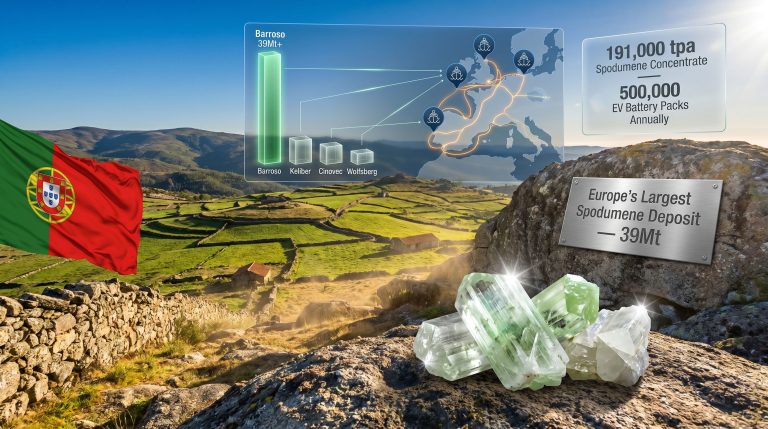
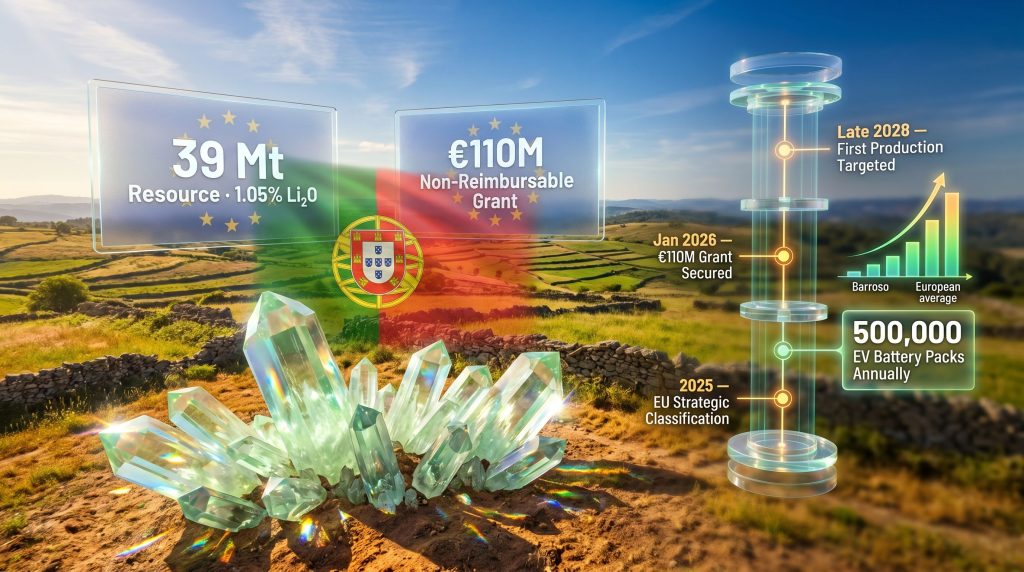
The Barroso deposit hosts a JORC-compliant resource of 39 million metric tonnes (Mt) at an average grade of 1.05% Li₂O, representing approximately 411,900 tonnes of contained Li₂O and roughly 1.019 million tonnes of lithium carbonate equivalent (LCE). Of this, 20.5 Mt has been confirmed as economically mineable under current assumptions.
How Barroso Compares Across European Hard-Rock Lithium Assets
| Metric | Barroso (Portugal) | European Hard-Rock Average |
|---|---|---|
| Total Confirmed Resource | 39 Mt | 5 to 15 Mt |
| Potential Extension | Up to 101+ Mt | Rarely exceeds 30 Mt |
| Li₂O Grade | 1.05% | 0.8 to 1.1% |
| EU Strategic Classification | Yes (CRMA, March 2025) | Selective |
| Projected Base Mine Life | 25+ years | 10 to 20 years |
| Extended Mine Life (if confirmed) | 50+ years | Rarely modelled |
The potential resource extensions of between 35 Mt and 62 Mt are particularly consequential. If geotechnical fieldwork currently underway confirms these extensions, the total resource base could exceed 100 million metric tonnes, fundamentally repositioning Barroso from a significant European deposit to a globally relevant lithium asset with a mine life stretching well beyond 50 years. Few hard-rock lithium projects anywhere in the world can credibly model that kind of longevity from a single orebody.
Production Targets, Economics, and the Role of Portuguese State Funding
Output Capacity and Battery Supply Chain Relevance
The project's design parameters position it as a meaningful contributor to European battery raw material supply rather than a symbolic domestic production exercise. Furthermore, understanding how lithium mining works at the operational level helps contextualise these targets:
- Planned lithium concentrate output of 25,000 tonnes per annum (tpa)
- Equivalent lithium hydroxide production of approximately 29,000 tpa
- Capacity to supply battery cells for roughly 500,000 electric vehicle battery packs annually
- A projected mine life of at least 25 years on the confirmed resource base, expandable to over 50 years if extensions are validated
The €110 Million Non-Reimbursable Grant
In January 2026, the Portuguese State committed a €110 million non-reimbursable grant to the project. The structure of this commitment deserves careful attention. A non-reimbursable grant is qualitatively different from a concessional loan or an equity participation. It transfers capital permanently without expectation of financial return to the state, functioning more like infrastructure investment than project finance. Mining Weekly reported on this grant, highlighting its significance for the broader European battery supply chain.
Sovereign non-reimbursable grants in the extractive sector are rarely deployed unless the host government regards the asset as having infrastructure-equivalent strategic importance to the national economy.
This framing helps contextualise why the Portuguese government subsequently intervened before the Mirandela Administrative and Fiscal Court in June 2026. Having committed €110 million in non-reimbursable capital, the state had both a financial and a political interest in ensuring project continuity.
The June 2026 Legal Suspension: What Actually Happened
Understanding the Injunction Mechanism
On 9 June 2026, the Mirandela Administrative and Fiscal Court granted a precautionary injunction halting fieldwork at Barroso. The legal action was brought by the Assembly of Common Land Holders of Barroso, a constituted community body with standing to contest land access decisions affecting collectively held property in the region.
The immediate trigger was a second administrative easement that had granted Savannah Resources access to community and private land to carry out geotechnical survey work required for the Definitive Feasibility Study (DFS). The land-holder assembly contested the procedural and legal legitimacy of this access grant.
Precautionary injunctions of this type are a recognised instrument in Portuguese administrative law. They are designed to preserve the status quo pending judicial examination, not to constitute a final determination on the merits of the underlying dispute. Their threshold for granting is relatively low, which is why community groups with legitimate standing can obtain them even against projects with substantial government backing.
How the Court Suspension Was Lifted
The Portuguese government filed a formal submission to the court articulating three core arguments:
- The suspension was causing material harm to the public interest
- The delay threatened a project of recognised national and European strategic significance
- Continued obstruction placed Portugal's commitments under the EU's energy transition framework at risk
Following this government intervention, the court lifted the suspension. A procedural point of significant legal consequence is that no right of appeal exists against the lifting of the injunction. This does not preclude further legal action by opponents through different procedural pathways, and the project's legal environment should be characterised as elevated-risk rather than resolved.
The Development Timeline: From Feasibility to First Ore
Key Milestones in Sequence
- 2023: Positive Environmental Impact Statement (DIA) issued by Portuguese authorities
- March 2025: European Commission classification as a Strategic Project under the Critical Raw Materials Act
- January 2026: €110 million non-reimbursable government grant secured
- March 2026: Accelerated project timeline announced by Savannah Resources
- May 2026: First capital equipment purchased for development programme
- June 2026: Fieldwork recommenced following lifting of court injunction
- End of 2026: Final Investment Decision (FID) targeted
- 2027: Construction commencement planned
- Late 2028: First production targeted
What the DFS Must Resolve Before the FID
The Definitive Feasibility Study is the critical technical gate before a Final Investment Decision can be made. The DFS must validate several interconnected technical and infrastructure questions, and advances in lithium extraction technologies will also influence process design choices at this stage:
- Geotechnical conditions across the full resource footprint, including areas subject to the recently contested access easement
- Water management infrastructure capable of handling up to 600,000 cubic metres per year of usage without materially compromising local aquifer systems
- Processing plant engineering for the spodumene-to-hydroxide conversion pathway, including calcination and caustic conversion stages
- Logistics and export corridors, particularly given proximity to Atlantic port infrastructure and the Spanish border
- Resource extension confirmation for the 35 to 62 Mt extension zones, which if validated would materially alter mine scheduling and economic modelling
A Decade of Opposition: The GIAHS Designation and the Green Paradox
Why Barroso Is Not an Ordinary Mining Dispute
The Barroso agricultural landscape carries a designation held by no other site in Portugal: recognition as a Globally Important Agricultural Heritage System (GIAHS) by the United Nations Food and Agriculture Organisation (FAO). This is the agricultural equivalent of a UNESCO World Heritage classification, acknowledging the region's traditional polyculture farming systems, its agro-biodiversity, and the intergenerational knowledge systems embedded in its land management practices.
The coexistence of this designation with an open-pit spodumene mining project creates a structural conflict that cannot be resolved purely through environmental mitigation measures. The GIAHS classification was granted precisely because the landscape represents a living, functioning agricultural system. Large-scale industrial extraction is incompatible with that characterisation in a way that no amount of progressive rehabilitation planning can fully address.
Core Environmental Concerns Raised by Opponents
- Water consumption projected at up to 600,000 m³ per year, raising substantive questions about impacts on agricultural irrigation and local water tables
- Acid rock drainage risk from spodumene processing in a geologically and hydrologically sensitive zone
- Permanent landscape transformation incompatible with the GIAHS designation's implicit requirement for heritage landscape preservation
- EU-level litigation pursued by environmental organisations contesting Barroso's inclusion on the CRMA Strategic Project list
The Central Tension in European Critical Mineral Policy
| Dimension | Pro-Development Position | Opposition Position |
|---|---|---|
| Climate Policy | Lithium is irreplaceable for EV batteries and grid storage | Industrial mining disrupts carbon-storing ecosystems |
| Food and Agricultural Heritage | Rural economic development for a declining region | GIAHS-designated farming systems face existential threat |
| Energy Sovereignty | Reduces EU reliance on Chinese-controlled supply chains | Local communities absorb costs for continental-scale benefits |
| Legal Framework | CRMA provides EU-level strategic project acceleration | National and local courts retain independent jurisdiction |
This tension is not unique to Barroso. It is the central paradox facing every European critical mineral project situated in ecologically or culturally significant terrain. The EU's desire to accelerate domestic production collides with the democratic and legal traditions of its member states, where community opposition has genuine procedural standing and judicial systems operate independently of industrial policy objectives.
The next major ASX story will hit our subscribers first
Europe's Critical Raw Materials Act and Where Barroso Fits
The CRMA's Binding Domestic Production Targets
The EU Critical Raw Materials Act, which entered into force in 2024, established legally structured benchmarks for domestic mineral production by 2030. Europe's critical raw materials push reflects the urgency behind these targets:
- A minimum of 10% of EU annual consumption to be extracted within EU borders
- A minimum of 40% of EU annual consumption to be processed domestically
- A minimum of 25% of EU annual consumption to be recovered from recycled sources
- A ceiling of 65% supply dependency on any single third country for any strategic raw material
Lithium sits at the apex of the EU's strategic mineral priority list. Current European consumption of battery-grade lithium is sourced predominantly from non-EU producers, with Chinese companies controlling a disproportionate share of the processing and refining stage. Meeting the CRMA's 10% domestic extraction target by 2030 is arithmetically impossible without projects of Barroso's scale entering production.
Portugal's Emerging Position as a Hard-Rock Lithium Hub
Portugal is geologically well-positioned to become the EU's primary hard-rock lithium producer. The country's northern regions host multiple active exploration licences across the same geological terranes that host Barroso. The lithium-caesium-tantalum (LCT) pegmatite systems of the Iberian Massif extend across both northern Portugal and northwestern Spain, representing one of Europe's most prospective lithium corridors.
The European critical minerals supply chain would benefit enormously if the Savannah Resources Portugal lithium project reaches production on its current timeline. It would establish Portugal as the first meaningful EU domestic lithium producer from hard-rock spodumene, creating a replicable operational template for other Iberian projects and demonstrating that CRMA strategic project mechanisms can translate into actual production outcomes.
Risk Assessment: What Investors and Analysts Should Track
Project Risk Matrix: Mid-2026 Assessment
| Risk Category | Description | Current Status |
|---|---|---|
| Legal and Regulatory | Further injunctions from community or environmental groups | Elevated, no appeal bar on future actions |
| Environmental Permitting | DFS water management validation pending | In progress |
| Community Relations | GIAHS designation creates structural conflict | Unresolved, ongoing engagement required |
| Resource Extension | 35 to 62 Mt extension requires geotechnical confirmation | Fieldwork recommencing post-injunction |
| Project Financing | DFS completion required before FID | On track, €110M grant secured |
| Construction Timeline | 2027 start contingent on end-2026 FID | Subject to legal and technical variables |
| Commodity Price | Lithium hydroxide prices subject to cyclical pressure | Structural long-term demand case intact |
The Consequences of a Delayed Final Investment Decision
A slip in the FID timeline beyond end-2026 carries compounding consequences:
- Construction commencement would shift from 2027 into 2028
- First production would likely defer beyond the 2028 target, potentially into 2029 or 2030
- Milestone-linked disbursement structures within the €110 million grant could create conditional financing uncertainty
- Portugal's CRMA compliance trajectory relative to the EU's 2030 benchmarks would weaken, increasing political pressure on the project's approvals environment
Frequently Asked Questions
Where is the Barroso lithium project located?
The project is situated near the town of Boticas in the Barroso region of northern Portugal, close to the Portuguese-Spanish border within the Iberian Massif geological province.
What is the confirmed resource size?
The JORC-compliant resource stands at 39 million metric tonnes containing approximately 411,900 tonnes of Li₂O. Potential extensions of between 35 Mt and 62 Mt could push the total resource above 100 million metric tonnes.
When is first production expected?
Savannah Resources is targeting first production in late 2028, contingent on a Final Investment Decision by end-2026 and construction commencement in 2027.
Why was fieldwork suspended in June 2026?
The Mirandela Administrative and Fiscal Court granted a precautionary injunction on 9 June 2026 following a legal challenge by the Assembly of Common Land Holders of Barroso over access rights to community land required for geotechnical survey work.
What environmental designation complicates the project?
The Barroso agricultural landscape is designated as a Globally Important Agricultural Heritage System (GIAHS) by the UN-FAO, making it the only such site in Portugal and creating an inherent tension with large-scale open-pit mining.
What is the projected output?
The project is designed to produce 25,000 tonnes per annum of lithium concentrate and approximately 29,000 tpa of lithium hydroxide equivalent, sufficient to supply battery cells for around 500,000 EV battery packs per year.
A Pivotal Test for European Industrial Policy
The Savannah Resources Portugal lithium project is more than a single mining development. It is a live stress test of whether the EU's ambitious critical mineral framework can function in practice within democratic, legally pluralistic member states. The project's June 2026 legal suspension and subsequent resumption following government intervention illustrates both the mechanism and its limits: top-down strategic designation can unlock procedural levers, but it cannot extinguish community opposition or insulate projects from independent judicial processes.
With a €110 million non-reimbursable state grant secured, EU Strategic Project status confirmed under the Critical Raw Materials Act, and geotechnical fieldwork recommencing across a resource base that could ultimately exceed 100 million metric tonnes, the project's near-term technical and financial fundamentals are the strongest they have been across its development history.
What remains unresolved is the deeper question: whether the social licence to mine in a GIAHS-designated, culturally significant agricultural landscape can be meaningfully constructed, or whether Barroso will continue to advance through legal and regulatory channels while community resistance remains structurally unresolved. The answer to that question will shape not just this project, but the entire trajectory of European domestic critical mineral development for the decade ahead.
This article is for informational purposes only and does not constitute financial or investment advice. Forecasts, timelines, and resource estimates referenced herein are subject to change and carry inherent uncertainty. Readers should conduct their own due diligence before making any investment decisions.
Want to Track the Next Major Mineral Discovery Before the Market Does?
Discovery Alert's proprietary Discovery IQ model delivers real-time alerts on significant ASX mineral discoveries — including critical minerals like lithium — instantly translating complex geological data into actionable investment insights for both short-term traders and long-term investors. Explore historic discoveries and their remarkable returns on Discovery Alert's dedicated discoveries page, and begin your 14-day free trial today to position yourself ahead of the broader market.