August 6, 2026
Europe's Lithium Supply Problem Is Bigger Than Most Investors Realise
Hard-rock lithium sits at the centre of one of the most structurally complex supply chain challenges facing the European industrial economy. Unlike crude oil or copper, lithium cannot simply be sourced from a diversified global spot market and delivered within weeks. Battery-grade lithium requires years of upstream development, precise mineral processing, and tightly controlled chemical conversion before it reaches a cathode production facility. Europe currently lacks the domestic infrastructure to produce meaningful volumes of this input, leaving EV manufacturers and battery gigafactories exposed to supply chains rooted in Australia, Chile, and Chinese processing networks.
The Savannah Resources Portugal lithium project, centred on the Barroso deposit in northern Portugal, represents the most advanced and largest-scale attempt to change that reality within European borders. Understanding what Barroso actually is, how it works geologically, and why its development path has been so contested requires going well beyond the surface-level headlines.
When big ASX news breaks, our subscribers know first
Why Portugal Has Emerged as a Focal Point for European Lithium Strategy
The Iberian Peninsula's Geological Advantage
Portugal is not a lithium producer by accident. The Iberian Massif, a Variscan-age geological formation spanning Portugal and Spain, hosts one of the densest concentrations of lithium-bearing pegmatite bodies in the world. Pegmatites are coarse-grained igneous rocks that form during the final crystallisation stages of magmatic intrusion, and they frequently concentrate rare minerals including spodumene, lepidolite, and petalite, all of which are lithium-bearing silicates.
Spodumene, the primary mineral at Barroso, is the commercially preferred hard-rock lithium source for battery manufacturers. Its chemical structure allows for efficient conversion to lithium hydroxide monohydrate, the form of lithium most compatible with nickel-rich NMC cathode chemistries used in high-energy-density EV batteries. Furthermore, spodumene extraction at this scale positions Portugal as a genuinely strategic node within the broader battery supply chain.
Hard-rock spodumene concentrate typically assays at 6% Li₂O before chemical conversion, compared to brine operations where lithium concentrations in raw brine may be as low as 0.02% to 0.15% lithium by weight. The processing efficiency difference is significant for precision battery supply chains.
Portugal's Structural Position Within the EU Supply Map
Portugal's Atlantic coastline position is not just geographically convenient. The country sits within 300 kilometres of five deep-water Atlantic ports, meaning spodumene concentrate produced at Barroso can reach processing facilities in northern Europe, the United Kingdom, or North America with substantially lower logistics costs than landlocked Central European competitors.
The EU's Critical Raw Materials Act, which came into force in 2024, established binding targets for member states to increase domestic production of strategic minerals. Lithium is classified as both a critical and strategic raw material under this framework, placing projects like Barroso within a regulatory environment designed to accelerate rather than obstruct their development. In addition, a dedicated critical raw materials facility is increasingly seen as essential to meeting these targets at scale.
What Is the Savannah Resources Barroso Lithium Project?
Project Overview: Scale, Ownership, and Classification
The Barroso Lithium Project is a hard-rock spodumene development located near the municipality of Boticas in the Trás-os-Montes region of northern Portugal. Savannah Resources (LON: SAVS) holds 100% ownership of the project, having consolidated its position through acquisition in 2019.
| Attribute | Detail |
|---|---|
| Developer | Savannah Resources (LON: SAVS) |
| Ownership | 100% |
| Location | Boticas, northern Portugal |
| Port Access | Within 300km of five deep-water Atlantic ports |
| Primary Mineral | Spodumene (hard-rock lithium silicate) |
| EU Classification | Strategic Project under the Critical Raw Materials Act (March 2025) |
| State Grant Received | €110 million non-reimbursable (January 2026) |
The Spodumene Concentration Process: A Technical Overview
Understanding what happens to the ore after it leaves the ground is critical to appreciating Barroso's commercial value. The processing sequence involves several distinct stages:
-
Mining and crushing: Run-of-mine ore is blasted, loaded, and fed into primary and secondary crushers to reduce particle size.
-
Dense media separation (DMS): Crushed ore passes through a dense media circuit to separate waste gangue minerals from lithium-bearing spodumene grains based on density differentials.
-
Flotation: Fine-grained spodumene is recovered through froth flotation, where chemical reagents selectively attach air bubbles to spodumene surfaces, floating them away from heavier waste minerals.
-
Concentrate production: The output is a spodumene concentrate, typically grading at around 6% Li₂O, which is the product sold to downstream converters.
-
Downstream conversion (off-site): Chemical converters roast the concentrate at high temperatures to convert alpha-spodumene into the more reactive beta-spodumene form, which is then leached with acid to produce lithium hydroxide or lithium carbonate.
Barroso's co-products add meaningful economic complexity to this picture. The deposit also contains recoverable feldspar and quartz, both of which serve the ceramics and glass industries across the Iberian Peninsula. These co-product revenues are expected to partially offset operating costs, improving the project's economic resilience during periods of lithium price softness.
How Large Is the Barroso Deposit?
Confirmed Resource and Extension Potential
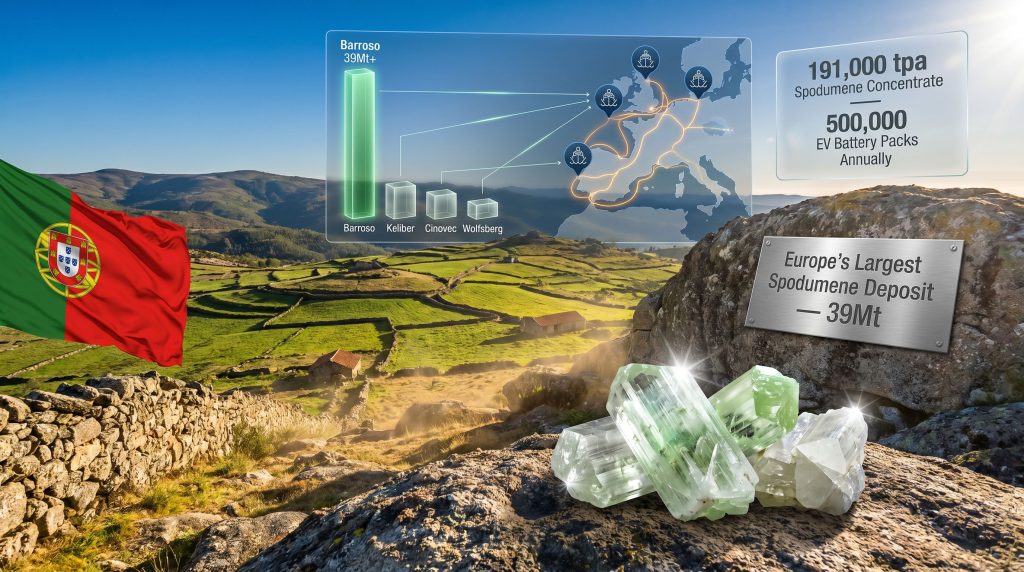
The confirmed mineral resource at Barroso currently stands at 39 million metric tonnes (Mt) at an average grade of 1.05% Li₂O, containing approximately 411,900 tonnes of lithium oxide. This makes it the largest confirmed spodumene deposit in Europe by a substantial margin.
| Resource Metric | Figures |
|---|---|
| Total Confirmed Resource | 39 million metric tonnes (Mt) |
| Contained Li₂O | 411,900 tonnes |
| Average Grade | 1.05% Li₂O |
| Extension Potential | 35Mt to 62Mt additional |
| Combined Upside Scenario | Exceeds 100Mt total |
| Projected Mine Life (Extended) | 50+ years |
Why Grade Matters as Much as Tonnage
An average grade of 1.05% Li₂O places Barroso in a commercially viable range for open-cut hard-rock operations. For context, most operating Australian spodumene mines, including operations at Greenbushes and Wodgina, target cut-off grades of around 0.4% to 0.5% Li₂O, meaning Barroso's grade is comfortably above economic thresholds at current lithium pricing.
What is less commonly understood is the importance of mineralogical consistency within a spodumene deposit. Heterogeneous ore bodies, where spodumene crystals vary significantly in size, crystal habit, or degree of alteration, can create processing challenges that reduce recovery rates and increase reagent consumption. Uniformity of mineralogy directly impacts the efficiency of both DMS and flotation circuits.
A 50-year mine life scenario would position Barroso as a multigenerational lithium asset, capable of supplying European battery supply chains well beyond the initial EV transition phase and into whatever energy storage technologies follow lithium-ion chemistry.
Development Timeline and Production Targets
Roadmap from Feasibility to First Lithium
| Milestone | Target Date |
|---|---|
| Positive Environmental Impact Statement (DIA) | May 2023 |
| EU Strategic Project Classification | March 2025 |
| €110M Non-Reimbursable Grant Awarded | January 2026 |
| First Capital Equipment Purchased | May 2026 |
| Final Investment Decision (FID) | End of 2026 |
| Construction Commencement | 2027 |
| First Spodumene Production | Late 2028 |
Annual Production Capacity and EV Supply Mathematics
The Definitive Feasibility Study (DFS) targets approximately 191,000 tonnes per annum (tpa) of spodumene concentrate at full production. To contextualise that figure:
-
A standard lithium-ion NMC battery pack for a mid-sized EV requires approximately 8 to 10 kilograms of lithium hydroxide equivalent.
-
Converting 191,000 tpa of 6% Li₂O spodumene concentrate yields roughly enough lithium to supply battery materials for approximately 500,000 electric vehicle battery packs annually.
-
At European EV sales projections tracking toward several million units per year by the late 2020s, a single Barroso-scale operation would represent a meaningful but not sufficient domestic supply contribution, underlining the systemic scale of Europe's lithium deficit.
The €110 Million Grant and What It Reveals About Government Commitment
Non-Reimbursable Funding: Why the Structure Matters
In January 2026, the Portuguese State awarded Savannah a €110 million non-reimbursable grant, one of the largest direct fiscal contributions to a single mining project in recent European history. The distinction between reimbursable and non-reimbursable funding is critical for project economics.
Non-reimbursable grants directly reduce the capital expenditure burden without creating debt obligations or diluting equity. In project finance terms, this reduces the debt-to-equity ratio required to reach a Final Investment Decision, lowers the weighted average cost of capital, and improves the project's internal rate of return under base-case commodity price assumptions.
For investors assessing the Savannah Resources Portugal lithium project, the grant signals that the Portuguese government has moved beyond rhetorical support into material financial commitment, a distinction that meaningfully reduces sovereign-level project risk. Consequently, the lithium supply-demand dynamics across Europe are beginning to shift in ways that make this kind of fiscal intervention not just logical but strategically necessary.
The next major ASX story will hit our subscribers first
Legal Challenges, Community Opposition, and the Injunction Episode
A Decade of Resistance: Understanding the Opposition Landscape
The Barroso project has faced persistent legal and community opposition spanning close to ten years. This is not unusual for large-scale extractive projects in ecologically sensitive regions, but the intensity and duration of opposition at Barroso is notable even by global mining standards.
Key events in the legal chronology include:
-
Multiple legal challenges filed by community groups and environmental organisations over successive years.
-
A precautionary injunction granted by the Mirandela Administrative and Fiscal Court on 9 June 2026, halting geotechnical fieldwork for approximately three weeks.
-
The injunction was filed by the Barroso Assembly of Common Land Holders following the granting of a second administrative easement providing Savannah access to communal and private land.
-
The Portuguese government intervened by formally declaring the project of national and European strategic importance, arguing that the suspension created serious harm to the public interest and endangered the broader energy transition framework.
-
The injunction was lifted on 30 June 2026, with no legal right of appeal available to opponents against the lifting order, though alternative legal avenues remain open to community groups.
The GIAHS Designation: A Less-Discussed Complication
One of the most underappreciated dimensions of the Barroso opposition relates to the region's Globally Important Agricultural Heritage Systems (GIAHS) designation, awarded by the United Nations Food and Agriculture Organisation (FAO). Barroso holds the distinction of being the only GIAHS-designated area in Portugal, a recognition tied to its centuries-old communal land management practices, traditional crop cultivation, and agropastoral farming systems.
This designation does not function as a legal veto over mining activity, but it creates significant reputational complexity. Mining an area carrying a UNESCO-equivalent agricultural heritage status exposes the project to international environmental advocacy attention that purely commercial or regulatory opposition cannot generate.
The project's projected annual water consumption of up to 600,000 cubic metres for mining operations sits at the centre of documented environmental agency concerns around groundwater and surface water impacts, particularly given the agricultural water dependency of surrounding communities.
How Barroso Compares to Other European Lithium Projects
European Hard-Rock Lithium: A Competitive Landscape
| Project | Country | Resource Scale | Development Status |
|---|---|---|---|
| Barroso (Savannah Resources) | Portugal | 39Mt+ (expandable to 100Mt+) | DFS stage, EU Strategic Project |
| Keliber | Finland | Smaller hard-rock deposits | Advanced development |
| Cinovec | Czech Republic | Large lithium-tin deposit | Permitting stage |
| Wolfsberg | Austria | Moderate spodumene resource | Feasibility stage |
Barroso's scale advantage over European peers is substantial. No other hard-rock lithium deposit in Europe approaches its confirmed resource tonnage, and its Atlantic port proximity confers a logistics advantage over landlocked Central European projects that must route concentrate through multiple national freight systems. However, the competitive landscape is evolving rapidly, and Europe's critical minerals supply chain remains a work in progress across multiple jurisdictions.
What the Geopolitical Dimension Means for Long-Term Value
Reducing European Exposure to Non-EU Supply Chains
European lithium supply chains carry a structural vulnerability that goes beyond simple import dependency. A significant portion of global lithium processing capacity is concentrated within Chinese industrial infrastructure, meaning that even when raw lithium is sourced from Australia or Chile, the chemical conversion step frequently passes through Chinese facilities before reaching European battery manufacturers.
A domestic European spodumene producer at Barroso's scale would allow European converters to establish processing relationships entirely within the EU and friendly-nation supply chains. This is not a minor operational consideration. It directly addresses the EU's stated objective of repatriating critical mineral value chains and reducing strategic exposure to third-country processing dependencies.
Furthermore, technologies such as direct lithium extraction are beginning to complement hard-rock pathways, offering additional optionality for European supply planners. The Critical Raw Materials Act's 10% domestic production target for strategic minerals by 2030 represents a regulatory floor, not a ceiling. Projects like Barroso that can demonstrate scalability toward the 100Mt resource potential are the kinds of assets that feature in long-range EU supply planning well beyond the initial 2030 milestone.
Frequently Asked Questions About the Savannah Resources Portugal Lithium Project
What is the Barroso Lithium Project?
The Barroso Lithium Project is a hard-rock spodumene lithium development in northern Portugal, 100% owned by London-listed Savannah Resources (LON: SAVS). It holds a confirmed resource of 39 million metric tonnes at 1.05% Li₂O, making it Europe's largest spodumene deposit by a significant margin.
When is first production expected?
First spodumene concentrate production is currently targeted for late 2028, following a Final Investment Decision expected by the end of 2026 and construction commencing in 2027.
Why was work suspended in June 2026?
A precautionary injunction granted by the Mirandela Administrative and Fiscal Court on 9 June 2026 halted geotechnical fieldwork for approximately three weeks. The Portuguese government formally declared the project of national and European strategic importance, and the injunction was lifted on 30 June 2026.
How much state funding has the project received?
The Portuguese State awarded Savannah a €110 million non-reimbursable grant in January 2026, representing one of the most significant direct state contributions to a European mining project in recent years.
What environmental concerns exist?
The Barroso region holds GIAHS designation from the UN-FAO, recognising its Globally Important Agricultural Heritage status. Environmental concerns centre on projected annual water consumption of up to 600,000 cubic metres and potential groundwater and surface water impacts on surrounding agricultural communities.
How much lithium can Barroso produce annually?
The DFS targets approximately 191,000 tonnes per annum of spodumene concentrate, sufficient to supply battery materials for around 500,000 electric vehicle battery packs each year.
This article contains forward-looking statements and projections based on publicly available information. Mining project timelines, resource estimates, and production targets are subject to change. Nothing in this article constitutes financial or investment advice. Readers should conduct their own due diligence before making investment decisions.
Want to Stay Ahead of the Next Major Mineral Discovery?
Discovery Alert's proprietary Discovery IQ model scans ASX announcements in real time, instantly translating complex mineral data into actionable investment insights across lithium and over 30 other commodities — explore historic discoveries and their exceptional returns, then begin your 14-day free trial at Discovery Alert to position yourself ahead of the broader market.