June 29, 2026
The Industrial Backbone of America's Lithium Ambition
Before a single tonne of battery-grade lithium carbonate can leave a processing facility, thousands of rotating machines must work in precise, unrelenting coordination. Electric motors are the invisible workforce of modern mining, and in large-scale hydrometallurgical operations like lithium processing, their selection, standardisation, and long-term reliability can determine whether a project achieves its production targets or falls short of them. Understanding this industrial reality reframes what might appear to be a routine equipment procurement announcement into something considerably more significant.
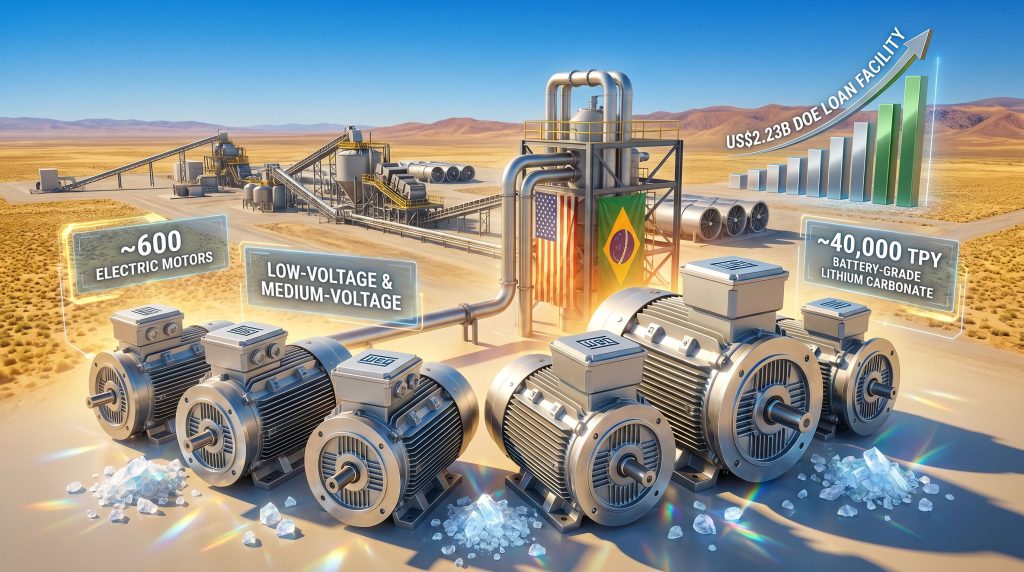
The agreement between WEG and Lithium Americas to supply WEG electric motors for the Thacker Pass lithium project, covering approximately 600 low- and medium-voltage motors for a greenfield processing plant in northern Nevada, is not simply a commercial transaction. It reflects a calculated approach to plant engineering that has measurable consequences for operational uptime, cost management, and the long-term scalability of what is being developed as America's most strategically important domestic lithium asset.
When big ASX news breaks, our subscribers know first
Thacker Pass: Scale, Geology, and Strategic Weight
Why This Deposit Commands Attention
Located in Humboldt County in northern Nevada, Thacker Pass holds the distinction of being the world's largest known measured lithium deposit. The geological character of the resource is distinct from the brine-dominated lithium deposits common in South America's Lithium Triangle. Thacker Pass hosts lithium within sedimentary clay formations, specifically lithium-bearing smectite clays, which require a different processing pathway than either brine evaporation or hard-rock spodumene flotation.
This mineralogical complexity is directly relevant to the motor supply contract. Clay-based lithium processing demands a broad range of mechanical operations, from crushing and agitation through to centrifugal separation and acid-leach circuit management, each placing distinct mechanical and thermal demands on rotating equipment. The diversity of applications within the Thacker Pass plant is precisely why the motor scope covers such a wide range of equipment types. Furthermore, Thacker Pass production plans have been structured with this operational complexity firmly in mind from the outset.
Production Targets and Capital Commitment
The project's Phase One production target is approximately 40,000 tonnes per year of battery-grade lithium carbonate, a specification that denotes material meeting the purity thresholds required by lithium-ion battery manufacturers, typically greater than 99.5% Li₂CO₃ content. At full scale, the operation is designed to reach up to 66,000 tonnes per year, equivalent to supplying battery material for roughly 800,000 electric vehicle battery packs annually.
| Metric | Detail |
|---|---|
| Location | Thacker Pass, Humboldt County, Nevada |
| Deposit Type | Lithium-bearing sedimentary clay (smectite) |
| Phase 1 Production Capacity | ~40,000 tpy battery-grade lithium carbonate |
| Full-Scale Annual Capacity | Up to 66,000 tpy |
| EV Battery Equivalent | ~800,000 EV battery packs per year |
| Project Capital Value | US$2.23 billion (DOE loan facility) |
| Estimated Construction Jobs | ~2,000 |
The project is supported by a US$2.23 billion loan facility from the U.S. Department of Energy, one of the largest single financial commitments to domestic critical mineral processing infrastructure in the country's history. General Motors holds a 38% equity stake in the project and has secured exclusive Phase 1 offtake rights, creating a direct line between Thacker Pass's output and one of the largest EV manufacturing programmes in North America. This US battery supply link represents a structural shift in how domestic automakers are approaching feedstock security.
WEG's Industrial Credentials and the Logic of Single-OEM Supply
Who WEG Is and Why It Was Selected
WEG S.A. is a Brazilian industrial multinational headquartered in Jaraguá do Sul, Santa Catarina, and ranks among the world's largest manufacturers of electric motors, transformers, variable frequency drives, and industrial automation equipment. The company operates manufacturing facilities across multiple continents and has an established presence in the North American mining sector, supplying equipment to operations spanning gold, copper, potash, and now lithium processing.
What makes WEG relevant to a project of Thacker Pass's complexity is not simply manufacturing capacity, but the ability to engineer motors specifically to mining-grade performance requirements across both low-voltage and medium-voltage platforms, and then back that supply with integrated technical support across commissioning, maintenance, and future expansion phases. WEG's agreement to supply electric motors for this project reflects the scale of trust placed in the company's engineering capabilities.
What the Contract Actually Covers
The WEG agreement encompasses approximately 600 electric motors distributed across the entire Thacker Pass processing plant. These units span two voltage classifications:
- Low-voltage motors operating up to 1,000 volts, typically deployed in auxiliary and moderate-duty applications
- Medium-voltage motors operating in the 1,000 to 15,000 volt range, used in high-power applications such as large crushers, primary pumps, and main process compressors
The breadth of application types covered under the contract reflects the operational complexity of a fully integrated lithium processing facility:
- Compressors for acid generation and gas management circuits
- Centrifugal and positive displacement pumps across leaching, washing, and precipitation stages
- Crushers and grinding mills for ore preparation
- Industrial fans and ventilation systems throughout the processing plant
- Agitators and mixing equipment in leach and neutralisation tanks
- Separators and classification systems for solids-liquid separation
- Decanter centrifuges, which are particularly critical in lithium carbonate precipitation and dewatering stages
Motors used in lithium carbonate precipitation circuits face a particularly demanding combination of thermal cycling, corrosive chemical exposure, and continuous duty requirements. These conditions demand elevated insulation classes and enclosure ratings well beyond standard industrial specifications.
The Operational Case for a Unified Motor Fleet
One of the less-discussed but economically significant aspects of the WEG agreement is the decision to source all 600 units from a single original equipment manufacturer. In large greenfield processing plants, multi-OEM motor fleets introduce compounding operational complexity that can erode profitability over a facility's operating life.
A standardised installed base delivers measurable advantages across several dimensions:
| Operational Factor | Multi-OEM Fleet | Single-OEM Fleet (WEG) |
|---|---|---|
| Spare parts inventory | Fragmented, high carrying cost | Consolidated, lower working capital |
| Variable speed drive selection | Multiple compatibility studies required | Unified drive platform possible |
| Maintenance training | Multiple equipment manuals and skill sets | Single training programme |
| Frame sizing standardisation | Inconsistent, increases installation complexity | Consistent, simplifies civil and structural design |
| Harmonic distortion studies | Complex multi-source analysis | Streamlined, single performance curve set |
| Expansion readiness | New compatibility assessments at each stage | Plug-in scalability using established specs |
When an entire plant's motor fleet is sourced from a single manufacturer, engineering teams benefit from consistent frame sizing, terminal configurations, and performance characteristics. This dramatically simplifies variable speed drive selection, power quality management, and preventive maintenance scheduling across the facility, consequently reducing both planned and unplanned downtime risk.
Performance Engineering for Mining-Grade Duty
What Mining Environments Actually Demand
Standard commercial motors are simply not designed for the conditions present inside an active mining and processing facility. Dust infiltration, mechanical vibration transmitted through structural steel from crushing and milling equipment, wide ambient temperature ranges, and the need for continuous 24/7 operation across multi-year intervals all impose demands that require purpose-engineered solutions.
| Performance Parameter | Requirement for Mining Applications |
|---|---|
| Enclosure Rating | High ingress protection (typically IP55 or higher) against dust and moisture |
| Insulation Class | Class F or H for continuous duty in elevated thermal environments |
| Vibration Tolerance | Engineered mounts and windings for crusher and mill-induced mechanical stress |
| Voltage Range | Low-voltage (up to 1kV) and medium-voltage (1kV to 15kV) |
| Drive Compatibility | Optimised for variable speed drive integration and harmonic mitigation |
| Scalability | Frame standardisation supporting phased capacity expansion |
Energy Efficiency at Scale: A Financial Variable Often Underestimated
At a facility deploying 600 motors simultaneously, the difference between standard efficiency and premium efficiency ratings is not an abstract specification preference. It translates directly into operating cost. Consider that a single 200 kW motor operating continuously at 95% load accumulates roughly 1.66 GWh of energy consumption annually. Scaled across hundreds of units, even fractional efficiency improvements generate material reductions in electricity cost over a 20-plus year asset life, particularly relevant in Nevada where industrial power prices are subject to ongoing regulatory adjustment.
Premium efficiency motors also generate less waste heat, reducing thermal stress on winding insulation and extending motor service life, compounding the economic benefit over time. In addition, advances in lithium extraction technologies are increasing the energy demands placed on processing equipment, making motor efficiency an increasingly critical variable in overall plant economics.
Situating the Contract Within the U.S. Critical Minerals Landscape
The Supply Chain Gap Thacker Pass Is Designed to Address
The United States currently imports the overwhelming majority of its battery-grade lithium from foreign sources, with significant proportions originating from processing facilities in China and South America. This structural dependency creates vulnerability across the EV manufacturing supply chain at precisely the moment when domestic automakers and battery producers are scaling production aggressively.
Thacker Pass is designed to directly address this gap by establishing a vertically integrated domestic production pathway, from mined ore through to specification battery-grade lithium carbonate, within U.S. borders. General Motors' equity participation and offtake agreement underscores the commercial logic: securing reliable, domestic lithium supply de-risks battery manufacturing programmes that cannot afford feedstock interruption. This aligns closely with the broader critical minerals strategy being pursued across allied nations seeking to reduce exposure to concentrated supply chains.
WEG's Position in the North American Industrial Ecosystem
The Thacker Pass motor contract elevates WEG's profile within the North American critical minerals sector in a way that transcends the individual transaction. Supplying the full motor complement for the largest lithium project in U.S. history provides a performance reference that will be visible to every mining operator, project developer, and engineering procurement contractor evaluating motor supply strategies for future lithium, cobalt, nickel, or rare earth processing facilities.
This matters because the pipeline of planned critical mineral processing infrastructure in North America is substantial. Multiple lithium refinery projects, battery precursor material facilities, and direct lithium extraction pilot programmes are at various stages of development, and each will require large-format motor procurement decisions. The battery raw materials market is consequently placing increasing scrutiny on which equipment manufacturers have demonstrated performance credentials in live processing environments. The institutional knowledge and application data WEG accumulates through the Thacker Pass project creates a competitive position that is difficult for rivals to replicate without equivalent field experience.
As reported by IM Mining, the scale and scope of the WEG motor supply agreement reflects the growing industrial seriousness with which Thacker Pass is being approached by global equipment partners.
Frequently Asked Questions
How many motors is WEG supplying to Thacker Pass?
WEG is supplying approximately 600 electric motors spanning the entire Thacker Pass processing plant, covering both low-voltage and medium-voltage configurations.
What types of equipment will the WEG motors power at Thacker Pass?
The motor package covers compressors, centrifugal and positive displacement pumps, crushers, grinding mills, industrial fans, agitators, separators, and decanter centrifuges across multiple processing zones within the facility.
What voltage classes are included in the WEG motor supply agreement?
The agreement covers both low-voltage motors (up to 1,000V) and medium-voltage motors (from 1,000V up to approximately 15,000V), matched to the power requirements of different equipment categories within the plant.
Why was a single-supplier motor strategy chosen for Thacker Pass?
A unified motor fleet from a single OEM delivers standardisation benefits across spare parts inventory, maintenance training, variable speed drive integration, and future expansion planning, reducing lifecycle operational cost and complexity.
What is the Phase 1 production capacity of Thacker Pass?
Phase 1 is designed to produce approximately 40,000 tonnes per year of battery-grade lithium carbonate, scaling to up to 66,000 tonnes per year at full capacity.
How is the Thacker Pass project financed?
The project is supported by a US$2.23 billion loan facility from the U.S. Department of Energy, alongside equity participation from General Motors, which holds a 38% ownership stake.
What is the connection between Thacker Pass and electric vehicle battery supply chains?
At full production, Thacker Pass is expected to supply battery-grade lithium carbonate sufficient to support approximately 800,000 EV battery packs per year, with General Motors holding exclusive Phase 1 offtake rights for domestic battery manufacturing.
When is Thacker Pass expected to begin production?
The project is currently under construction. Specific commissioning timelines are subject to construction progress and regulatory approvals, and prospective investors or stakeholders should consult Lithium Americas' official project disclosures for current scheduling guidance.
The next major ASX story will hit our subscribers first
Key Takeaways: The Industrial Architecture Behind U.S. Lithium Independence
| Contract Element | Detail |
|---|---|
| Supplier | WEG S.A. (Brazilian industrial multinational) |
| Client Project | Thacker Pass Lithium Project, Nevada |
| Total Motor Units | ~600 |
| Motor Voltage Classes | Low-voltage and medium-voltage |
| Application Range | Compressors, pumps, crushers, fans, agitators, separators, centrifuges |
| Deposit Classification | World's largest known measured lithium deposit |
| Phase 1 Output Target | ~40,000 tpy battery-grade lithium carbonate |
| DOE Loan Facility | US$2.23 billion |
| GM Equity Stake | 38%, with exclusive Phase 1 offtake rights |
Three Structural Shifts This Contract Reflects
The WEG electric motors for Thacker Pass lithium project agreement is a useful lens through which to observe three broader structural shifts occurring simultaneously in U.S. industrial and energy policy:
- The onshoring of critical mineral processing is moving from policy objective to physical infrastructure, with large-scale capital commitments translating into greenfield plant construction that requires sophisticated industrial equipment supply chains.
- Single-OEM procurement strategies are gaining favour in large-scale mining projects as operators recognise that lifecycle cost optimisation depends as much on operational standardisation as on upfront equipment pricing.
- Global industrial equipment manufacturers with genuine mining application depth are being positioned as critical enablers of the energy transition, not merely as component suppliers, but as long-term operational partners in assets that will run for decades.
The Thacker Pass project, and the motor supply architecture underpinning it, may well serve as a reference model for how future critical mineral processing facilities in North America approach equipment procurement, operational standardisation, and supply chain resilience from the ground up.
This article is intended for informational purposes only and does not constitute financial or investment advice. Project timelines, production targets, and financial figures are subject to change. Readers should conduct their own due diligence and consult professional advisors before making investment decisions.
Want to Stay Ahead of the Next Major Mineral Discovery?
Discovery Alert's proprietary Discovery IQ model scans ASX announcements in real time, instantly identifying significant mineral discoveries across lithium and more than 30 other commodities — turning complex data into clear, actionable opportunities for investors at every level. Explore how historic discoveries have generated substantial returns on the Discovery Alert discoveries page, and begin your 14-day free trial today to position yourself ahead of the broader market.