July 25, 2026
Why Basaltic Rocks Are the Foundation of Planetary Science
Few rock types carry the scientific weight of basaltic rocks. Across Earth's oceanic crust, the lunar maria, the volcanic plains of Mars, and the ancient surfaces of Mercury, basaltic compositions appear with remarkable consistency. This universality is not coincidental. It reflects a fundamental property of rocky planetary bodies: when mantle-like materials partially melt, the resulting magma tends toward a basaltic composition. Understanding this rock family is, in the most literal sense, a gateway to decoding the thermal and volcanic history of the inner solar system.
When big ASX news breaks, our subscribers know first
The Numbers Behind Basalt's Dominance
The scale of basaltic rock production on Earth is staggering. Oceanic crust, which is almost entirely basaltic in composition, averages 6 to 7 kilometres in thickness and underlies roughly 60 to 70 percent of Earth's surface area. At mid-ocean ridges alone, the planet continuously generates new basaltic crust through a process that has operated for billions of years, making basalt the single most volumetrically significant rock type being produced on Earth today.
On the Moon, basaltic lavas fill the large impact basins visible on the nearside, covering approximately 16 to 17 percent of the lunar surface by area. Radiometric dating of Apollo samples places the eruption of most lunar mare basalts between roughly 3.8 and 3.1 billion years ago, providing a critical chronological anchor for understanding the early bombardment history of the inner solar system. Mars, similarly, hosts extensive basaltic plains, and orbital mineralogy data from missions including Mars Reconnaissance Orbiter has confirmed basaltic mineral assemblages across vast swaths of the Martian surface.
From Mantle to Surface: The Chemistry of Ascent
Understanding what basaltic rocks are requires first understanding what they are not when they begin their journey. Deep within Earth's mantle, the source material is ultramafic in composition, meaning it is even richer in iron and magnesium than the basaltic rocks it eventually produces. Geochemical modelling consistently indicates that approximately 15 percent partial melting of mantle peridotite is required to generate a magma of broadly basaltic composition. This chemical gap between source and product is a foundational constraint in igneous petrology.
As this magma ascends toward the surface, three sequential processes progressively alter its chemistry:
-
Crystal fractionation occurs as early-crystallising minerals either settle out of or remain suspended within the rising melt, shifting its bulk composition away from its mantle origin.
-
Volatile exsolution takes place as decreasing pressure allows dissolved gases and fluids, including water (H₂O), carbon dioxide (CO₂), sulfur (S), fluorine (F), and hydrogen (H), to escape from the melt.
-
Compositional drift is the cumulative result: the lava that eventually erupts at the surface carries a chemically distinct signature compared to the magma that began its ascent in the mantle.
This is why the terms magma and lava are not interchangeable. Magma refers to molten rock at depth, under pressure. Lava refers to molten rock at or near the surface. The distinction encodes real chemical and physical differences that matter enormously to petrological interpretation.
One of the most compelling pieces of physical evidence linking basaltic magma to its mantle source comes in the form of mantle xenoliths, fragments of deep mantle rock that are occasionally ripped from the surrounding geology and transported upward within rapidly ascending basaltic magma. The most common type is peridotite, an olivine- and pyroxene-rich rock that represents unmelted mantle material. Where xenoliths are found within basaltic lavas, they provide direct, undrilled samples of Earth's upper mantle, making them among the most scientifically valuable specimens in all of geology.
Defining Basaltic Rocks: Classification and Essential Mineralogy
Where Basaltic Rocks Fit in the Igneous Rock Family
Basaltic rocks are igneous rocks, meaning they crystallise directly from cooling magma or lava rather than forming through sedimentary accumulation or metamorphic transformation. Within the igneous family, they are classified as mafic, a term derived from the elemental symbols for magnesium (Mg) and iron (Fe, from the Latin ferrum). This designation reflects their characteristic enrichment in iron- and magnesium-bearing minerals relative to more silica-rich rock types such as andesite or rhyolite.
In older geological literature, basaltic rocks were sometimes described as basic, a reference to their behaviour in chemical solution rather than their mineralogy. This classification system has largely been superseded by modern petrographic frameworks, though the term occasionally appears in historical references. Furthermore, understanding the broader context of mineralogy and ores helps illuminate why such classifications carry practical as well as academic significance.
The Two Essential Minerals
For a rock to be classified as basaltic, it must contain a dominant proportion of two specific minerals:
| Essential Mineral | Description |
|---|---|
| Plagioclase feldspar | A silicate framework mineral forming the structural backbone of most basaltic rocks |
| Clinopyroxene | An iron- and magnesium-rich chain silicate critical to mafic rock identification |
These two minerals together define the basaltic family. Their combined dominance in the mineral assemblage is the non-negotiable criterion for classification.
Varietal Minerals: Refining the Classification
Beyond the essential minerals, varietal or accessory minerals allow geologists to assign more specific names within the basaltic family. Their presence and relative proportions reflect subtle differences in magma chemistry, temperature, and volatile content:
- Olivine produces olivine basalt when present in significant quantities
- Hornblende indicates that the original magma contained elevated water content
- Biotite suggests potassium enrichment within the melt
- Magnetite is a common iron oxide accessory in mafic systems
- Rutile, apatite, and zircon are trace accessories of particular interest to geochronologists because zircon, in particular, is used for uranium-lead radiometric dating
How Grain Size Reveals Cooling History
The Fundamental Principle
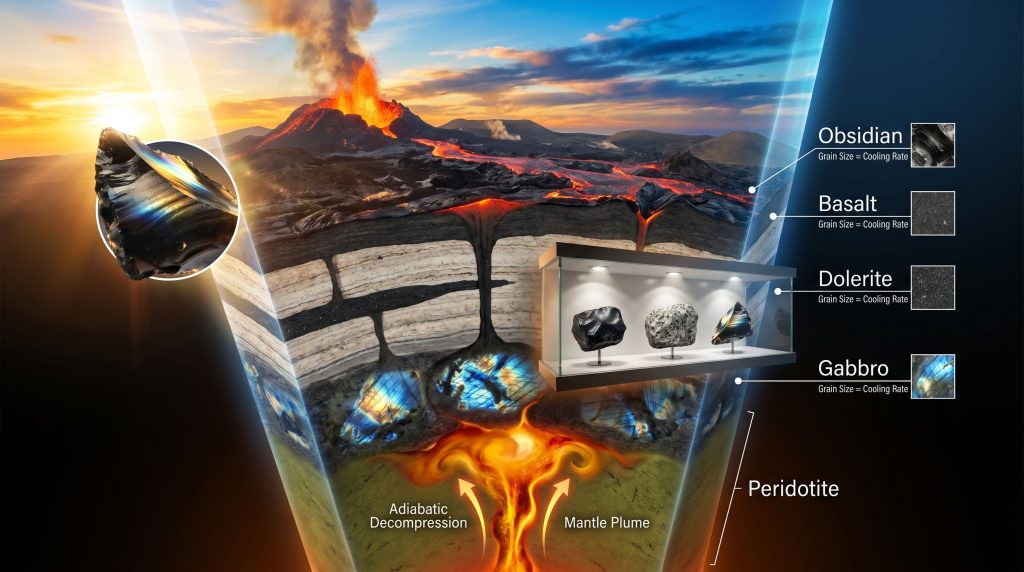
One of the most powerful and immediately practical tools in field geology is the ability to read a rock's cooling history directly from its mineral grain size. The governing principle is straightforward: the slower a magma or lava cools, the more time crystals have to grow, and the larger those crystals become. Conversely, rapid cooling produces fine-grained or even glassy textures where crystallisation was interrupted before it could proceed.
This relationship between grain size and cooling rate allows geologists to infer emplacement depth, eruptive style, and tectonic setting from hand specimens alone. According to research published by EBSCO, these textural properties are central to distinguishing basaltic rock variants in both field and laboratory settings.
The Four Major Basaltic Rock Types
Obsidian
Obsidian represents the extreme end of rapid cooling. In some cases, lava quenches so quickly that no crystalline structure develops at all, producing a volcanic glass with an amorphous microstructure. This can occur when lava erupts onto land, flows into seawater, or contacts cold, wet shallow rock.
Because obsidian lacks the regular atomic lattice of a crystalline solid, it fractures differently from conventional rocks, producing the conchoidal fracture and exceptionally sharp edges that made it a preferred cutting material for prehistoric cultures across multiple continents. Its geological occurrence confirms surface or near-surface eruption and extremely rapid thermal quenching.
Basalt
Basalt is the benchmark surface volcanic rock and the most common product of mafic volcanism. Its crystals are microscopic, typically requiring magnification to resolve, though they are definitely present unlike in obsidian. The rock typically appears black, dark gray, or dark greenish-black, a colour directly tied to the dominance of dark iron- and magnesium-rich minerals in its assemblage.
Several textural variations are geologically informative:
- Aphanitic texture describes the standard fine-grained, uniform appearance of typical basalt
- Porphyritic texture occurs when larger crystals, called phenocrysts, are set within a fine-grained groundmass, indicating a two-stage cooling history where crystals began growing at depth before the magma migrated toward the surface
- Vesicular texture preserves gas bubble cavities formed during volatile exsolution at the time of eruption
- Amygdaloidal texture develops when those vesicles are subsequently filled by secondary minerals such as calcite, zeolites, or quartz
Chemically, basalt is characterised by low silica content, typically in the range of 45 to 52 percent SiO₂, combined with relatively elevated concentrations of iron, magnesium, calcium, and sodium or potassium oxides compared with more evolved volcanic rocks. The National Park Service's overview of basaltic lava flows provides a useful reference for understanding how these chemical properties influence eruptive behaviour in the field.
Dolerite (Diabase)
Dolerite, known as diabase in North American geological literature, occupies the middle ground between surface-erupted basalt and deep-intruded gabbro. Its crystals are small but visible to the naked eye, particularly with the assistance of a hand lens or stereo microscope. This intermediate grain size reflects emplacement at shallow to moderate crustal depths, where cooling is slower than at the surface but faster than in deep crustal settings.
A diagnostic field feature of dolerite intrusions is the progressive increase in crystal size toward the intrusion's centre. This reflects the thermal gradient between the cold wall rock at the margins (which promotes rapid cooling and finer grains) and the insulated core of the intrusion (which cools more slowly and permits larger crystals to develop). Where dolerite contacts cold, wet sedimentary rocks, near-instantaneous quenching can produce a chilled margin, a glassy or very fine-grained zone that confirms the intrusive contact relationship and is a reliable field identification feature.
Gabbro
Gabbro is the coarse-grained, deep crustal equivalent of basalt, sharing nearly identical mineralogy and bulk chemistry but developing large, easily visible crystals as a result of slow cooling at significant depth. The crystals are often euhedral to idiomorphic, meaning they have grown into well-formed, geometrically recognisable shapes unimpeded by competition from surrounding grains.
The high plagioclase content of some gabbros can make them visually resemble granite in the field, a common identification challenge that is resolved by checking mineral assemblage rather than appearance alone. Certain gabbro varieties are visually spectacular: labradorite-rich gabbro displays striking iridescent optical effects caused by light interference within the layered internal structure of labradorite feldspar crystals. Tectonically, gabbro forms the lower layers of oceanic crust at mid-ocean ridges and is a key component of ophiolite sequences, ancient slices of oceanic crust now preserved on land.
Comparative Summary: Basaltic Rock Types by Grain Size
| Rock Type | Grain Size | Cooling Rate | Typical Setting | Diagnostic Field Feature |
|---|---|---|---|---|
| Obsidian | None (glassy) | Extremely rapid | Surface eruption | Conchoidal fracture, sharp edges |
| Basalt | Microscopic | Rapid | Surface or shallow intrusion | Dark colour, fine uniform texture |
| Dolerite | Fine to visible | Moderate | Shallow intrusion | Visible crystals, chilled margins |
| Gabbro | Coarse | Slow | Deep crustal intrusion | Large crystals, possible iridescence |
Where Basaltic Rocks Form: Tectonic Controls and Mantle Dynamics
Three Mechanisms That Generate Basaltic Magma
The question of where basaltic rocks form is inseparable from the question of how basaltic magma is generated in the first place. Because the mantle is predominantly solid rather than liquid, melting requires either a change in temperature, a change in pressure, or a change in the composition of the mantle material. Three geological mechanisms drive this:
1. Mantle Plumes
Localised zones of elevated heat deep within the mantle, referred to as mantle plumes, can drive partial melting without any change in pressure or composition. Plume-generated volcanism characteristically occurs well away from tectonic plate boundaries, producing intraplate volcanic chains such as the Hawaiian Islands. The progressive aging of volcanic islands along a hotspot chain, with older islands located farther from the active hotspot, provides a direct record of plate motion over geological time and is one of the most elegant demonstrations of plate tectonic theory.
2. Adiabatic Decompression Melting
As tectonic plates diverge, the underlying mantle rises to fill the widening gap. As pressure on the rising mantle decreases, melting occurs without any additional heat input, a counterintuitive process known as adiabatic decompression melting. This is the dominant mechanism at mid-ocean ridges and in continental rift zones.
The Mid-Atlantic Ridge illustrates this process at a global scale. As the North and South American plates separate from the Eurasian and African plates, the underlying mantle rises, decompresses, and melts, producing enormous volumes of basaltic magma that rise to form new oceanic crust. The buoyancy of this hot, newly generated magma further elevates the ridge topography, reducing pressure on the mantle below and sustaining further melting in a self-reinforcing cycle. This is why the Mid-Atlantic Ridge functions as the longest volcanic chain on Earth.
3. Flux Melting
In subduction zone settings, water and other volatiles released from the descending oceanic slab lower the melting point of the overlying mantle wedge, driving partial melting through a change in composition rather than temperature or pressure. While the primary products of subduction-related volcanism tend toward more silica-rich compositions, basaltic andesites and other mafic arc magmas are also generated through this mechanism.
Major Tectonic Settings for Basaltic Rock Formation
| Tectonic Setting | Primary Mechanism | Rock Types Produced | Global Example |
|---|---|---|---|
| Mid-ocean ridges | Adiabatic decompression | Basalt, Gabbro | Mid-Atlantic Ridge |
| Oceanic hotspots | Mantle plume heating | Basalt | Hawaiian Islands |
| Continental rifts | Decompression melting | Basalt, Dolerite | East African Rift |
| Large igneous provinces | Flood basalt eruptions | Basalt | Deccan Traps, India |
| Subduction arcs | Flux melting | Basaltic andesite | Pacific Ring of Fire |
The next major ASX story will hit our subscribers first
Field and Laboratory Identification of Basaltic Rocks
Basalt vs. Gabbro: Same Chemistry, Different Texture
A common source of confusion in field geology is the visual distinction between basalt and gabbro. Both rocks share nearly identical mineralogy and bulk chemistry, with silica contents typically falling in the 45 to 52 percent SiO₂ range and mineral assemblages dominated by plagioclase and clinopyroxene. The single differentiating factor is grain size, which is entirely a product of cooling history.
| Property | Basalt | Gabbro |
|---|---|---|
| Grain size | Fine (microscopic) | Coarse (visible to naked eye) |
| Cooling environment | Surface or near-surface | Deep crustal |
| Silica content | ~45 to 52% SiO₂ | ~45 to 52% SiO₂ |
| Mineral assemblage | Plagioclase + clinopyroxene ± olivine | Plagioclase + clinopyroxene ± olivine |
| Visual appearance | Dark, uniform, fine-grained | Speckled, coarse, crystalline |
| Common confusion | Occasionally confused with fine-grained dolerite | Sometimes mistaken for granite |
Lesser-Known Identification Nuances
Several identification subtleties are worth noting for those moving beyond introductory-level recognition:
- Porphyritic basalts, which contain visible phenocrysts within a fine groundmass, can initially appear ambiguous because the phenocrysts suggest a coarser rock type. The key is recognising that the groundmass grain size, not the phenocrysts, reflects the final cooling environment.
- The presence of vesicles immediately confirms a surface or very shallow eruptive origin, as gas bubbles can only be preserved where confining pressure was low enough to allow volatile exsolution.
- Chilled margins in dolerite or gabbro intrusions are a reliable field indicator of intrusive contact relationships and help distinguish intrusive from extrusive origins in ambiguous exposures.
Economic and Scientific Applications of Basaltic Rocks
Industrial Uses and Emerging Technologies
Basaltic rocks have supported human industry for millennia and continue to find new applications:
- Crushed aggregate: Basalt is widely quarried for road construction, railway ballast, and concrete production due to its hardness, durability, and wide availability.
- Building and paving stone: Its resistance to weathering and attractive dark appearance make it a preferred material in construction across many regions.
- Basalt fibre: An emerging high-performance material produced by melting and extruding basalt rock into continuous fibres. Basalt fibre is gaining traction as a cost-competitive alternative to fibreglass in composite manufacturing, offering comparable tensile strength with potentially superior thermal resistance and chemical stability.
Ore Hosting Potential
Basaltic terrains, particularly those associated with large igneous provinces (LIPs) and komatiitic volcanism, can host world-class economic mineral deposits. In addition, processes such as ore deposit metamorphism can further modify and concentrate mineralisation within these already metal-rich environments.
- Nickel, copper, and platinum group element (PGE) deposits are historically associated with mafic and ultramafic magmatic systems. The concentration of these metals occurs through magmatic sulfide segregation, a process in which immiscible sulfide liquid droplets scavenge metals from the surrounding melt. Furthermore, magmatic nickel deposits represent some of the most economically significant mineralisation styles associated with basaltic and ultramafic magmatic systems globally.
- Flood basalt systems and their associated intrusive equivalents represent some of the most significant magmatic sulfide terrains on Earth, making the identification and mapping of basaltic provinces a matter of direct economic relevance to the mining sector. IOCG deposit formation and VMS ore deposits are also closely linked to basaltic and mafic volcanic settings, further underscoring the economic importance of these terrains.
Planetary Science and Remote Sensing
The basaltic compositions of other planetary surfaces are not merely academic curiosities. Remote sensing instruments aboard orbital missions use near-infrared spectroscopy to detect the characteristic absorption features of pyroxene and olivine, the defining minerals of mafic rocks, allowing scientists to map volcanic provinces on Mars, the Moon, and Mercury without physical sample collection.
The broader implication is significant: because basaltic magmatism is driven by the same fundamental physics of mantle partial melting across all rocky planetary bodies, the tools developed to interpret basaltic rocks on Earth translate directly to the interpretation of planetary surfaces elsewhere in the solar system.
Frequently Asked Questions About Basaltic Rocks
What is the difference between basalt and obsidian?
Both obsidian and basalt can share similar bulk chemistries, but they differ fundamentally in physical structure. Basalt contains microscopic crystals that formed during moderately rapid cooling, while obsidian is a volcanic glass with no crystalline order, produced when lava cools almost instantaneously. The absence of a crystalline lattice in obsidian produces its characteristic conchoidal fracture and razor-sharp edges, properties that made it highly valued as a cutting material long before the development of metal tools.
Why is basalt so common on the ocean floor?
Oceanic crust is continuously regenerated at mid-ocean ridges through adiabatic decompression melting of the underlying mantle. Because this process operates along a globally connected ridge system spanning tens of thousands of kilometres, it produces enormous volumes of basaltic magma that solidify to form new seafloor. The relatively young age of oceanic crust, no portion of which is older than approximately 200 million years, reflects the continuous cycling of basaltic material through seafloor spreading and subduction.
How can you tell basalt apart from gabbro in the field?
Grain size is the definitive criterion. Basalt is fine-grained with crystals too small to resolve without magnification, while gabbro has coarse, easily visible crystals. Both rocks share essentially identical mineral assemblages and chemical profiles. The difference is entirely a product of cooling rate, which in turn reflects emplacement depth.
What makes mantle xenoliths scientifically valuable?
Mantle xenoliths are fragments of deep mantle rock transported to the surface within rapidly ascending basaltic magma. They provide direct physical samples of Earth's upper mantle at depths that are entirely inaccessible to drilling technology. Geochemical analysis of xenoliths allows scientists to constrain the composition, temperature, and pressure conditions of the mantle source regions that generate basaltic magma, providing data that would otherwise require inference from indirect geophysical measurements alone.
Can basaltic rocks form on other planets?
Yes, and this is one of the most important insights in comparative planetology. Basaltic compositions have been confirmed on the Moon through Apollo sample analysis, on Mars through both rover analysis and orbital spectroscopy, and on Mercury through data from the MESSENGER orbital mission. The consistency of basaltic compositions across rocky planetary bodies reflects the universal tendency of mantle-like source materials to generate mafic magmas during partial melting, making basalt a geological constant across the inner solar system.
Key Takeaways: The Geological Significance of Basaltic Rocks
Basaltic rocks are far more than a common dark-coloured stone. They are the primary product of Earth's continuously operating mantle melting system, the dominant rock type on the ocean floor, and a geochemical bridge connecting Earth's surface geology to the deep interior. A few core principles summarise their significance:
- Basaltic rocks are the most volumetrically significant rock type produced at Earth's surface, underpinning roughly 60 to 70 percent of the planet's crustal area
- Their grain size directly encodes their cooling history and emplacement depth, from glassy obsidian at the surface to coarse gabbro kilometres underground
- They originate through partial melting of the upper mantle, driven by three distinct mechanisms: mantle plume heating, adiabatic decompression, and flux melting
- Their mineral assemblage, dominated by plagioclase and clinopyroxene, remains consistent across all grain size variants despite dramatic differences in physical appearance
- Understanding basaltic rocks provides direct insight into plate tectonics, planetary evolution, economic ore systems, and Earth's deep interior dynamics
Disclaimer: Statistical ranges and geochemical parameters cited in this article reflect widely published values in geological literature. Precise figures may vary between studies depending on the analytical methods, sample sets, and regional geological contexts used. Readers pursuing original research applications should consult primary peer-reviewed sources and current geological survey datasets.
Want to Capitalise on the Next Major Mineral Discovery Before the Market Does?
The same geological principles that make basaltic terrains host to world-class nickel, copper, and PGE deposits are actively shaping ASX exploration today — and Discovery Alert's proprietary Discovery IQ model scans every ASX announcement in real time, instantly identifying significant mineral discoveries and translating complex data into actionable investment opportunities before the broader market reacts. Explore how historic discoveries have generated substantial returns and begin your 14-day free trial to position yourself ahead of the next major find.