June 10, 2026

Strategic scenario modeling reveals how infrastructure threats fundamentally reshape global commodity markets through interconnected vulnerability networks. When critical energy chokepoints face geopolitical targeting, mining operations experience cascading cost escalations that transform operational economics within hours rather than months. The modern mining sector's deep integration with global energy systems creates systemic exposure to infrastructure disruption that extends far beyond traditional supply chain risks, particularly evident in recent Trump threat to attack Iran power plants scenarios affecting global markets.
Understanding Base Metal Vulnerability to Energy Infrastructure Threats
The relationship between geopolitical infrastructure targeting and base metal markets demonstrates how modern mining operations have become dependent on stable energy supply chains. When power generation facilities or strategic shipping corridors face disruption threats, commodity markets immediately price in both direct operational impacts and broader demand destruction scenarios.
Critical Market Movements During Infrastructure Crisis Events
| Metal | Price Impact | Market Response Time | Strategic Implications |
|---|---|---|---|
| Copper | -0.6% immediate decline | Within trading hours | Industrial demand concerns |
| Aluminum | 4-year highs followed by -1.8% | 24-48 hour volatility | Production halt vulnerabilities |
| Oil | Immediate surge response | Real-time escalation | Mining cost amplification factor |
Recent market events illustrate these dynamics precisely. Copper futures fell 0.6% to $12,359.50 per ton on the London Metal Exchange following escalated infrastructure threats in the Middle East region. Furthermore, aluminium demonstrated even more dramatic volatility, reaching four-year highs before declining 1.8% as markets processed both supply disruption and potential demand destruction scenarios.
The energy-mining cost transmission mechanism operates through multiple channels, contributing to increased copper price volatility:
• Direct electricity cost escalation affecting smelting operations
• Transportation fuel price increases impacting logistics chains
• Risk premium incorporation into financing costs
• Central bank policy uncertainty triggering liquidity concerns
According to market analysis from Oanda, base metals including copper face significant demand destruction threats when central banks begin reversing liquidity-easing cycles during energy crises. Oil prices serve as the primary driver for commodity markets, with upward crude trends persisting as long as strategic waterway flow clarity remains absent.
When big ASX news breaks, our subscribers know first
The Strait of Hormuz: Global Mining's Critical Infrastructure Dependency
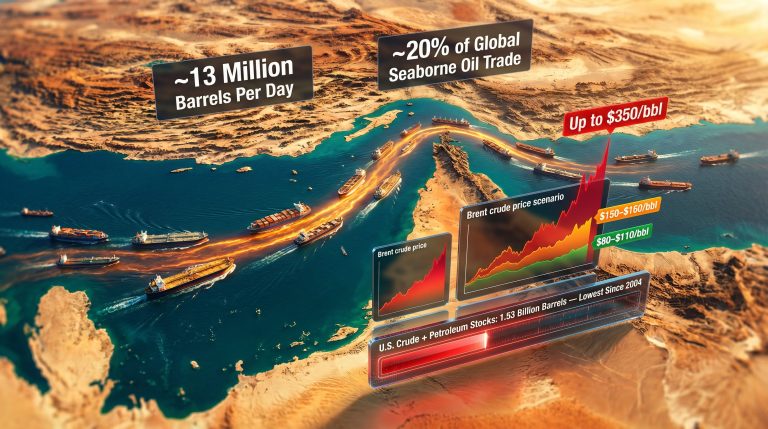
The Strait of Hormuz represents more than a shipping corridor for mining operations; it functions as a critical infrastructure node where 20% of global oil transit occurs through a 21-mile-wide geographic constraint. This strategic waterway's importance to mining economics cannot be overstated, as energy cost escalation immediately transmits through operational structures across the industry.
Energy Transit Dependencies Through Strategic Chokepoints
The concentration of global energy flows through narrow geographic points creates systemic vulnerability for mining operations worldwide. Approximately one-fifth of global oil and liquefied natural gas typically passes through the Strait of Hormuz during normal operations, making alternative routing scenarios critical for operational planning.
Mining cost structures demonstrate particular sensitivity to energy price volatility because:
• Electricity represents 25-40% of total operational costs for energy-intensive processes
• Diesel fuel comprises 15-25% of extraction operation expenses
• Transportation costs account for 8-15% of total operational budgets
• Processing facility operations require continuous energy inputs for economic viability
When infrastructure threats emerge, these cost components can escalate dramatically. Crisis scenarios historically demonstrate electricity cost increases reaching 35-55% of total operations, whilst transportation expenses can surge to 15-30% of operational budgets due to alternative routing requirements and fuel price premiums.
Real-world operational impacts became evident when Emirates Global Aluminium, the Middle East's largest aluminium producer, experienced forced production halts at smelting facilities due to regional infrastructure threats. This direct disruption pathway illustrates how infrastructure targeting immediately translates into mining production constraints, reflecting broader energy transition security challenges.
Alternative Supply Route Economics and Mining Cost Implications
Alternative routing scenarios present mining operations with complex cost-benefit calculations when primary energy supply corridors face disruption. The Cape of Good Hope route adds approximately 15 additional transit days compared to traditional Suez Canal passages, creating immediate cost premiums of approximately $2.50 per barrel for energy inputs.
Supply Chain Rerouting Impact Assessment
Geographic rerouting options each present distinct operational challenges:
-
Cape of Good Hope Alternative
- Additional 6,000 nautical miles versus primary routes
- 15-day transit time extension impacting supply scheduling
- Fuel cost premiums plus extended voyage insurance costs
- Limited vessel capacity for ultra-large crude carriers
-
Suez Canal Dependencies
- LNG vessel size restrictions limiting carrier capacity
- Canal toll increases creating fixed cost premiums
- Congestion risks generating unpredictable delivery schedules
- Historical closure vulnerabilities demonstrated repeatedly
-
Overland Pipeline Constraints
- Existing infrastructure geographically limited
- Construction timelines requiring multi-year development periods
- Political stability dependencies for cross-border projects
- Insufficient capacity for global demand requirements
The economic mathematics of alternative routing creates immediate operational pressure on mining companies. Extended shipping routes translate directly into higher energy input costs, affecting everything from electricity generation at remote mining sites to diesel fuel for heavy equipment operations. However, these challenges also drive oil market movements that impact global commodity pricing.
Energy-Intensive Mining Operations: Vulnerability Assessment
Aluminium smelting operations demonstrate the highest vulnerability to energy infrastructure disruptions due to their continuous electricity requirements. Unlike other mining processes that can temporarily suspend operations during energy price spikes, aluminium smelters require sustained power inputs to maintain operational viability.
Industry-Specific Vulnerability Analysis
Different mining sectors exhibit varying degrees of infrastructure threat sensitivity:
• Aluminium smelting: Highest vulnerability due to continuous electricity requirements
• Copper processing: Moderate vulnerability through diesel fuel dependencies
• Iron ore beneficiation: Variable vulnerability based on processing complexity
• Lithium extraction: Emerging vulnerability as processing scales increase
"Energy infrastructure threats are fundamentally altering mining investment strategies, with companies prioritising energy independence and geographic diversification over traditional cost optimisation models."
The transmission mechanism from infrastructure threats to mining costs operates through interconnected channels. When regional power generation faces targeting threats, electricity prices immediately spike across connected grid systems. Mining operations with high electricity consumption ratios experience proportional cost increases that can eliminate project economics within days.
BMO analysis indicates that oil shocks can push mining costs sharply higher across all operational categories. Consequently, this recognition from major financial institutions demonstrates how infrastructure vulnerabilities have become central considerations for mining sector investment decisions, influencing industry evolution trends across the sector.
Central Bank Policy Responses and Mining Sector Liquidity
Infrastructure crisis events trigger central bank policy uncertainty that compounds direct operational cost increases for mining companies. When energy prices surge due to supply corridor threats, monetary authorities face competing pressures between inflation control and economic growth support, creating additional uncertainty for mining sector financing.
Liquidity Cycle Disruption Patterns
Central bank responses to energy infrastructure crises typically follow predictable patterns:
• Interest rate hike expectations during persistent energy price increases
• Quantitative easing programme modifications based on inflation trajectory
• Currency volatility amplification affecting international mining operations
• Credit market tightening for resource sector financing
These monetary policy adjustments create secondary effects on mining operations beyond direct energy cost increases. Project financing becomes more expensive precisely when operational costs are escalating, creating compound pressure on mining economics.
The demand destruction mechanism operates through multiple channels. Industrial consumers reduce metal consumption when energy costs spike, creating downward pressure on commodity prices even as production costs increase. This squeeze between rising costs and falling revenues represents the most challenging scenario for mining operations.
Geographic Risk Distribution and Mining Investment Strategies
Mining companies demonstrate varying levels of infrastructure threat exposure based on geographic asset distribution and energy source dependencies. Operations in politically stable jurisdictions with domestic energy resources exhibit superior resilience during global infrastructure crisis periods.
Regional Vulnerability Assessment Framework
Australia's Strategic Mining Position:
- Distance from Middle Eastern conflict zones provides operational stability
- Domestic energy resource base reduces import dependencies
- Established Pacific shipping routes offer alternative logistics options
- Government strategic reserve policies support supply chain continuity
North American Mining Resilience Factors:
- Continental energy production capabilities reduce external dependencies
- Trade agreement protections through USMCA framework
- Strategic petroleum reserve utilisation during crisis periods
- Cross-border supply chain integration providing flexibility
Emerging Market Mining Exposure:
- Higher dependence on imported energy increasing vulnerability
- Limited alternative transportation infrastructure
- Currency volatility amplifying cost impact effects
- Political stability considerations during crisis periods
The geographic distribution of mining assets becomes a critical risk management consideration when infrastructure threats emerge. Companies with concentrated exposure to single regions or energy systems face disproportionate vulnerability compared to geographically diversified operations. These considerations are increasingly important given recent tariff impact analysis affecting global trade patterns.
The next major ASX story will hit our subscribers first
Technology Investment and Mining Sector Infrastructure Independence
Infrastructure threat exposure is accelerating technology adoption across the mining sector as companies seek to reduce dependencies on external energy and transportation systems. Renewable energy integration, automated operations, and digital supply chain monitoring represent strategic responses to infrastructure vulnerability.
Technology-Driven Risk Mitigation Strategies
Mining companies are implementing comprehensive technology solutions:
-
Renewable Energy Integration Projects
- Solar and wind power installations at remote mining sites
- Energy storage solutions for operational continuity
- Hybrid power systems reducing grid dependencies
- Distributed energy generation capabilities
-
Automated Mining Systems
- Reduced labour exposure during crisis periods
- Remote operation capabilities from secure locations
- Predictive maintenance systems optimising energy efficiency
- Digital twin technologies for operational optimisation
-
Supply Chain Digital Monitoring
- Real-time tracking of energy input deliveries
- Alternative routing optimisation algorithms
- Inventory management systems for strategic stockpiling
- Supplier diversification through digital platforms
These technological investments represent fundamental shifts in mining capital allocation strategies. Rather than focusing solely on production capacity expansion, companies are prioritising operational independence and supply chain resilience.
Investment Framework for Infrastructure Crisis Scenarios
Evaluating mining investments during periods of infrastructure threat requires sophisticated risk assessment frameworks that incorporate both operational vulnerabilities and strategic positioning factors. Traditional mining investment metrics prove insufficient when geopolitical infrastructure targeting becomes a persistent risk factor.
Enhanced Due Diligence Criteria for Mining Investments
| Risk Factor | Assessment Criteria | Investment Implications |
|---|---|---|
| Energy Source Dependency | Percentage of electricity from external grids | Higher dependency = elevated risk premium |
| Geographic Concentration | Asset distribution across stable jurisdictions | Diversification provides risk mitigation |
| Transportation Route Options | Number of viable shipping alternatives | Route flexibility reduces operational exposure |
| Government Relationship Quality | Regulatory stability and strategic partnerships | Strong relationships enable crisis support |
Defensive Mining Investment Characteristics
Superior mining investments during infrastructure crisis periods demonstrate specific characteristics:
• Domestic energy source access reducing import dependencies
• Multiple transportation route availability providing operational flexibility
• Established government partnerships enabling policy support during crises
• Diversified commodity exposure spreading market risk across metals
• Strong balance sheet positioning supporting operations during cost spikes
Opportunity Identification in Crisis Markets
Infrastructure threats create investment opportunities through market dislocation:
• Undervalued assets in stable jurisdictions receiving flight-to-quality capital
• Technology leaders in operational efficiency commanding premium valuations
• Strategic metal exposure alignment with supply security priorities
• Companies with superior risk management demonstrating operational resilience
Recent Trump threat to attack Iran power plants statements from April 2, 2026, exemplify how political rhetoric immediately translates into mining sector volatility. Markets processed these threats within hours, demonstrating the real-time nature of infrastructure risk transmission to commodity markets.
Long-Term Strategic Implications for Global Mining
Infrastructure threat scenarios are fundamentally reshaping long-term mining industry structure through accelerated geographic diversification, technology adoption, and supply chain redesign. These changes represent permanent shifts rather than temporary crisis responses, as companies recognise that infrastructure vulnerability has become a persistent rather than episodic risk factor.
Industry Transformation Drivers
Several structural changes are emerging across the global mining sector:
• Geographic asset diversification prioritising stable jurisdiction exposure
• Energy independence investments reducing external supply dependencies
• Strategic partnership development with governments in stable regions
• Technology adoption acceleration for operational autonomy
• Supply chain redesign incorporating multiple routing scenarios
Mining companies that successfully navigate infrastructure threat scenarios demonstrate superior strategic planning capabilities and operational flexibility. These characteristics become competitive advantages in an environment where traditional cost optimisation strategies prove insufficient for managing geopolitical risks.
In addition, the intersection of infrastructure vulnerability and mining economics requires continuous scenario planning and adaptive risk management strategies. Companies that integrate geopolitical infrastructure analysis into operational planning and investment decision-making demonstrate superior positioning for navigating an increasingly complex global operating environment.
Disclaimer: This analysis is based on publicly available market data and geopolitical developments. Mining investments involve significant risks including commodity price volatility, operational challenges, and geopolitical uncertainties. Investors should conduct thorough due diligence and consider professional financial advice before making investment decisions.
Are You Positioned to Identify Mining Opportunities During Infrastructure Crises?
Discovery Alert's proprietary Discovery IQ model delivers real-time alerts on significant ASX mineral discoveries, instantly empowering subscribers to identify actionable opportunities ahead of the broader market during periods of heightened volatility and infrastructure uncertainty. Begin your 14-day free trial today and secure your market-leading advantage in navigating the complex intersection of geopolitical risks and mineral discovery opportunities.