
June 10, 2026
The Economics Behind Europe's Recycled Aluminium Revolution
The cost calculus of producing aluminium has shifted dramatically over the past decade. While primary smelting requires enormous quantities of electricity to reduce bauxite-derived alumina into metal, secondary remelting of aluminium scrap consumes roughly 95% less energy per tonne of output. In an era defined by volatile European energy prices and tightening carbon regulation, that differential is no longer a marginal efficiency gain. It has become a structural competitive advantage reshaping where investment flows, how supply chains are designed, and which producers emerge as long-term winners.
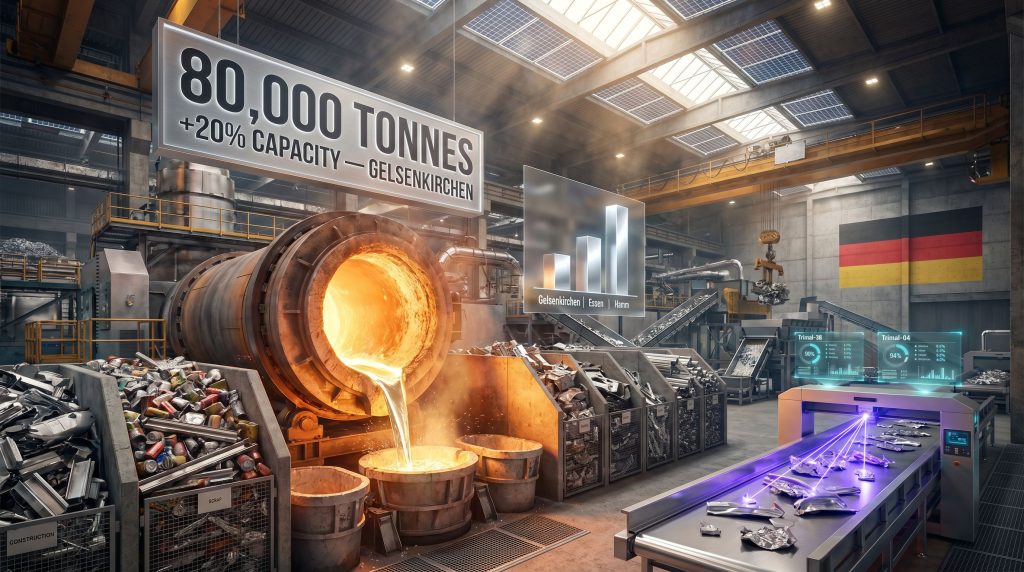
Germany sits at the epicentre of this transformation. Its dense industrial base, anchored by automotive manufacturing and mechanical engineering, generates both the demand pull and the scrap supply needed to sustain a world-class secondary aluminium ecosystem. It is within this context that Trimet expands German recycling capacity by 80,000 tonnes per annum, a milestone that deserves careful unpacking for what it reveals about the trajectory of European secondary aluminium production.
When big ASX news breaks, our subscribers know first
Germany's Position in the European Secondary Aluminium Market
Understanding why western Germany has become a concentration point for secondary aluminium investment requires stepping back from individual company decisions and examining the structural forces at work across the continent.
European automotive original equipment manufacturers are operating under intensifying Scope 3 emissions accountability frameworks, which means the carbon embedded in purchased materials now registers directly in their reported environmental performance. Aluminium, as one of the most energy-intensive materials in vehicle manufacturing, sits high on procurement decarbonisation priority lists. Consequently, automotive supply chain managers are increasingly specifying minimum recycled content thresholds in aluminium purchasing contracts, a requirement that simply did not exist at scale five years ago.
Simultaneously, the EU's Carbon Border Adjustment Mechanism creates financial incentives to reduce the embedded carbon intensity of aluminium processed and sold within European markets. Combined with circular economy legislation that progressively discourages primary material dependency, the regulatory environment is systematically favouring producers who have invested in secondary processing infrastructure. Furthermore, Europe's critical minerals supply chain pressures are accelerating this shift toward domestically processed secondary metal.
Germany's role within this landscape is not accidental. The country's automotive sector accounts for a disproportionate share of European aluminium demand, and its proximity to post-industrial and post-consumer scrap flows across western Europe provides feedstock access that few locations can match. Trimet's three-facility recycling cluster across Gelsenkirchen, Essen, and the forthcoming Hamm site represents a deliberate concentration of processing capability in this geographic sweet spot.
Breaking Down the Three-Site Investment Programme
Trimet's capacity expansion is not a single-site story. It involves coordinated investment across three distinct facilities, each serving a specific operational function within the broader recycling value chain.
| Facility | Investment Type | Capacity Impact | Timeline |
|---|---|---|---|
| Gelsenkirchen | New rotary furnace melting units | +80,000 tonnes per annum (~20% uplift) | Operational |
| Essen | Expanded scrap storage and alloy-specific separation | +16,000 tonnes | Completed |
| Hamm | Greenfield scrap sorting, processing and logistics | TBC | By end of 2026 |
The Gelsenkirchen Upgrade: Technical Depth
The most significant component of the programme is the installation of new rotary furnace melting units at the Gelsenkirchen plant. According to Trimet's official announcement, the new furnace is capable of processing up to 200 tonnes of aluminium scrap per day and carries a load capacity of approximately 40 tonnes per charge, replacing two of the three legacy furnaces previously operating at the site.
Rotary furnaces are particularly well-suited to processing heterogeneous aluminium scrap, including painted, coated, and contaminated materials that would be difficult to handle efficiently in other furnace configurations. Their rotating drum geometry improves thermal contact between the charge and the furnace atmosphere, supporting higher metal recovery rates and more consistent melt temperatures.
The Gelsenkirchen site also now incorporates rooftop solar panels that contribute electricity to facility operations, reducing grid dependency in a market environment where industrial electricity costs remain elevated. While solar generation alone cannot power heavy industrial melting operations, its integration signals a systematic approach to reducing the facility's overall energy cost base and carbon footprint.
Hydrogen-Rich Process Gas: What August 2026 Changes
From August 2026, Trimet's Gelsenkirchen melting furnaces will transition to operating on hydrogen-rich process gas. This is technically significant for reasons that go beyond regulatory compliance optics.
When hydrogen combusts, its primary byproduct is water vapour rather than carbon dioxide. In aluminium melting applications, substituting hydrogen-rich gas blends for conventional natural gas reduces the CO₂ intensity of the thermal input per tonne of metal produced. For Trimet's customers tracking Scope 3 emissions, this translates into measurable improvements in the carbon profile of purchased aluminium.
The shift to hydrogen-rich process gas at an operational industrial scale, rather than a pilot project, positions Gelsenkirchen as a meaningful early example of hydrogen fuel integration within European secondary aluminium processing. This is a technically demanding transition that most producers have not yet attempted at comparable throughput levels.
It is worth noting that hydrogen-rich gas blends, rather than pure hydrogen, present a more immediately practical pathway for existing furnace infrastructure. Pure hydrogen combustion requires modified burner configurations and safety systems. Blended process gas allows incremental transition while delivering measurable emissions reductions, which is exactly the kind of pragmatic decarbonisation pathway that industrial operators can implement at scale without replacing entire facility infrastructure.
The Hamm Facility: Scrap Intelligence as Competitive Advantage
The greenfield facility under development in Hamm represents arguably the most forward-looking component of Trimet's investment programme, because it addresses a constraint that has historically limited the quality ceiling of secondary aluminium production: the metallurgical uncertainty of incoming scrap.
Why Scrap Composition Matters More Than Most Realise
The aluminium scrap entering a remelting facility is rarely uniform. Post-consumer scrap in particular arrives as a mixture of different alloy families, each carrying different concentrations of alloying elements such as silicon, magnesium, copper, manganese, and zinc. When incompatible alloys are melted together, unwanted elements can accumulate in the melt, degrading the mechanical properties of the finished product and limiting what specifications it can meet.
Traditional scrap sorting relies on visual identification, manual sorting by trained operators, and basic handheld X-ray fluorescence spectrometry. These methods work reasonably well for large, clearly identifiable scrap pieces but struggle with mixed, fragmented, or heavily processed material streams where alloy identification from visual inspection alone is unreliable.
Laser-Based Analysis: A Step Change in Throughput and Precision
The Hamm facility will deploy laser-based analysis technology capable of rapidly determining the elemental composition of individual scrap pieces as they move through the processing line. This approach, related to laser-induced breakdown spectroscopy (LIBS) techniques, generates an elemental fingerprint of each piece in milliseconds, enabling real-time sorting decisions by alloy family before the material enters any remelting process.
The practical implications are significant:
- Contamination between incompatible alloy groups is substantially reduced, lowering the risk of off-specification melt chemistry
- The need for costly corrective alloying additions during remelting diminishes when input streams are better characterised
- Higher-value post-consumer scrap can be redirected toward higher-specification end uses rather than being downgraded to commodity remelt
- Traceability of scrap inputs improves, which is increasingly important for customers requiring verified recycled content documentation
Beyond its metallurgical function, the Hamm facility appears designed to serve as a regional scrap aggregation and pre-processing node, drawing in material from surrounding industrial catchments and preparing it for distribution to Trimet's remelting operations. This logistics dimension is strategically important: securing high-quality, pre-sorted scrap supply at scale is one of the most significant bottlenecks facing secondary aluminium producers as demand for recycled-content metal accelerates.
Essen Infrastructure Upgrades: The Underappreciated Role of Scrap Storage
The Essen facility upgrades have received less attention than the Gelsenkirchen furnace installation or the Hamm greenfield, but they address a genuinely important operational challenge that is often overlooked in discussions of recycling capacity.
Trimet has expanded storage areas at Essen to accommodate alloy-specific separation and segregated storage of incoming aluminium scrap, adding approximately 16,000 tonnes of additional scrap handling capacity. The logic behind dedicated alloy-segregated storage is straightforward but consequential.
When different alloy grades of scrap are stored together, commingling occurs, and once mixed at the storage stage, recovery of individual alloy streams becomes difficult or impossible without sophisticated sorting. By maintaining segregated inventories from the point of receipt, Trimet preserves the option to route specific scrap grades to the remelting processes for which they are best suited, rather than defaulting to lowest-common-denominator blended melts.
This upstream quality control discipline reduces the frequency and magnitude of corrective interventions needed during the melting process and improves batch-to-batch consistency in finished alloy properties, which is something that premium automotive customers require and will pay for. In addition, this approach mirrors investment philosophies seen elsewhere in the industry, such as Hydro's wire rod casthouse investments targeting energy efficiency and product quality simultaneously.
Trimet's Alloy Portfolio: Engineering Recycled Content Into Safety-Critical Applications
The infrastructure investments described above would have limited commercial impact without a complementary product development strategy capable of translating improved scrap quality into alloys that customers actually want to buy.
The Trimal-04 and Trimal-05 Transition
Trimet currently markets Trimal-04 as a high-pressure die-casting alloy formulated with elevated recycled content, positioning it as a lower-carbon alternative to Trimal-05, which is produced primarily from primary aluminium. This pairing strategy, offering recycled-content equivalents alongside primary-based products, is a practical approach to managing customer transition risk while building commercial momentum behind secondary material adoption.
Recycled Trimal-38: The Technical Frontier
The more ambitious development is a recycled-content variant of Trimal-38, an alloy used in battery housings, structural crash management components, and other automotive applications where energy absorption and controlled deformation under impact loading are critical performance requirements.
This is technically demanding for a specific reason. Crash performance in aluminium structural components depends on tightly controlled alloy composition and microstructure. Even modest deviations in the concentration of key alloying elements can alter deformation behaviour in ways that affect crash test outcomes. Secondary aluminium feedstocks, by their nature, carry more compositional variability than primary metal, which creates an engineering challenge in maintaining crash performance specifications batch after batch.
Trimet's approach involves targeted adjustments to alloy composition formulations to accommodate the variability inherent in secondary feedstocks while preserving the mechanical property thresholds required for automotive certification. Success in this area would represent a meaningful technical achievement with significant commercial implications:
- Electric vehicle battery enclosures are one of the fastest-growing demand categories for structural aluminium alloys in the automotive sector
- The ability to supply crash-certified battery housing alloys with verified high recycled content would directly support automotive OEM Scope 3 reduction targets
- It would potentially open Trimet to EV-specific supply contracts in a market segment where demand is growing rapidly and where low-carbon material credentials are becoming procurement prerequisites
The next major ASX story will hit our subscribers first
What This Investment Signals for the European Secondary Aluminium Market
Trimet's multi-site programme is not occurring in isolation. It reflects and reinforces several converging dynamics that are reshaping competitive positioning across European secondary aluminium production. For context, similar strategic thinking is evident in how Rio Tinto's Gladstone operations are being repositioned around lower-carbon energy inputs.
| Strategic Dimension | Trimet's Approach | Broader European Trend |
|---|---|---|
| Capacity growth mechanism | Furnace upgrades + greenfield development | Mix of brownfield expansions and acquisitions |
| Decarbonisation pathway | Hydrogen process gas + rooftop solar | Varied; electric furnaces, renewable PPAs, hydrogen pilots |
| Scrap quality management | Laser-based sorting at dedicated facility | Emerging adoption of sensor-based sorting technologies |
| Alloy portfolio strategy | Recycled-content variants of established alloys | Industry-wide push for drop-in secondary alloy specifications |
One dimension that deserves particular attention is the competitive pressure that improved scrap sorting capability creates at the industry level. As producers like Trimet invest in laser-based alloy identification and segregated scrap logistics, they gain access to higher-quality secondary feedstocks that competitors without equivalent infrastructure cannot readily access. Over time, this creates a two-tier market structure: producers with sophisticated scrap intelligence capabilities can serve premium, specification-sensitive customers, while those without them are increasingly constrained to commodity remelt markets where price competition is more intense and margins are thinner.
The energy economics also deserve emphasis. With primary aluminium smelting in Europe facing persistent cost pressure from elevated electricity prices, the ~95% energy consumption advantage of secondary remelting is not merely an environmental talking point. It is a durable cost structure advantage that makes well-invested secondary producers structurally more resilient across commodity price cycles than primary smelters operating in high-energy-cost jurisdictions. Furthermore, industry analysts tracking Alcoa's joint venture activity have noted similar patterns of capital rotating toward lower-energy-intensity processing assets.
As reported by Aluminium Today, Trimet's expansion programme is being closely watched across the European aluminium sector as a benchmark for how secondary producers can simultaneously grow capacity, improve scrap quality management, and advance decarbonisation objectives within a single coordinated investment cycle.
Key Figures at a Glance
- +80,000 tonnes per annum of new recycled aluminium melting capacity at Gelsenkirchen, representing approximately a 20% uplift at that facility
- 200 tonnes of scrap per day processing capability from the new rotary furnace installation
- ~40-tonne load capacity per charge on the new furnace
- +16,000 tonnes of additional scrap handling and storage capacity at Essen
- August 2026: Target date for hydrogen-rich process gas transition at Gelsenkirchen
- End of 2026: Target commissioning date for the Hamm greenfield facility
- ~95% lower energy consumption for secondary aluminium remelting versus primary smelting
Disclaimer: This article contains forward-looking statements regarding facility commissioning timelines, capacity targets, and technology transitions. These are based on publicly available company disclosures and industry analysis. Actual outcomes may differ from projections due to operational, regulatory, or market factors. This article does not constitute financial or investment advice.
Want to Track the ASX Companies Supplying the Materials Driving This Industrial Shift?
Discovery Alert's proprietary Discovery IQ model scans ASX announcements in real time, instantly identifying significant mineral discoveries — including the aluminium and critical minerals plays powering Europe's decarbonisation transition — and delivering actionable insights to subscribers before the broader market reacts. Explore historic discoveries and their returns on Discovery Alert's dedicated discoveries page, and begin your 14-day free trial to position yourself ahead of the next major find.