June 10, 2026
The Leverage Paradox: Why Venezuela Is Washington's Most Complicated Energy Bet
Global oil markets have spent years absorbing the consequences of concentrated supply in politically unstable regions. The structural vulnerability of routing roughly 20% of seaborne crude through the Strait of Hormuz has never been a secret, yet institutional inertia and short-term price cycles repeatedly delayed the diversification investments that could reduce that dependence. The escalation of US-Iran hostilities in 2026, culminating in the downing of a US Army Apache helicopter near the Omani coast on 9 June and subsequent retaliatory strikes, has transformed that theoretical vulnerability into a live market crisis. Against this backdrop, US defends Venezuelan oil achievements as both a foreign policy milestone and an energy security hedge. Understanding whether that positioning holds requires looking well beyond the export headline numbers.
When big ASX news breaks, our subscribers know first
Venezuela's Export Recovery: What the Tanker Data Actually Shows
Parsing the Seven-Year High
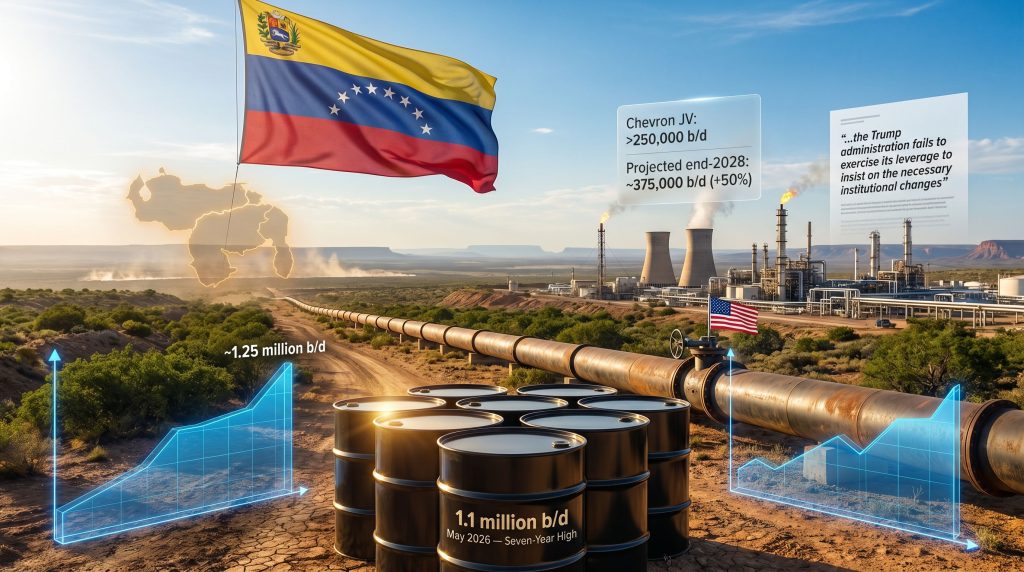
Venezuelan crude exports reached approximately 1.25 million barrels per day (b/d) in the weeks commencing 18 and 25 May 2026, according to Kpler shipping data. On a full-month average basis, May 2026 exports came in at roughly 1.1 million b/d — the highest monthly reading since February 2019. These figures represent a statistically significant inflection in a production story that had been defined for years by persistent decline.
US envoy to Venezuela John Barrett publicly attributed this recovery to ongoing American operational engagement with the interim government led by acting President Delcy Rodriguez. Assistant Secretary of State Caleb Orr, speaking at the Atlantic Council's Global Energy Forum in Washington on 9 June 2026, characterised Venezuela as a standout achievement of US foreign policy under the current administration.
Understanding the Structural Context Behind the Numbers
Placing the export recovery in historical context is essential for accurate interpretation. Furthermore, the Venezuela power crisis has added another layer of complexity to the country's operational challenges:
- Venezuelan crude output peaked at over 3 million b/d in the late 1990s before entering a prolonged decline
- By the height of the Maduro era, production had fallen to near-record lows, erasing decades of petroleum industry development
- Infrastructure deterioration, chronic underinvestment, and a fragile national electricity grid compounded the operational challenges
- Chevron, the only major US producer to maintain Venezuelan operations throughout the sanctions period, has expanded joint venture output from approximately 50,000 b/d historically to more than 250,000 b/d in recent years
A Chevron representative disclosed in May 2026 that a single grid failure event has the capacity to simultaneously knock out as many as 40 production wells — a detail that illustrates how physically fragile the current recovery remains, regardless of the directional improvement in export volumes.
The Sanctions Architecture: How the Framework Actually Functions
General Licenses vs. Full Sanctions Removal
A critical distinction that often gets lost in policy commentary is the difference between the Treasury's January 2026 general license framework and an outright lifting of sanctions. These are materially different legal and commercial instruments. The US policy on PDVSA has been central to shaping how this framework was designed and implemented:
| Feature | General License Framework | Full Sanctions Removal |
|---|---|---|
| Commercial oil activities permitted | Yes (lifting, refining, transport, sale) | Yes |
| Targeted individual/entity restrictions | Remain in force | Removed |
| Revenue routing control | US-administered accounts | Open market |
| Reversibility | High (executive action) | Requires legislative process |
| Political conditionality | Embedded | Absent |
The revenue routing mechanism deserves particular attention from an analytical standpoint. Venezuelan crude proceeds are reportedly channelled through US-controlled accounts, giving Washington simultaneous financial oversight and a credible economic coercion instrument. This architecture was deliberately designed to function as an incentive structure rather than a simple commercial concession.
The Orinoco Belt: Venezuela's Heavy Oil Identity
Venezuela's petroleum geology is dominated by the Orinoco Heavy Oil Belt, one of the largest accumulations of extra-heavy crude on the planet. This is not conventional light crude — Orinoco production is characterised by high viscosity, high sulphur content, and API gravities typically ranging from 8° to 16° API, requiring either upgrading facilities (known as upgraders or mejoradores) or blending with lighter diluents before it can be transported or refined.
This geological reality has direct investment implications:
- Processing extra-heavy Orinoco crude demands specialised refinery configurations, particularly coking and hydrocracking capacity
- Canadian operators have developed analogous expertise processing Alberta oil sands bitumen, which is why ExxonMobil's chief executive Darren Woods specifically referenced the applicability of the company's Canadian heavy-oil operational knowledge to Venezuela
- Chevron's strategic decision to trade gas interests in exchange for expanded heavy crude acreage in the Orinoco Belt signals a deliberate long-term positioning play, not an opportunistic short-term move
Chevron's Venezuelan joint venture production is projected to increase by a further 50% by end-2028, potentially approaching 375,000 b/d from its current base.
The Investment Case: Strengthening, But Not Yet Decisive
Why the Major US Producers Are Still Waiting
The contrast between Chevron's expanded commitment and the cautious posture of ExxonMobil and ConocoPhillips reflects fundamentally different risk tolerance profiles and legacy legal entanglements:
ExxonMobil's stated prerequisites:
- Contractual clarity and enforceable legal protections against asset seizure
- Application of Canadian heavy-oil expertise as a technical bridge
- Sufficient price environment to justify capital-intensive heavy crude development
ConocoPhillips' stated prerequisites:
- Economic and policy stability as baseline conditions
- Rule of law and market competitiveness benchmarks
- Debt recovery mechanisms addressing outstanding obligations owed by the Venezuelan state
Research published by Rice University's Center for Energy Studies underscores the evolving calculus: as geopolitical oil prices trade near $100/bl and global supply tightens due to Middle East conflict, the relative attractiveness of Venezuela as an investment destination is materially improving compared to the start of 2026. The argument runs that the longer supply disruptions persist, the more compelling Venezuela's potential output growth becomes for US producers seeking reserve replacement.
Early-mover advantage is already being captured by smaller US independents. Companies including Hunt Oil and Crossover Energy have signed commercial agreements in Caracas, positioning themselves ahead of any wave of larger capital commitments.
Comparative Investment Environment
| Factor | Venezuela (2026) | Canada Oil Sands | Other Latin America |
|---|---|---|---|
| Fiscal regime competitiveness | Improving (revised hydrocarbons law) | Established and predictable | Varies significantly |
| Infrastructure condition | Severely degraded | Mature and operational | Mixed |
| Political risk | Elevated (transition period) | Low | Moderate |
| US policy alignment | High (active engagement) | High (USMCA partner) | Moderate |
| Time to material production uplift | 3 to 5+ years | Near-term expansions possible | Project-dependent |
Venezuela has revised its hydrocarbons law to create a more competitive royalty and tax framework. However, as Chevron's chief executive Mike Wirth noted in June 2026, individual deal terms for taxes and royalties are still negotiated on a case-by-case basis, creating residual uncertainty that complicates capital allocation decisions within diversified corporate portfolios.
The Democratic Governance Deficit: Washington's Accountability Problem
What the Congressional Critics Are Actually Arguing
The Trump administration's framing of US defends Venezuelan oil achievements is being directly contested on Capitol Hill, and the critics' argument is structurally more sophisticated than a simple partisanship divide.
In a formal letter dated 8 June 2026 to Secretary of State Marco Rubio, House Foreign Affairs Committee Ranking Member Gregory Meeks (D-NY) and Senate Foreign Relations Committee Ranking Member Jeanne Shaheen (D-NH) outlined a leverage-maximisation argument: the administration possesses significant economic and political tools to demand democratic institutional reforms, but risks squandering that window by allowing the current governance status quo to persist without attaching meaningful conditionality to its continued support. For further context, the Council on Foreign Relations has examined where Venezuela's oil revenues have actually gone under US oversight arrangements.
The Governance Scorecard
| Governance Dimension | Current Status (June 2026) |
|---|---|
| Executive authority | Acting President Delcy Rodriguez (former VP under Maduro) |
| Electoral timeline | Not established |
| Political prisoners | 473 individuals still detained |
| US recognition of Maduro | Withheld; removed from power 3 January 2026 |
| Regime personnel continuity | Described by Congressional critics as substantially Maduro-era |
The 473 documented political prisoners represent the sharpest accountability flashpoint in the current framework. Families of detainees conducted demonstrations outside the US Embassy in Caracas, and US officials committed to individual consultations on specific cases — a response that critics characterise as procedurally adequate but strategically insufficient.
The core tension is whether the administration's engagement strategy front-loads commercial benefits while deferring political conditionality, or whether it is deliberately sequencing incentives to build reform constituencies within Venezuela's governing structure. Neither interpretation is yet definitively supported by observable outcomes.
Iran, the Strait of Hormuz, and Venezuela's Strategic Positioning
Why the Middle East Conflict Context Matters
The geopolitical backdrop to the narrative that US defends Venezuelan oil achievements cannot be analysed in isolation from concurrent events. On 8 June 2026, Iran suspended ballistic missile operations against Israel, causing Brent crude to pull back from an intraday high above $98/bl to trade around $94/bl. The following day, an Iranian attack downed a US military helicopter near the Strait of Hormuz, triggering retaliatory US strikes and renewed supply disruption concerns. Consequently, the resulting oil price rally has intensified scrutiny of alternative supply sources.
Market Context: The Strait of Hormuz functions as the world's most consequential energy chokepoint. Approximately 20% of global oil trade transits this narrow passage. Sustained disruption to Iranian and broader Gulf energy flows creates structural demand for alternative heavy crude sources, particularly those within US-aligned supply networks.
The administration's Venezuela narrative is being actively deployed as a counterpoint to Congressional criticism of the Iran policy — essentially presenting hemispheric energy gains as partial compensation for Middle Eastern supply disruptions. This dual-use political framing is strategically coherent but analytically separable: Venezuela's medium-term production potential does not offset acute near-term Gulf supply shocks.
Why Venezuela Cannot Be a Rapid-Response Supply Buffer
This distinction matters significantly for market participants. In addition, the broader trade war oil markets dynamic has further complicated supply-demand forecasting across the sector:
-
Capital lead times are measured in years, not months. Rehabilitating Venezuela's degraded upstream infrastructure requires sustained investment flows before meaningful incremental barrels reach export terminals.
-
Electricity grid vulnerability creates operational fragility that cannot be resolved quickly. The exposure of up to 40 production wells per grid outage event is a systemic risk, not a manageable operational fluctuation.
-
Refinery compatibility issues affect Venezuelan heavy crude's addressable market. Extra-heavy Orinoco crude requires specific processing configurations that limit the range of refineries capable of handling it efficiently.
-
Price sensitivity of the investment case introduces scenario dependency. Capital decisions calibrated to ~$100/bl oil carry significant downside exposure if Middle East tensions de-escalate faster than anticipated.
The next major ASX story will hit our subscribers first
Scenario Analysis: Three Pathways for Venezuela's Oil Future
The sustainability of the current US-Venezuela engagement framework is not binary. Three distinct scenarios shape the range of plausible outcomes. Columbia University's Energy Policy programme has also analysed US actions in Venezuela and the conditions required for each pathway to materialise:
-
Scenario A: Democratic Progress Validates the Framework. The Rodriguez administration establishes a credible electoral timeline, releases a material portion of political prisoners, and US investment expands beyond Chevron to include at least one additional major integrated producer. This pathway validates the conditional engagement approach and reduces Congressional pressure for sanctions reimposition.
-
Scenario B: Governance Stagnation Erodes Political Support. Without measurable democratic reform progress, bipartisan Congressional pressure intensifies and the administration's ability to sustain the current commercial framework weakens. The 473 political prisoners become a recurring legislative flashpoint.
-
Scenario C: Price Collapse Removes the Investment Rationale. A rapid de-escalation of Middle East conflict significantly reduces oil prices, undermining the economic case for capital-intensive Venezuelan heavy oil development and freezing the investment decisions of larger US operators.
Key Data Reference: Venezuela Oil Policy at a Glance
| Metric | Value or Status |
|---|---|
| Venezuelan crude exports, May 2026 monthly average | ~1.1 million b/d |
| Peak weekly export rate, May 2026 | ~1.25 million b/d |
| Last comparable export level | February 2019 |
| Chevron JV production, current | Over 250,000 b/d |
| Chevron JV production, projected end-2028 | ~375,000 b/d (+50%) |
| Political prisoners remaining | 473 |
| Electoral timeline status | Not established |
| Brent crude price context, early June 2026 | ~$94 to $100/bl range |
| Wells at risk per single grid outage | Up to 40 |
FAQ: US Venezuela Oil Policy Explained
What is driving the recent surge in Venezuelan crude exports?
The combination of active US operational engagement with the interim government, expanded Chevron joint venture activity in the Orinoco Belt, and the conditional commercial permissions established through Treasury's January 2026 general license framework has collectively lifted monthly average exports to approximately 1.1 million b/d in May 2026, the highest since early 2019.
Why are ExxonMobil and ConocoPhillips not yet committing capital?
Both companies are conditioning investment on factors including contractual certainty, enforceable legal protections, competitive fiscal terms, and in ConocoPhillips' case, mechanisms to recover outstanding debts owed by the Venezuelan state. The scale of infrastructure rehabilitation required makes the bar for capital commitment correspondingly high.
What is the significance of Venezuela's hydrocarbons law revision?
The revised law moves toward a more competitive royalty and tax structure, but individual deal terms are still negotiated separately for each project. This deal-by-deal variability introduces uncertainty that complicates portfolio-level capital allocation decisions for large integrated producers.
Can Venezuelan production offset Middle East supply disruptions?
Not in the short term. Infrastructure rehabilitation timelines, electricity grid fragility, and the capital investment required mean any meaningful incremental production gains from Venezuela are a multi-year proposition, not a rapid-response mechanism for acute supply shocks.
Disclaimer: This article is intended for informational purposes only and does not constitute financial or investment advice. Forecasts, projections, and scenario analyses involve inherent uncertainty. Readers should conduct independent due diligence before making any investment or commercial decisions based on information contained herein. Market data references reflect conditions as reported in early June 2026 and are subject to change.
Want to Track the Next Major Commodity Opportunity Before the Market Does?
As geopolitical tensions reshape global energy supply chains and commodity markets respond in real time, Discovery Alert's proprietary Discovery IQ model instantly notifies subscribers of significant ASX mineral discoveries — turning complex market signals into clear, actionable opportunities. Explore how historic mineral discoveries have generated extraordinary returns or start your 14-day free trial today to position yourself ahead of the broader market.