
June 30, 2026
When a Pipeline Becomes a Lifeline: The Architecture of Iraq's Export Crisis
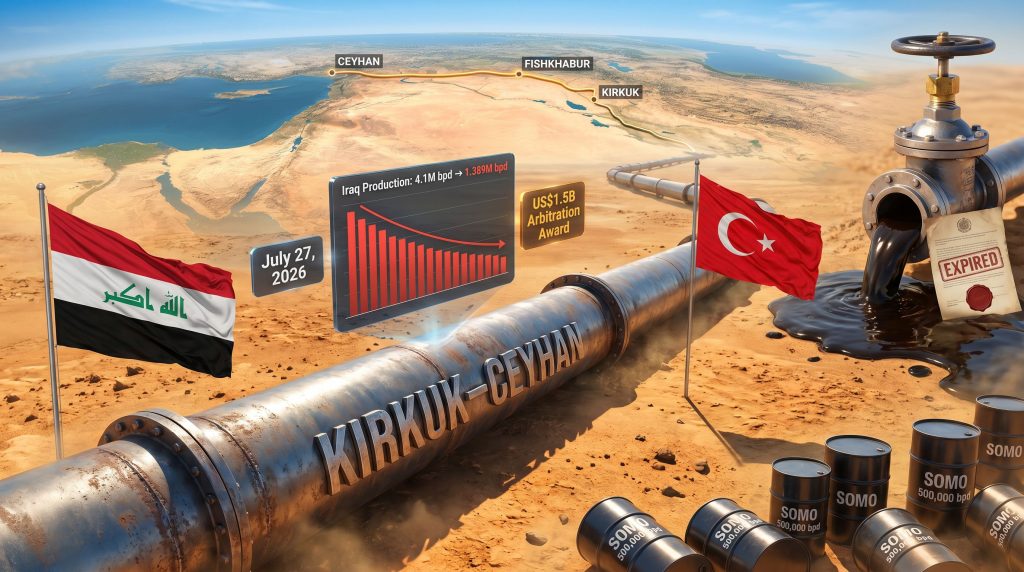
Energy infrastructure rarely commands public attention until it fails. For decades, the network of pipelines threading through northern Iraq and into Turkey's Mediterranean coast operated as a background utility, relevant mainly to traders, engineers, and diplomats. That quiet has ended. With a treaty deadline of July 27, 2026 approaching and Iraq's primary export route through the Strait of Hormuz effectively severed since late February, the Iraq oil pipeline agreement with Turkey has transformed from a routine bilateral arrangement into the single most consequential energy negotiation of the year.
Understanding what is at stake requires stepping back from the immediate politics and examining how the system actually works, why it broke down, and what the competing actors in this crisis genuinely want.
When big ASX news breaks, our subscribers know first
The Pipeline System at the Centre of the Crisis
The Iraq-Turkey Pipeline, historically known as the Kirkuk-Ceyhan Pipeline, is not a single pipe but a dual-line system built across decades of development and repair. Its specifications reveal both its potential and its fragility:
| Pipeline Component | Diameter | Nameplate Capacity | Operational Reality |
|---|---|---|---|
| ITP Pipe 1 | 46-inch (1,168 mm) | 1.1 million bpd | 250,000–400,000 bpd under normal conditions |
| ITP Pipe 2 | 40-inch (1,016 mm) | 500,000 bpd | Supplementary; under rehabilitation |
| KRG Pipeline (Taq Taq–Fishkhabur) | Single track | Up to 1 million bpd (expanded from 700,000 bpd) | Active but treaty-constrained |
| Kirkuk-Nineveh Segment (new federal) | N/A | 350,000 bpd design | Under construction/commissioning |
The gap between nameplate capacity and real-world throughput is itself a story. Even before Islamic State's emergence disrupted northern Iraq from 2014 onward, the pipeline was subject to recurring attacks from Sunni militant groups operating across the Salahaddin and Nineveh provinces. The result was that a system theoretically capable of moving 1.6 million bpd routinely delivered a fraction of that volume.
Why the 1973 Agreement Matters So Much
A critical but underappreciated detail: both the Federal Government of Iraq (FGI) pipeline system and the Kurdistan Regional Government's (KRG) separate single-track route through Khurmala to Fishkhabur fall under the same 1973 Crude Oil Pipeline Agreement with Turkey. This means both pipelines face simultaneous termination on the same date unless Baghdad and Ankara reach a new arrangement.
Both federal and Kurdish pipeline flows converge at the Fishkhabur border terminal, making it the fulcrum of Iraq's entire northern export architecture. The loss of this single junction point under treaty termination would collapse both systems at once.
How the 2023 Arbitration Ruling Set This Crisis in Motion
The origins of the current impasse trace back not to 2026 or even 2025, but to a 2023 legal decision whose consequences have compounded steadily ever since.
In March 2023, an international arbitration court found that Turkey had breached the 1973 pipeline agreement by allowing the KRG to export oil independently of Baghdad's federal State Organisation for Marketing of Oil (SOMO). The ruling awarded Iraq approximately US$1.5 billion in damages.
The context for this dispute runs deeper than a simple contract breach. A 2014 arrangement between the FGI and the KRG had established a revenue-sharing structure in which the KRG committed to routing approximately 550,000 bpd of oil through SOMO. In exchange, the KRG received roughly 17% of central budget revenues monthly. Baghdad's opposition to independent Kurdish oil sales was not merely procedural.
The fear was explicit: that independent export revenues would fund the KRG's long-term push toward full political separation from Iraq.
How Turkey Triggered the Deadline
Turkey's response to the arbitration ruling was to trigger a contractual termination clause in July 2025, providing a mandatory one-year notice period. This created the July 27, 2026 deadline. Critically, energy analysts and those close to Iraq's Oil Ministry have noted that Turkey's use of a one-year notice window rather than immediate closure reflects a deliberate negotiating strategy. Ankara is not seeking the pipeline's death. It is seeking maximum concessions from a counterpart whose options have narrowed dramatically. Furthermore, why Turkey plans to end its 52-year oil pipeline deal with Iraq signals Ankara's intent to reshape the relationship on its own terms.
The Hormuz Closure: Turning a Dispute Into an Emergency
Prior to the Strait of Hormuz closure on February 28, 2026, the Iraq oil pipeline agreement with Turkey was important but not existential. Approximately 95% of Iraq's crude exports moved through the Hormuz chokepoint toward Asian buyers, with China as the dominant destination. The ITP served as a supplementary northern route, already idled since 2023.
The Hormuz blockade changed everything. Iraq's domestic storage infrastructure filled rapidly, forcing production shutdowns across major fields. The consequences extend beyond the immediate revenue loss:
- Reservoir pressure depletion from prolonged well shutdowns reduces a field's long-term recoverable reserves
- Water infiltration into depressurised reservoirs causes permanent formation damage
- Infrastructure corrosion during idle periods degrades wellheads, pipelines, and processing equipment
- Once pressure is lost from a reservoir, restoring original production rates is often impossible without costly intervention
The Scale of Iraq's Production Collapse
The scale of the production collapse is stark. Iraq was producing over 4.1 million bpd in the three months leading up to the Hormuz closure. By April 2026, output had fallen to an average of 1.389 million bpd, a reduction of approximately 2.7 million bpd. The last time Iraq's production fell to comparable levels was immediately following the 2003 U.S.-led invasion, a benchmark that contextualises just how severe the current disruption has become.
Baghdad's emergency response has centred on overland trucking. Reaching approximately 500 trucks per day, each carrying between 200 and 250 barrels, the operation generates roughly 100,000 to 125,000 bpd of export volume. Against a national budget that has historically derived over 90% of its revenues from oil, this is structurally incapable of preventing fiscal deterioration.
If the ITP agreement lapses on July 27, 2026, and the Hormuz blockade remains unresolved, Iraq's only functioning export mechanism becomes overland trucking. That system cannot generate the revenue necessary to sustain government operations, creating conditions for a cascading fiscal and social crisis within a compressed timeframe.
What Turkey Is Demanding: A Multi-Layered Concession Framework
Reports from sources with direct knowledge of Iraq's Oil Ministry negotiations indicate that Turkey's demands span several distinct categories, each designed to extract long-term structural advantage rather than a single transaction:
Financial Offsets
- Full offset or cancellation of the US$1.5 billion arbitration judgment through in-kind energy arrangements rather than cash payment
- Effective forgiveness of a debt Turkey technically still owes Baghdad, reframed as a negotiating chip
Transit Fee Restructuring
- Existing tariff rates stand at US$1.00 per barrel (one pipeline) and US$1.25 per barrel (second pipeline)
- Turkey is demanding a substantial increase above these benchmarks
- Minimum daily volume commitments in the hundreds of thousands of barrels per day
- Penalty clauses imposing one-for-one fines if Iraq fails to meet committed volumes
Multi-Sector Joint Ventures
- Partnerships spanning oil, gas, petrochemicals, and electricity generation
- Investment obligations structured to place the financial burden primarily on Iraq
- Designed to create durable Turkish leverage over Iraqi energy infrastructure for decades
The Strategic Development Road Project
- Turkey is pushing for Iraq's formal commitment to the US$17 billion Strategic Development Road Project
- This corridor links Iraq's deepwater Al Faw Grand Port in Basra through major oil and gas fields northward to Fishkhabur, then onward via road and rail into Europe
- Al Faw Grand Port, under construction with Chinese involvement, is anticipated to become a flagship Persian Gulf export hub
- The Development Road backlinks eastward to China's Belt and Road Initiative, creating a Eurasian connectivity corridor that serves Beijing's long-term trade architecture
Baghdad's Infrastructure Response: The Kirkuk-Nineveh Pipeline
Regardless of how the Turkey negotiations resolve, Iraq's Oil Ministry has pressed ahead with the rehabilitation of its northern federal pipeline infrastructure. The Kirkuk-to-Nineveh pipeline segment represents the most significant immediate development:
- Route: Kirkuk K1 field through Salahaddin Province into Nineveh Province (near Mosul), connecting to the Fishkhabur border terminal
- Design capacity: 350,000 bpd, sized to allow phased commissioning without stress-testing the full 1.6 million bpd nameplate of the older system
- Initial trial target: 150,000 to 250,000 bpd of Kirkuk crude
The strategic logic of this segment is as much political as technical. By routing oil through federal territory rather than KRG-controlled areas, Baghdad is constructing infrastructure that explicitly does not depend on Erbil's cooperation. The longer-term plan integrates a southern Basra-to-Haditha corridor, which upon completion would connect Persian Gulf production directly to the Fishkhabur terminal, creating an end-to-end federal pipeline spine from the Gulf to Turkey's Mediterranean coast. However, analysts have cautioned that Iraq's new pipeline ambitions face formidable technical and political obstacles before they can become a reality.
The next major ASX story will hit our subscribers first
Geopolitical Alignment: Who Stands Behind Each Actor
The pipeline negotiation does not exist in isolation from broader great-power competition. Indeed, the wider geopolitical landscape is reshaping energy relationships across the region. Each of the three primary actors carries the weight of external backers whose interests do not necessarily align with a quick resolution:
| Actor | Primary External Backers | Core Interest |
|---|---|---|
| FGI (Baghdad) | China, Russia | Maximise federal oil revenues; assert sovereignty over Kurdish exports |
| KRG (Erbil) | Western governments, United States | Maintain independent export capacity; protect fiscal autonomy |
| Turkey (Ankara) | Self-interest first; NATO nominally | Extract maximum concessions; advance infrastructure connectivity |
Turkey's positioning within this matrix is genuinely complex. As a NATO member, it maintains formal alignment with Western policy while routinely acting in ways that serve its own strategic calculus. The purchase of Russian S-400 missile defence systems resulted in Turkey's expulsion from the F-35 programme. Turkey also used its NATO veto as active leverage during the Finland and Sweden accession negotiations before ultimately permitting their membership.
Ankara's indispensability to the alliance rests on its control of the Bosphorus and Dardanelles, the sole maritime exit for Russia's Black Sea fleet, a position that grants Turkey structural immunity from the most severe consequences of defiance.
China's interest in the outcome extends beyond oil supply. The convergence of the Strategic Development Road Project with Belt and Road infrastructure means that a comprehensive Turkey-Iraq energy agreement incorporating the Development Road would directly advance Beijing's Eurasian connectivity goals. Consequently, this creates a scenario where Turkey's self-interest and China's long-term infrastructure ambitions point toward the same outcome — one that may sit uncomfortably with Western policy preferences given the KRG's traditional alignment with Washington. These geopolitical trade tensions are increasingly reshaping how energy agreements are structured globally.
Scenario Mapping: Four Pathways to July 27, 2026
Scenario 1: Full Renewal with Turkish Concessions Accepted
Iraq agrees to elevated transit tariffs, volume commitments, joint venture obligations, and arbitration debt restructuring. Pipeline resumes at 150,000 to 350,000 bpd initially. The primary driver here is Baghdad's fiscal desperation combined with the absence of viable alternatives.
Scenario 2: Provisional Extension with Negotiations Continuing
A short-term technical extension beyond July 27 preserves interim flows of 180,000 to 230,000 bpd under a preliminary framework while core disputes over tariff levels and volume penalties remain unresolved. Neither party benefits from a hard stop, giving this scenario meaningful probability.
Scenario 3: Treaty Lapses, Emergency Measures Escalate
No deal is reached. Iraq accelerates the Kirkuk-Nineveh commissioning and expands overland trucking while international pressure mounts on Ankara. Fiscal conditions in Baghdad deteriorate significantly within weeks.
Scenario 4: Comprehensive Strategic Partnership Including Development Road
A full multi-sector agreement incorporating oil, gas, petrochemicals, electricity, and the US$17 billion Development Road is formalised. Pipeline capacity scales toward the full nameplate over a multi-year horizon. China and Turkey's converging Belt and Road interests provide the structural logic for this outcome.
Broader Market Implications: Supply Risk and Price Dynamics
Iraq's production collapse carries systemic significance beyond its own borders. As OPEC+'s second-largest producer, a sustained reduction from 4.1 million bpd to below 1.4 million bpd removes approximately 2.7 million bpd from global supply at precisely the moment that Iranian exports, Hormuz transit volumes, and other Middle Eastern flows are simultaneously compressed. OPEC's market influence in managing these disruptions will be closely watched by traders and policymakers alike.
Reservoir damage risk compounds the medium-term picture. Prolonged production shutdowns create the possibility that some of Iraq's field output cannot be fully restored even after political and infrastructure conditions normalise. Iraq's reservoir management history includes pre-existing vulnerabilities — including ageing infrastructure and prior production interruptions — that may amplify the impact of the current shutdown.
Furthermore, an oil price rally driven by these supply-side shocks could have far-reaching consequences for global inflation and monetary policy. If July 27 passes without a resolution to the Iraq oil pipeline agreement with Turkey, and the Hormuz situation remains unresolved, global oil markets would face the simultaneous loss of multiple major supply sources with no near-term replacement pathway.
The resulting oil price movements in such a scenario could represent one of the most significant structural supply-side compressions in recent decades — a risk that remains, arguably, underpriced in energy markets today.
Disclaimer: This article is intended for informational and educational purposes only. It does not constitute financial, investment, or legal advice. Forecasts, scenarios, and market projections involve inherent uncertainty and should not be relied upon as the basis for investment decisions. Readers should conduct their own due diligence and consult qualified advisers before making any investment decisions related to energy markets or geopolitical risk.
Want to Position Yourself Ahead of the Next Major Resource Discovery?
While geopolitical disruptions reshape global energy supply chains, Discovery Alert's proprietary Discovery IQ model scans ASX announcements in real time, instantly identifying significant mineral discoveries and translating complex data into actionable investment insights — explore Discovery Alert's dedicated discoveries page to see how historic finds have generated substantial returns, and begin your 14-day free trial today to secure a market-leading edge.