July 30, 2026
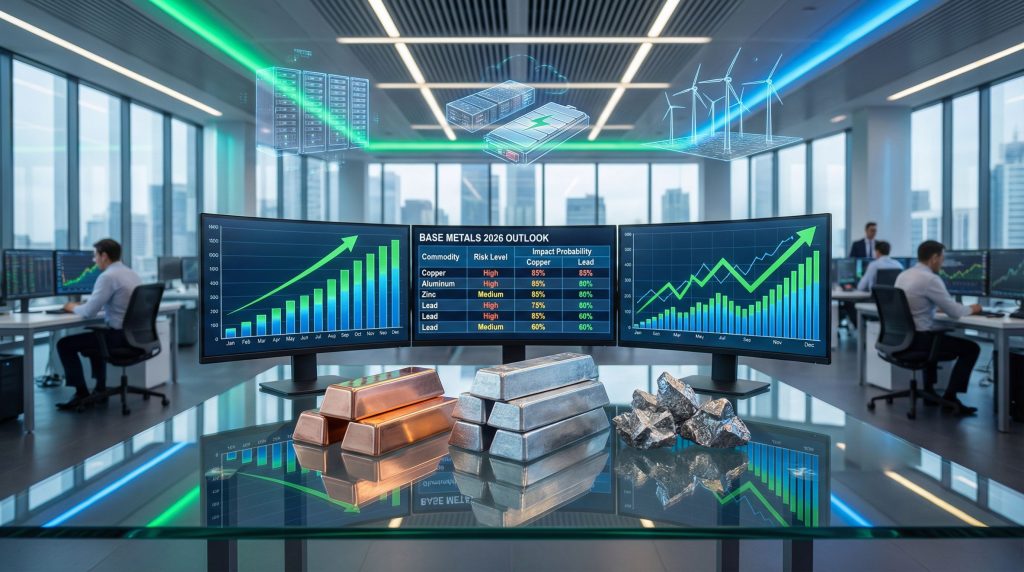
The base metals outlook 2026 presents unprecedented market dynamics as traditional cyclical patterns intersect with structural demand transformation from artificial intelligence infrastructure, electrification acceleration, and supply chain vulnerabilities. Understanding these converging forces becomes essential for navigating investment opportunities that transcend conventional economic cycles.
The current market environment demonstrates how emerging demand drivers maintain pricing strength even during broader macroeconomic weakness. This paradox challenges traditional forecasting models and requires strategic scenario planning that incorporates both cyclical recovery timing and structural demand permanence.
Industrial Recovery Patterns Signal Strategic Inflection Points
Manufacturing sector trajectories across major economies reveal divergent recovery patterns that will determine base metals demand intensity through 2026. Manufacturing PMI readings below 50 across major economies in November 2025 indicate contraction, yet metal markets demonstrate remarkable resilience through structural demand drivers operating independently of traditional cyclical indicators.
The disconnect between manufacturing weakness and metals strength reflects fundamental shifts in demand composition. Most base metals trended upward through 2025 following April's market correction, with copper reaching record highs and tin achieving multi-year peaks by November 2025. This performance occurred despite subdued global economic conditions, suggesting that traditional leading indicators may inadequately capture emerging demand structures.
Technology infrastructure investment creates distinct demand cycles that persist through broader economic weakness. Data center construction for artificial intelligence applications, renewable energy integration, and defence spending generate metal consumption patterns that operate independently from traditional manufacturing activity. These demand sources demonstrate lower sensitivity to interest rate cycles and economic downturns, providing structural price support during periods of manufacturing contraction.
Regional Manufacturing Divergence Creates Arbitrage Opportunities
North American manufacturing recovery timing differs significantly from European and Asian patterns, creating regional pricing differentials and trade flow opportunities. The Federal Reserve's monetary policy accommodation, including expected rate cuts at the December 10, 2025 meeting, supports commodity market liquidity whilst European Central Bank policy creates different regional demand dynamics for construction and automotive metals applications.
Manufacturing recovery catalysts include inventory restocking cycles, fiscal stimulus deployment, and monetary policy transmission. However, the magnitude and timing of these traditional drivers may prove less significant than structural demand from technology sector capital expenditure and electrification investments.
When big ASX news breaks, our subscribers know first
Central Banking Coordination Influences Commodity Capital Flows
Monetary policy accommodation creates structural support for industrial metals investment as central banks globally shift toward expansionary policies. Markets are pricing in additional Federal Reserve rate cuts as 2026 approaches, enhancing liquidity conditions that favour commodity assets and industrial materials positioning.
Rate reduction cycles historically correlate with commodity price strength through multiple transmission mechanisms. Lower discount rates enhance the present value of future commodity demand, whilst reduced carrying costs support physical inventory accumulation. Expectations of further interest rate cuts and policy support represent key bullish drivers sustaining copper price strength and broader base metals momentum.
The coordination between Federal Reserve and European Central Bank policies creates spillover effects across regional metal demand patterns. Divergent monetary policy timing between major economies influences currency relationships, trade flows, and regional pricing dynamics for aluminium and copper in construction and automotive applications.
Liquidity Transmission Through Commodity Indices
Institutional capital allocation toward commodity indices accelerates during accommodative monetary cycles. Intense investor and speculative engagement in copper markets demonstrates how monetary policy creates favourable conditions for commodity investment, independent of immediate supply-demand fundamentals.
Commodity indices benefit from portfolio rebalancing as fixed income yields decline and equity market volatility increases. This financial demand layer operates alongside industrial consumption, creating price dynamics that may exceed levels justified purely by physical market conditions.
Chinese Economic Rebalancing Creates Bidirectional Metal Demand Uncertainty
China's structural economic transition generates conflicting signals for base metals consumption as the economy shifts from property-led growth toward manufacturing and technology sectors. Economic growth is slowing with property sector weakness, soft labour markets, and low household confidence, creating uncertainty about incremental metal demand from traditional infrastructure investment.
The Chinese economy faces deflationary pressures and overcapacity challenges that government stimulus efforts have not yet reversed. This situation presents potential for either further demand weakness or recovery should more stimulus measures be implemented, creating significant uncertainty for global metal markets heavily dependent on Chinese consumption patterns.
Aluminium Supply Constraints Override Demand Uncertainty
Despite broader economic challenges, Chinese aluminium markets demonstrate widening demand-supply divergence that reinforces constructive medium-term price outlooks. Primary aluminium capacity ceilings continue to anchor supply growth, preventing meaningful expansion even as power conditions normalise in key producing provinces.
Aluminium demand sources remain robust across multiple sectors. Automotive output rises supported by strong new-energy vehicle production, solar value-chain investment sustains healthy consumption of industrial extrusion, and accelerated grid spending bolsters demand for conductor materials. This demand diversity provides resilience against property sector weakness.
Aluminium was the third strongest performing base metal in 2025, approaching $3,000 per tonne by early December as supply constraints began dominating market narratives. The capacity ceiling mechanism prevents rapid supply responses to higher prices, creating structural support for sustained price levels.
Regional Metal Flow Imbalances Persist
Chinese zinc production demonstrates how regional surpluses cannot easily rebalance global markets due to logistical constraints. Chinese zinc exports hit three-year highs in October 2025, but slim margins and logistical challenges act as bottlenecks limiting rebalancing speed despite significant production surplus.
This regional imbalance pattern creates arbitrage opportunities constrained by physical logistics rather than pricing mechanisms. The inability to rapidly export surplus production suggests that global market rebalancing may occur through production adjustments rather than trade flow optimisation.
Supply Chain Vulnerabilities Amplify Price Discovery Across Multiple Metals
Mining infrastructure faces simultaneous risks across geopolitical, environmental, and labour dimensions that create correlated supply disruptions. Copper and tin supply disruptions drove record prices by end-November 2025, whilst disruption concerns increasingly dominate aluminium's narrative, indicating sector-wide vulnerability rather than isolated project issues.
The pattern of simultaneous supply concerns across multiple metals suggests systemic infrastructure vulnerabilities. Environmental regulations, geopolitical tensions, and labour disputes create operational risks that can constrain production capacity across multiple metals simultaneously, amplifying price volatility during supply-demand imbalances.
Furthermore, the critical minerals supply chain faces unprecedented scrutiny as governments recognise the strategic importance of mineral security. This heightened awareness drives policy changes that could reshape global supply patterns through 2026.
Critical Mineral Production Geography
Regional production concentration creates systematic vulnerability to geopolitical disruptions and natural disasters. The concentration of copper production in Chile, Peru, and the Democratic Republic of Congo exposes global supply chains to country-specific risks including regulatory changes, political instability, and infrastructure failures.
Supply Concentration Risk Assessment:
| Metal | Primary Producers | Supply Risk Level | 2026 Impact Probability |
|---|---|---|---|
| Copper | Chile, Peru, DRC | High | 75% |
| Aluminium | China, Russia, Canada | Medium-High | 60% |
| Zinc | China, Peru, Australia | Medium | 45% |
| Lead | China, Australia, US | Low-Medium | 30% |
Production concentration risks extend beyond country-level exposure to include corporate concentration, where individual mining companies control significant portions of global supply. This concentration amplifies the impact of operational disruptions, labour negotiations, and corporate strategic decisions on global pricing.
Transportation Infrastructure Bottlenecks
Shipping route disruptions, port congestion, and rail capacity constraints create pricing volatility independent of mine-level production. The efficiency of global logistics networks determines whether regional production surpluses can effectively rebalance global shortfalls, as demonstrated by Chinese zinc export challenges despite domestic surplus conditions.
Transportation bottlenecks become particularly significant during periods of high demand or supply disruption, when logistics capacity becomes the limiting factor for market rebalancing. These constraints can maintain regional price differentials and delay the transmission of supply responses to market signals.
Artificial Intelligence Infrastructure Drives Unprecedented Copper Intensity
Data centre expansion for artificial intelligence applications creates step-change increases in copper demand intensity compared to traditional computing infrastructure. Each AI-capable facility requires 3-5 times traditional server infrastructure copper intensity for power distribution, cooling systems, and high-performance computing clusters.
The scale of AI infrastructure deployment extends beyond individual data centres to include power grid upgrades, specialised cooling systems, and redundant power supply networks. This infrastructure requires copper quantities that scale exponentially with AI capability requirements, creating sustained demand pressure that operates independently from traditional economic cycles.
AI Infrastructure Copper Requirements:
- Power distribution systems: High-current electrical infrastructure
- Cooling infrastructure: Heat exchanger and cooling loop networks
- Computing clusters: Interconnect wiring and power delivery
- Grid integration: Transmission capacity upgrades for power delivery
The mining industry evolution demonstrates how technological advancement creates new demand patterns that traditional forecasting models struggle to capture accurately.
Technology Sector Capital Expenditure Sustainability
The durability of AI infrastructure investment depends on continued productivity gains and revenue generation from artificial intelligence applications. Concerns about potential AI bubble formation create uncertainty about sustained capital expenditure levels, but the fundamental productivity enhancements from AI suggest structural rather than cyclical demand patterns.
Technology sector capital allocation toward AI infrastructure demonstrates characteristics of long-term capacity building rather than speculative investment. The physical infrastructure requirements for AI capabilities create durable metal demand that persists through technology adoption cycles.
Electric Vehicle Manufacturing Scales Copper Requirements
Electric vehicle production growth translates to copper demand increases of 80-100 kg per vehicle compared to 20-25 kg for internal combustion engines, creating sustained demand pressure as automotive electrification accelerates globally. This demand intensity scales directly with EV market share growth and cannot be easily substituted with alternative materials.
The copper intensity differential between electric and internal combustion vehicles creates multiplicative demand effects as automotive production shifts toward electrification. Battery systems, electric motors, charging infrastructure, and power management systems all require significant copper quantities that scale with vehicle performance and range requirements.
Manufacturing Scale-Up Challenges
Electric vehicle manufacturing scale-up requires supply chain coordination across battery production, motor manufacturing, and vehicle assembly. The copper requirements for EV production create upstream demand for mining capacity, smelting operations, and refined copper processing that must scale simultaneously with automotive production capacity.
Regional EV manufacturing policies influence copper demand geography as production shifts toward markets with supportive regulatory frameworks. Strong new-energy vehicle production in China demonstrates how policy support creates regional demand concentrations that influence global metal flow patterns.
The electric vehicles transformation illustrates how automotive electrification creates cascading effects throughout the mineral supply chain, extending beyond immediate manufacturing requirements.
The next major ASX story will hit our subscribers first
Renewable Energy Integration Multiplies Aluminium and Copper Requirements
Solar panel manufacturing and wind turbine construction require aluminium and copper quantities that scale directly with renewable energy capacity additions. Grid integration infrastructure demands additional copper for transmission line construction, transformer capacity, and power distribution networks supporting intermittent renewable generation.
The metal intensity of renewable energy infrastructure exceeds traditional power generation due to distributed generation requirements, energy storage integration, and grid stabilisation systems. Solar value-chain investment sustains healthy consumption of industrial aluminium extrusion, whilst wind turbine production drives copper demand for generator windings and power transmission components.
Renewable Energy Metal Requirements:
- Solar installations: Aluminium frames, copper wiring, grid connections
- Wind turbines: Copper generator windings, aluminium structural components
- Grid integration: Transmission lines, transformer capacity, storage systems
- Energy storage: Battery systems, power electronics, cooling infrastructure
Long-Term Infrastructure Investment Cycles
Renewable energy infrastructure operates on 20-30 year asset lifecycles, creating sustained metal demand that extends beyond initial construction periods. Maintenance, upgrades, and capacity expansions generate additional metal consumption throughout the operational lifetime of renewable energy installations.
Copper Market Dynamics Suggest Continued Price Escalation
Copper faces unique strain with record high exchange prices due to supply-demand imbalances in refined markets and record low treatment charges due to concentrate market imbalances. This dual imbalance creates a situation where rebalancing one market exacerbates conditions in the other, suggesting continued price pressure through 2026.
The fundamental challenge in copper markets stems from concentrate supply constraints that force treatment charge declines whilst simultaneously creating refined copper shortfalls. Rebalancing the concentrate market requires smelter production cuts, but this will only exacerbate imbalances in refined markets, creating a structural price support mechanism.
The copper global supply forecast provides detailed analysis of regional production challenges that continue constraining global copper availability.
Technical Analysis Price Targets
Bullish Case Scenario ($13,000+/tonne):
- Mining project delays persist in South American operations
- Chinese stimulus accelerates infrastructure investment
- AI data centre construction exceeds current deployment projections
- Supply disruptions continue in major producing regions
Base Case Scenario ($11,500-12,500/tonne):
- Moderate supply additions from existing operations
- Steady demand growth from electrification trends
- Limited new mine development due to capital constraints
- Gradual inventory normalisation
Bearish Case Scenario ($9,500-10,500/tonne):
- Economic slowdown reduces industrial demand
- Recycling rates increase significantly through technology improvements
- Trade tensions disrupt global consumption patterns
- Alternative materials gain market share in key applications
Supply-Side Constraints Drive Price Discovery
Multiple bullish undercurrents sustain copper price momentum including supply disruptions, regional inventory distortions, demand perceptions around electrification and AI data centre build-out. These drivers suggest continued price strength extending into Q1 2026.
The combination of supply constraints and structural demand growth creates conditions for sustained price elevation beyond traditional cyclical patterns. Technical analysis suggests additional upside potential as momentum indicators remain supportive of continued price advances.
Aluminium Energy Cost Dynamics Create Price Floor Effects
Aluminium production costs remain elevated due to energy price volatility, creating price floors around $2,800/tonne whilst demand from solar and automotive sectors provides upside potential to $3,200/tonne. Energy cost pass-through mechanisms ensure that production economics support current price levels even during demand weakness.
The energy-intensive nature of primary aluminium smelting creates direct linkages between power costs and production economics. Disruption concerns increasingly support aluminium uptrends approaching $3,000 per tonne as supply-side constraints combine with energy cost pressures to maintain pricing support.
Capacity Utilisation Optimisation
Primary aluminium production operates with limited flexibility due to the continuous nature of smelting operations. Production cuts require significant lead times and carry high restart costs, creating supply inelasticity that amplifies price responses to demand changes.
Regional energy cost differentials influence aluminium production geography and trade flow patterns. Chinese capacity constraints prevent rapid supply responses despite normalising power conditions, whilst energy costs in other producing regions continue supporting price levels.
Regional Zinc Imbalances Suggest Gradual Price Normalisation
Zinc markets demonstrate Chinese surplus production creating export pressure whilst global markets face shortfalls, with price outcomes dependent on logistics efficiency and trade policy developments. Average LME zinc prices for 2025 forecast at $3,218 per tonne with slight increases expected in first half 2026 due to regional disparities.
The global zinc market structure reflects production concentration in China creating surplus conditions that cannot be rapidly exported due to logistical constraints and margin pressures. This regional imbalance suggests gradual price normalisation as supply-demand conditions rebalance through production adjustments rather than trade flow optimisation.
Mine Supply Growth Supports Rebalancing
Solid mine production growth forecasted for 2025-27 includes multiple project developments that should provide additional supply toward mid-2026. The Aljustrel mine in Portugal recently restarted, whilst Bunker Hill is scheduled for commissioning in early 2026.
Upcoming Zinc Supply Additions:
- Romina project: Mid-2026 production target
- Rosh Pinah 2.0: Capacity expansion completion
- Gediktepe development: Turkish production addition
- Gamsberg expansion: South African capacity increase
These supply additions should support treatment charge improvements in 2026 whilst gradually addressing global supply deficits outside China.
Geopolitical Factors Create Strategic Resource Competition
Trade policy structures between major economies influence metal flow patterns and regional pricing differentials, with particular impact on aluminium and steel-related applications. Tariff implementations create cost advantages for domestic production whilst potentially disrupting established supply chain relationships.
Government initiatives to secure critical mineral supplies create additional demand layers that may not respond to traditional price signals. Strategic stockpiling programmes operate independently from commercial demand patterns, creating baseline consumption that persists through economic cycles.
The critical minerals strategy reveals how national security considerations increasingly influence mineral market dynamics, creating demand that operates outside traditional economic parameters.
Mining Investment Climate Evolution
Regulatory environments in key producing regions affect long-term supply capacity development, influencing medium-term price trajectories. Environmental compliance requirements, permitting timelines, and taxation policies determine the attractiveness of mining investment across different jurisdictions.
Presidential approval for the Ambler road project demonstrates how infrastructure policy decisions influence long-term supply development. Access to mineral resources requires coordinated infrastructure investment that operates on decades-long timelines.
Strategic Investment Approaches for Base Metals Exposure
Base metals exposure provides inflation hedging characteristics and industrial growth participation opportunities, with copper offering the strongest fundamental support among major metals due to supply constraints and structural demand growth.
Portfolio allocation strategies should account for both cyclical recovery timing and structural demand permanence. The convergence of artificial intelligence infrastructure, electrification, and renewable energy creates sustained demand drivers that operate independently from traditional economic cycles.
Risk Management Framework Development
Hedging Strategies by Metal:
- Copper: Long positions with volatility protection through options
- Aluminium: Supply chain security focus with forward contracting
- Zinc: Regional arbitrage opportunities with logistics risk management
- Lead: Stable demand expectations with limited upside potential
Risk management approaches must account for supply concentration risks, transportation bottlenecks, and geopolitical disruption potential. Diversification across multiple metals and supply chain relationships reduces exposure to single-point failures.
Market Entry Timing Considerations
Q1 2026 presents opportunities as seasonal demand patterns align with monetary policy support and infrastructure investment acceleration. Inventory restocking cycles traditionally occur in early quarters, whilst policy support measures typically gain momentum following fiscal year transitions.
Q3-Q4 periods may experience volatility from harvest-related demand cycles and year-end positioning adjustments. Understanding seasonal patterns helps optimise entry timing whilst maintaining strategic positioning for structural demand trends.
Technological Disruption Risks Challenge Traditional Forecasts
Recycling technology advances could alter primary demand calculations for copper and aluminium specifically through improved recovery rates from electronic waste and industrial scrap. Advanced sorting technologies, hydrometallurgical processes, and urban mining techniques increase secondary supply potential.
Recovery Rate Improvements:
- Copper recycling: Electronic waste processing efficiency gains
- Aluminium recycling: Automotive and construction scrap optimisation
- Mixed metal recovery: Separation technology enhancements
- Urban mining: Infrastructure deconstruction metal recovery
The economics of recycling operations depend on metal prices, energy costs, and regulatory frameworks supporting circular economy initiatives. Higher primary metal prices enhance recycling economics whilst environmental regulations create additional incentives for secondary production.
Alternative Material Development Competition
Technological substitution risks vary by application, with aluminium facing competition in automotive lightweighting applications and copper potentially challenged in some electrical applications through advanced materials development.
Substitution Risk Assessment:
- Aluminium: Carbon fibre, advanced plastics, steel alternatives
- Copper: Aluminium conductors, fibre optics, wireless technologies
- Zinc: Alternative corrosion protection systems
- Lead: Battery chemistry alternatives, radiation shielding materials
However, the physical properties of base metals create application-specific requirements that limit substitution potential in critical applications. High electrical conductivity, corrosion resistance, and mechanical properties often make base metals irreplaceable in essential applications.
Climate Policy Acceleration Drives Infrastructure Metal Demand
Carbon pricing mechanisms and environmental regulations accelerate demand for metals used in clean energy infrastructure whilst constraining high-emission production methods. Climate policy acceleration creates both demand drivers and supply constraints that influence long-term price trajectories.
Renewable energy targets, electric vehicle mandates, and energy efficiency requirements create regulatory demand for specific metals that operate independently from market cycles. These policy-driven demand sources provide baseline consumption levels that persist through economic downturns.
Environmental Production Constraints
Carbon pricing and environmental compliance requirements increase production costs for energy-intensive metals like aluminium whilst potentially constraining capacity expansion in high-emission production facilities.
Environmental Compliance Impacts:
- Production cost increases from carbon pricing implementation
- Capacity constraints from environmental regulation compliance
- Technology investment requirements for emission reduction
- Regional production shifts toward lower-carbon jurisdictions
Strategic Scenario Planning Framework Implementation
Market participants should develop multiple price scenarios incorporating macroeconomic variables, supply chain disruptions, and technological demand drivers to maintain strategic flexibility through volatile market conditions.
Key Scenario Variables:
- Macroeconomic recovery timing across major economies
- Supply chain disruption frequency and duration
- Technology adoption rates for AI, EVs, and renewable energy
- Geopolitical stability in key producing regions
- Climate policy implementation speed and scope
Scenario planning frameworks should incorporate both high-probability base cases and low-probability high-impact events that could dramatically alter market conditions. This approach enables strategic positioning that remains effective across multiple potential outcomes.
Enhanced Market Intelligence Systems
Critical Leading Indicators:
- Manufacturing PMI trends across major economies
- Infrastructure spending announcements and implementation timelines
- Mining project development milestones and delays
- Technology sector capital expenditure patterns
- Policy changes affecting metal demand or supply
Market intelligence systems should monitor both traditional economic indicators and emerging demand signals from technology sectors. The combination of cyclical and structural demand drivers requires expanded information gathering beyond conventional commodity market analysis.
According to recent analysis from Stockhead, "copper and silver are flying into 2026 at all-time highs" driven by structural demand fundamentals. Furthermore, ING's commodities outlook suggests that "metals heat up as energy cools" in their 2026 forecast.
Strategic Market Insight: The base metals outlook 2026 reflects fundamental market structure changes where traditional cyclical analysis must incorporate structural demand permanence from technological transformation, requiring adaptive investment strategies that account for both industrial recovery timing and long-term electrification trends.
The intersection of monetary policy accommodation, supply chain vulnerabilities, and technology-driven demand creates market conditions where strategic positioning and risk management become critical for navigating volatility whilst capturing structural growth opportunities.
Disclaimer: This analysis contains forward-looking statements and projections based on current market conditions and available data. Base metals prices are subject to significant volatility due to macroeconomic factors, supply disruptions, and demand fluctuations. Past performance does not guarantee future results, and investors should conduct independent research and consider professional advice before making investment decisions.
Looking to Capitalise on the Next Major Mineral Discovery?
Discovery Alert's proprietary Discovery IQ model delivers real-time alerts on significant ASX mineral discoveries, turning complex market data into actionable insights for investors navigating the dynamic base metals landscape. Understand how historic discoveries can generate substantial returns whilst positioning yourself ahead of the market with immediate notifications of discovery-rich announcements across copper, aluminium, zinc, and other critical commodities.