July 18, 2026
Fertilizer, Sanctions, and the Geopolitics of Soil Nutrients
Few commodities sit at the precise intersection of food security, geopolitical leverage, and commodity market dynamics quite like potash. Unlike oil or rare earths, potash rarely dominates headlines, yet every major agricultural economy depends on it. The mineral compound, rich in potassium, is one of three primary macronutrients applied to farmland globally, alongside nitrogen and phosphorus. Without adequate potassium replenishment, soil fertility degrades, crop yields fall, and food prices rise.
This is not a marginal effect. It is measurable, documented, and of acute concern to the roughly 100 nations that import more fertilizer than they produce. Much like US fertilizer import reliance, the vulnerability of depending on geopolitically sensitive producers creates structural risks that extend well beyond commodity markets.
Understanding why the US wants Ukraine to help ease restrictions on Belarus potash requires starting not with politics, but with the underlying agricultural mechanics that make this mineral strategically irreplaceable.
When big ASX news breaks, our subscribers know first
Why Potash Is Not Just Another Commodity
Potassium is the nutrient that governs how plants regulate water, synthesise proteins, and resist disease. Commercially, it is extracted primarily as potassium chloride (KCl), commonly called muriate of potash, or as potassium sulphate (SOP), a premium-grade variant used in chloride-sensitive crops such as fruits, vegetables, and tobacco.
The distinction between MOP and SOP matters commercially because SOP commands a significant price premium, sometimes two to three times the MOP benchmark, and is produced through more energy-intensive processes.
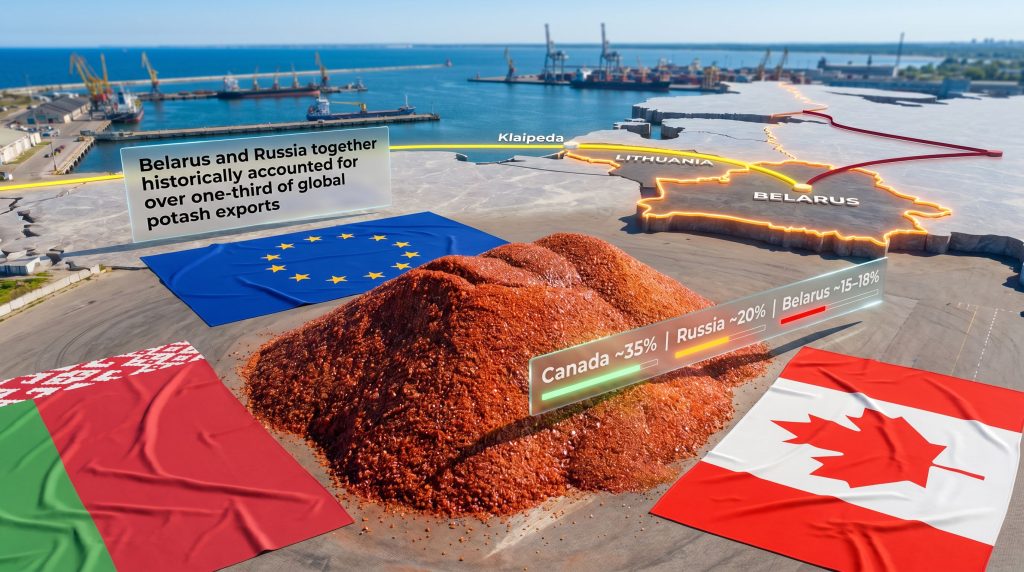
Global potash supply is among the most geographically concentrated of any major commodity:
| Producer | Estimated Global Share | Key Export Routes |
|---|---|---|
| Canada (Nutrien, Mosaic) | ~35% | Atlantic and Pacific shipping lanes |
| Russia | ~20% | Baltic and Arctic ports |
| Belarus | ~15–18% | Historically via Klaipeda, Lithuania |
| Other (Jordan, China, Germany) | ~27–30% | Regional distribution |
This concentration creates a structural fragility that policymakers in food-importing nations understand viscerally. When a single producer is disrupted, the downstream effect on fertilizer costs, and ultimately food prices, arrives within one to two growing seasons. The 2022 events in Ukraine compounded this vulnerability dramatically, as both Russia and Belarus simultaneously became subjects of coordinated Western sanctions regimes.
"The removal of over one-third of global potash supply from accessible Western markets within a single growing season is not an abstract policy outcome. It is a direct contributor to fertilizer price spikes that ripple into bread, grain, and vegetable costs across developing-world food systems already operating on thin margins."
The Sanctions Architecture That Created a New Problem
From Democratic Repression to Trade Restrictions
The Belarus sanctions story begins in August 2020, when a deeply contested presidential election returned Alexander Lukashenko to power amid widespread accusations of fraud and a subsequent crackdown on peaceful protesters, journalists, and civil society organisations. The response from the European Union, the United States, the United Kingdom, and Canada was a coordinated escalation of economic pressure targeting the Lukashenko regime's most profitable revenue streams.
By 2021, the US Treasury had designated Belaruskali, the state-owned potash giant and one of the world's largest producers, as a sanctioned entity. This was not a peripheral action. Belaruskali had historically accounted for a substantial portion of Belarus's hard currency earnings, making it a central pillar of Lukashenko's economic foundation.
The immediate consequences were significant:
- Lithuania's Klaipeda port, which had processed the majority of Belarusian potash exports for decades, was effectively closed to Belaruskali cargoes under EU sanctions
- Baltic Sea transit routes through Lithuanian and Latvian infrastructure became inaccessible
- Belarus was forced to reroute its potash export logistics through Russian rail networks and ports, including Ust-Luga
- Foreign currency revenues fell materially as more expensive and less efficient Russian routing increased the cost base for Belarusian producers
The Unintended Consequence: Deeper Minsk-Moscow Dependency
Here lies one of the more analytically underappreciated dimensions of the Belarus sanctions episode. The original policy objective was to impose sufficient economic pain on the Lukashenko regime to compel behavioural change on human rights. The practical outcome, however, moved in a different direction.
By stripping Belarus of its Western transit infrastructure, sanctions removed the very economic independence that might have given Lukashenko an incentive to maintain some distance from Moscow. Post-2021, with potash rerouted entirely through Russian logistics networks, Lukashenko became structurally more, not less, dependent on Kremlin goodwill for his economic survival.
"The paradox at the heart of the Belarus sanctions architecture is that its most measurable effect was accelerating the Minsk-Moscow economic integration that Western policymakers claimed to want to prevent."
This dynamic is now central to the US argument for partial sanctions relief. Washington's position, articulated through back-channel diplomatic engagement, is that restoring some degree of economic normalisation for Belarus through potash trade could theoretically reduce Lukashenko's dependence on Russian financial support. Whether this theory holds in practice is a separate question, and one with considerable supply chain disruption risks that analysts continue to debate.
The Prisoners-for-Potash Framework: Conditionality as Diplomacy
In early 2025, the Trump administration began a process of conditional engagement with Minsk that produced a concrete, if limited, outcome. Following the release of hundreds of political prisoners by the Lukashenko government, the US partially lifted its own restrictions on select Belarusian potash entities. This was framed explicitly as a reversible, conditional measure rather than a permanent policy normalisation.
The State Department's position on this arrangement rests on several key pillars:
- The US remains engaged on the question of political prisoner releases and expects continued measurable progress
- Sanctions relief cannot be used to support Russia's military operations in Ukraine under any circumstances
- Lukashenko must demonstrate sustained behavioural change, including ending politically motivated arrests
- Sanctions can be reimposed at any time if Minsk fails to fulfil its commitments
This conditionality framework represents a recognisable diplomatic tool: granting incremental economic normalisation in exchange for verifiable political concessions, while retaining the leverage to reverse course. Whether it constitutes genuine strategic leverage or largely symbolic diplomacy depends heavily on one critical factor: European participation.
Why the EU Holds the Decisive Vote
The Klaipeda Corridor: More Than a Port
Klaipeda is not simply Lithuania's main commercial seaport. For decades it served as the most efficient potash export hub on the planet for Belarusian production. Its infrastructure, including dedicated rail connections, specialised loading terminals, and established shipping lanes into global agricultural commodity markets, was purpose-built around the Belarusian potash trade.
EU sanctions that prohibit Belarusian potash from transiting Lithuanian territory have effectively frozen this infrastructure out of its primary use case. The economic cost to Lithuania's port revenues is real, though Lithuanian policymakers have consistently judged this cost to be outweighed by national security considerations.
The critical legal point is this: Lithuania cannot independently authorise the resumption of potash transit. EU sanctions law operates at the bloc level. Any modification to the Belarus potash transit prohibition would require a qualified majority decision at the EU Council, involving all 27 member states. This is not a technicality. It is the principal structural barrier to any real-world change in potash trade flows.
Lithuania's Position: Caught Between Washington and Brussels
Lithuanian Foreign Minister Kestutis Budrys acknowledged, in remarks at a closed-door ruling party meeting, that regional governments were beginning to sense increased pressure from the US regarding potash transit. He confirmed there was additional activity from the American side on the issue.
However, the office of Lithuanian President Gitanas Nauseda subsequently characterised the situation as involving theoretical discussions rather than formal pressure, and reaffirmed Lithuania's intention to support extending EU sanctions in 2026. President Nauseda's reasoning reflects the dominant Eastern European view: Belarus has not demonstrated the behavioural change that would justify sanctions relaxation.
Critically, Lukashenko allowed Russian forces to stage their February 2022 invasion of Ukraine from Belarusian territory, and Belarus continues to host Russian military infrastructure. Minsk's announcement of snap nuclear exercises alongside Russian forces, timed contemporaneously with US diplomatic outreach, did not go unnoticed in Vilnius or Warsaw.
Eastern Europe's Unified Resistance
Poland, the Baltic states, and several Central European members remain the most resolute opponents of any softening toward Belarus within the EU framework. Their argument is rooted in geography and lived historical experience. These are nations that share borders or close proximity with both Russia and Belarus, that understand Russian military doctrine from direct proximity, and that view any incremental normalisation of Belarus sanctions as a dangerous signal about the durability of Western commitments.
Furthermore, President Volodymyr Zelenskyy's warning that Belarus risks being drawn further into Russia's war reinforced the argument that any sanctions relaxation now would be premature at best and strategically reckless at worst.
Ukraine's Diplomatic Dilemma
Washington's reported request that Kyiv advocate with European partners for easing potash-related restrictions places Ukraine in an extraordinarily delicate position. The theoretical logic the US presents is that reducing Belarus's economic dependence on Russia serves Ukraine's long-term strategic interest by weakening the Minsk-Moscow axis.
The Ukraine-US minerals deal has already drawn significant attention to the complex economic arrangements Washington is pursuing with Kyiv. Consequently, the practical political reality is that Ukraine being seen to advocate for any economic benefit to the Lukashenko regime, which facilitated the invasion of Ukrainian territory, carries severe domestic and diplomatic risks. The strategic implications for Ukraine in navigating these competing pressures should not be underestimated.
Ukraine's Foreign Ministry did not respond to requests for comment on the reported US approach. That silence is itself informative.
The US wants Ukraine to help ease restrictions on Belarus potash in a manner that would theoretically serve broader Western agricultural and geopolitical interests. However, the asymmetry between American agricultural policy concerns and Ukrainian existential security considerations makes this a particularly fraught diplomatic ask.
The next major ASX story will hit our subscribers first
Scenario Analysis: What Sanctions Relief Would Actually Mean for Potash Markets
| Scenario | Description | Market Impact | Geopolitical Risk |
|---|---|---|---|
| US Relief Only, EU Unchanged | Current situation | Minimal. Belarus still routes through Russia | Low impact on coalition |
| US + EU Partial Relief, Klaipeda Reopened | Lithuania transit restored | Meaningful supply increase, downward price pressure | Eastern EU backlash, coalition strain |
| Full Multilateral Sanctions Removal | Belarus re-enters Western markets at scale | Structural fertilizer cost reduction | High risk, weakens broader sanctions architecture |
Global potash prices have remained elevated relative to their pre-2021 baselines partly because Belarusian supply volumes have been absent from Western commodity markets for several years. Any credible signal that EU sanctions could be modified would likely trigger repricing across potash futures contracts and downstream fertilizer derivatives.
Agricultural commodity traders, particularly those managing nitrogen-potassium input cost exposure for large-scale grain producers, would price in supply normalisation well in advance of any formal policy change.
The Russian Dimension: An Overlooked Complication
One aspect of the Belarus potash sanctions debate that receives insufficient analytical attention is the degree to which Russian logistics operators have become embedded within Belarusian potash export infrastructure since 2021. When Belaruskali rerouted through Russian rail and ports, it was not simply changing shipping lanes. It entered into commercial relationships with Russian freight operators, terminal operators, and financial intermediaries.
Even if Western sanctions were eased tomorrow, unwinding this commercial dependency would take years. Infrastructure agreements, take-or-pay contracts, and established operational relationships with Russian counterparties do not dissolve overnight. This creates a structurally important observation: any near-term partial sanctions relief may generate revenues that flow partly through Russian commercial channels, potentially benefiting Russian intermediaries alongside Belarusian producers.
This is not a reason to permanently foreclose the diplomatic option. However, it is a reason why the conditionality architecture needs to be far more sophisticated than simple licence reinstatement.
The Broader Sanctions Coalition Risk
From Moscow's perspective, the Belarus potash debate is instructive regardless of outcome. If the US succeeds in persuading European partners to ease Belarus sanctions, it establishes a template: sustained diplomatic engagement, conditional prisoner releases, and economic incentives can create fractures in coordinated Western sanctions coalitions.
The evolving geopolitical mining landscape illustrates how mineral dependencies increasingly shape foreign policy decisions in ways that complicate traditional alliance structures. Russia's strategic interest in monitoring where European pressure points exist within the sanctions architecture is therefore significant, and any partial normalisation toward Belarus creates a rhetorical and analytical precedent that Russian diplomats will reference in discussions about Russian sanctions relief timelines.
"The Belarus potash question is not simply a fertilizer trade dispute. It is a test case for the long-term durability of multilateral sanctions as a foreign policy instrument in a world where commodity dependencies and food security concerns create persistent pressure points."
FAQ: Belarus Potash and the US Diplomatic Push
What is potash and why does it matter geopolitically?
Potash is a potassium-rich mineral used as a primary agricultural fertilizer. Its production is concentrated among a small number of countries, making supply disruptions directly consequential for global food prices. Belarus is one of the world's largest producers, and its exclusion from Western markets since 2021 has contributed to elevated fertilizer costs globally.
Why did the US ease sanctions on Belarusian potash in 2025?
The Trump administration partially lifted restrictions on select Belarusian potash entities following the release of hundreds of political prisoners by the Lukashenko government. The relief was structured as conditional and reversible, not as a permanent normalisation of trade relations.
What is the US asking Ukraine to do?
Washington has reportedly asked Kyiv to advocate with European partners for easing transit and trade restrictions on Belarusian potash, framing this as a mechanism to reduce Minsk's economic dependence on Moscow. This is precisely why the US wants Ukraine to help ease restrictions on Belarus potash — to weaken the broader Minsk-Moscow economic axis.
Why can't Lithuania simply reopen potash transit?
EU sanctions law explicitly prohibits Belarusian potash transit through Lithuanian territory. Lithuania cannot unilaterally reverse this ban. Any change requires an EU Council decision with qualified majority support, a threshold that currently has no political pathway given the bloc's unified posture.
Does US sanctions relief alone change global potash prices?
Not materially. Without EU participation, Belarus cannot access its most efficient export routes. Real price effects in global potash markets would require EU-level sanctions modification, which remains politically unlikely in the near term.
What is Belaruskali?
Belaruskali is Belarus's dominant state-owned potash producer and historically one of the world's largest potash companies by volume. It was designated by the US Treasury in 2021 as part of the sanctions response to political repression in Belarus.
Key Takeaways
- Belarus potash sanctions were designed to pressure Lukashenko but inadvertently deepened his economic dependence on Moscow by removing Western transit options
- The US has implemented conditional, reversible sanctions relief tied to political prisoner releases, but the real-world trade impact remains limited
- Washington is seeking broader coalition support, including from Ukraine and EU partners, to extend the diplomatic framework
- The EU remains the decisive actor in this equation, and there are currently no signals from Brussels indicating appetite for modification of the Belarus sanctions posture
- Eastern European member states, particularly Lithuania and Poland, remain firmly opposed on national security grounds
- Russian logistics operators have become commercially embedded within Belarusian potash export infrastructure since 2021, complicating any clean sanctions unwind
- Global potash markets continue to price in supply constraints that would only ease with multilateral relief, a scenario without a clear near-term political pathway
This article contains analysis of geopolitical scenarios and commodity market dynamics. It does not constitute financial or investment advice. Readers should conduct independent due diligence before making any investment decisions related to potash, fertilizer markets, or associated equities.
Want to Stay Ahead of Major Commodity Discoveries Before the Broader Market Reacts?
While geopolitical shifts in potash and fertiliser markets highlight how concentrated mineral supply chains can reshape global economics, Discovery Alert's proprietary Discovery IQ model delivers real-time alerts on significant ASX mineral discoveries — turning complex commodity data into actionable investment insights the moment announcements hit the exchange. Explore historic discoveries and the returns they generated, then begin your 14-day free trial at Discovery Alert to position yourself ahead of the market.