August 24, 2026
Understanding the Forces Behind Basin-Wide Production Contraction
The global energy landscape continues evolving through complex interactions between technological advancement, regulatory frameworks, and market dynamics. Mature petroleum basins worldwide face similar challenges as natural depletion intersects with shifting policy environments and investment priorities. These patterns reveal fundamental tensions between immediate economic pressures and long-term strategic considerations that shape resource extraction decisions.
Economic modelling suggests that policy volatility creates compounding effects beyond simple tax burden calculations. When fiscal regimes change frequently, operators must factor uncertainty premiums into project economics, effectively raising the minimum return thresholds required for investment approval. This phenomenon particularly impacts marginal projects and field extensions that depend on stable, predictable cash flows to justify development costs.
The relationship between taxation policy and production outcomes demonstrates classic economic elasticity principles. While higher tax rates theoretically generate increased government revenue, the practical effects often diverge significantly when applied to declining resource bases. Production decline rates can accelerate beyond natural depletion curves when investment capital migrates to more favourable jurisdictions.
When big ASX news breaks, our subscribers know first
What Triggered the North Sea's Rapid Production Collapse?
Economic and Regulatory Pressures Converge
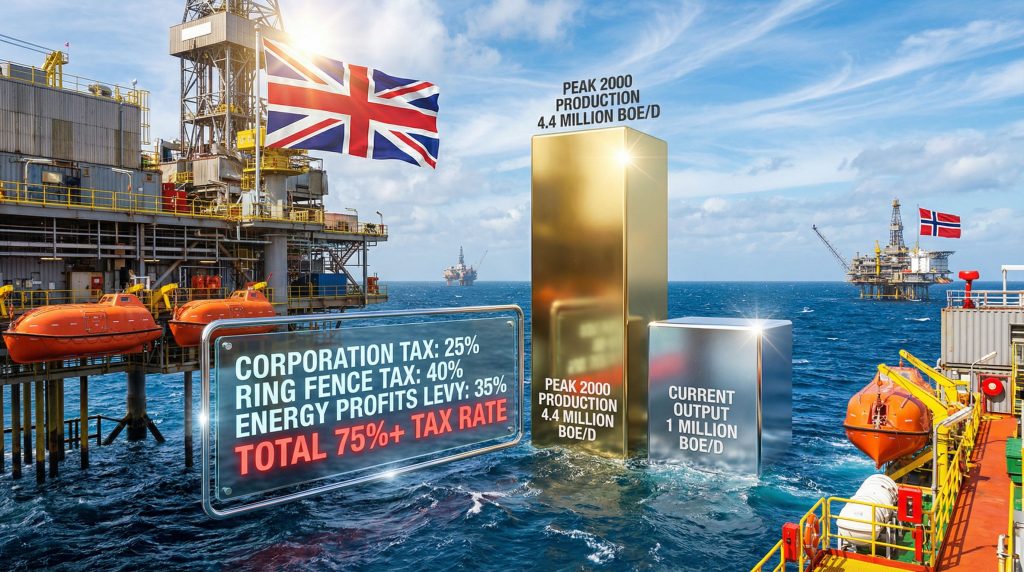
The transformation of the UK Continental Shelf from a world-class petroleum province to its current diminished state reflects the intersection of geological maturity with policy-driven acceleration. Basin-wide production has contracted from peak levels of 4.4 million barrels of oil equivalent daily in 2000 to approximately 1 million boe/d in 2025, representing a 77% decline over 25 years.
This North Sea oil and gas decline trajectory significantly exceeds typical decline rates observed in mature petroleum basins globally. Natural depletion typically follows more gradual curves, suggesting that non-geological factors have amplified the underlying resource exhaustion trends. Furthermore, this decline pattern demonstrates how oil price dynamics interact with regulatory pressures to influence investment decisions.
Multi-Layered Fiscal Framework Impact
The UK's current energy taxation structure represents one of the most aggressive fiscal regimes globally for hydrocarbon extraction operations. The combined tax burden includes:
| Tax Component | Rate | Cumulative Impact |
|---|---|---|
| Corporation Tax | 25% | Base corporate taxation |
| Ring Fence Tax (Supplementary Charge) | 40% | Petroleum-specific levy |
| Energy Profits Levy | 35% | Additional windfall surcharge |
| Total Effective Rate | 75%+ | Among highest globally |
This fiscal structure creates substantial project economics challenges, particularly for marginal discoveries and field extension opportunities. The ring-fence system isolates petroleum operations from other business activities, preventing operators from offsetting exploration costs against broader corporate income streams.
Investment Climate Deterioration Patterns
The combination of punitive taxation and regulatory complexity has generated what industry participants characterise as challenging investment conditions. Capital allocation decisions increasingly favour jurisdictions with more predictable fiscal frameworks and streamlined regulatory processes.
Key indicators of investment climate stress include:
• Upstream investment decline: Projected 10% year-over-year reduction to $26 billion for 2026
• Banking sector withdrawal: 40-50% reduction in sector lending capacity
• Exploration activity cessation: Zero exploration wells drilled during fiscal 2024-25
• Operator capital flight: Strategic divestment by major international companies
The cessation of exploration drilling represents a particularly significant milestone, marking the first year in North Sea oil and gas decline history without new well activity. This development signals fundamental shifts in operator confidence and long-term basin viability assessments.
Why Are Major Operators Abandoning the Basin?
Strategic Capital Redeployment Patterns
Leading international energy companies have initiated systematic withdrawal from UK Continental Shelf operations, citing fiscal instability and regulatory uncertainty as primary decision factors. These exits represent strategic portfolio optimisation rather than temporary operational adjustments.
Apache Corporation announced cessation of UK North Sea production operations by 2030, stating that expected returns do not economically support required investments under current regulatory frameworks. This decision affects multiple producing assets and represents complete basin exit for a significant regional operator.
Ineos Energy suspended all new UK North Sea investment commitments during summer 2024, following warnings about fiscal regime instability. The company's leadership, including former BP CFO Brian Gilvary, described the UK system as having the most unstable fiscal regime globally for petroleum operations.
Serica Energy, identified as one of the largest regional producers, actively explores Norwegian alternatives for capital deployment rather than pursuing additional UK development opportunities. Management has characterised the UK as more fiscally unstable than almost anywhere else globally.
Regulatory Impediment Escalation
Beyond taxation concerns, operators face increasing regulatory complexity through environmental litigation and licensing process disruption. The UK's approach contrasts sharply with other European jurisdictions that maintain active exploration programmes while pursuing climate objectives.
Environmental activism has successfully challenged major project approvals through court proceedings. The Rosebank and Jackdaw projects, representing significant capital commitments from Shell and Equinor respectively, were declared unlawfully approved in January 2025, creating precedents that may affect future development decisions.
This regulatory instability compounds fiscal concerns by introducing timeline unpredictability into project development cycles. Operators must factor potential legal challenges and approval delays into economic models, further degrading project returns and investment attractiveness.
What Economic Consequences Are Emerging?
Government Revenue Contraction Paradox
Despite implementing higher tax rates designed to capture increased government revenue from petroleum operations, actual receipts have contracted sharply due to production declines and reduced investment activity. This outcome demonstrates the elasticity challenges inherent in high-tax regimes applied to declining resource bases. Additionally, tariffs impact investments across various sectors, creating broader economic uncertainty.
Tax Receipt Trajectory Analysis:
• 2022-23: £9.8 billion in government receipts
• 2024-25: £4.5 billion (54% decline from peak)
• Projected 2026: Sub-£3 billion (continued erosion trend)
This revenue collapse illustrates how production declines can overwhelm tax rate increases, resulting in net government income reduction despite higher marginal tax burdens on remaining operators.
Regional Economic and Employment Impacts
The sector's contraction generates cascading effects throughout integrated supply chains and regional economies, particularly affecting Scotland and North East England where petroleum industry infrastructure concentrates. MPs warn clean energy jobs not being created at the pace or scale needed to match North Sea oil and gas decline.
Workforce Impact Indicators:
• Job losses 2014-2023: 33% reduction in direct employment
• Dependent employment: Estimated 200,000+ roles reliant on North Sea activity
• Skills migration: Qualified personnel relocating to Norwegian and international projects
• Supply chain contraction: Reduced utilisation of specialised services and infrastructure
The petroleum industry functions as an integrated ecosystem with specialised services, supply chain infrastructure, and skilled labour concentrated in specific regional centres. Sector contraction creates multiplier effects through direct operator workforce reductions, service company attrition, and port facility underutilisation.
Energy Security Cost Implications
Declining domestic production necessitates increased reliance on international energy markets, exposing consumers to price volatility and supply disruption risks. The UK currently sources approximately 45% of its natural gas consumption domestically, with this proportion projected to decline below 25% by 2035.
Import Dependency Growth Projections:
• Current domestic gas supply: 45% of total consumption
• 2035 projection: Less than 25% domestic supply share
• LNG import requirement growth: 200%+ increase by 2030
This transition toward import dependency creates price vulnerability during supply disruption events and reduces government control over domestic energy costs.
How Does Norway's Approach Differ Strategically?
Comparative Fiscal Policy Framework
Norway has maintained North Sea production stability through balanced fiscal policies that preserve investment incentives while capturing resource rents for sovereign wealth accumulation. The Norwegian Continental Shelf sustains approximately 4.1 million boe/d output through continued investment in tie-back projects and field extensions.
Policy Comparison Framework:
| Policy Area | Norway Approach | UK Approach |
|---|---|---|
| Tax Stability | Long-term predictable framework | Frequent changes and windfall levies |
| Exploration Support | Active licensing rounds continue | Effective moratorium via litigation |
| Energy Security Priority | Domestic production maintained | Import dependency accepted |
| Transition Financing | Oil revenue funds green investments | Tax industry to finance transition |
| Regulatory Process | Streamlined approval systems | Complex litigation-prone processes |
Resource Rent Capture Philosophy
Norway's approach balances value extraction from hydrocarbon resources with investment incentive preservation through the Government Pension Fund Global (Oil Fund). This model demonstrates how petroleum revenues can finance energy transition investments while maintaining production economics that support continued development.
The Norwegian system employs royalty structures and equity stakes that preserve project economics while capturing resource rents, contrasting with the UK's high marginal tax rate approach that can render marginal projects uneconomic. Consequently, this approach addresses energy transition challenges more effectively than punitive taxation models.
Production Sustainability Results
Norwegian Continental Shelf production stability demonstrates that alternative policy approaches remain viable for mature petroleum basins. The continued investment in Norwegian projects by international operators suggests that fiscal and regulatory frameworks significantly influence capital allocation decisions.
Recent statements from UK operators actively exploring Norwegian opportunities, including Serica Energy's assessment that Norway offers conditions where business models can be recreated, illustrate the practical impacts of comparative policy frameworks on investment flows.
What Are the Long-Term Energy Security Implications?
Import Dependency Acceleration Trends
The UK's declining domestic production necessitates increased reliance on international energy markets, exposing consumers and industrial users to price volatility and supply disruption risks. Current domestic gas supply covers 45% of consumption, with projections indicating this will fall below 25% by 2035.
Energy Security Risk Modelling:
• Normal weather conditions: 6% gas price increase by 2029
• Cold weather scenario: 13% price premium above baseline
• Supply disruption events: Potential for extreme price volatility
Moreover, these trends intersect with broader energy security trends affecting strategic resource availability globally.
LNG Market Dependency Growth
The 200%+ growth in LNG import requirements by 2030 implies substantial dependency on global LNG markets, shipping capacity, and terminal infrastructure. This transition creates exposure to supply chain disruptions, shipping bottlenecks, and geopolitical tensions affecting major LNG exporting regions.
Global LNG markets remain relatively tight, with new supply additions often offset by growing demand from Asian markets. European dependence on LNG imports has increased significantly since 2022, creating competition for available cargoes and contributing to price volatility.
Strategic Autonomy Considerations
Energy security increasingly features in European policy discussions following recent geopolitical developments. Germany and the Netherlands have recently agreed to explore for gas in their North Sea sectors, indicating renewed recognition of domestic production's strategic value.
The contrast between UK policy direction and continental European approaches suggests different assessments of the trade-offs between climate objectives and energy security considerations. Domestic energy production provides strategic value beyond immediate economic returns, particularly during periods of international supply disruption.
The next major ASX story will hit our subscribers first
Could Policy Reversals Restore Production Viability?
Remaining Resource Base Assessment
Despite claims of resource exhaustion, technical analysis suggests significant remaining hydrocarbon potential exists within UK Continental Shelf areas. Current estimates indicate substantial undeveloped resources that could support continued production with appropriate investment incentives.
Resource Potential Evaluation:
• Proven reserves: 1.5 billion barrels (2024 assessment)
• Additional resource potential: 2.6 billion boe through enhanced recovery techniques
• Undeveloped discoveries: Multiple projects awaiting investment decisions
• Exploration potential: Remaining prospects in underexplored areas
Major operators including Shell and Equinor committed significant capital to Rosebank and Jackdaw projects based on detailed technical evaluations, suggesting commercial viability under appropriate fiscal conditions. Furthermore, OPEC production impact on global markets makes domestic production increasingly valuable for energy security.
Economic Revival Scenario Analysis
Policy reform advocates argue that fiscal incentives could regenerate North Sea oil and gas decline activity and deliver substantial economic benefits through increased production, employment, and tax revenue generation.
Potential Economic Impact Assessment:
• GDP contribution: £165 billion over project lifecycles
• Government tax revenue recovery: £50+ billion through increased production volumes
• Employment restoration: 100,000+ direct and indirect job creation
• Regional economic multiplier effects: Substantial benefits for Scotland and North East England
Former Prime Minister Tony Blair's recent analysis supports domestic production revival, suggesting that North Sea development could contribute £165 billion to UK economic growth while providing energy security benefits.
Investment Climate Recovery Requirements
Restoring operator confidence would require comprehensive policy reform addressing both fiscal and regulatory frameworks. Key elements would include tax rate moderation, regulatory process streamlining, and long-term policy stability commitments.
The Norwegian model demonstrates that balanced approaches can maintain production while pursuing climate objectives. Successful policy reform would need to address the fundamental investment climate challenges that have driven operator exits and capital flight to alternative jurisdictions.
What Lessons Emerge for Resource-Dependent Economies?
Policy Stability as Investment Foundation
The North Sea experience demonstrates how fiscal volatility can accelerate natural resource depletion beyond geological decline rates. Investment capital proves highly sensitive to policy uncertainty, with operators willing to accept lower returns in exchange for stable, predictable regulatory environments.
Resource-dependent economies benefit from maintaining consistent fiscal frameworks that balance government revenue objectives with investment incentive preservation. Frequent policy changes create uncertainty premiums that can render marginal projects uneconomic.
Balanced Transition Strategy Development
Successful energy transitions require careful calibration between environmental objectives and economic sustainability. Premature industry destruction can undermine transition financing while creating energy security vulnerabilities and economic disruption.
Norway's approach demonstrates how hydrocarbon revenues can finance renewable energy investments while maintaining production economics. This model preserves employment and tax revenue streams during transition periods while building sovereign wealth for future investment.
Energy Security as Strategic Asset
Domestic energy production provides strategic value extending beyond immediate economic returns. Recent geopolitical developments have reinforced the importance of energy security considerations in policy formulation.
The UK's transition toward import dependency creates exposure to international price volatility and supply disruption risks that may ultimately prove more costly than maintaining domestic production capabilities during transition periods.
Industry Transformation and Future Pathways
The North Sea oil and gas decline trajectory illustrates complex interactions between policy decisions, market dynamics, and resource economics in mature petroleum basins. While natural depletion factors contribute to production decline, policy frameworks significantly influence the pace and extent of basin contraction.
The contrast between UK and Norwegian approaches demonstrates that alternative policy pathways remain available, though implementation would require fundamental shifts in fiscal and regulatory frameworks. The economic and strategic implications of current trends will influence UK energy policy, public finances, and national security considerations for decades.
However, the renewables jobs needed amid North Sea oil gas decline debate continues as policymakers struggle with transition timing and workforce implications. Time-sensitive decisions regarding domestic energy production will determine whether the UK accepts accelerated import dependency or implements reforms that could extend production while supporting broader transition objectives.
The resolution of this strategic choice will reshape energy markets, economic development patterns, and geopolitical relationships throughout the North Sea region. This analysis draws upon industry data, government publications, and expert assessments to examine the factors driving North Sea production trends and their broader implications for energy policy and economic development. Readers should consider multiple perspectives and current market conditions when evaluating energy investment and policy decisions.
Looking to Capitalise on Energy Sector Opportunities?
Discovery Alert's proprietary Discovery IQ model delivers real-time alerts on significant ASX mineral discoveries, including critical energy transition commodities, instantly empowering subscribers to identify actionable opportunities ahead of the broader market. Begin your 14-day free trial today and secure your market-leading advantage whilst the energy landscape continues evolving.