August 11, 2026
Understanding Battery Architecture and Chemical Composition
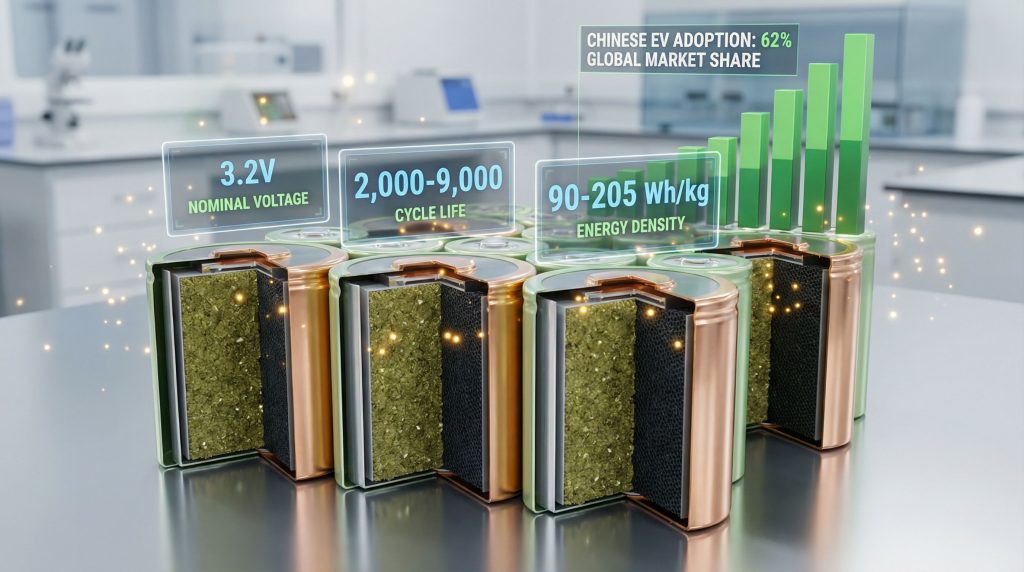
Lithium iron phosphate batteries represent a fundamental shift in energy storage technology, built around the LiFePO4 cathode material paired with graphitic carbon anodes. This electrochemical architecture operates at 3.2 volts nominal per cell, compared to the 3.7-volt output of conventional lithium-ion systems. The crystalline structure of iron phosphate provides enhanced thermal stability through its robust molecular bonds, which resist decomposition under extreme temperature conditions.
Manufacturing processes for LFP technology differ significantly from traditional NCM (nickel-cobalt-manganese) battery production. The iron phosphate cathode requires specialised sintering temperatures and atmospheric controls during synthesis, whilst the absence of expensive cobalt and nickel simplifies supply chain management and reduces raw material costs.
Performance Characteristics and Energy Trade-offs
Energy density specifications for lithium iron phosphate batteries typically range from 90-205 Wh/kg, representing a trade-off against higher-density alternatives like NCM systems. This lower energy density necessitates additional cells to achieve equivalent power output, particularly in applications requiring compact form factors.
The voltage architecture difference creates design challenges in consumer electronics but proves advantageous in large-scale applications where safety margins take precedence over space constraints. Cost structure analysis reveals that material input savings often offset manufacturing complexity, particularly in high-volume production environments.
| Battery Chemistry | Energy Density (Wh/kg) | Nominal Voltage | Cycle Life | Safety Rating |
|---|---|---|---|---|
| LFP | 90-205 | 3.2V | 2,000-15,000 | Excellent |
| NCM | 150-250 | 3.7V | 1,000-2,000 | Good |
| LCO | 180-220 | 3.7V | 500-1,000 | Fair |
When big ASX news breaks, our subscribers know first
Superior Safety Performance in Critical Applications
Thermal Management and Fire Prevention Systems
Temperature tolerance characteristics position LFP technology as superior for safety-critical deployments. Operational windows spanning -20°C to 60°C exceed most conventional battery chemistries, whilst thermal runaway resistance provides additional protection margins. The phosphate-based structure prevents oxygen release during thermal stress events, eliminating a primary fire propagation mechanism found in other lithium-ion configurations.
Short-circuit behaviour analysis demonstrates that LFP batteries exhibit controlled failure modes rather than catastrophic decomposition. This characteristic results from the stable crystal lattice structure that maintains integrity even under electrical abuse conditions.
LFP batteries demonstrate superior safety characteristics through their inherent chemical stability, making them the preferred choice for applications where human safety cannot be compromised.
Safety certification standards including UL 1642, IEC 62619, and GB/T 17852 have established specific testing protocols for LFP technology. Furthermore, these frameworks evaluate thermal abuse, mechanical stress, and electrical fault conditions to verify safe operation across anticipated use scenarios.
Structural Resilience Under Extreme Conditions
Mechanical stress resistance enables LFP deployment in automotive crash scenarios where battery pack integrity directly affects occupant safety. Vibration tolerance specifications exceed requirements for mobile applications, whilst overcharge protection mechanisms provide built-in safety features that complement external battery management systems.
Real-world safety incident data from vehicle manufacturers indicates significantly lower fire rates for LFP-equipped vehicles compared to NCM alternatives. However, specific incident statistics require verification against manufacturer safety reports and regulatory databases.
Extended Operational Lifespan Through Advanced Chemistry
Cycle Life Performance and Degradation Modelling
Lithium iron phosphate batteries achieve 2,000-9,000 charge-discharge cycles in standard applications, with latest iterations reaching 15,000 cycles under optimised conditions. Capacity retention curves demonstrate superior longevity compared to conventional chemistries, maintaining 80% capacity after 1,000 cycles or 90% capacity after 500 cycles in typical deployment scenarios.
Fast-charging impact analysis reveals that LFP technology tolerates aggressive charging protocols with minimal long-term degradation. Consequently, this characteristic enables rapid vehicle charging without compromising battery investment over multi-year ownership periods.
Market deployment data indicates growing confidence in LFP longevity, with lithium deployment reaching 60,900 tons globally in September 2025, representing a 25% year-over-year increase. This growth rate matches overall battery deployment expansion, suggesting that cycle life specifications meet commercial vehicle requirements across diverse applications.
Depth of Discharge Optimisation Protocols
Battery management system integration enables lifespan maximisation through intelligent discharge protocols. Comparative analysis between 80% and 100% depth of discharge strategies demonstrates that conservative discharge management can extend operational life by 30-50% in stationary applications.
Temperature-controlled charging algorithms optimise battery health by adjusting charging rates based on ambient conditions and internal cell temperatures. These protocols prevent thermal stress accumulation that contributes to capacity degradation over extended use periods.
- Optimal charging temperature range: 10°C to 45°C
- Fast charging protocols: 0.5C to 3C depending on thermal conditions
- Maintenance requirements: Annual capacity testing and thermal inspection
- BMS integration: Real-time monitoring of voltage, current, and temperature parameters
Commercial Deployment and Market Integration
Electric Vehicle Market Penetration
Global electric vehicle sales reached 18.5 million units in the first eleven months of 2025, representing 21% year-over-year growth. China dominates this expansion, accounting for 62% of global sales with 19% growth in 2025. The Chinese EV market has standardised on lithium iron phosphate chemistry, with LFP accounting for 48% of global EV batteries in 2024.
Macquarie Bank projects LFP market share will rise to 65% by 2029, a significant upward revision from previous forecasts of 49%. This projection reflects improving energy density characteristics and continued cost advantages that make LFP competitive across broader vehicle segments. For instance, the EV market transformation continues to drive adoption across multiple sectors.
Tesla Model 3 and Model Y variants equipped with LFP batteries demonstrate the technology's viability in mainstream passenger vehicles. Range specifications meet consumer requirements whilst providing cost advantages that enable broader EV market accessibility.
Stationary Energy Storage Applications
Grid-scale battery installations leverage LFP's safety and longevity advantages for utility-scale projects. Global installations of battery energy storage systems increased 38% year-over-year in the first ten months of 2025, driven primarily by LFP deployments in renewable energy integration projects.
Residential solar storage systems benefit from LFP's extended cycle life and maintenance-free operation. Sizing calculations typically specify 10-20 kWh capacity for average household requirements, with 15-year operational lifespans that justify initial investment costs.
Load balancing and peak shaving applications utilise LFP's rapid response characteristics and high cycle count tolerance. Industrial facilities deploy these systems to reduce demand charges and provide backup power during grid outages.
Ford Motor's recent announcement of a $19.5 billion charge on EV investments whilst simultaneously committing $2 billion to energy storage batteries illustrates the shifting market dynamics toward stationary applications where LFP technology excels.
Technology Limitations and Design Constraints
Energy Density Trade-offs and Engineering Solutions
Space and weight penalties limit LFP adoption in compact device applications where energy density requirements exceed current LFP capabilities. Smartphone and laptop integration remains challenging due to form factor constraints, though engineering solutions continue advancing through cell-to-pack manufacturing innovations.
Range limitations in passenger vehicle segments reflect the energy density gap compared to NCM alternatives. However, the performance differential continues narrowing through cathode material optimisation and particle size engineering advances.
Next-generation electrolyte formulations promise enhanced performance characteristics whilst maintaining LFP's safety advantages. Projected energy density roadmaps through 2030 suggest continued improvements that could eliminate current application limitations. In addition, developments in battery recycling breakthrough technologies further enhance the sustainability of these systems.
Cold Weather Performance Challenges
Capacity reduction patterns below 0°C require heating system integration in cold climate deployments. Battery pack insulation and thermal management systems add complexity and cost but enable year-round operation in regions with extreme winter conditions.
Regional deployment considerations must account for seasonal performance variations:
- Above 10°C: Full capacity and charging rate capability
- 0°C to 10°C: 10-20% capacity reduction, slower charging recommended
- Below 0°C: 30-50% capacity reduction, heating system required
- Below -20°C: Operational limits reached, thermal management critical
Engineering solutions include resistive heating elements, thermal insulation packages, and predictive heating algorithms that prepare batteries for operation in cold conditions.
Technological Evolution and Market Disruption
Energy Density Improvements and Manufacturing Innovation
Cell-to-pack manufacturing innovations reduce weight overhead by eliminating traditional module structures and integrating cells directly into vehicle chassis designs. This approach improves space utilisation whilst maintaining structural integrity and thermal management capabilities.
Cathode material optimisation focuses on particle size engineering and surface modifications that enhance ion transport whilst preserving cycle life characteristics. These developments target the energy density gap that currently limits LFP adoption in certain applications. Furthermore, initiatives like establishing a battery-grade lithium refinery strengthen the supply chain infrastructure.
Automated production line developments reduce manufacturing costs whilst improving quality control and defect rates. Chinese manufacturers have achieved significant scale economies that position LFP as the cost-effective solution across multiple market segments.
Recycling process optimisation addresses end-of-life considerations through closed-loop material recovery systems. Iron phosphate materials demonstrate excellent recyclability compared to complex multi-metal chemistries, supporting circular economy initiatives.
Competitive Technology Landscape
Sodium-ion battery development presents potential future competition to LFP dominance. CATL's Naxtra technology achieves performance levels that nearly match LFP efficiency whilst utilising abundant sodium resources instead of lithium. CATL founder Robin Zeng projects sodium-ion technology could replace up to 50% of the LFP market, though this transition timeline remains speculative.
Solid-state battery development continues advancing but faces manufacturing scalability challenges that delay commercial deployment. Current production costs exceed conventional lithium-ion technologies by significant margins, limiting near-term market penetration despite superior performance characteristics.
The next major ASX story will hit our subscribers first
Future Market Dynamics and Strategic Implications
Supply Chain Security and Manufacturing Capacity
Chinese manufacturing dominance creates both opportunities and risks for global LFP adoption. Current production capacity concentrated in China provides cost advantages but raises supply chain security concerns for international markets. Diversification strategies include capacity expansion in North America and Europe, though these initiatives require substantial capital investment and technology transfer.
Critical material dependencies for lithium and iron phosphate remain manageable compared to cobalt and nickel supply constraints. Alternative sourcing strategies continue developing, with Australian, Chilean, and North American lithium projects expanding production capacity. For instance, the direct lithium extraction boost demonstrates innovative approaches to securing resources.
Trade policy impacts on global LFP deployment vary by region, with tariff structures and local content requirements influencing manufacturing location decisions. Investment flows increasingly target domestic production capabilities as countries prioritise energy security considerations.
Grid Modernisation and Renewable Energy Integration
Solar and wind storage pairing optimisation leverages LFP's cost-effectiveness and safety characteristics for utility-scale installations. Grid modernisation requirements increasingly specify long-duration storage systems where LFP technology provides economic advantages over peak-power oriented alternatives.
Electric vehicle-to-grid integration potential creates additional value streams for LFP-equipped vehicles. Bidirectional charging capabilities enable vehicle batteries to provide grid services during peak demand periods, though regulatory frameworks continue developing to support these applications. Additionally, the broader lithium batteries revolution continues to transform energy storage across multiple sectors.
Key Technology Assessment and Strategic Outlook
Lithium iron phosphate batteries demonstrate clear advantages in safety-critical applications through inherent thermal stability and extended operational lifespans. Manufacturing cost benefits drive market penetration in price-sensitive segments, whilst continued technology evolution addresses current energy density limitations. For further technical details, comprehensive safety specifications outline the superior protection characteristics.
Energy density trade-offs currently limit adoption in space-constrained applications, though engineering solutions continue advancing through innovative manufacturing approaches and materials optimisation. The performance gap between LFP and conventional chemistries continues narrowing as development investments yield incremental improvements.
Strategic importance in global energy transition initiatives positions LFP technology as essential for electrification goals across transportation and grid storage applications. Market share projections suggest continued expansion as cost advantages and safety characteristics outweigh energy density constraints in most deployment scenarios.
Technology evolution trajectories indicate sustained performance improvements through 2030, with energy density enhancements and manufacturing cost reductions supporting broader market adoption. Competitive positioning against emerging technologies like sodium-ion remains favourable, though long-term market dynamics depend on continued innovation and manufacturing scale economies.
Disclaimer: This analysis contains forward-looking projections based on current market trends and technology development trajectories. Actual performance and market adoption may vary based on technological breakthroughs, regulatory changes, and competitive dynamics. Investment and deployment decisions should consider specific application requirements and risk tolerance factors.
Ready to Capitalise on the Next Lithium Battery Breakthrough?
Discovery Alert's proprietary Discovery IQ model delivers instant notifications on significant lithium and battery technology discoveries across the ASX, empowering subscribers to identify actionable opportunities before the broader market catches on. Explore Discovery Alert's dedicated discoveries page to understand how historic mineral discoveries have generated exceptional returns, then begin your 30-day free trial today to position yourself ahead of the next major breakthrough in battery technology investments.