July 10, 2026
Understanding Battery Chemistry Fundamentals and Performance Parameters
The ongoing debate between sodium-ion batteries versus lithium-ion batteries centres on fundamental electrochemical differences that determine their respective performance capabilities and commercial viability. Modern energy storage systems rely on electrochemical processes that convert chemical potential energy into electrical current through controlled ion movement between electrodes. Furthermore, the fundamental architecture involves cathode materials, anode structures, electrolyte solutions, and separator membranes working in coordination to enable charge and discharge cycles.
Performance characteristics depend heavily on the specific ionic species employed and their interaction with electrode materials. However, these differences create significant implications for energy density, cost structures, and practical deployment scenarios across various applications.
Electrochemical Architecture and Ion Transport Mechanisms
The migration of charge carriers through electrolyte solutions follows distinct pathways based on ionic radius and mobility characteristics. Sodium ions, with their larger hydrated radius of approximately 3.58 Å compared to lithium's 2.76 Å, encounter greater resistance during transport through liquid electrolyte media. Consequently, this physical constraint necessitates different electrode material selections and structural optimizations.
In addition, recent developments in direct lithium extraction technology highlight the ongoing evolution in lithium processing capabilities.
Current Commercial Performance Metrics:
• CATL Naxtra sodium-ion cells achieve 175 Wh/kg with 5C charging capabilities
• HiNa sodium-ion products deliver 165 Wh/kg energy density
• Advanced LFP systems reach 205 Wh/kg with 12C charging rates
• Standard LFP ranges between 120-180 Wh/kg
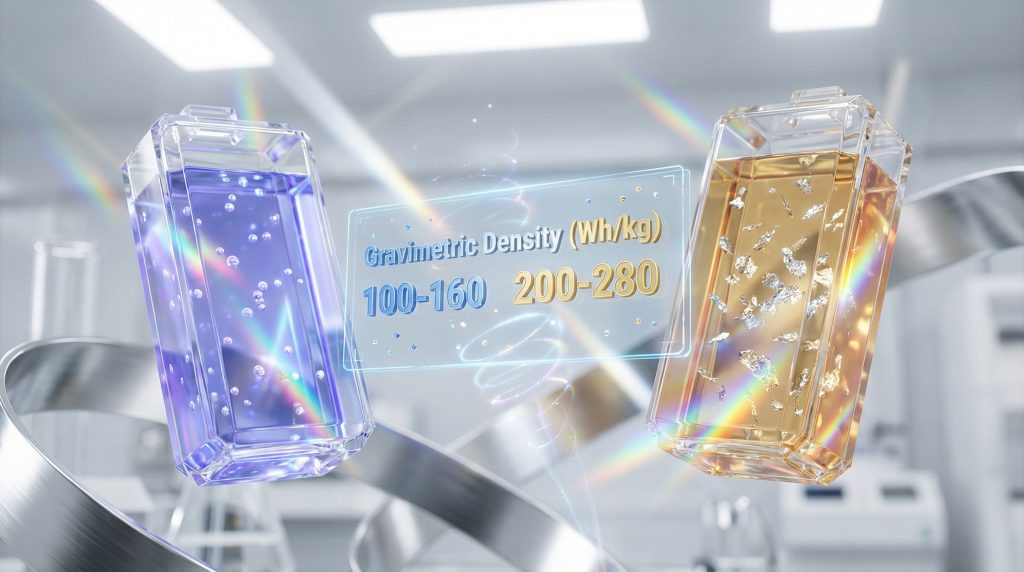
• NMC lithium-ion variants span 200-280 Wh/kg
The voltage platform differential creates additional system complexity. Sodium-ion cells typically operate between 3.0-3.6V nominal voltage, while lithium-ion systems function at 3.6-3.7V. This voltage gap, combined with lower energy density, requires larger cell quantities or higher parallel configurations to achieve equivalent power outputs.
Energy Storage Capacity Metrics and Density Calculations
Real-world installation data reveals significant volumetric disparities between battery chemistries. BYD's MC Cube system demonstrates this contrast clearly: lithium-ion configuration delivers 6.4 MWh capacity within a 20-foot equivalent container, while the identical system using sodium-ion cells provides only 2.3 MWh capacity. This represents a 64% capacity reduction in identical physical footprints.
| Battery Type | Gravimetric Density (Wh/kg) | Volumetric Density (Wh/L) | Commercial Readiness |
|---|---|---|---|
| Sodium-Ion (Current) | 160-175 | 200-300 | Limited deployment |
| LiFePO4 | 120-205 | 220-350 | Mature commercial |
| NMC Li-ion | 200-280 | 400-700 | Dominant technology |
Round-trip efficiency metrics show comparable performance between chemistries, with sodium-ion systems achieving 90-plus percent efficiency rates. However, the volumetric disadvantage creates cascading cost implications for transportation, installation labour, and balance-of-system components where container quantity increases while usable capacity declines.
When big ASX news breaks, our subscribers know first
Raw Material Economics and Manufacturing Cost Structure
The economic foundation of sodium-ion technology rests on abundant precursor materials, yet current manufacturing costs present a counterintuitive challenge. Sodium carbonate pricing operates in the hundreds of dollars per metric ton range, while lithium carbonate commands thousands of dollars per metric ton. Nevertheless, this raw material cost advantage of approximately 10:1 should theoretically provide significant economic benefits.
Furthermore, the battery metals investment landscape continues evolving as manufacturers evaluate long-term supply security and cost projections across different chemistries.
Supply Chain Cost Structure Analysis
Manufacturing reality contradicts material cost advantages. Current sodium-ion cell production carries at least a 30% cost premium over lithium-ion manufacturing, despite utilising cheaper input materials. This cost inversion stems primarily from production scale disadvantages rather than material expenses.
Key Cost Components:
• Raw Materials: Sodium carbonate vs lithium carbonate price differential
• Current Collectors: Aluminium ($2,000-2,500/MT) vs copper ($8,000-10,000/MT)
• Manufacturing Scale: Early-stage facilities operate at lower capacity utilisation
• Learning Curves: Underdeveloped production processes impose efficiency penalties
The aluminium current collector advantage provides modest cost reduction compared to copper requirements in lithium-ion systems. However, current collectors represent only 3-5% of total cell cost-of-goods-sold, limiting overall impact on system economics.
Geographic Resource Distribution and Strategic Implications
Supply chain resilience considerations favour sodium-ion chemistry due to synthetic sodium production capabilities. Unlike lithium extraction, which concentrates in specific geographic regions (Australia, Chile, Argentina), sodium compounds can be manufactured globally using conventional chemical processes. Consequently, this geographic flexibility reduces geopolitical risk exposure and supply chain concentration concerns.
However, achieving cost competitiveness requires substantial production volume expansion. The circular constraint emerges where demand remains suppressed due to current cost disadvantage, yet cost reduction depends on demand-driven manufacturing scale. Chinese manufacturers (BYD, CATL, HiNa) continue prioritising lithium-ion R&D investment over sodium-ion development, creating widening technology divergence rather than convergence.
In addition, recent lithium market challenges demonstrate how market dynamics influence technology development priorities and investment decisions.
Grid-Scale Energy Storage Applications and Market Reality
Utility-scale installations theoretically present optimal deployment environments for sodium-ion technology. Grid operators prioritise cost per kilowatt-hour, cycle life, and safety margins over volumetric efficiency. Land availability typically presents minimal constraints for stationary storage projects, potentially negating sodium-ion's volumetric disadvantage.
Stationary Storage Optimisation Factors
Grid storage applications prioritise cost per kWh, cycle life, and safety over energy density. Sodium-ion's lower volumetric requirements become less critical when space constraints are minimal, making the technology particularly suitable for utility-scale installations.
Current Deployment Statistics:
• Total global sodium-ion BESS installations: 148 MWh completed
• China Southern Power Grid deployment: 10 MWh Phase 1 (Guangxi Zhuang region)
• Phase 2 target: 100 MWh total project capacity
• Market demand: Virtually non-existent despite favourable application characteristics
Temperature Performance and Environmental Resilience
Sodium-ion systems demonstrate superior cold-weather operational characteristics compared to lithium-ion variants. This temperature tolerance advantage reduces thermal management system complexity and provides operational benefits in extreme climate regions. Cold-weather performance limitations that constrain lithium-ion installations become less problematic with sodium-ion chemistry.
The Hithium one-hour BESS product features 162 Ah sodium-ion cells with claimed 20,000-cycle lifespans, targeting data centre applications for load spike mitigation. However, power density specifications remain undisclosed, creating assessment gaps for applications requiring rapid response capabilities.
Safety Characteristics and Thermal Management Requirements
Safety profile advantages represent sodium-ion technology's most compelling differentiation factor. Thermal runaway risk reduction compared to lithium-ion systems provides significant operational benefits, particularly for installations in populated areas or regulatory environments emphasising safety margins.
Thermal Runaway Risk Assessment
Sodium-ion cells demonstrate reduced fire hazard potential during failure modes. CATL's Naxtra cells have successfully completed stress testing without gas venting, showcasing ability to endure rigorous conditions whilst maintaining safety integrity. This performance contrasts with lithium-ion thermal runaway scenarios that can progress to fire and explosion risks.
Safety Comparison Factors:
• Thermal Stability: Higher threshold temperatures before thermal runaway initiation
• Gas Generation: Reduced toxic gas production during cell failure modes
• Containment Requirements: Simplified safety system engineering
• Regulatory Compliance: Enhanced margins for building code requirements
Furthermore, innovations in battery recycling breakthrough technology continue improving safety protocols for end-of-life battery management across all chemistries.
Battery Management System Complexity
Voltage monitoring and cell balancing requirements differ between chemistries due to distinct voltage platforms and degradation mechanisms. Sodium-ion systems require adapted battery management system configurations to optimise performance and safety monitoring protocols.
Protection circuit design considerations include different cutoff voltages, charging algorithms, and temperature compensation factors. Maintenance protocols must account for sodium-ion specific degradation patterns and capacity fade mechanisms.
Charging Performance and Power Delivery Analysis
Fast charging capabilities present mixed performance characteristics between sodium-ion batteries versus lithium-ion batteries. Current commercial sodium-ion products demonstrate competitive charging rates, with some specifications approaching or exceeding standard lithium-ion performance.
Fast Charging Capabilities and C-Rate Performance
| Metric | Sodium-Ion | LiFePO4 | NMC Li-ion |
|---|---|---|---|
| Maximum C-Rate | 3-5C | 2-3C | 1-2C |
| 10-80% Charge Time | 15-25 min | 20-35 min | 30-60 min |
| Cold Weather Performance | Superior | Good | Limited |
CATL's Naxtra sodium-ion cells achieve 5C charging rates, while advanced LFP systems reach 12C capabilities. This performance gap indicates continued technology development requirements for sodium-ion systems to match cutting-edge lithium-ion charging speeds.
Power Density and Peak Discharge Capabilities
High-rate discharge performance varies significantly between battery chemistries. Power electronics compatibility considerations include voltage stability during peak discharge events and sustained power delivery capabilities for grid frequency response applications.
Grid frequency regulation services require rapid power delivery adjustments, typically within seconds or sub-second timeframes. Sodium-ion systems must demonstrate comparable response characteristics to established lithium-ion installations to qualify for ancillary service markets.
Current Market Deployment and Commercial Limitations
Despite theoretical advantages for specific applications, sodium-ion battery adoption remains constrained by economic and performance realities. Even within China, where most sodium-ion development occurs, commercial demand has not materialised at scale.
Commercial Installation Data and Project Scale Analysis
Global deployment statistics reveal limited market penetration despite years of development effort. The 148 MWh total installed capacity represents minimal market share compared to gigawatt-scale lithium-ion BESS deployments worldwide.
Regional Deployment Patterns:
• China: Primary development hub with limited commercial adoption
• Europe/North America: Minimal deployment activity
• Regulatory Drivers: Safety-focused applications showing interest
• Project Scales: Primarily demonstration and pilot installations
Moreover, insights from lithium refinery insights demonstrate the continued expansion of lithium processing infrastructure, highlighting industry confidence in lithium-ion technology dominance.
Technology Maturity and Development Timeline
R&D investment levels continue favouring lithium-ion technology development over sodium-ion advancement. Major manufacturers (BYD, CATL, Hithium) allocate substantially higher resources to lithium-ion innovations, creating accelerating performance gaps rather than convergence.
Manufacturing capacity expansion plans remain limited due to uncertain demand visibility. Without clear market signals supporting sodium-ion adoption, manufacturers maintain cautious investment approaches for production scaling.
The next major ASX story will hit our subscribers first
Material Recovery and Environmental Impact Considerations
End-of-life management for sodium-ion systems requires distinct recycling processes compared to established lithium-ion recovery pathways. Material value recovery economics differ significantly due to precursor material cost differentials.
Material Recovery Processes and Economic Viability
Sodium-ion recycling development remains in early stages, with limited economic incentives for material recovery given low-cost sodium compounds. Unlike lithium, cobalt, and nickel recovery from lithium-ion systems, sodium recycling lacks compelling economic drivers.
Recovery Process Considerations:
• Sodium Compound Value: Low economic incentive for material recovery
• Process Complexity: Simplified compared to lithium-ion multi-metal separation
• Infrastructure Requirements: Limited existing capacity for sodium-ion processing
• Circular Economy Integration: Reduced material value constrains recycling economics
Environmental Impact Assessment
Life cycle analysis comparisons between battery chemistries encompass manufacturing energy consumption, transportation impacts, and disposal considerations. Carbon footprint variations depend on production locations, grid electricity sources, and material transportation distances.
Sodium-ion systems potentially offer reduced environmental impact through abundant raw material availability and simplified supply chains. However, current manufacturing inefficiencies and longer transportation distances for specialised components may offset material advantages.
Future Market Positioning and Technology Trajectories
Technology development roadmaps for sodium-ion batteries focus on addressing fundamental performance and cost disadvantages relative to rapidly advancing lithium-ion systems. Energy density improvements and manufacturing cost reduction represent critical development priorities.
Technology Roadmap and Performance Improvement Trajectories
Sodium-ion batteries are expected to capture 5-10% of the stationary storage market by 2030, primarily in applications where cost and safety outweigh energy density requirements. Key development focuses include improving energy density to 180+ Wh/kg and reducing manufacturing costs by 40% through economies of scale.
Development Priorities:
• Energy Density Enhancement: Target 180+ Wh/kg performance levels
• Manufacturing Scale: Cost reduction through production volume expansion
• Material Optimisation: Advanced cathode and anode material development
• System Integration: Balance-of-system cost optimisation
Market Segmentation and Competitive Positioning
Niche application identification includes starter batteries for vehicles, emergency backup power systems, and specific grid applications prioritising safety over performance. Market sizing for these segments remains limited compared to mainstream energy storage markets.
Strategic partnerships and technology licensing trends indicate continued cautious investment approaches. Without clear cost competitiveness pathways, major manufacturers maintain diversified technology portfolios rather than committing exclusively to sodium-ion development.
Investment requirements for commercial viability include substantial manufacturing capacity expansion and sustained R&D funding. The circular constraint between demand generation and cost reduction continues limiting sodium-ion technology advancement compared to lithium-ion battery performance acceleration.
What are the Key Differences Between Sodium-Ion and Lithium-Ion Technologies?
Are sodium-ion batteries safer than lithium-ion?
Sodium-ion systems demonstrate superior safety characteristics, including reduced thermal runaway risk, lower fire hazard potential, and enhanced tolerance to extreme conditions. These advantages make sodium-ion technology particularly suitable for installations requiring elevated safety margins, though performance and cost trade-offs remain significant.
Why haven't sodium-ion batteries replaced lithium-ion in electric vehicles?
Energy density limitations and current cost premiums prevent sodium-ion adoption in transportation applications. Electric vehicles require maximum energy storage within weight and volume constraints, where sodium-ion's 64% volumetric disadvantage creates unacceptable range and performance compromises.
What is the expected lifespan difference between these technologies?
Cycle life specifications for sodium-ion systems claim 20,000 cycles, comparable to advanced lithium-ion products. However, long-term degradation mechanisms and capacity retention characteristics require further validation through extended operational testing rather than accelerated laboratory conditions.
Furthermore, detailed comparisons of sodium-ion versus lithium-ion performance continue revealing technology-specific advantages and limitations across different applications.
How do extreme temperatures affect each battery type?
Sodium-ion batteries demonstrate superior cold-weather performance compared to lithium-ion systems, maintaining operational capability in extreme temperature conditions. This characteristic provides advantages for installations in harsh climates where lithium-ion systems require extensive thermal management.
Which technology offers better value for home energy storage?
Current cost premiums and energy density limitations make sodium-ion batteries versus lithium-ion batteries an unfavourable comparison for residential applications. Home energy storage prioritises space efficiency and cost-effectiveness, where sodium-ion's volumetric disadvantage and 30% cost premium create compelling disadvantages compared to mature lithium-ion alternatives.
Disclaimer: Battery technology development involves ongoing research and commercial uncertainties. Performance specifications, cost projections, and market adoption timelines represent current industry analysis and may change based on technological breakthroughs, manufacturing scale achievements, or market demand shifts. Investment decisions should consider multiple technology pathways and risk factors.
Ready to Capitalise on Battery Technology Investment Opportunities?
Discovery Alert's proprietary Discovery IQ model delivers instant notifications on significant ASX mineral discoveries in the battery metals sector, transforming complex market data into actionable investment insights for both short-term traders and long-term investors. Begin your 30-day free trial today to position yourself ahead of the market and discover why historic mineral discoveries can generate substantial returns.