May 22, 2026
Understanding Battery-Electric Drive Systems in Heavy-Haul Operations
Modern mining operations increasingly demand propulsion systems capable of delivering sustained power output while maintaining operational flexibility across diverse terrains. Electric locomotive technology has evolved beyond traditional overhead catenary systems to incorporate sophisticated battery storage solutions that enable autonomous operation across extended distances.
Furthermore, recent developments in battery recycling breakthrough technology are creating more sustainable pathways for electric vehicle deployment across industrial applications.
Power Classification Standards
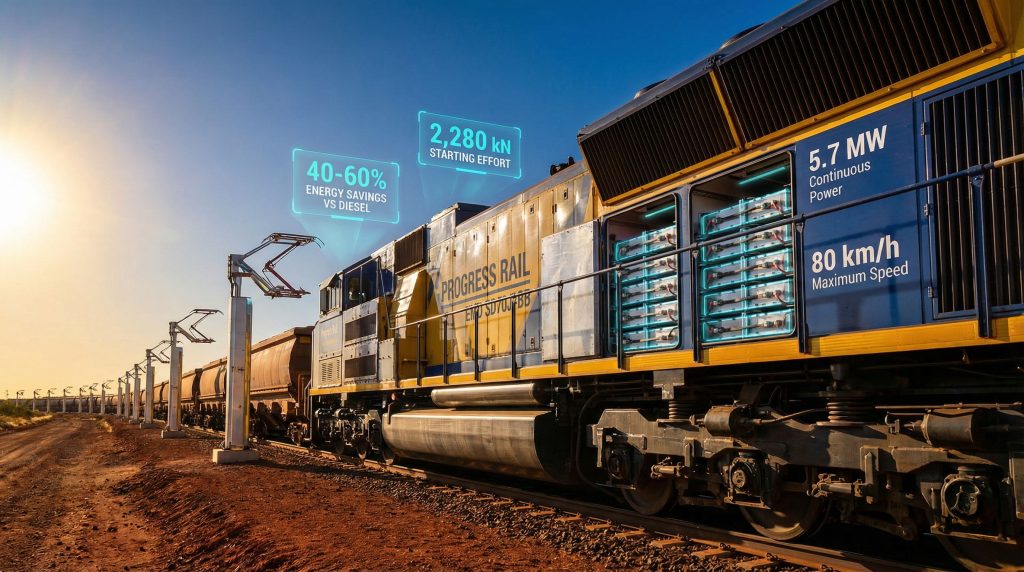
Battery-electric locomotives utilise megawatt-hour (MWh) energy storage capacity as the primary classification metric, distinct from conventional horsepower ratings. The world's biggest electric locomotive currently deployed in mining operations features 14.5 MWh lithium-ion battery capacity, capable of delivering 5.7 MW continuous traction power through an eight-axle configuration.
Physical specifications for heavy-haul applications require careful balance between weight distribution and energy density. Current generation units achieve 265-tonne operating weight while maintaining 24-metre length over coupler pulling faces, enabling operation across standard, narrow, and broad track gauge systems at maximum speeds reaching 80 kilometres per hour.
In addition, the adoption of electric vehicles in mining operations demonstrates the broader transformation occurring across the sector.
Traction Force Dynamics
Starting tractive effort represents the maximum force available during initial acceleration from stationary positions, whilst continuous ratings indicate sustained pulling capacity during normal operations. Advanced electric drivetrains provide instant torque delivery across the entire speed range, eliminating the power curve limitations inherent in diesel-electric systems.
Regenerative braking capabilities enable energy recovery during speed control operations, where kinetic energy converts back to electrical storage rather than dissipating as heat through traditional friction braking systems. This mechanism can achieve 20-30% energy recovery during downhill operations, significantly extending operational range between charging cycles.
When big ASX news breaks, our subscribers know first
Operational Performance Comparison Analysis
Battery-electric systems demonstrate measurable advantages over conventional diesel-electric configurations across multiple performance parameters, particularly in applications requiring sustained high-power output over extended periods.
Power Output and Energy Efficiency
| System Configuration | Peak Power (MW) | Energy Efficiency | Maintenance Interval |
|---|---|---|---|
| Diesel-Electric | 4.5-5.5 | 35-40% thermal | 500-1,000 hours |
| Battery-Electric | 5.7-7.0+ | 85-90% electrical | 2,000-3,000 hours |
| Hybrid Systems | Variable | 50-65% combined | 1,000-1,500 hours |
Electric drivetrains eliminate combustion engine inefficiencies, achieving 85-90% energy conversion efficiency compared to 35-40% thermal efficiency in diesel systems. This translates to substantially reduced operational energy costs, particularly in regions with favourable electricity pricing structures.
Dynamic Performance Characteristics
Electric motors deliver maximum torque instantaneously from zero speed, providing superior grade climbing performance on steep mining haul roads. Unlike diesel engines requiring time to build power through turbocharger spooling, electric systems respond immediately to throttle inputs.
The absence of gear shifting requirements eliminates power interruption during acceleration phases, maintaining consistent tractive effort throughout the speed range. This characteristic proves particularly valuable in heavy-haul operations where maintaining momentum reduces energy consumption and improves cycle times.
Current Market Technology Leaders
Progress Rail EMD SD70J-BB Specifications
The Progress Rail EMD SD70J-BB represents current benchmark performance in battery-electric locomotive technology, featuring comprehensive specifications optimised for mining applications:
- Battery Capacity: 14.5 MWh lithium-ion energy storage system
- Continuous Power: 5.7 MW traction output
- Physical Dimensions: 265 tonnes weight, 24 metres over couplers
- Speed Capability: 80 km/h maximum operating speed
- Track Compatibility: Standard, narrow, and broad gauge operation
- Charging Systems: Wayside charging with dynamic braking energy recovery
Technical documentation indicates that dynamic braking activation automatically charges battery systems during speed control operations, capturing energy that would otherwise convert to heat through traditional braking methods. Alternative charging occurs through wayside infrastructure tailored to specific operational requirements.
Moreover, these technological advances align with broader battery metals investment trends that are reshaping the mining sector.
Wabtec FLXdrive Platform
BHP's deployment of Wabtec electric locomotives on Pilbara iron ore routes represents parallel technology development focused on proven retrofit capabilities. These units underwent extensive trials connecting mining operations to Port Hedland, demonstrating commercial viability in demanding Australian mining conditions.
Wabtec's modular approach enables integration with existing diesel locomotive fleets, providing upgrade pathways that preserve infrastructure investments whilst introducing electric propulsion benefits.
International Technology Benchmarks
Chinese heavy-haul electric locomotive development has achieved significant power output milestones, with multi-section configurations capable of handling 10,000+ tonne train consists. These systems demonstrate the scalability potential for battery-electric technology in extreme heavy-haul applications, including the world's most powerful locomotives.
Furthermore, companies like Progress Rail have developed advanced battery-electric locomotive technology specifically designed for heavy-duty mining operations.
Note: Specific performance claims for international systems require independent verification from manufacturer documentation and peer-reviewed technical publications.
Strategic Investment Drivers in Mining Operations
Environmental Compliance Requirements
Mining companies face increasing pressure to achieve measurable emission reductions aligned with corporate sustainability commitments and government environmental mandates. Electric locomotive adoption provides immediate elimination of diesel exhaust emissions, particularly valuable in underground mining environments where air quality directly impacts worker safety.
Progress Rail emphasised their contribution to reducing emissions in heavy-haul rail applications, whilst Fortescue leadership described their electric locomotive deployment as redefining what's possible for heavy-haul rail operations.
Economic Justification Models
Total cost of ownership analysis must consider multiple factors beyond initial capital investment:
- Energy Cost Stability: Electricity pricing typically demonstrates lower volatility than diesel fuel markets
- Maintenance Reduction: Electric drivetrains require fewer scheduled service intervals due to reduced mechanical complexity
- Productivity Improvements: Higher availability rates through reduced downtime for maintenance activities
- Infrastructure Longevity: Battery systems designed for 10-15 year operational lifecycles with replacement programmes
Mining companies recognise that electric locomotive technology represents a substantial advancement in operational capability, with enthusiasm for deployment indicating organisational confidence in long-term benefits.
However, successful implementation requires sophisticated data-driven mining operations to optimise performance and efficiency.
Australian Mining Environment Performance
Pilbara Operational Conditions
The Pilbara region presents unique challenges for locomotive technology, requiring equipment capable of reliable operation in extreme environmental conditions:
- Temperature Extremes: Operating temperatures exceeding 45°C require robust thermal management systems
- Dust Exposure: Extensive filtration and sealing protection against iron ore dust infiltration
- Distance Requirements: Haul routes spanning 200+ kilometres between mining sites and port facilities
- Tonnage Demands: Train consists exceeding 30,000 tonnes for maximum transport efficiency
Competitive Technology Deployment
Both Fortescue and BHP have implemented parallel electric locomotive programmes, indicating industry-wide recognition of technology benefits:
Fortescue's Progress Rail Partnership:
- Two EMD SD70J-BB units delivered to Port Hedland operations
- International logistics chain from Brazil via South Africa
- Focus on maximum battery capacity and range optimisation
BHP's Wabtec Collaboration:
- Electric locomotive trials on iron ore rail routes
- Emphasis on retrofit compatibility with existing infrastructure
- Deployment timeline approximately one month ahead of Fortescue
These concurrent implementations provide valuable comparative data on different technological approaches to battery-electric locomotive deployment in identical operational environments. Additionally, this adoption demonstrates the broader sustainable mining transformation occurring across the industry.
Charging Infrastructure Development
Wayside Charging Systems
Electric locomotive operations require carefully planned charging infrastructure capable of delivering high-power electrical input within operational time constraints:
- Power Delivery Systems: High-voltage DC fast charging capabilities
- Grid Integration: Electrical substation capacity upgrades to support charging loads
- Automated Connection: Pantograph and third-rail coupling systems for unmanned operation
- Charging Optimisation: Balance between charging speed and battery longevity considerations
Dynamic Energy Recovery
Regenerative braking systems capture kinetic energy during train deceleration, converting motion back to electrical storage. This technology proves particularly valuable in mining applications with significant elevation changes, where loaded trains generate substantial energy during descent phases.
Energy Recovery Mechanisms:
- Conversion of kinetic energy to electrical current during braking
- Battery storage of recovered energy for subsequent acceleration
- Grid integration capabilities for feeding excess energy to mining facility power systems
- Optimised battery management to maximise storage system lifespan
The next major ASX story will hit our subscribers first
Future Technology Evolution Pathways
Autonomous Operation Integration
Electric locomotive technology provides ideal foundations for autonomous operation development, eliminating combustion engine complexity that complicates remote monitoring and control systems:
- Remote Control Systems: Operator-free train operation for hazardous route segments
- Artificial Intelligence: Machine learning optimisation for energy efficiency and route planning
- Safety Enhancement: Advanced collision avoidance and emergency braking protocols
- Fleet Management: Centralised monitoring with predictive maintenance capabilities
Next-Generation Battery Technology
Battery technology advancement continues at accelerated pace, with several developments promising significant performance improvements:
- Solid-State Batteries: Higher energy density enabling extended range or reduced weight
- Modular Systems: Hot-swappable battery packs for continuous operation during maintenance
- Recycling Programmes: Sustainable end-of-life material recovery for environmental compliance
- Cost Reduction: Industry projections indicate 50% battery cost decline by 2030
Market Expansion Opportunities
Electric locomotive success in Australian iron ore operations creates expansion opportunities across global mining sectors:
- Commodity Diversification: Applications in coal, copper, lithium, and precious metals mining
- Geographic Expansion: Technology transfer to mining operations worldwide
- Retrofit Market: Converting existing diesel locomotive fleets to electric propulsion
- Cross-Industry Applications: Lessons learned for passenger and freight rail development
Implementation Success Factors
Technical Integration Requirements
Successful electric locomotive deployment requires comprehensive planning across multiple technical domains:
- Electrical Infrastructure: Grid stability and capacity verification for charging operations
- Workforce Development: Training programmes for electric system maintenance and operation
- Supply Chain Management: Parts availability and technical support for specialised components
- Performance Monitoring: Real-time data collection systems for operational optimisation
Financial Planning Considerations
Electric locomotive investment involves substantial capital commitment requiring careful financial structure:
- Coordinated Investment: Locomotive acquisition timing with infrastructure development
- Technology Risk: Protection against rapid technological advancement and obsolescence
- Partnership Strategies: Risk sharing arrangements with equipment manufacturers
- Return Timelines: Achieving financial payback within acceptable 5-7 year periods
The deployment of the world's biggest electric locomotive in Australian mining operations represents a significant milestone in heavy-haul rail technology evolution. With Fortescue and BHP leading adoption through different technological partnerships, the mining industry demonstrates confidence in electric locomotive capabilities for demanding operational environments.
Consequently, this technological advancement marks a pivotal moment for heavy-haul rail transport, establishing new benchmarks for performance, efficiency, and environmental responsibility. As the world's biggest electric locomotive continues proving its capabilities in Australian mining operations, industry-wide adoption appears increasingly inevitable across global mining sectors.
Disclaimer: This analysis is based on publicly available information and industry reports. Operational performance claims should be verified through manufacturer documentation and peer-reviewed technical publications. Investment decisions should consider multiple risk factors and consult qualified technical and financial advisors.
Looking to Capitalise on Mining Technology Advancements?
Discovery Alert's proprietary Discovery IQ model delivers real-time alerts on significant mineral discoveries across the ASX, helping investors identify companies at the forefront of mining innovation and technological transformation. Experience how major technological breakthroughs can drive substantial market returns by exploring Discovery Alert's dedicated discoveries page, and begin your 30-day free trial today to position yourself ahead of the market.