June 24, 2026
The Scale Problem That Incremental Solutions Cannot Solve
Open-cut mining operations generate emissions in ways that are structurally resistant to easy fixes. Unlike stationary industrial processes, which can be decarbonised through equipment upgrades or grid connections, large-scale haulage fleets operate across kilometres of variable terrain, under extreme physical loads, and in environmental conditions that push the limits of almost any technology. Diesel has dominated this space for decades not because it was the best option environmentally, but because no alternative could match its energy density, reliability, and operational flexibility at scale. That calculus is now changing, and the battery-electric haul truck trial in the Pilbara is one of the most consequential real-world tests of whether that change is genuinely viable.
The numbers behind the emissions challenge are significant. Diesel haulage fleets represent one of the largest individual contributors to operational greenhouse gas emissions in open-cut iron ore mining. When you factor in the scale of Pilbara operations, with hundreds of ultra-class trucks running continuous shift patterns across enormous pit-to-crusher distances, the aggregate carbon footprint becomes a material liability for producers with binding decarbonisation commitments. Fuel efficiency improvements, while useful at the margin, cannot close the gap between current emission levels and the targets major miners have publicly set. Full electrification is not a preference; it is increasingly a mathematical necessity.
When big ASX news breaks, our subscribers know first
Why Jimblebar Was Chosen as the Trial Centrepiece
Not every mine site is suitable for pushing the boundaries of battery-electric mining technology, and the selection of BHP's Jimblebar iron ore operation in Western Australia's Pilbara region was deliberate. Jimblebar represents one of the most operationally intensive environments in the global iron ore industry. Haul cycles are continuous, payloads are heavy, ambient temperatures regularly exceed 40°C in summer, and the distances between pit faces and processing infrastructure create energy consumption profiles that simply do not exist in smaller or more temperate mining environments.
These conditions are precisely what makes the site so valuable as a testing ground. If a battery-electric system can sustain reliable performance at Jimblebar, that performance data becomes applicable to a vast range of large-scale open-cut operations globally. The two Cat® 793 XE Early Learner units currently operating at the site are among only seven such trucks deployed anywhere in the world, giving Jimblebar a disproportionately significant role in Caterpillar's global commercialisation program for battery-electric haulage.
The Cat® 793 XE Early Learner: What the Truck Actually Is
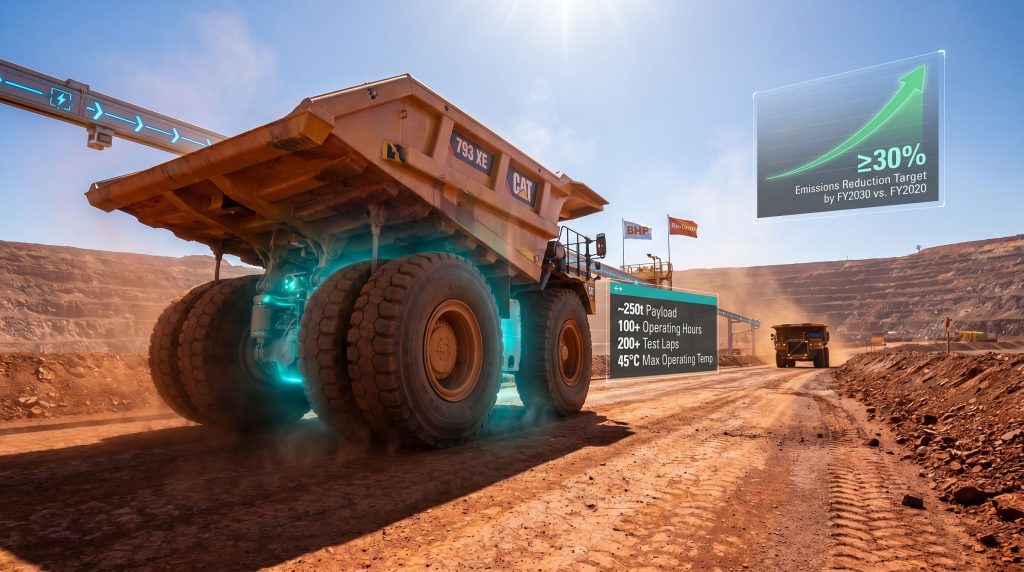
Understanding the designation matters for interpreting what this trial can and cannot tell us. The Cat® 793 XE is Caterpillar's battery-electric variant within the 793-series, a platform already well-established in large-scale mining through its diesel-powered predecessors. The key specifications relevant to Pilbara operations include:
- Payload capacity: approximately 250 tonnes per cycle, consistent with the operational requirements of large iron ore haulage
- Thermal tolerance: engineered to operate in ambient conditions reaching 45°C, directly addressing the Pilbara's summer extremes
- Powertrain architecture: battery-electric drive replacing the diesel-mechanical or diesel-electric systems used in conventional 793-series trucks
- Development status: classified as an "Early Learner" unit, meaning it is a pre-commercial platform generating field data rather than a finalised production model
The Early Learner classification is important context for investors and industry observers. These are not trucks that have been signed off for fleet procurement. They are sophisticated engineering tools designed to close the gap between proving ground performance and the realities of sustained commercial mine-site operation, a gap that has historically been one of the most difficult to bridge in mining equipment development.
Before arriving in the Pilbara, the 793 XE units underwent rigorous safety validation and controlled performance assessments at Caterpillar's Tucson Proving Ground in Arizona. According to BHP and Rio Tinto's official announcement, the transition from that controlled environment to Jimblebar represents a significant step-up in operational complexity and environmental severity.
The Three-Party Collaboration: Structure and Rationale
The arrangement between BHP, Rio Tinto, and Caterpillar is genuinely unusual in an industry where competitive dynamics typically discourage the sharing of operational data. Understanding why two of the world's largest iron ore producers are running a joint trial on the same platform at the same site requires thinking about where competitive advantage actually lies in mining decarbonisation.
At this stage of technology development, neither company benefits from proprietary exclusivity over early-phase validation data. The real competitive differentiation will come later, when each company applies trial learnings to its own infrastructure decisions, fleet procurement strategies, and operational integration approaches. The joint trial is fundamentally a pre-competitive collaboration on enabling technology, with post-trial divergence built into the program design from the outset.
WesTrac, the authorised Caterpillar dealer for Western Australia, plays a critical in-field support role, providing equipment servicing, parts logistics, and technical assistance that would be difficult to centralise through Caterpillar's global operations alone. This local service layer is itself an important element of the commercial viability assessment, since any large-scale fleet deployment would depend heavily on in-region maintenance capability.
| Trial Parameter | Detail |
|---|---|
| Host site | Jimblebar iron ore mine, Pilbara, WA |
| Units deployed at site | 2 × Cat® 793 XE Early Learner |
| Total global Early Learner deployments | 7 units worldwide |
| Payload capacity | ~250 tonnes per cycle |
| Maximum rated operating temperature | 45°C |
| Phase 1 operating hours | 100+ hours |
| Phase 1 test laps completed | 200+ laps |
| BHP FY2030 emissions target | ≥30% reduction vs. FY2020 baseline |
| Next trial phase | Dynamic (in-motion) charging systems |
What Phase One Data Actually Reveals
More than 100 hours of active operation and over 200 individual monitored test laps completed in the first phase of the trial represent a meaningful dataset, but one that needs to be interpreted carefully. This is early-phase data, generated under structured testing conditions rather than the fully unconstrained, shift-pattern operations of a commercial haulage fleet.
What Phase One validates is a specific set of assumptions:
- Safety protocols function as designed under real mine-site conditions rather than controlled proving ground scenarios
- Powertrain performance meets baseline specifications across varying haul gradients and load conditions at Jimblebar
- Thermal management systems demonstrate adequate battery temperature regulation under ambient conditions consistent with Pilbara operations
- Maintenance procedures developed for the 793 XE are executable within the mine-site environment without requiring specialised infrastructure that would be impractical at scale
Beyond these binary validations, the trial is also generating continuous data streams covering energy consumption per cycle, infrastructure load profiles, and the interaction between the electric truck's systems and Jimblebar's existing fleet management architecture. This data is less about pass or fail and more about quantifying the parameters that will define the commercial business case for electrification. Furthermore, the role of renewable energy in mining will be closely linked to how that energy consumption data ultimately shapes the infrastructure investment decisions ahead.
The distinction between validating a technology and proving a commercial case is critical. Phase One confirms the trucks can operate safely and perform mechanically at Jimblebar. The commercial case depends on what the energy consumption data, infrastructure load requirements, and total cost of ownership modelling ultimately shows across extended operational periods.
The Charging Infrastructure Question: The Harder Problem
Battery-electric trucks do not operate in isolation. Their viability at fleet scale depends entirely on the charging infrastructure ecosystem built around them, and this is where the most technically complex and commercially consequential questions remain open.
The Jimblebar trial is evaluating two fundamentally different charging approaches:
High-powered static charging involves fixed infrastructure at designated locations along the haul route or at operational pauses, designed to deliver rapid recharge cycles during scheduled downtime. This approach is conceptually straightforward but introduces operational scheduling constraints that do not exist with diesel refuelling, which can be completed in minutes anywhere on the haul route.
Dynamic charging via in-motion energy transfer is the more ambitious and technically novel element of the next trial phase. This system is designed to deliver electrical energy to the truck while it continues moving, eliminating or substantially reducing the charging downtime penalty. If proven viable at the scale and terrain variability of a Pilbara haul road, dynamic charging could remove one of the most significant operational efficiency barriers facing battery-electric haulage adoption.
The engineering challenges of dynamic charging in this context should not be underestimated. Haul roads in large Pilbara iron ore operations can extend for several kilometres across variable gradients, with surface conditions that deteriorate under heavy traffic. Deploying reliable in-motion energy transfer infrastructure across that environment, while maintaining the throughput of a high-utilisation haulage fleet, represents a genuinely unsolved engineering problem at commercial scale.
The Capital Cost Dimension
Transitioning from diesel to electric haulage is not simply a matter of swapping one truck for another. The infrastructure investment required to support a battery-electric fleet at scale includes:
- High-capacity charging stations or dynamic charging infrastructure across haul routes
- Substantial increases in on-site electrical generation or grid connection capacity
- Battery management and thermal regulation systems integrated into mine-site infrastructure
- Modified maintenance facilities and technician training programmes
- Fleet management software capable of optimising electric truck scheduling around energy availability
Against these capital costs sits the long-term savings profile from eliminated diesel fuel purchases and reduced drivetrain maintenance requirements. The economic case for electrification is real, but the capital intensity of the transition means that investment decisions made during the trial phase will shape operational economics for the next decade or longer.
Fortescue's Parallel Path and the Multi-Track Industry Dynamic
The battery-electric haul truck trial in the Pilbara does not exist in a competitive vacuum. Fortescue, the Pilbara's third major iron ore producer, has been pursuing its own proprietary electric haul truck development programme, including work on high-capacity fast charging infrastructure tailored to its specific operational profile. This parallel development track illustrates an important dynamic in mining decarbonisation technology: multiple technical approaches are being pursued simultaneously, and it is not yet clear which architecture will prove most commercially durable.
The existence of multiple competing approaches is actually healthy for the sector's long-term transition. Competition between OEM-led solutions like the Cat® 793 XE programme and producer-led proprietary development accelerates innovation and creates pressure on cost reduction timelines. However, it also means the industry has not yet converged on a standard technical architecture, which introduces supply chain fragmentation risk for operators making early infrastructure commitments.
The next major ASX story will hit our subscribers first
The Downstream Significance for Global Steel Supply Chains
The carbon intensity of Pilbara iron ore has become an increasingly material consideration for steelmakers navigating their own decarbonisation obligations. As major steel producers in Asia and Europe face mounting pressure from carbon pricing mechanisms and customer commitments, the emissions profile of their raw material inputs is drawing greater scrutiny. Consequently, green steel pricing dynamics are increasingly influencing how iron ore producers frame their electrification investments to downstream customers.
A successful transition to battery-electric haulage across Pilbara operations would reduce the embedded emissions in Australian iron ore exports, improving the competitive position of Pilbara producers relative to higher-emission supply alternatives. This dynamic is already influencing how long-term supply agreements are structured, with some steelmakers beginning to incorporate carbon intensity metrics into procurement criteria alongside traditional price and quality specifications. In addition, shifts in China steel and iron ore markets are adding further urgency to these carbon intensity considerations.
For BHP and Rio Tinto, demonstrated progress on electrification therefore serves a dual commercial purpose: reducing direct operational emissions toward internally committed targets, and maintaining the premium position of Australia's iron ore leadership in a steel supply chain that is itself undergoing a structural low-carbon transition.
From Seven Trucks to Fleet Scale: The Path Forward
The gap between seven globally deployed Early Learner units and a commercialised fleet-scale deployment programme is substantial, and the mining industry should be clear-eyed about the milestones that still need to be crossed. A credible pathway to fleet electrification requires:
- Completion of dynamic charging trials and confirmation of operational efficiency outcomes
- Extended multi-shift operation data demonstrating sustained performance without unexpected degradation in battery capacity or powertrain reliability
- Full cost-of-ownership modelling validated against real operational data rather than design assumptions
- Supply chain development for battery cells and powertrain components at the volumes required for fleet procurement
- Local service capability scaled to support large fleets rather than pilot programmes
None of these steps are insurmountable, but each represents genuine uncertainty in the current timeline. The Jimblebar trial is building the evidence base required to make those steps achievable, which is precisely why its early-phase results matter to the broader industry even before a commercial deployment decision has been made. As Mining Weekly reports, neither BHP nor Rio Tinto have confirmed a fleet-scale procurement commitment at this stage, underscoring that the battery-electric haul truck trial in the Pilbara remains firmly in its evidence-gathering phase.
If the battery-electric haul truck trial in the Pilbara ultimately demonstrates sustained commercial-grade performance across extended operations, it will fundamentally reshape the investment case for large-scale mining in a carbon-constrained world. Success here does not just validate a truck. It validates a transformation in how the world's most capital-intensive extractive industry can operate.
This article contains forward-looking assessments based on publicly available trial data and industry analysis. Readers should note that technology trials involve inherent uncertainty, and outcomes from early-phase testing should not be interpreted as confirmation of commercial deployment decisions or investment outcomes. Independent professional advice should be sought before making any investment decisions related to companies or technologies discussed in this article.
Want to Track the Mining Companies Driving This Transformation?
Discovery Alert's proprietary Discovery IQ model delivers real-time alerts the moment significant ASX mineral discoveries are announced, turning complex data across 30+ commodities into clear, actionable insights — so investors can act ahead of the broader market. Explore how historic discoveries have generated extraordinary returns and begin your 14-day free trial today to position yourself at the forefront of mining's next major shift.