June 24, 2026
The Deepwater Economics of Stranded Gas: Why the South Atlantic Is Rewriting the LNG Playbook
For decades, the commercial logic of deepwater gas development was brutally simple: if you could not pipe it to shore cheaply, you left it in the ground. Floating LNG technology has fundamentally disrupted that calculus, and nowhere is this shift more consequential right now than in the waters off Suriname's northern coastline. The Petronas gas discovery offshore Suriname is not merely another exploration milestone to log and move on from. It is the latest confirmation that a geological province long overshadowed by its Guyanese neighbour is beginning to assert itself as one of the Atlantic Basin's most structurally compelling deepwater plays.
Understanding what is genuinely at stake here requires stepping back from the headline numbers and examining the layered geology, the evolving partnership architecture, the infrastructure choices being made, and the economic scenarios those choices will ultimately produce. Furthermore, the LNG supply outlook for 2025 and beyond adds important context to why this discovery matters beyond Suriname's borders.
When big ASX news breaks, our subscribers know first
The Geological Foundation: Why the Suriname-Guyana Basin Keeps Delivering
The Suriname-Guyana Basin sits at the confluence of ancient continental breakup geology and exceptionally well-preserved deepwater turbidite systems. The basin's Campanian-age sandstone formations, deposited roughly 72 to 84 million years ago during the Late Cretaceous period, have proven to be the primary reservoir target across the region. These formations are characterised by high porosity, strong lateral continuity, and naturally pressurised reservoir conditions that support both oil and gas accumulations within the same stratigraphic package.
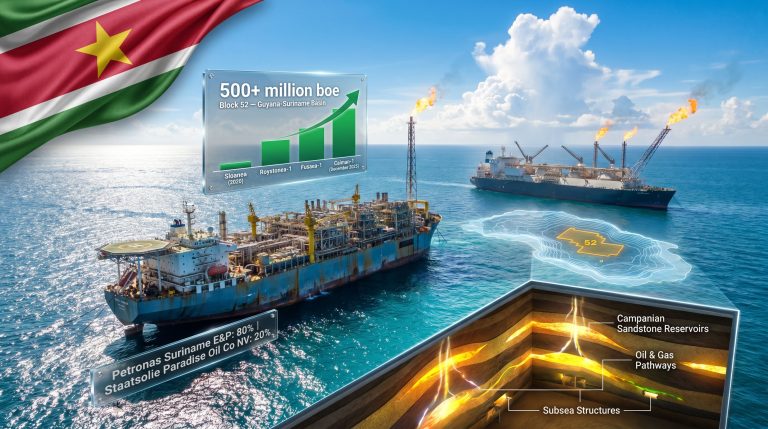
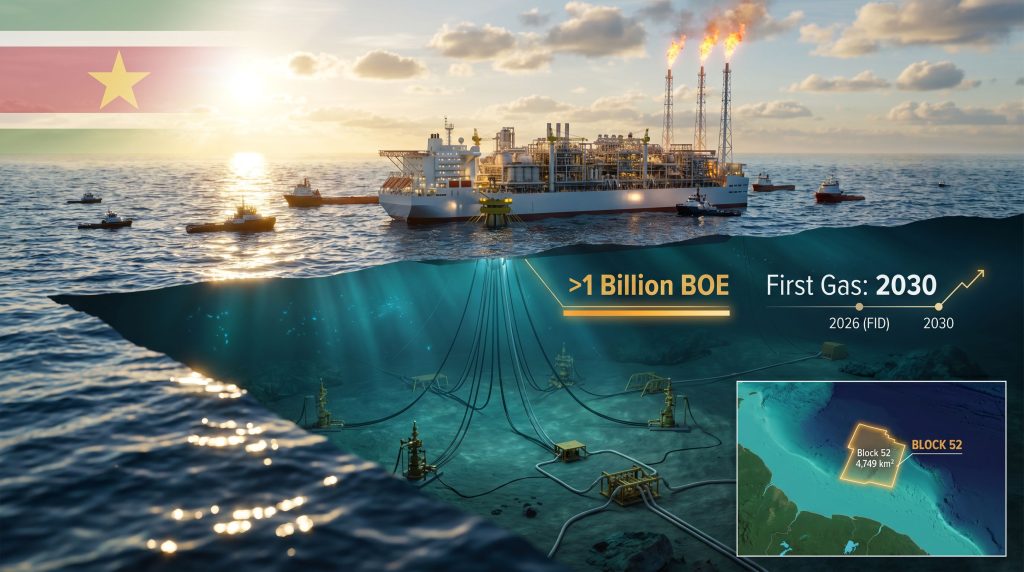
Block 52 itself spans approximately 4,749 square kilometres north of Paramaribo, Suriname's capital, in water depths reaching around 450 metres. This places it in what the industry classifies as the shallow end of deepwater territory, a depth range that meaningfully reduces subsea infrastructure complexity compared to ultra-deepwater projects operating below 1,500 metres. That physical characteristic is not incidental to the FLNG development concept being advanced for the block; it directly influences the engineering options available and the cost envelope within which those options can be executed.
What makes the Campanian play in Suriname particularly interesting from a geological standpoint is the stacking of multiple reservoir packages within a single wellbore. The Fusaea-1 exploration well, drilled to a total depth of 5,227 metres and spudded in February 2024, encountered precisely this kind of multi-layer stratigraphy. Rather than a single hydrocarbon-bearing interval, the well intersected several distinct oil and gas-bearing Campanian sandstone packages at depth. This stacked reservoir character is geologically significant because it multiplies the development optionality available to the operator and reduces the per-barrel infrastructure cost when wells can produce from multiple intervals simultaneously.
Block 52 Discovery History at a Glance
| Discovery | Year | Hydrocarbon Type | Significance |
|---|---|---|---|
| Sloanea-1 | 2020 | Gas | First hydrocarbon confirmation in Block 52 |
| Roystonea-1 | 2023 | Oil | First oil discovery; commercially declared 2025 |
| Fusaea-1 | 2024 | Oil and Gas | Third discovery; deepens integrated development case |
From Eight Discoveries to One Billion Barrels: What the Cumulative Resource Base Means
The aggregate resource picture that has emerged from Block 52 over the past five years is striking by any measure. Petronas has now confirmed eight separate hydrocarbon discoveries within the block, collectively unlocking an estimated gross resource base exceeding 1 billion barrels of oil equivalent. To contextualise that figure, it places Block 52 within a small cohort of deepwater exploration programmes globally that have achieved billion-barrel-scale resource recognition from a single licence area.
The Roystonea-1 oil discovery, commercially declared in 2025, and the Fusaea-1 find together represent estimated combined recoverable resources of approximately 400 million barrels of oil equivalent. These two assets anchor the integrated development case for the block, providing both the scale justification and the hydrocarbon diversification (oil and gas) that typically underpins a commercially robust deepwater development concept. In addition, the broader commodity price impacts of such large-scale resource discoveries continue to reverberate across global energy markets.
Equally notable is the operational record that Petronas has compiled across this exploration programme. The drilling of Fusaea-1 was completed without a single lost-time incident, continuing a clean safety record across the broader Block 52 campaign. In deepwater drilling, where well intervention costs can exceed several million dollars per day, an incident-free operational track record is not just a safety achievement; it is a direct financial indicator of programme execution quality.
The FID Pathway: Six Steps Between Discovery and Capital Commitment
A Final Investment Decision is the single most consequential threshold in the lifecycle of any major upstream project. It is the moment at which exploration success converts into committed development capital, and it carries with it a cascade of contractual, financial, and operational obligations that are extremely difficult to reverse. Petronas is targeting an FID in 2026 for the commercially viable gas reserves within Block 52, a timeline that was materially enabled by the commercial declaration of the Sloanea-1 gas discovery in November 2025.
What is a Final Investment Decision (FID)?
An FID is the formal point at which an energy company commits development capital to a discovered resource. It follows appraisal confirmation, engineering studies, and commercial agreements, and it marks the transition from an exploration programme to full-scale project execution. Once sanctioned, FID projects typically cannot be paused without significant financial and contractual consequences. A definitive feasibility study process shares several parallels with this pre-FID discipline, particularly in how operators de-risk capital decisions before committing.
The distinction between a discovery announcement and a commercial declaration is a nuance that often escapes general reporting but carries significant technical and legal weight. A commercial declaration is an operator's formal assertion that a discovered accumulation is economically viable under the terms of the governing production-sharing contract. It triggers specific obligations under Suriname's regulatory framework, administered through Staatsolie, the national oil company, and sets the clock running on development plan submission timelines.
The pre-FID process for Block 52 encompasses several sequential milestones:
- Appraisal drilling to confirm reservoir continuity and refine recoverable resource estimates
- Development concept selection evaluating standalone FLNG versus hub-and-spoke integration with nearby resources
- Front-End Engineering and Design (FEED) completion for subsea infrastructure and the FLNG hull and topsides
- Gas offtake agreement execution with LNG buyers, establishing the commercial foundation for project financing
- Regulatory approval from Staatsolie and relevant Surinamese government counterparts
- FID sanction and financing structure finalisation, including potential project finance tranches and equity contributions
FLNG: A Regional First With Global Precedent
The development architecture selected for Block 52's gas resources centres on a Floating LNG facility, to be positioned approximately 120 kilometres offshore in water depths of around 450 metres. This will be the first FLNG installation in the Suriname-Guyana region, a distinction that carries both technical and commercial significance.
FLNG was chosen over conventional onshore LNG processing for several reasons that are specific to Block 52's geography and reservoir characteristics. An offshore pipeline to bring gas ashore would require significant capital and add complexity that is difficult to justify at current reservoir scales. An FLNG solution eliminates the need for that pipeline entirely, allows the production facility to be positioned directly above or near the reservoir, and can theoretically be relocated if reservoir performance changes over the field's life.
Petronas brings directly relevant operational experience to this development concept. The company operates two FLNG vessels offshore Malaysia: PFLNG Satu, the world's first purpose-built FLNG vessel when it was deployed in 2016, and PFLNG Dua, deployed subsequently in deeper water. This track record provides Petronas with proprietary knowledge of FLNG commissioning, production ramp-up, and operational optimisation that most operators in the South Atlantic simply do not possess.
Comparable deepwater FLNG projects across West Africa and Southeast Asia have required development capital in the range of $5 billion to $12 billion, depending on vessel size, reservoir complexity, and subsea infrastructure scope. Block 52's relatively moderate water depth and the potential to integrate oil production from Roystonea-1 into a combined development hub could meaningfully improve capital efficiency relative to those benchmarks.
Subject to FID being achieved in 2026 and a standard four-year deepwater project execution window, first gas from Block 52 is projected for approximately 2030.
Petronas in the Competitive Landscape: How Block 52 Stacks Up Regionally
Suriname's offshore development picture is being shaped by two distinct programmes operating on parallel but non-overlapping timelines. However, understanding the broader oil market geopolitics is equally important when assessing where Suriname's emerging production fits within global supply dynamics.
| Operator | Asset | Status | Hydrocarbon Type | Target Date |
|---|---|---|---|---|
| Petronas (operator, 50% WI) | Block 52 | Pre-FID | Gas and Oil | FID 2026; First Gas 2030 |
| TotalEnergies-led consortium | Offshore Block | Development | Oil | First Oil 2028 |
| ExxonMobil and Hess | Stabroek Block, Guyana | Production | Oil | Producing |
| Petrobras | Pre-Salt Basins, Brazil | Production | Oil and Gas | Producing |
The TotalEnergies-led consortium's project, Suriname's inaugural offshore production venture, remains on track to deliver first oil in 2028, according to Suriname's Oil Minister. This is a structurally important parallel development because it means Suriname will have production-stage hydrocarbon revenues flowing before Block 52 reaches first gas. That sequencing reduces the country's fiscal dependence on any single project and provides Staatsolie and the Surinamese government with practical experience in managing royalty streams and production-sharing arrangements before the larger Block 52 cash flows arrive.
ExxonMobil's 2024 withdrawal from Block 52 is a detail worth analysing more carefully than it typically receives. When a supermajor exits a pre-FID deepwater position, the conventional market interpretation is negative. However, in Petronas' case, the exit consolidated operational control within a single decision-making entity with a clear strategic rationale for FLNG development. Rather than managing a joint-venture dynamic with a partner whose internal capital allocation priorities had shifted, Petronas retained operatorship and development pace autonomy. That outcome arguably strengthened the project's path to FID rather than weakening it.
The next major ASX story will hit our subscribers first
Suriname's Economic Scenarios: Three Pathways to a Transformed Fiscal Position
The economic stakes of Block 52's development are not abstract for Suriname. The country experienced a significant debt restructuring process in the early 2020s following severe fiscal pressures, and the prospect of substantial hydrocarbon export revenues represents a generational opportunity to rebuild government finances on a more sustainable foundation. Furthermore, the geopolitical risk landscape that shapes investor appetite for frontier energy projects adds another layer of complexity to Suriname's development ambitions.
Three scenarios frame the range of plausible outcomes:
Scenario A (Base Case): On-Track Development
- FID achieved in 2026; FLNG operational by 2030 at plateau capacity
- Suriname receives royalties, production-sharing entitlements, and corporate income taxes from Block 52
- Combined with TotalEnergies' oil revenues from 2028, hydrocarbon export receipts could materially alter GDP composition by the early 2030s
Scenario B (Downside): Delayed FID
- FID pushed to 2027 or 2028 due to gas marketing delays, financing constraints, or regulatory process extensions
- First gas deferred to 2032, reducing near-term fiscal benefit
- Increased pressure on the government to demonstrate governance credibility to international investors and lenders
Scenario C (Upside): Expanded Development
- Additional discoveries within Block 52 trigger a larger integrated development concept
- FLNG capacity expanded; a potential second train considered for mid-2030s construction
- Suriname emerges as a credible Atlantic Basin LNG exporter, attracting further exploration licensing interest from international operators
Unlike neighbouring Guyana, which commenced oil production in 2019 and rapidly transformed its fiscal trajectory, Suriname remains in the pre-production phase across the majority of its offshore acreage. The Block 52 development programme represents one of the most consequential economic opportunities in the country's modern history, but realising its full potential requires sustained capital commitment, governance discipline, and continued exploration success within the block.
Key Metrics at a Glance
| Metric | Detail |
|---|---|
| Total Discoveries in Block 52 | 8 |
| Gross Resources Unlocked | More than 1 billion BOE |
| Fusaea-1 Well Depth | 5,227 metres |
| Block 52 Area | Approximately 4,749 km² |
| Roystonea + Fusaea Recoverable Resources | Approximately 400 million barrels |
| FID Target | 2026 |
| First Gas Target | 2030 |
| FLNG Deployment Water Depth | Approximately 450 metres |
| FLNG Distance Offshore | Approximately 120 km |
| Petronas Working Interest | 50% (operator) |
What to Watch: Near-Term Milestones That Will Define the Block 52 Story
For industry observers and investors tracking the development of Suriname's offshore energy sector, several near-term signals will be decisive in determining whether Block 52 progresses on its stated timeline or faces headwinds.
- Gas offtake agreement disclosures: LNG marketing arrangements with buyers are the commercial backbone of any FLNG project. Announcements of binding or conditional offtake contracts would represent a significant confidence signal for FID timing.
- FLNG contractor selection: The award of engineering, procurement, and construction contracts for the FLNG vessel will confirm that pre-FID engineering has advanced sufficiently to justify major capital commitments.
- Staatsolie participation terms: How Suriname's national oil company elects to participate in Block 52's development, whether through a carried interest, a direct equity stake, or a production-sharing arrangement, will shape both the project's financing structure and the government's revenue expectations.
- Further exploration results: Block 52 still contains undrilled prospects. Any additional discovery announcements before FID would either expand the development concept or introduce complexity that could extend the pre-FID timeline.
The Petronas gas discovery offshore Suriname is best understood not as a single event but as the most recent data point in a disciplined, multi-year exploration campaign that has systematically de-risked one of the South Atlantic's most structurally interesting deepwater licence areas. With eight discoveries confirmed, a commercial gas declaration secured, and an FID target locked for 2026, Block 52 is approaching the moment where exploration success must convert into development execution. How Petronas navigates that transition, and how Suriname positions itself to capture the resulting economic value, will define both organisations' trajectories through the 2030s.
This article is intended for informational purposes only and does not constitute financial or investment advice. Forward-looking statements regarding development timelines, resource estimates, and economic outcomes are subject to material risks, uncertainties, and assumptions that could cause actual results to differ materially from those projected. Readers should conduct independent due diligence before making any investment decisions.
Want to Stay Ahead of the Next Major Energy or Mineral Discovery?
Discovery Alert's proprietary Discovery IQ model delivers real-time alerts on significant ASX mineral discoveries, turning complex resource data into actionable investment insights for both short-term traders and long-term investors — explore historic discovery returns on Discovery Alert's discoveries page to understand the scale of opportunity these moments can represent, then begin your 14-day free trial at Discovery Alert to position yourself ahead of the market.