
June 24, 2026
The Deepwater Geology That Is Reshaping South America's Energy Map
Deepwater geology operates on timescales and complexities that rarely align with investor attention spans. Yet when the subsurface delivers, it tends to deliver at scale. The Upper Cretaceous sedimentary systems of the Guyana-Suriname Basin represent precisely this kind of geological phenomenon: a structurally coherent, hydrocarbon-rich fairway that has quietly become one of the most consequential offshore frontiers on the planet.
What makes this basin particularly compelling from a technical standpoint is the consistency of its Campanian-age sandstone reservoirs. These depositional sequences, laid down during a period of significant sediment input from ancient river systems draining the South American craton, created thick, porous, and permeable sand bodies with the exact characteristics required to trap and preserve large hydrocarbon accumulations.
The same geological logic that unlocked billions of barrels in Guyana's Stabroek Block extends laterally into Suriname's offshore waters, albeit with variations in structural geometry and trap configuration that have kept explorers busy for years.
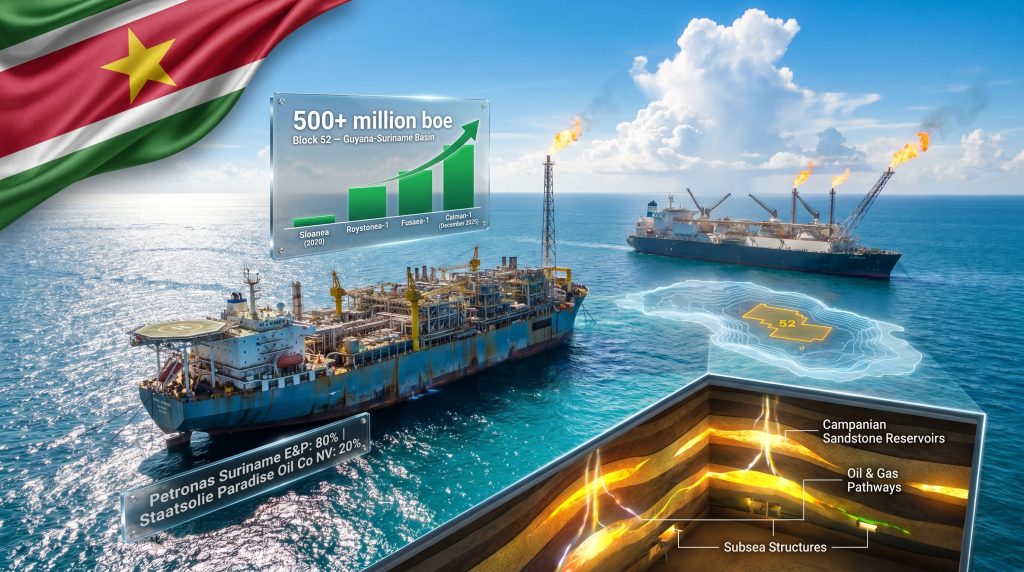
The Petronas Suriname offshore Block 52 discovery programme has become the most watched expression of that geological potential, and recent announcements confirm the block is maturing from a frontier exploration story into a genuine multi-hydrocarbon development opportunity.
When big ASX news breaks, our subscribers know first
From Gas Play to Full-Spectrum Hydrocarbon Opportunity
The Sloanea Foundation
The Block 52 story did not begin with oil. When Petronas drilled the Sloanea-1 well in 2020, the result was a natural gas discovery significant enough to eventually be declared commercially viable by Staatsolie, setting the block on a trajectory toward a Final Investment Decision (FID) for gas development. That FID is now expected in 2026, with first gas production targeted for approximately 2030.
The Sloanea discovery performed an important geological function beyond confirming the presence of hydrocarbons. It demonstrated that the Campanian sandstone packages in Block 52 were both laterally extensive and sufficiently porous to support commercial accumulations. In practical terms, it gave Petronas's geoscience teams a calibration point for understanding how hydrocarbons were distributed across the broader block.
Roystonea-1: When the Block Became an Oil Story
The drilling of the Roystonea-1 well in November 2023 fundamentally changed how the energy industry perceived Block 52. Located approximately 185 kilometres offshore, drilled through 904 metres of water depth, the well encountered multiple oil-bearing Campanian sandstone intervals. For a block already progressing toward gas commerciality, the confirmation of oil substantially expanded the potential value proposition.
Oil and gas co-existing within a single deepwater block is not unusual in geological terms. What matters is the spatial relationship between accumulations and whether shared infrastructure can be used to develop them efficiently. Roystonea's oil discovery opened that conversation for Block 52 in a way that a gas-only block simply cannot.
Fusaea-1 and the Eastward Extension
Confirmed in May 2024, the Fusaea-1 well was drilled approximately 9 kilometres east of Roystonea-1. It encountered both oil-bearing and gas-bearing Campanian sandstone intervals, a result that proved two critical things simultaneously.
First, the oil-bearing fairway identified at Roystonea was not an isolated structural trap but a more laterally continuous hydrocarbon system. Second, the presence of gas at Fusaea created an opportunity to think about integrated development concepts that could monetise both phases of the hydrocarbon column.
Together, Roystonea and Fusaea are estimated to hold a combined recoverable resource of approximately 400 million barrels of oil equivalent (boe), a figure that on its own approaches the minimum threshold commonly required to justify a standalone deepwater Floating Production, Storage and Offloading (FPSO) vessel deployment.
Caiman-1 and the Ongoing Four-Well Campaign
Drilling at the Caiman-1 well concluded in December 2025, targeting the western portion of Block 52. Petronas characterised the results as encouraging, though detailed reservoir data remains under evaluation. The well forms part of a structured four-well exploration campaign designed to systematically test the block's prospectivity from east to west.
In June 2026, Suriname's President Jennifer Simons publicly confirmed that Petronas had made another discovery at Block 52, describing the result as setting the foundation for multiple oil and gas developments across the country's offshore acreage.
Resource Scale: What the Numbers Actually Mean
Discovery Summary and Resource Estimates
| Discovery | Date | Hydrocarbon Type | Resource Status |
|---|---|---|---|
| Sloanea-1 | 2020 | Natural Gas | Commercially viable; FID 2026 |
| Roystonea-1 | November 2023 | Oil | ~400 million boe (combined) |
| Fusaea-1 | May 2024 | Oil and Gas | Included in 400 million boe estimate |
| Caiman-1 | December 2025 | Oil and Gas | Under evaluation |
| Block 52 Total | 2026 estimate | Oil and Gas | 500+ million boe (Rystad Energy) |
Energy research firm Rystad Energy has estimated the block's total recoverable resource potential at over 500 million boe, a figure that industry analysts consider a conservative floor rather than a ceiling given that the four-well campaign has not yet concluded and appraisal drilling has not begun in earnest.
A 500 million boe recoverable resource base places Block 52 firmly within the category of deepwater developments that can support standalone infrastructure. At this scale, the economics of both FPSO deployment for oil and Floating LNG (FLNG) for gas become viable on independent terms, rather than requiring the subsidisation of shared facilities.
The commerciality declaration for oil is being targeted within 18 months of mid-2026, implying a mid-2027 milestone that would trigger appraisal drilling obligations, development concept selection, and the activation of the block's fiscal framework under its production-sharing agreement with Staatsolie.
The Ownership Restructure That Simplified Everything
ExxonMobil's November 2024 Exit
In November 2024, ExxonMobil transferred its 50% working interest in Block 52 to Petronas. The transaction left Petronas as both the sole operator and the dominant equity holder. The current participating interest structure is:
- Petronas Suriname E&P: 80%
- Staatsolie's Paradise Oil Co NV: 20%
ExxonMobil's departure is analytically significant precisely because it occurred as the block was demonstrating genuine commercial potential. The company's decision likely reflects its internal capital allocation priorities, particularly given its enormous commitment to the Stabroek Block in neighbouring Guyana, rather than any scepticism about Block 52's prospectivity.
For Petronas, the consolidation of operatorship eliminates the friction inherent in joint venture decision-making. With a single operator controlling 80% of the equity, development concept selection, contractor negotiations, and FID timing can proceed more efficiently than would be possible with a 50-50 partner structure.
This pattern of national oil companies acquiring strategic deepwater positions as international majors rationalise their upstream portfolios is observable across multiple frontier basins globally. Petronas's Block 52 consolidation fits squarely within that broader structural dynamic, and furthermore reflects the shifting geopolitical resource landscape that is reshaping how upstream assets change hands.
Development Pathways: Two Infrastructure Scenarios
The FLNG Route for Gas Monetisation
The Sloanea gas discovery, now declared commercially viable, is the likely anchor for a standalone Floating LNG facility. FLNG technology allows gas to be liquefied offshore and loaded directly onto LNG carriers without the requirement for expensive onshore liquefaction infrastructure, a critical advantage for a country like Suriname that lacks existing offshore production facilities.
The global context for this development pathway is favourable. Suriname's Oil Minister Patrick Brunings has articulated a clear strategic vision: positioning the country as a dependable gas supplier for Atlantic Basin markets, including Europe and North America, where energy security priorities have accelerated the search for reliable LNG sources. The global LNG supply outlook supports this ambition, with demand from importing nations showing no sign of abating through the decade.
FLNG project economics typically require confirmed gas volumes, offtake agreements, and a financing structure capable of supporting capital expenditure that can reach $3 to $5 billion for mid-scale facilities.
The FPSO Scenario for Oil Development
Oil commerciality is being pursued on a parallel track. With Roystonea and Fusaea combining for an estimated 400 million boe, the block approaches the resource threshold at which a dedicated FPSO becomes economically justified. Key variables include:
- Appraisal drilling results that confirm or revise the current resource estimates.
- Oil price assumptions used in the development concept economics.
- The timeline for achieving commerciality declaration and triggering development obligations.
- Reservoir connectivity between Roystonea and Fusaea, which affects how wells can be designed and drilled.
A phased development model, where gas is monetised first through FLNG while oil appraisal continues, would allow Petronas to generate early cash flow while managing the capital intensity of parallel development programmes.
Suriname's Industrial Downstream Ambitions
Beyond crude exports and LNG shipments, Suriname's government has articulated an ambition to use domestic gas production as feedstock for value-added industries. The country's bauxite processing sector, which has historically been constrained by energy costs, could be substantially revitalised by access to cheap domestic gas. A downstream petrochemical industry built on this foundation would represent a significant step toward economic diversification for a country that has historically depended on commodity export revenue.
Suriname vs. Guyana: Same Basin, Different Timelines
Comparative Development Framework
| Metric | Guyana | Suriname |
|---|---|---|
| Current Production | 900,000+ bpd | Pre-production (first output 2028) |
| Lead Operator | ExxonMobil (Stabroek Block) | TotalEnergies (Block 58), Petronas (Block 52) |
| Resource Base | Multi-billion boe | 500+ million boe (Block 52 estimate) |
| Development Stage | Active production scaling | Appraisal and FID phase |
| Gas Strategy | Domestic use and LNG ambitions | FLNG and industrial downstream |
Guyana's trajectory, from first commercial discovery to 900,000 barrels per day of production, provides an instructive but imperfect template for Suriname. The Stabroek Block's resource scale is fundamentally different from what has been confirmed at Block 52 to date, and ExxonMobil's operational capabilities are distinct from those of a state-owned operator like Petronas working in an unfamiliar frontier.
What Suriname can learn from Guyana includes the value of stable fiscal frameworks, the importance of early infrastructure investment in reducing per-barrel development costs, and the compounding benefit of maintaining operator relationships with companies that have the capital and technical depth to execute complex deepwater projects at pace.
The first production from Suriname's offshore resources is expected to come from the TotalEnergies-led consortium at an adjacent block, targeted for 2028. That milestone will serve as a proof-of-concept for the broader Suriname offshore development ecosystem and is likely to accelerate investor interest in blocks including Block 52.
The next major ASX story will hit our subscribers first
Suriname's Open-Door Licensing Round
Staatsolie's current open-door licensing round covers over 70,000 square kilometres across five offshore sectors. The flexible structure allows companies to submit proposed work programmes and negotiate either production-sharing contracts or joint study agreements designed to improve the quality of seismic data across prospective but under-explored areas.
This format is structurally more accommodating than traditional sealed-bid licensing rounds because it allows operators to tailor their commitments to their risk appetite and technical capabilities. For smaller operators seeking entry into the basin, joint study agreements provide a lower-cost mechanism to evaluate prospectivity before committing to well-funded exploration programmes.
The breadth of acreage on offer relative to what has been drilled to date signals that the Petronas Suriname offshore Block 52 discovery represents a fraction of Suriname's total prospective resource base. Significant seismic data gaps remain across portions of the basin, and the government's willingness to use joint study agreements as a tool for de-risking these areas suggests a pragmatic approach to attracting a diverse range of operator capabilities.
Key Risks That Could Alter the Block 52 Trajectory
No deepwater development programme is without material risk. For Block 52, the critical uncertainties include:
- Commodity price sensitivity: Deepwater FPSO economics are typically calibrated against long-term oil price assumptions. Understanding global oil market dynamics is essential here, as sustained prices below the development breakeven threshold — which for frontier deepwater projects often sits in the $45 to $65 per barrel range — could delay oil FID.
- Appraisal drilling outcomes: The 500 million boe estimate from Rystad Energy remains subject to revision. Appraisal wells may confirm, expand, or narrow this figure, with significant implications for development concept selection.
- Reservoir connectivity: Understanding the degree to which Roystonea and Fusaea share a connected pressure system affects both resource booking methodology and well planning for development.
- Fiscal and regulatory stability: Suriname's production-sharing framework must remain competitive relative to other Atlantic margin opportunities to attract the sustained capital required for full-field development.
- Infrastructure bottlenecks: The absence of any existing offshore production infrastructure in Suriname's waters means that every development requires a greenfield build, adding capital intensity and execution complexity.
Disclaimer: Resource estimates, FID timelines, and production forecasts referenced in this article are drawn from industry analyst projections and operator statements. They are subject to material revision and should not be construed as investment advice. Deepwater exploration and development carries inherent geological, technical, and commercial risks.
Petronas Beyond Malaysia: A Strategic Deepwater Footprint
The Block 52 programme represents more than a single exploration success for Petronas. It reflects a deliberate international upstream diversification strategy that has seen the Malaysian national oil company build positions across multiple frontier basins outside its home market. Indeed, commodities diversification trends at the corporate level are increasingly mirroring this kind of geographic expansion across frontier basins.
Operating a deepwater block in the Americas as a sole operator is a meaningful demonstration of Petronas's technical capabilities and its willingness to assume the full complexity of frontier project management. As the Petronas Suriname offshore Block 52 discovery progresses toward its gas FID and oil commerciality declaration, the block's evolution will serve as a case study in how state-owned energy enterprises from hydrocarbon-producing nations can successfully compete for and develop strategic deepwater acreage in an era of shifting international major priorities.
The Guyana-Suriname Basin's geological endowment is not in question. What Block 52's next chapter will determine is whether the commercial, technical, and operational frameworks are in place to convert that endowment into sustained production, revenue, and the economic transformation that Suriname's government has articulated as its long-term ambition.
Want to Stay Ahead of the Next Major Resource Discovery?
Discovery Alert's proprietary Discovery IQ model delivers real-time alerts on significant ASX mineral discoveries, translating complex geological and resource data into actionable investment insights for both short-term traders and long-term investors — explore historic examples of exceptional discovery returns to understand what's possible, then begin your 14-day free trial at Discovery Alert to position yourself ahead of the broader market.