June 24, 2026
Why Precision Has Replaced Power as the Defining Principle of Blast Engineering
The way mining operations fracture rock has quietly undergone one of the most significant engineering transformations in the industry's history. For decades, the dominant logic was straightforward: apply sufficient explosive energy to break the rock, then manage the consequences. That philosophy is now being systematically retired. The modern paradigm centres on a fundamentally different question: how can energy be placed, timed, and directed with enough precision that the consequences require almost no management at all?
This shift from brute-force extraction toward data-driven fragmentation control reflects modern drilling and blasting advancements that go far beyond simple technological upgrades. It reflects a convergence of economic pressure, safety regulation, environmental accountability, and computational capability that has made precision blast engineering not just desirable, but commercially necessary. Understanding why this transformation is accelerating requires a close look at the engineering principles, technologies, and operational philosophies now reshaping blast design in practice.
When big ASX news breaks, our subscribers know first
The Engineering Foundation: Why Borehole Placement Determines Everything
Before any explosive is loaded, the geometry of the drill pattern has already determined the upper limit of fragmentation quality achievable from that blast. This principle is frequently underestimated outside of specialist blast engineering circles, yet it underpins every subsequent operational decision.
The three geometric variables that govern energy distribution across a rock mass are burden, spacing, and stemming length. Burden refers to the distance between a blast hole and the nearest free face. Spacing controls the lateral distance between adjacent holes in the same row. Stemming length determines how much inert material seals the explosive column within the hole, directly influencing the confinement pressure that drives fragmentation.
When any one of these variables deviates from the site-calibrated design, the consequences cascade through the entire blast:
- Insufficient burden generates excessive fly rock and uncontrolled surface heave rather than clean rock breakage
- Over-wide spacing creates bridges of unbroken rock between holes, forcing costly secondary blasting and delaying downstream crushing circuits
- Inadequate stemming length causes premature gas venting, wasting explosive energy and generating excessive airblast overpressure
- Misaligned drill holes at depth produce divergent borehole geometry, meaning the effective burden at the toe of the hole bears no relationship to the design burden at the collar
Borehole diameter adds another dimension to this calculus. Larger diameter holes accommodate higher explosive column weights per metre, but they also require proportionally wider burden and spacing to prevent over-confinement, which can generate excessive ground vibration rather than clean fragmentation.
Presplit Blasting: Creating a Structural Boundary Before the Main Detonation
One of the most technically sophisticated applications of precision blast geometry is presplit blasting. The technique involves drilling a closely spaced row of holes along the designed excavation boundary and firing them simultaneously, or in very tight sequence, before the main production blast commences. The simultaneous detonation of lightly loaded, decoupled charges generates a controlled fracture plane through the rock mass.
This fracture plane then acts as a structural discontinuity that reflects and attenuates the energy wave from the subsequent production blast, protecting the remaining rock wall from damage. The engineering requirements are stringent. Hole spacing in a presplit line typically ranges from eight to twelve times the borehole diameter, and charge decoupling ratios must be carefully calculated to generate tensile fracturing between holes without causing uncontrolled crushing around each individual borehole.
The operational benefit extends beyond wall stability. Presplit blasting measurably reduces the volume of post-blast ground support required in underground headings and open pit high walls, translating directly into reduced rehabilitation costs and improved long-term geotechnical performance.
AI-Assisted Drilling Technology: Eliminating Variability at the Source
The single greatest source of deviation between a designed blast pattern and the executed pattern has historically been human variability in drill positioning. Fatigue, shift handover inconsistencies, and the physical difficulty of establishing precise collar angles in confined or geometrically complex headings all contribute to cumulative pattern degradation. Furthermore, AI in drilling and blasting addresses this problem directly at its root.
| Technology | Operational Function | Performance Benefit |
|---|---|---|
| AI-assisted jumbo drills | Automated borehole positioning aligned to geological models | Reduces ore dilution, improves high-wall stability |
| Robotic jumbo systems | Fully mechanised drilling in confined or hazardous headings | Eliminates personnel exposure in high-risk zones |
| Precision manipulator arms | Real-time angular correction during collar establishment | Achieves exact spacing patterns for optimised blast geometry |
| Automated drill monitoring | Continuous penetration rate and torque logging | Identifies geological anomalies before blasting commences |
The critical innovation embedded in AI-assisted drilling rigs is not simply automation for its own sake. These systems integrate directly with three-dimensional orebody models, validating each hole position against the digital design before drilling commences and making real-time angular corrections when the manipulator arm detects positional deviation. The result is a level of pattern consistency that human operation cannot replicate across extended shift cycles.
Automated penetration rate and torque logging provides a secondary benefit that is often overlooked: the drill string's behaviour in the rock is itself a geological sensor. Abrupt changes in penetration rate, torque variance, and bit vibration signature indicate transitions in rock hardness, the presence of pre-existing fracture planes, or unexpected void structures. Capturing this data allows blast engineers to modify charge loading decisions in real time, before explosive placement, rather than discovering geological anomalies after the blast has already produced unexpected results.
How Does 3D Geological Data Integration Transform Drill Planning?
The integration of three-dimensional point cloud mapping and geomechanical modelling into drill plan design represents a departure from the historical practice of applying standardised pattern templates across heterogeneous geology. In addition, 3D geological modelling combined with LiDAR survey data of blast bench surfaces and structural geology models from core logging programmes now generates site-specific drill patterns optimised for actual rock mass conditions.
This approach reduces re-drilling frequency, which is both a direct cost and a geotechnical risk. Every re-drilled hole introduces additional fracture surfaces into the rock mass surrounding the blast area, potentially creating preferential energy transmission pathways that compromise wall stability. Predictive geological profiling, informed by continuous drilling data, materially reduces the incidence of these unplanned interventions.
Electronic Detonators and Computer-Controlled Blasting: The Fragmentation Revolution
The transition from pyrotechnic initiation systems to fully programmable electronic detonators is arguably the single most consequential technical shift in modern blasting practice. The performance differential between these two approaches is not marginal; it is transformative.
| Parameter | Traditional Detonators | Electronic Detonators |
|---|---|---|
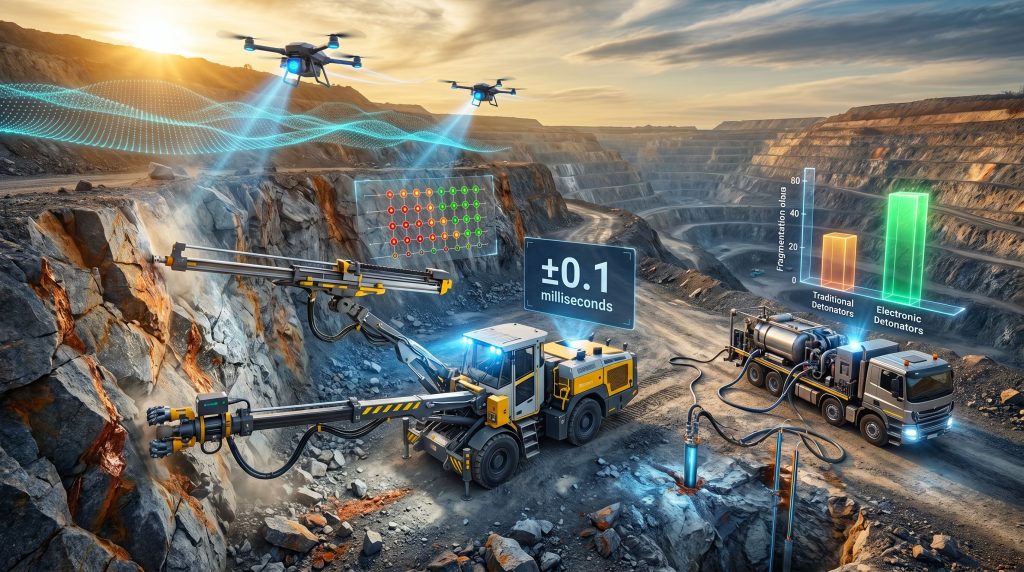
| Timing accuracy | ±10 to 15 milliseconds | ±0.1 milliseconds |
| Programmability | Fixed delay sequences | Fully customisable delay intervals |
| Misfire risk | Higher due to pyrotechnic variability | Significantly reduced through digital verification |
| Fragmentation consistency | Variable | Highly optimised and repeatable |
| Vibration management | Limited control | Precise inter-hole timing minimises ground vibration |
The physics underlying this performance gap centres on the relationship between inter-hole timing and seismic energy superposition. When detonations occur with imprecise timing, the compressive waves generated by adjacent holes can constructively interfere, amplifying peak particle velocity and transmitting damaging vibration energy into adjacent infrastructure. Electronic detonators, by enabling timing control to within one tenth of a millisecond, allow blast engineers to intentionally stagger energy release so that wave interference is destructive rather than constructive.
Computer-controlled blast design platforms extend this capability by modelling the entire energy distribution profile of a blast pattern before a single hole is loaded. Engineers can simulate fragmentation curves, predict muck pile geometry, and evaluate vibration propagation scenarios across multiple delay configurations before committing to a final design. According to recent advancements in drilling and blasting research, the feedback loop this creates between simulated and actual blast performance is progressively refining institutional blast design knowledge at a rate that was not possible with conventional methods.
"Precision inter-hole timing through electronic initiation allows engineers to achieve optimised fragmentation while simultaneously managing structural impact on adjacent infrastructure, a dual objective that conventional pyrotechnic systems were fundamentally incapable of delivering."
Remote detonation architectures, which transmit firing commands via radio-frequency or fibre-optic channels to detonation control units positioned within the blast pattern, complete the safety equation by removing all personnel from blast exclusion zones at the moment of initiation. Redundancy systems built into these architectures ensure that signal interference from environmental sources cannot trigger unintended detonation.
Drone Technology and AI Optimisation Across the Complete Blast Cycle
The role of unmanned aerial systems in drilling and blasting operations has expanded well beyond the survey applications that first established drones as useful mining tools. Contemporary blast operations deploy drone technology at three distinct phases of the blast cycle, each delivering safety and performance benefits that ground-based methods cannot replicate.
Pre-blast: High-resolution photogrammetry generates accurate three-dimensional topographic models of blast bench surfaces, identifying surface irregularities, tension crack networks, and slope instability zones that would influence drill pattern positioning. Thermal imaging detects moisture anomalies and hidden void structures within the bench face that could compromise explosive column confinement. Zone clearance verification, which previously required personnel to physically sweep the blast area, is now conducted aerially, eliminating human exposure entirely.
During blast design: Machine learning algorithms process accumulated blast performance datasets to identify correlations between drill geometry parameters, explosive product selection, delay configurations, and fragmentation outcomes. This analysis progressively refines the predictive accuracy of blast design software, reducing the gap between modelled and actual performance with each iteration. Consequently, AI-powered mining efficiency gains are compounding across successive blast campaigns.
Post-blast: Aerial fragmentation analysis using image recognition software measures particle size distribution across the muck pile, quantifying whether the blast achieved its target fragmentation curve. Misfire identification, residual explosive hazard mapping, and incomplete detonation zone assessment are all conducted without personnel entry into the post-blast area. These assessments generate structured performance reports that feed directly back into the next blast design cycle.
Non-Explosive and Eco-Engineered Blasting: Expanding the Operational Envelope
Conventional explosives remain the dominant fragmentation technology in large-scale mining, but a growing category of operational contexts now requires alternatives. Urban proximity restrictions, sensitive ecological preservation zones, and underground headings with strict vibration and airblast limits have collectively created meaningful demand for non-explosive and environmentally engineered fragmentation solutions.
Expansive demolition grouts operate through hydration-driven volumetric expansion within pre-drilled holes. The chemical reaction generates fracturing pressure over a period of hours without producing any detonation event, airblast, or significant vibration. The technique is particularly applicable in confined spaces where explosive use is prohibited and in heritage-sensitive environments where structural integrity of adjacent rock formations must be maintained.
Hydraulic rock splitters apply controlled radial mechanical force through wedge systems inserted into pre-drilled boreholes. The applied force initiates fracture planes along the path of least resistance, producing clean, predictable rock separation. These systems are used extensively in dimension stone quarrying and in excavation projects where fragment size uniformity is commercially critical.
Microwave-assisted rock fragmentation represents an emerging experimental technology that exploits differential thermal expansion between mineral phases within heterogeneous rock. By selectively heating specific mineral components, the technique generates internal stress concentrations that weaken rock structure ahead of mechanical extraction, potentially reducing the specific energy consumption of both fragmentation and comminution.
On the conventional explosives side, significant progress has been made in reducing the chemical footprint of blast operations. Low-fume, low-nitrogen oxide explosive formulations reduce post-blast air quality impacts in confined and poorly ventilated environments. Water-gel and emulsion explosive systems, which are inherently less sensitive than traditional nitrate-based products, offer improved safety profiles alongside reduced ground vibration transmission characteristics.
Directed energy charge design concentrates explosive force toward the intended fragmentation direction while incorporating energy-absorbing materials between the explosive column and the borehole wall. This approach prevents unintended damage to reserved rock masses adjacent to the excavation boundary and measurably reduces the volume of post-blast ground support and remediation required.
The next major ASX story will hit our subscribers first
Environmental Management: Engineering Controls for the Four Primary Blast Risks
The four principal environmental challenges generated by conventional drilling and blasting operations each require distinct engineering responses:
- Airborne particulate matter generated during drilling operations is addressed through wet drilling suppression systems that inject water at the drill collar, binding dust particles before they become airborne. Post-blast dust suppression employs water cannons and fog cannons to settle particulate from the blast cloud before it migrates beyond the site boundary.
- Noise pollution is mitigated through electronic timing optimisation, which reduces peak overpressure by distributing detonation events across extended delay sequences rather than generating single high-amplitude pressure events.
- Ground vibration transmission is managed through precision inter-hole delay sequencing that decouples energy release across time, preventing the constructive superposition of compressive wave fronts that drives peak particle velocity above infrastructure damage thresholds.
- Water contamination risk from residual explosive compounds and drill cutting runoff is addressed through closed-loop water reclamation systems and containment bunding that prevents chemical infiltration into groundwater systems.
| Environmental Risk | Mitigation Technology | Operational Outcome |
|---|---|---|
| Dust generation | Wet drilling systems and suppression sprays | Reduces airborne particulate at the drill collar |
| Noise propagation | Electronic timing optimisation and blast confinement | Minimises peak overpressure events |
| Ground vibration | Precision inter-hole delay sequencing | Decouples energy release to reduce peak particle velocity |
| Water contamination | Closed-loop water reclamation and containment bunding | Prevents chemical infiltration into groundwater systems |
A principle that experienced blast engineers consistently emphasise is that no two blast designs should be identical. Site-specific planning, informed by pre-blast environmental baseline surveys that establish vibration and noise threshold limits for each individual location, is the only reliable framework for keeping blast impacts within acceptable bounds across varying geological and environmental contexts.
The Pathway to Fully Autonomous Blast Operations
The trajectory of modern drilling and blasting advancements is converging toward a future where complete drill-and-blast cycles are designed, executed, and evaluated with minimal direct human involvement. This transition is unfolding in recognisable stages. Furthermore, mining automation trends confirm that the institutional appetite for autonomous systems is accelerating across major mining jurisdictions.
- Stage 1 (current deployment): AI systems support human decision-making in drill pattern design and blast timing optimisation, with human operators retaining execution authority
- Stage 2 (near-term): Robotic drilling and mechanised charging systems execute physical operations under remote human supervision from surface control rooms
- Stage 3 (emerging): Fully integrated AI platforms independently manage complete drill-and-blast cycles, with human oversight limited to exception handling and strategic approval
The enabling infrastructure for Stage 3 operations is maturing rapidly. Five-generation telecommunications networks provide the low-latency data transmission required for real-time remote operation of drilling and blasting equipment across entire mine sites. Digital twin technology creates continuously updated virtual replicas of blast environments, enabling scenario simulation before physical execution. Sensor fusion platforms combine LiDAR, acoustic monitoring, thermal imaging, and seismic data into unified operational intelligence systems.
Growing capital allocation toward autonomous mining systems is being driven by the compound pressure of rising labour costs, increasingly stringent safety compliance requirements, and a progressive maturation of AI capabilities. Regulatory frameworks in several major mining jurisdictions are also beginning to accommodate remote and autonomous blasting approvals, signalling that the institutional barriers to full deployment are gradually being addressed alongside the technical ones.
The broader significance of this transformation extends beyond operational efficiency metrics. Techniques such as downhole geophysics are increasingly integrated into autonomous workflows, ensuring that as blast cycles become fully automated, geological intelligence remains at the centre of every design decision. As these systems become integrated components of intelligent mine ecosystems, fragmentation quality becomes a continuously optimised variable rather than a fixed design outcome. Next-generation blasting technology suggests that each blast cycle will generate data that improves the performance of every subsequent one, establishing a compounding performance advantage for early adopters of autonomous blast management systems.
Frequently Asked Questions: Modern Drilling and Blasting Advancements
What is the primary advantage of electronic detonators over conventional detonators?
Electronic detonators provide timing accuracy to within ±0.1 milliseconds, compared to a tolerance range of ±10 to 15 milliseconds for pyrotechnic alternatives. This precision enables engineers to control fragmentation outcomes, reduce ground vibration transmission, and minimise structural impact on adjacent infrastructure with a level of reliability that was previously unachievable.
How Do Drones Improve Safety in Blasting Operations?
Drones eliminate the requirement for personnel to physically enter blast exclusion zones for pre-blast inspections, zone clearance verification, and post-blast hazard assessment. Equipped with high-resolution cameras and thermal sensors, they identify unstable rock formations, residual explosive hazards, and misfire locations from a safe aerial distance, removing the most dangerous manual inspection activities from the human task list entirely.
What Are Non-Explosive Blasting Technologies and When Are They Used?
Non-explosive techniques such as expansive demolition grouts and hydraulic rock splitters are applied in environments where conventional blasting is prohibited or impractical, including urban proximity zones, sensitive ecological areas, and underground headings where vibration and airblast limits are strictly enforced. These methods produce no detonation event and generate negligible ground vibration.
How Does AI Improve Blast Design Outcomes?
AI systems process large volumes of accumulated blast performance data to identify statistically significant relationships between drill geometry, explosive parameters, delay configurations, and fragmentation results. This enables continuous refinement of blast designs across successive campaigns, reducing secondary blasting requirements, improving crusher feed consistency, and lowering the overall cost per tonne of material moved.
What Environmental Risks Does Modern Blasting Technology Specifically Address?
Contemporary blasting systems target four primary environmental risks: airborne dust generation, noise pollution, ground vibration transmission, and water contamination from explosive residue. Solutions include wet drilling suppression, electronic timing optimisation, closed-loop water management, and directional charge engineering designed to contain blast energy within the intended fragmentation zone while minimising transmission into the surrounding environment.
This article is intended for informational and educational purposes. References to emerging technologies and autonomous systems reflect current industry development trajectories and should not be interpreted as guarantees of specific operational outcomes. Readers making operational or investment decisions should seek independent professional advice appropriate to their specific circumstances.
For further reading on operational innovation across the global mining sector, additional technical analysis and editorial coverage is available through Metals Mining Review Europe at metalsminingrevieweurope.com.
Want to Capitalise on the Next Major ASX Mineral Discovery Before the Broader Market?
Discovery Alert's proprietary Discovery IQ model delivers real-time alerts the moment significant mineral discoveries are announced on the ASX, transforming complex geological data into actionable investment insights for both short-term traders and long-term investors — start your 14-day free trial today and explore historic discoveries that have generated extraordinary returns.