June 24, 2026
The Talent Crisis Reshaping Global Mining Before It Peaks
The mining industry has historically solved its hardest problems underground. Ore bodies that were once unreachable became accessible through advances in drilling technology, geomechanics, and blasting chemistry. But the defining challenge of 21st-century mining is not geological. It is human. The World Mining Congress encuentro de la academia minería represents one of the sector's most consequential efforts to address the widening gap between specialised skills that modern operations demand and the talent that educational institutions currently produce.
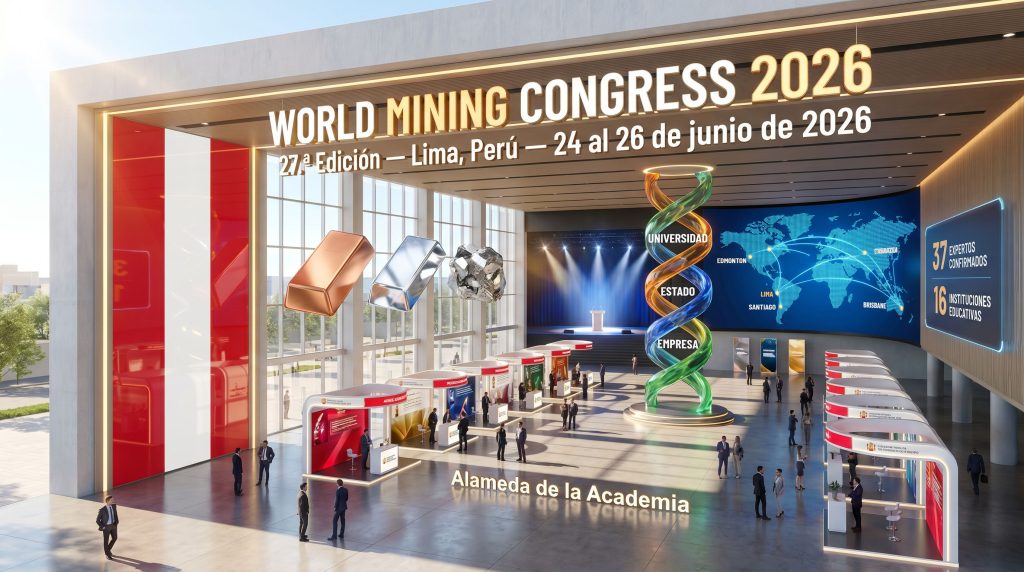
This tension sits at the heart of what the World Mining Congress 2026 is attempting to address through a dedicated academic programme embedded within the world's most prestigious gathering of mining professionals. When Lima hosts the 27th edition of the WMC from 24 to 26 June 2026, the final day will carry a distinct character: a structured, high-level convergence between the institutions that produce knowledge and the industry that desperately needs it.
When big ASX news breaks, our subscribers know first
Why the World Mining Congress Matters More Than Ever
The World Mining Congress was established in 1958 in Poland and has since evolved into the premier global platform for mining leadership, technical exchange, and cross-border collaboration. Organised under the affiliation of the United Nations, it convenes every two to three years in a country that reflects the geopolitical and economic weight of the global minerals sector.
Choosing Lima for the 2026 edition is not incidental. Peru ranks among the world's top producers of copper, silver, zinc, and gold, and its mineral endowment positions it as a critical node in global supply chains for the energy transition. The event is organised by the Instituto de Ingenieros de Minas del Perú (IIMP), the country's leading professional body for mining engineers, and will feature 37 confirmed high-level speakers spanning corporate leadership, technical specialisation, and academic research.
The congress unfolds across three strategic axes that reflect the pressures reshaping the industry globally:
- Technological transformation – the integration of automation, digitalisation, and artificial intelligence into mine operations and planning
- Social trust – the evolving frameworks of social licence, community engagement, and environmental, social, and governance (ESG) accountability
- International collaboration – structured knowledge transfer between mineral-producing and mineral-consuming nations amid growing competition for critical resources
A call for technical abstracts remains open until 31 August 2025, allowing researchers and practitioners to contribute to the congress's technical programme.
The Encuentro de la Academia: What It Is and Why It Exists
On 26 June 2026, the final day of the congress, a specialised session titled the Encuentro de la Academia will take place in the Sala Paraíso of the Lima Convention Centre, beginning at 9:00 a.m. This is not a peripheral workshop or a networking add-on. It is a formally structured, three-block programme designed to interrogate the relationship between higher education and extractive industry at a moment when that relationship is more consequential than at any prior point in mining history.
The initiative is driven by the IIMP and brings together a deliberately diverse audience: university academics, postgraduate researchers, industry executives, and state representatives. The goal is not simply information exchange but the construction of durable institutional links between knowledge producers and operational decision-makers.
Furthermore, it is worth noting a common source of confusion in the sector's digital ecosystem. An initiative with the same name, the Encuentro de la Academia, was also associated with the PERUMIN 37 Mining Convention held in September 2024. While both share an overarching philosophy of connecting academia and industry, they are entirely separate events with distinct organisers, formats, and contexts. The programme analysed here belongs exclusively to the WMC 2026 framework.
Three Thematic Blocks That Define the Agenda
Block One: Academia as a Catalyst for Responsible Innovation
The opening block positions universities not as passive observers of industrial change but as active generators of the solutions that responsible mining requires. The keynote address is delivered by Douglas Aitken, a professor at the Sustainable Minerals Institute (SMI) at the University of Queensland, Australia.
Queensland's SMI is one of the most cited research institutions in applied mining science globally. Its work spans tailings management, water efficiency in mineral processing, mine rehabilitation, and socio-environmental impact assessment. Aitken's contribution to the WMC programme draws on decades of institutionalised collaboration between Australian universities and mining companies, a model that has produced commercially deployable research outputs rather than academic papers that never leave library shelves.
The Australian model is particularly instructive for Latin American mining nations because it demonstrates how co-funded research centres can align university incentives with industry timelines. Rather than allowing a structural mismatch between the three-to-five year horizon of academic research and the quarter-by-quarter demands of listed mining companies, the SMI framework operates on shared milestones and mutual accountability. In addition, mining innovation trends suggest this collaborative approach is becoming an industry standard worldwide.
Block Two: The Triple Helix as a Structural Condition for Competitiveness
The second thematic block elevates the conversation from project-level collaboration to systemic institutional architecture. The principal speaker is Marilú Martens, national director of CARE Peru, bringing a perspective that situates higher education reform within broader development policy.
The triple helix model, which conceptualises the university-state-industry relationship as a set of overlapping, interdependent functions, has been applied in innovation economics since the 1990s. In the context of mining, it takes on particular urgency because curriculum reform at universities rarely happens without policy incentives, and policy incentives rarely materialise without demonstrated industry demand.
The structural challenge is that all three actors in this helix tend to operate on incompatible timescales. Universities work across academic cycles measured in semesters and degree programmes. The state operates on electoral cycles and budget frameworks. Mining companies plan on ore reserve life, capital expenditure cycles, and commodity price projections. Aligning these three rhythms requires institutional architecture that none of the three actors can build unilaterally.
Block Three: Emerging Professionals in a Transforming Industry
The third block directly addresses the generation that will inherit the operational and strategic responsibilities of mining within the next decade. Abigail Paul, a doctoral candidate at the University of Alberta, Canada, presents findings from applied research developed collaboratively between academic institutions and industry partners.
The University of Alberta has long maintained structured industrial doctoral programmes in which postgraduate candidates embed within mining operations for defined periods, generating research outputs that address specific operational problems. This model produces professionals who understand both the epistemological rigour of academic inquiry and the pragmatic constraints of working mines, a combination that is extraordinarily rare and increasingly valuable.
Paul's contribution at the WMC is significant not just for its content but for what it signals: the deliberate inclusion of emerging researchers in a forum that has historically been dominated by senior executives and established academics. This reflects a growing recognition within the global mining community that innovation cycles are compressing and that early-career researchers are often closer to frontier developments than their more senior counterparts.
The Alameda de la Academia: Making Knowledge Visible
Complementing the three thematic blocks is the Alameda de la Academia, an exhibition space within the congress where 16 national and international educational institutions present their academic programmes, research lines, and sector-specific capacity development offerings.
The Alameda serves a function that is underrated in conversations about talent development: it makes the supply of knowledge visible to those with the demand for it. In most mining conferences, the exhibitor floor is populated by equipment manufacturers, technology vendors, and service providers. The deliberate integration of educational institutions into this commercial and technical space signals a reframing of what counts as a strategic resource in mining.
Institutions participating in the Alameda represent a cross-section of Latin American and international higher education, creating a rare physical environment where a chief human resources officer from a major mining company might stand three metres from the director of a postgraduate programme in mineral processing or geotechnical engineering.
The Talent Gap: A Risk the Industry Systematically Underestimates
Understanding why the Encuentro de la Academia and the broader WMC 2026 academic programme matter requires understanding the nature of the talent crisis that the mining sector is entering. This is not a straightforward shortage of workers. It is a structural mismatch between the competency profiles that modern mining operations require and the profiles that conventional mining engineering curricula are designed to produce.
The forces driving this mismatch include:
- Automation and autonomous systems – the deployment of autonomous haul trucks, drill rigs, and processing control systems requires operators who understand both the mechanical and algorithmic dimensions of these systems. Indeed, mining automation transformation has advanced far faster than most university programmes can accommodate
- Decarbonisation pressures – the shift toward battery-electric underground equipment and hydrogen-powered surface fleets requires competencies that traditional curricula rarely integrate. The pressures around electrification and decarbonisation are reshaping what skills the sector urgently needs
- ESG accountability – the increasing sophistication of ESG reporting and stakeholder engagement requirements demands professionals who combine technical mining knowledge with environmental science, social anthropology, and financial literacy
- Data science and AI integration – the use of machine learning in geological modelling, predictive maintenance, and process optimisation is advancing rapidly. AI in exploration is one area where the skills gap is particularly acute, as is the growing demand for rare earth exploration insights within postgraduate research programmes
| Country | Institution | Collaboration Model |
|---|---|---|
| Australia | University of Queensland, SMI | Industry co-funded research centres with shared IP frameworks |
| Canada | University of Alberta | Industrial doctoral programmes with operational embedding |
| Chile | Universidad de Chile | Applied research programmes linked to major producers |
| Peru | IIMP + national universities | Technical linkage platforms and sector-specific events |
The table above illustrates a clear pattern: the countries with the most mature university-industry collaboration frameworks in mining are also among those with the highest rates of productivity growth and technological adoption in their extractive sectors. This is not coincidental.
The next major ASX story will hit our subscribers first
Peru's Broader Role in the Knowledge Economy of Mining
For Peru, hosting the WMC 2026 and embedding an academic programme of this depth within its framework carries implications that extend beyond the congress itself. The country has historically been positioned as a mineral wealth provider rather than a knowledge generator within the global mining system. The World Mining Congress encuentro de la academia minería represents a deliberate effort to change that positioning.
Peru's universities are producing growing numbers of mining and geological engineering graduates, but the quality of research output from these institutions has not kept pace with the operational complexity of the projects those graduates will work on. Closing this gap requires the kind of structured, long-term institutional engagement that the WMC 2026 programme is designed to catalyse.
The IIMP's role as principal organiser of this academic initiative is also significant. As the country's leading professional engineering body, it occupies an institutional position that allows it to convene actors across all three nodes of the triple helix without being captured by any one of them. Consequently, the official WMC 2026 platform provides the most current information on how to engage with this historic congress.
Key Details at a Glance
| Detail | Information |
|---|---|
| Edition | 27th World Mining Congress |
| Host City | Lima, Peru |
| Dates | 24 to 26 June 2026 |
| Principal Organiser | Instituto de Ingenieros de Minas del Peru (IIMP) |
| International Affiliation | United Nations-affiliated organisation |
| Year WMC Founded | 1958, Poland |
| Confirmed Speakers | 37 high-level global experts |
| Encuentro de la Academia Date | 26 June 2026 |
| Venue (Academic Session) | Sala Paraiso, Lima Convention Centre |
| Session Start Time | 9:00 a.m. |
| Alameda Participating Institutions | 16 national and international educational bodies |
| Abstract Submission Deadline | 31 August 2025 |
Frequently Asked Questions
What is the World Mining Congress 2026?
The WMC 2026 is the 27th edition of a globally recognised mining congress founded in 1958. It takes place in Lima, Peru from 24 to 26 June 2026, organised by the IIMP under the umbrella of a United Nations-affiliated international organisation.
What is the Encuentro de la Academia within the WMC 2026?
It is a specialised full-day programme on 26 June 2026 structured around three thematic blocks focused on innovation, institutional collaboration, and emerging professional talent in mining. The World Mining Congress encuentro de la academia minería is entirely distinct from the similarly named initiative associated with PERUMIN 37 in 2024.
Who are the keynote speakers for the academic session?
The three principal speakers are Douglas Aitken from the Sustainable Minerals Institute at the University of Queensland, Marilú Martens from CARE Peru, and Abigail Paul, a doctoral candidate from the University of Alberta.
What is the Alameda de la Academia?
It is an exhibition space integrated into the congress where 16 educational institutions present their academic programmes, research capabilities, and talent development offerings to industry participants.
How can academics and researchers participate in WMC 2026?
Participation pathways include submitting technical abstracts before 31 August 2025, attending or presenting within the World Mining Congress encuentro de la academia minería programme on 26 June, or representing an institution in the Alameda de la Academia exhibition space.
This article is informational in nature and does not constitute financial or investment advice. Event details, speaker confirmations, and programme structures are subject to change by the organising bodies. Readers are encouraged to consult official WMC 2026 communications for the most current information. Further coverage of Latin American and global mining developments is available through Reporte Minero at reporteminero.cl.
Want to Know Which ASX Mining Companies Are Making the Next Major Discovery?
While the global mining industry works to close its talent and innovation gap, Discovery Alert's proprietary Discovery IQ model is already scanning ASX announcements in real time, delivering instant alerts on significant mineral discoveries to subscribers. Explore historic discoveries and their exceptional market returns to understand the opportunity, then begin your 14-day free trial at Discovery Alert to position yourself ahead of the broader market.