June 24, 2026
The Industrial Logic Behind Long-Term Gas Contracts in Energy-Intensive Manufacturing
Few industrial processes expose the fragility of energy supply chains quite like alumina refining. The Bayer process, which converts bauxite into alumina through a sequence of pressure-dissolution and calcination stages, demands continuous, high-temperature thermal energy. Unlike manufacturing processes that can tolerate intermittent power, alumina refining is unforgiving. When gas supply falters, production does not simply slow down; it collapses in ways that ripple across the entire aluminium value chain.
This reality sits at the heart of the Woodside gas supply deal with Alcoa's Western Australian alumina refineries, a structured multi-year agreement that reflects both the operational vulnerabilities of energy-intensive industry and the commercial logic of locking in supply certainty before a market tightens further.
When big ASX news breaks, our subscribers know first
Western Australia's Domestic Gas Market: The Architecture of Industrial Energy Security
Western Australia operates one of the most distinctive domestic gas policy frameworks in the world. Under the state's domestic gas reservation policy, LNG export projects are required to set aside a portion of their production for the local market. This mechanism was designed precisely to prevent the kind of supply-demand imbalance that can hollow out energy-intensive industries when export demand outcompetes local consumption.
The practical effect is significant. It creates conditions in which large industrial consumers, including alumina refiners, can negotiate long-term contracts with domestic gas producers rather than competing for spot market volumes against LNG export demand. For energy-intensive manufacturers operating on thin margins with enormous fixed cost bases, this distinction is commercially critical. Furthermore, Australia's energy export challenges make this domestic reservation policy increasingly important for local industry.
The Pluto-Karratha Interconnector: Infrastructure as a Prerequisite
The physical infrastructure enabling this particular agreement is the Pluto-Karratha Gas Plant Interconnector. In December 2025, the Western Australian Government approved an extension to this interconnector, allowing gas produced at Woodside's Pluto LNG facilities to be processed through the Karratha gas plant for domestic distribution purposes.
This approval was not simply a logistical upgrade. It materially expanded the volume of domestically available gas by opening a processing pathway that had previously been constrained. Without this infrastructure decision, the supply headroom required to support a 31.1 petajoule domestic commitment between 2027 and 2030 would have been significantly more difficult to underwrite.
Infrastructure Context: The December 2025 Pluto-Karratha interconnector extension approval was a structural prerequisite that unlocked the additional domestic gas volumes making this supply agreement commercially viable. It is a clear example of how targeted infrastructure investment translates into long-term industrial certainty.
The Energy Vulnerability of Alumina Refining: Why This Deal Matters
How the Bayer Process Creates Structural Gas Dependency
The Bayer process is the globally dominant method for producing alumina from bauxite ore. It requires sustained high-temperature heat across multiple process stages, including digestion, where bauxite is dissolved in caustic soda under high pressure and temperature, and calcination, where aluminium hydroxide is converted into alumina through intense heating. Natural gas is the primary thermal energy source for both stages in the Western Australian context.
This is not a preference arrangement. There is currently no commercially viable, large-scale alternative to natural gas for delivering the sustained thermal output required by these processes in Australian refinery settings. Electrification of high-temperature industrial heat at this scale remains technically immature and prohibitively capital-intensive within a 2027-2030 planning window.
Alcoa's Western Australian Refinery Network: Scale and Exposure
Alcoa operates three alumina refineries in Western Australia, collectively representing one of the largest alumina production hubs on the planet. The facilities at Pinjarra in the Peel region, Wagerup in the South-West, and Kwinana in the Perth metropolitan area draw their energy supply from the same Western Australian domestic gas network.
The vulnerability of this configuration was starkly demonstrated during the 2024-2025 gas shortage episode. Alcoa's Kwinana refinery was forced to reduce output by approximately 30% and temporarily switch to diesel fuel as a fallback energy source before reverting to gas in early 2026. This event was not merely operationally inconvenient.
| Refinery | Location | Disruption Impact |
|---|---|---|
| Kwinana | Perth metropolitan area | ~30% production cut; emergency diesel fallback activated |
| Pinjarra | Peel Region, WA | Exposed to same domestic pipeline gas supply constraints |
| Wagerup | South-West WA | Integrated into WA domestic gas network; shared supply risk |
Diesel-powered refinery operations carry a substantially higher cost profile than gas-fired operations. The unplanned fuel switch at Kwinana imposed significant additional operating costs at a time when alumina price dynamics were already under pressure. It also generated higher emissions per unit of alumina produced, creating an additional compliance and reputational burden.
From Disruption to Structured Certainty
The Kwinana episode functioned as a stress test that exposed the operational and financial risk of relying on informal or short-term energy procurement arrangements for capital-intensive industrial facilities. Spot market gas procurement can deliver competitive pricing in favourable conditions, but it offers no protection against the kind of supply squeeze that forced Alcoa into costly emergency measures.
A multi-year, volume-defined contract fundamentally changes the risk profile. It converts an unpredictable variable cost into a planned expenditure line, eliminates the operational risk of supply gaps, and allows refinery managers to optimise production scheduling around a known energy envelope rather than managing around supply uncertainty.
Breaking Down the Woodside-Alcoa Agreement: Terms and Commercial Context
Core Contract Parameters
The agreement's headline figures are straightforward but contextually significant. According to reporting from Reuters, the key terms are as follows:
- Total contracted volume: 31.1 petajoules (PJ) of natural gas
- Supply period: 2027 through 2030
- Gas source: Woodside's Western Australian upstream operations, utilising the expanded Pluto-Karratha processing pathway
- End use: Thermal energy supply to Alcoa of Australia's Western Australian alumina refinery network
- Contracting entity: Alcoa of Australia, the wholly owned local operating subsidiary of US-listed Alcoa Corp (NYSE: AA)
Contextualising 31.1 PJ Within Woodside's Domestic Portfolio
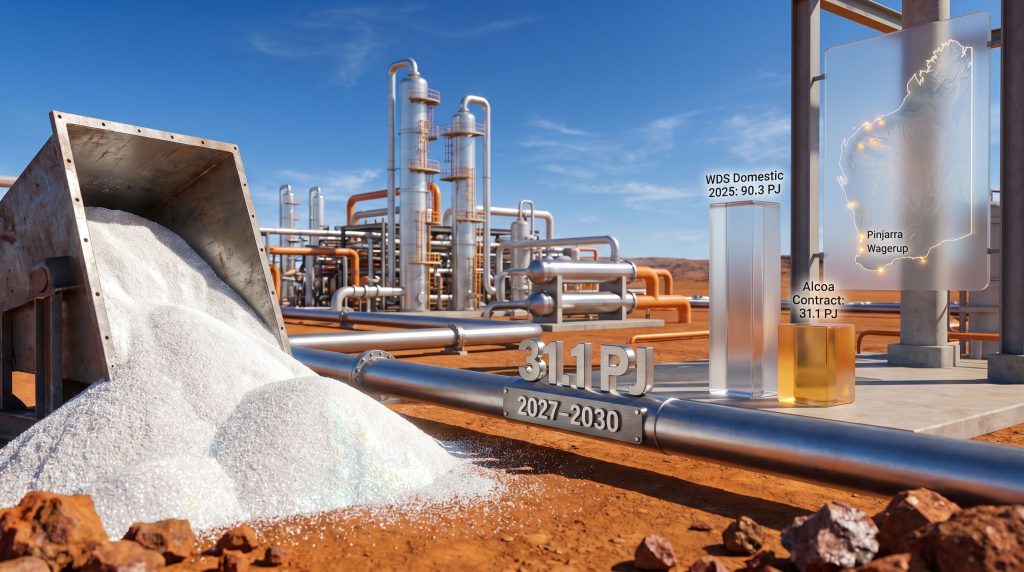
The scale of this commitment becomes clearer when positioned against Woodside's broader domestic gas operations. In 2025, Woodside produced 90.3 PJ of domestic gas, representing approximately 21% of Western Australia's total domestic gas supply. The volume committed to Alcoa under this agreement, at 31.1 PJ, represents roughly one-third of that annual domestic output being directed to a single industrial customer group over the contract term.
Scale Perspective: Committing approximately 34% of its 2025 annual domestic gas output to a single industrial buyer across a three-year window is a material allocation that underscores both the scale of Alcoa's energy demand and Woodside's confidence in its ability to service that commitment alongside other domestic supply obligations.
This is not incidental. It signals that Woodside has sufficient confidence in its post-interconnector-expansion domestic supply capacity to underwrite a major long-term industrial contract without constraining its ability to meet other domestic market obligations or LNG export commitments. In addition, this arrangement complements the broader alcoa joint venture activity that has been shaping the company's strategic direction.
Woodside's 40-Year Domestic Supply Track Record
Woodside has maintained a continuous presence as a Western Australian domestic gas supplier for more than 40 years. This longevity is commercially relevant beyond simple reputation. It reflects deep familiarity with the operational and logistical characteristics of the WA domestic gas market, established infrastructure relationships, and a demonstrated capacity to manage supply reliability through various market cycles.
For an industrial buyer like Alcoa, counterparty reliability in a long-term gas contract is not a peripheral concern. A supplier that cannot consistently deliver contracted volumes defeats the purpose of the agreement entirely.
Western Australia's Industrial Competitiveness and the Downstream Aluminium Chain
Energy Security as a Competitive Advantage
Multi-year gas contracts do more than resolve an individual company's operational problem. They function as a form of industrial policy outcome, reinforcing Western Australia's attractiveness as a location for energy-intensive manufacturing investment. When capital allocators evaluate whether to maintain, expand, or reinvest in refinery-scale industrial assets, the reliability and cost predictability of energy supply sits near the top of the decision criteria.
Industries operating with locked-in, long-term energy supply arrangements carry fundamentally different investment risk profiles compared with those exposed to spot market procurement. This distinction affects not only operating cost certainty but also the ability to secure long-term offtake commitments from downstream buyers who require production reliability guarantees.
Downstream Effects Across the Aluminium Value Chain
Stable alumina output from Western Australian refineries is not simply a local industrial story. The downstream effects extend across global aluminium supply chains, and aluminium industry leaders are watching developments in WA closely. Specifically:
- Consistent alumina production provides reliable feedstock to aluminium smelters, reducing the risk of input shortages that drive aluminium price volatility.
- Predictable refinery operations reduce price uncertainty for downstream aluminium consumers in construction, automotive, aerospace, and energy sectors.
- Operational stability in WA's alumina sector protects thousands of direct and indirect jobs in a regional economy where the industry is a primary employer.
- Reduced production interruption risk lowers the likelihood of emergency procurement events that distort spot alumina pricing.
Implications for Chemical Commodity Markets
Natural gas has dual relevance in this context. It is both an energy source for alumina refining and a feedstock for chemical commodity production including ammonia, methanol, and hydrogen. Structured long-term supply agreements of the type Woodside and Alcoa have executed contribute to cost stability in these adjacent markets by reducing the probability of demand-driven price spikes.
The agreement is unlikely to produce significant price reductions in these commodities. Its primary market function is cost stabilisation, providing a more predictable operating environment for all gas-intensive industries drawing from the same Western Australian domestic supply network.
Natural Gas as a Bridge Fuel: The Transition Dimension
Comparing Energy Pathways for Alumina Refining
The 2027-2030 timeframe positions this agreement squarely within the current energy transition period for Australian heavy industry. It is worth examining where natural gas sits relative to alternative energy pathways for alumina production:
| Energy Source | Operational Suitability | Cost Profile | Emissions Footprint |
|---|---|---|---|
| Natural Gas (piped) | High: continuous, high-temperature output | Lower and predictable | Moderate: lower than diesel |
| Diesel (backup) | Limited: emergency fallback only | Significantly higher operating cost | Higher emissions intensity |
| Renewable Electricity | Emerging: industrial heat electrification immature | High upfront capital; lower long-run cost | Lowest operational emissions |
| Green Hydrogen | Nascent: not commercially viable at scale | Very high; electrolyser cost dependent | Near-zero if renewably produced |
Full electrification or hydrogen-based refining of alumina at Western Australian scale is not operationally or commercially viable within this contract window. The industrial heat requirements of the Bayer process demand energy densities and continuity characteristics that current renewable and hydrogen technologies cannot reliably deliver at competitive cost in Australian refinery settings.
Natural gas therefore occupies a pragmatic bridging role. It is neither a permanent solution nor an ideological choice. It is the most commercially and operationally viable option for maintaining alumina production reliability while the sector evaluates genuinely scalable low-emissions alternatives. However, the mining decarbonisation benefits being realised across the broader sector suggest that low-emissions solutions are advancing faster than many anticipated.
What Comes After 2030?
The question of what energy arrangements Alcoa and Woodside negotiate beyond 2030 will be shaped by several intersecting variables. Progress in low-emissions industrial heat technology, the evolution of Western Australia's domestic gas reservation policy in the context of growing LNG export competition, and the economic maturity of green hydrogen production at refinery scale will all influence the next contract cycle.
Woodside has publicly signalled ongoing engagement with customers regarding additional domestic supply opportunities beyond 2026, indicating that the company views domestic gas supply as a sustained commercial priority rather than a legacy obligation. Furthermore, advances in renewable energy in mining will likely play an increasing role in shaping post-2030 energy strategies for operations like Alcoa's WA refineries.
The next major ASX story will hit our subscribers first
Investor Perspective: Reading the Market Signal
Woodside's share price recorded a modest decline of approximately 1.5% to A$28.35 following the announcement of the agreement. This reaction warrants careful interpretation rather than reflexive concern.
Short-term market responses to long-term supply contract announcements frequently reflect pricing-related concerns, specifically whether contracted volumes were sold at rates that optimise near-term revenue. They do not necessarily reflect a negative assessment of the deal's strategic merit. As reported by LNG Industry, the agreement represents a considered long-term positioning rather than a short-term revenue play.
Investor Framework: Long-term domestic gas supply contracts function primarily as earnings stability instruments. Their value lies in reducing exposure to LNG spot price volatility, securing reliable revenue streams from creditworthy industrial counterparties, and demonstrating domestic market credibility that supports broader regulatory and social licence considerations.
For investors with longer time horizons, the strategic logic of this agreement is clear. A creditworthy, large-scale industrial buyer locked in for a three-year term provides revenue predictability that pure LNG spot market exposure cannot replicate. In an environment of LNG price volatility driven by geopolitical and demand-side uncertainty, domestic contracted volumes carry a premium stability value that is often underweighted in short-term price reactions.
Frequently Asked Questions
What is the Woodside gas supply deal with Alcoa's Western Australian alumina refineries?
Woodside Energy has entered into a gas sale and purchase agreement with Alcoa of Australia to supply 31.1 petajoules of natural gas from Woodside's Western Australian operations between 2027 and 2030. The contracted gas will be used to power Alcoa's alumina refineries at Pinjarra, Wagerup, and Kwinana in Western Australia.
Why does Alcoa require a structured multi-year gas agreement?
Alumina refining is among the most energy-intensive industrial processes in Australia. A prior gas shortage in 2024-2025 forced Alcoa's Kwinana refinery to reduce output by approximately 30% and switch to diesel, a costly and higher-emissions emergency measure. A structured long-term contract eliminates that supply uncertainty and converts an unpredictable operating cost into a planned expenditure item.
How significant is 31.1 PJ relative to Woodside's total domestic production?
Woodside produced 90.3 PJ of domestic gas in 2025, representing roughly 21% of Western Australia's total domestic supply. The Alcoa commitment represents approximately one-third of that annual domestic output, making it a material allocation to a single industrial customer group.
What enabled Woodside to make this supply commitment?
The Western Australian Government's December 2025 approval of an extension to the Pluto-Karratha Gas Plant Interconnector expanded the volume of Pluto-sourced gas that can be processed and distributed domestically, creating the supply headroom necessary to underwrite the 2027-2030 commitment.
Is natural gas a permanent solution for Alcoa's WA refineries?
Within the 2027-2030 contract window, natural gas remains the only commercially and operationally viable primary energy source for the Bayer process at WA refinery scale. Full electrification and green hydrogen alternatives are not yet technically mature or cost-competitive for large-scale Australian alumina refining. Natural gas currently serves as a bridge fuel while lower-emissions alternatives develop.
Key Takeaways
- The Woodside gas supply deal with Alcoa's Western Australian alumina refineries commits 31.1 PJ of gas supply across a three-year window from 2027 to 2030, addressing a demonstrated vulnerability in Alcoa's energy supply chain.
- The agreement was enabled by the December 2025 approval of the Pluto-Karratha interconnector extension, which expanded Woodside's domestic supply capacity.
- Alcoa's Kwinana refinery suffered a ~30% production cut during the 2024-2025 gas shortage, demonstrating the direct operational and financial cost of supply insecurity at industrial scale.
- At 31.1 PJ, the contracted volume represents roughly one-third of Woodside's 2025 annual domestic gas output of 90.3 PJ, reflecting a significant commitment to a single industrial customer.
- Natural gas functions as a pragmatic bridge fuel for WA alumina refining; full decarbonisation through electrification or hydrogen is not commercially viable within this contract period.
- Long-term domestic supply contracts deliver earnings stability and reduce LNG spot price exposure for Woodside, offering strategic value that short-term share price movements may underweight.
Want to Catch the Next Major ASX Resource Discovery Before the Market Does?
Discovery Alert's proprietary Discovery IQ model scans ASX announcements in real time, instantly identifying high-potential mineral discoveries across more than 30 commodities — turning complex data into clear, actionable opportunities for both short-term traders and long-term investors. Explore historic examples of exceptional discovery returns and begin your 14-day free trial today to position yourself ahead of the broader market.