
July 16, 2026
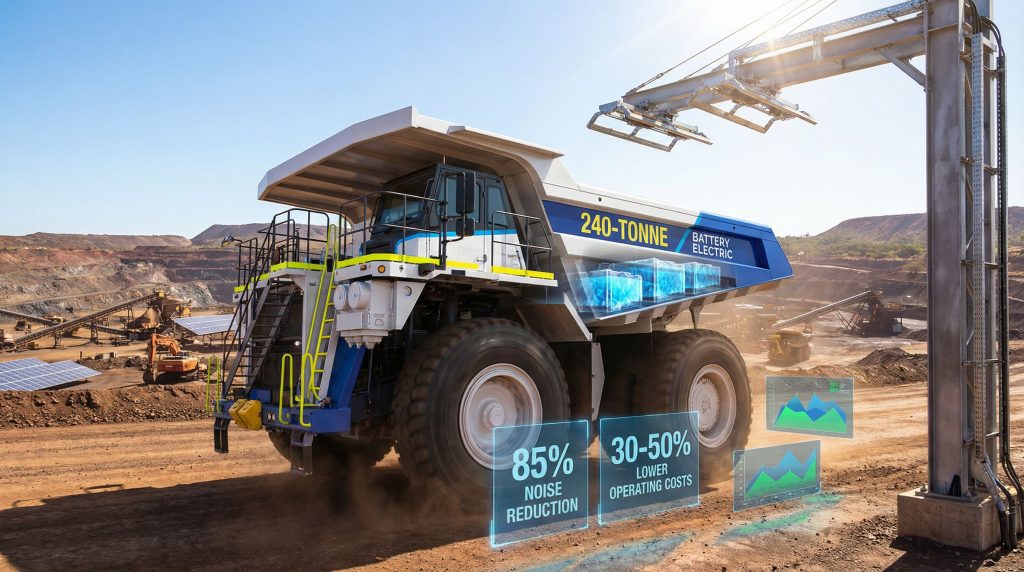
The mining industry stands on the precipice of a revolutionary technological transformation that will fundamentally redefine heavy equipment operations. Battery electric haul trucks are emerging as the cornerstone of this evolution, representing far more than simple equipment upgrades. Furthermore, this shift addresses escalating operational costs, stringent environmental regulations, and the relentless pursuit of operational efficiency in an increasingly competitive global commodity market.
The world's first battery electric haul truck deployments showcase sophisticated engineering solutions that challenge traditional assumptions about power delivery, maintenance protocols, and total cost ownership. Moreover, these innovations are driving the mining industry evolution whilst simultaneously supporting comprehensive mining sustainability transformation initiatives across the sector.
Understanding Battery Electric Haul Truck Technology Revolution
The technological foundation of electric mining vehicles represents a convergence of advanced power management architectures with robust battery technologies. These systems are specifically designed to withstand extreme operational conditions that characterise modern mining environments.
Electric haul truck systems operate at voltage levels ranging from 600V to 1000V DC, particularly in trolley-assisted configurations. Battery energy density in lithium-ion systems used for mining applications typically achieves 150-250 Wh/kg, according to U.S. Department of Energy Vehicle Technologies Office data from 2024.
Core Components of Electric Mining Vehicle Systems
The drivetrain architecture eliminates traditional transmission systems in favour of direct-drive electric motors. Battery management systems monitor individual cell voltage, temperature, and state of charge across hundreds of cells simultaneously.
Thermal management systems maintain battery operating temperatures between 15-35°C for optimal performance and longevity. Vehicle control units coordinate power distribution between traction motors, auxiliary systems, and regenerative braking components.
Electric motors deliver maximum torque instantaneously at zero RPM, contrasting sharply with diesel engines that develop torque progressively through engine speed increase. This characteristic enables improved acceleration and precise speed modulation critical for mining operations.
Regenerative Braking Technology for Downhill Operations
Regenerative braking systems can recover 15-25% of energy during downhill operations in mining haul routes, according to research published in the International Journal of Electrical Power & Energy Systems. This energy recovery capability provides substantial operational advantages in mining environments with significant elevation changes.
The regenerative system converts kinetic energy back into electrical energy during deceleration, storing it in the battery pack for subsequent use. Consequently, this technology reduces brake wear whilst improving overall energy efficiency across mining cycles.
Charging Infrastructure Requirements for Mining Operations
Overhead trolley charging systems utilise pantograph technology to maintain electrical contact between overhead catenary wires and vehicle-mounted pantograph receptors. These systems provide continuous power supply during operation on designated haul routes, eliminating range limitations for specific route segments.
Power grid integration presents unique challenges in remote mining locations. Electrical infrastructure must support high-power charging demands whilst maintaining grid stability. Fast-charging capabilities require specialised electrical installations rated for 500-1000 amps depending on vehicle load requirements.
When big ASX news breaks, our subscribers know first
How Do Battery Electric Haul Trucks Compare to Traditional Diesel Models?
The performance differential between electric mining vehicles and diesel haul trucks extends across multiple operational parameters that directly impact mining productivity and cost structures.
Performance Metrics Analysis
Electric motors generate approximately 80-90 dB(A) sound levels at standard operating load, compared to 110+ dB(A) for diesel haul trucks. This represents a noise reduction of 20-30 dB(A), which translates to approximately 99% reduction in perceived loudness on the logarithmic decibel scale.
| Metric | Battery Electric | Diesel |
|---|---|---|
| Torque Delivery | Instant maximum torque at 0 RPM | Progressive torque curve 1200-1800 RPM |
| Operating Noise | 80-90 dB(A) | 110+ dB(A) |
| Drivetrain Efficiency | 85-92% | 30-35% |
| Ventilation Requirements | 40-50% reduction underground | Standard industrial requirements |
| Maintenance Intervals | Simplified schedule | Complex multi-system maintenance |
Operational Advantages in Mining Environments
Underground mining operations benefit significantly from reduced ventilation requirements. Diesel haul truck operations require ventilation systems rated for 15-20 air changes per hour to manage exhaust gases and thermal load. Electric vehicles eliminate exhaust gases, reducing ventilation requirements to 5-8 air changes per hour.
This reduction lowers energy consumption for underground ventilation systems by 40-50%. Lower heat generation from electric motors improves working conditions whilst reducing cooling system load. Diesel engines convert approximately 65% of fuel energy to waste heat rather than mechanical work, whilst electric motors generate minimal thermal output.
Predictable maintenance schedules represent another operational advantage. Electric haul trucks eliminate oil changes, fuel system maintenance, spark plugs, timing belt replacements, and transmission fluid servicing. Maintenance primarily consists of brake system inspections, tire rotation, battery thermal management system monitoring, and drivetrain component evaluation.
Which Mining Companies Are Leading Electric Haul Truck Deployment?
Several major manufacturers have developed commercial battery electric haul truck programmes, each pursuing distinct technological approaches to address mining industry requirements.
Major Manufacturer Development Programmes
Caterpillar Cat 793 XE has been announced for commercial deployment in trolley-assist configurations. The system integrates battery pack technology with catenary overhead charging capability for underground and surface mining applications.
Hitachi EH4000AC-3 represents a retrofit conversion approach, transforming existing diesel EH 4000 platforms into battery electric configurations. The system maintains payload capacity of 91-95 tonnes depending on configuration whilst incorporating trolley-assisted electric operation capability.
Komatsu has developed electric drive solutions through partnership programmes for field trials and commercial deployment assessments. Their approach focuses on integrated power management systems compatible with existing mining fleet infrastructure.
Liebherr has pursued autonomous electric vehicle integration, developing battery-electric platforms with autonomous operation capability. This technology development emphasises compatibility with autonomous fleet management systems for fully integrated mining operations.
Mining Operation Test Sites and Field Deployments
The world's first battery electric haul truck completed operational testing at First Quantum Minerals' Kansanshi Copper Mine in Solwezi, Zambia. The Hitachi EH 4000 AC retrofitted battery-electric haul truck completed its test run in underground copper mining conditions.
This deployment provides operational data on electric haul truck performance in underground copper mining environments. The trial evaluated energy consumption patterns, operational reliability, and integration with existing mining infrastructure in copper ore extraction operations.
Manufacturing companies pursue parallel technology pathways, with some prioritising trolley-assist systems for maximising power availability and operational continuity. Others develop full battery-only solutions for increased operational flexibility. Each approach addresses different mining operational constraints and site infrastructure availability.
What Are the Economic Benefits of Electric Haul Truck Adoption?
The financial case for battery electric haul truck adoption involves complex total cost of ownership calculations that extend well beyond initial purchase price considerations.
Total Cost of Ownership Analysis
Initial capital expenditure for battery electric haul trucks ranges from $3-5 million USD per vehicle, representing a 100-150% premium over equivalent diesel haul trucks priced at $1.5-2.5 million USD. However, operational cost savings accumulate substantially over vehicle lifetimes.
Energy cost analysis reveals significant ongoing savings potential:
- Diesel operations: $50-80 per operating hour in fuel costs (based on $1.00/litre diesel consumption)
- Electric operations: $15-25 per operating hour in electricity costs (based on $0.10/kWh consumption)
- Fuel cost savings: 60-70% reduction in energy expenses
Maintenance cost reduction provides additional economic benefits. Diesel haul trucks typically require $30-50 per operating hour in scheduled and unscheduled maintenance, whilst electric haul trucks require an estimated $15-25 per operating hour due to reduced mechanical complexity.
Return on Investment Calculations
Payback period analysis for mining operations assumes 5,000 operating hours annually over 15-year vehicle lifetime (75,000 total operating hours):
- Energy cost savings: $2.625-4.875 million USD over vehicle lifetime
- Maintenance cost savings: $0.75-1.875 million USD over vehicle lifetime
- Total operational savings: $3.375-6.75 million USD
- Payback period: 3-6 years depending on local electricity rates and duty cycle
Fuel cost volatility mitigation provides additional value. Diesel fuel prices exhibit 30-50% annual volatility based on crude oil futures pricing, whilst electricity prices from established grid connections typically show 5-15% annual volatility.
Carbon Credit Revenue Potential
Carbon credit values under voluntary carbon market schemes range from $15-50 per tonne CO₂ equivalent. A haul truck replacing diesel operations eliminates approximately 400-600 tonnes CO₂ annually, generating potential annual carbon credit revenue of $6,000-30,000 USD per vehicle.
Over a 15-year lifetime, this represents $90,000-450,000 USD per vehicle in additional revenue. These financial incentives complement the broader transition towards renewable energy integration across mining operations.
How Do Electric Haul Trucks Support Mining Decarbonization Goals?
Battery electric haul truck adoption directly addresses multiple environmental and regulatory pressures facing modern mining operations. Furthermore, these systems align with global sustainability commitments whilst providing measurable emissions reductions.
Emissions Reduction Quantification
Diesel haul trucks emit approximately 8.9 kg CO₂ per litre of fuel burned, based on standard carbon emission factors. Electric vehicles produce zero direct emissions during operation, though Scope 2 emissions depend on electricity grid composition.
Grid electricity source significantly impacts overall sustainability. Renewable electricity sources produce near-zero operational emissions, whilst coal-heavy grids generate approximately 400-600 grams CO₂ per kWh. Life-cycle assessment must include battery production emissions to provide comprehensive environmental impact evaluation.
Underground operations particularly benefit from emission elimination. Diesel exhaust gases require extensive ventilation systems that consume substantial energy. Electric vehicles eliminate this requirement, reducing overall mine energy consumption whilst improving air quality for underground workers.
ESG Compliance and Regulatory Advantages
Mining companies face increasing pressure to meet corporate net-zero commitments. Electric haul truck deployment provides measurable progress toward emissions reduction targets whilst improving social licence to operate through reduced environmental impact.
Regulatory compliance benefits include meeting emission restrictions in jurisdictions with stringent air quality standards. ESG criteria alignment supports investor relations as financial markets increasingly evaluate environmental performance in investment decisions.
What Challenges Face Battery Electric Haul Truck Implementation?
Despite significant advantages, battery electric haul truck adoption faces substantial technical and economic obstacles that mining operators must address. These challenges require comprehensive planning and strategic investment to overcome.
Technical and Operational Limitations
Battery degradation in extreme mining environments presents ongoing challenges. High temperatures, vibration, and dust exposure can accelerate battery capacity loss, potentially requiring battery replacement before vehicle end-of-life.
Range limitations affect long-haul mining operations where battery capacity may be insufficient for extended duty cycles without recharging. Cold weather performance compounds this issue, as battery efficiency decreases significantly in sub-zero temperatures common in northern mining regions.
Payload capacity trade-offs occur due to battery weight. Large battery packs reduce available payload capacity, potentially requiring more vehicles to maintain equivalent hauling capacity compared to diesel fleets.
Infrastructure Investment Requirements
Electrical grid upgrades represent substantial capital requirements for mining sites. High-power charging systems demand significant electrical infrastructure investments, particularly in remote locations with limited grid connectivity.
Implementation Cost Breakdown:
- Electrical grid infrastructure: $2-5 million per mine site
- Charging station installation: $500,000-1,000,000 per station
- Workforce training programmes: $100,000-250,000 per site
- Fleet management system integration: $200,000-500,000 per operation
Workforce training requirements extend beyond equipment operation to include electrical safety protocols, battery handling procedures, and specialised maintenance techniques. Skill development needs may require external contractor support during transition periods.
The next major ASX story will hit our subscribers first
What Does the Future Hold for Electric Mining Vehicle Technology?
Emerging technologies promise to address current limitations whilst expanding electric vehicle capabilities in mining applications. Moreover, technological advancement patterns suggest accelerating development across multiple fronts.
Emerging Technology Developments
Solid-state battery advancement represents the next generation of energy storage technology. These systems promise higher energy density, improved safety characteristics, and enhanced temperature tolerance compared to current lithium-ion technologies. Commercial availability for mining applications is projected for the early 2030s.
Autonomous operation integration with electric systems creates synergistic benefits. Electric powertrains provide precise control characteristics that complement autonomous navigation systems, whilst simplified maintenance requirements support unmanned operation in remote locations.
Hydrogen fuel cell hybrid alternatives offer potential solutions for extended-range applications. These systems combine battery electric technology with hydrogen fuel cells for operations requiring longer duty cycles without charging infrastructure.
The development of improved battery recycling breakthrough technologies will further enhance the sustainability profile of electric mining vehicles. These advances address end-of-life battery management whilst recovering valuable materials.
Market Adoption Projections
Industry forecasts suggest electric haul truck penetration will accelerate through the 2030s as technology matures and costs decline. Geographic deployment patterns favour regions with strong renewable electricity infrastructure and stringent emission regulations.
Fleet replacement cycle considerations indicate gradual adoption as existing diesel equipment reaches end-of-life. Mining companies typically operate haul trucks for 10-15 years, suggesting transition timelines extending through the 2040s for complete fleet electrification.
How Can Mining Companies Prepare for Electric Haul Truck Transition?
Strategic planning for electric haul truck adoption requires comprehensive assessment of technical, financial, and operational factors specific to each mining operation. Furthermore, successful implementation demands coordination across multiple organisational levels.
Strategic Planning Framework
Fleet electrification roadmap development should begin with detailed analysis of current haul truck utilisation patterns, route characteristics, and operational requirements. This assessment identifies optimal applications for electric technology whilst highlighting potential challenges.
Pilot programme design enables controlled testing of electric technology under actual operating conditions. Small-scale deployments provide operational data whilst minimising financial risk during technology validation phases.
Stakeholder engagement encompasses equipment operators, maintenance personnel, site management, and environmental compliance teams. Change management programmes address training requirements and operational procedure modifications necessary for electric vehicle integration.
Implementation Best Practices
Deployment Strategy Checklist:
• Site assessment for electrical infrastructure readiness
• Operator training programme development focused on electric vehicle operation
• Maintenance team skill enhancement for battery and electric drivetrain systems
• Performance monitoring protocols for energy consumption and operational efficiency
• Safety procedure updates for electrical systems and battery handling
• Integration planning with existing fleet management systems
Site assessment should evaluate existing electrical infrastructure capacity, proximity to grid connections, and potential for renewable energy integration. This analysis determines infrastructure investment requirements and implementation timelines.
Performance monitoring systems enable data collection on energy consumption, charging patterns, and maintenance requirements. This information supports operational optimisation and provides baseline data for fleet expansion decisions.
Why Are Mining Operations Increasingly Adopting Electric Technology?
The convergence of environmental regulations, economic pressures, and technological advancement creates compelling drivers for electric vehicle adoption. Additionally, corporate sustainability commitments require measurable progress towards decarbonisation goals.
BHP and Rio Tinto have welcomed their first Caterpillar battery electric haul trucks to the Pilbara region, demonstrating major mining companies' commitment to electric technology deployment. These implementations provide real-world operational data whilst establishing precedents for industry-wide adoption.
The world's first battery electric haul truck deployments across various mining operations demonstrate technology maturity and commercial viability. However, successful implementation requires careful planning, appropriate infrastructure investment, and comprehensive change management programmes.
The transition to battery electric haul trucks represents a fundamental shift in mining equipment technology that extends beyond simple fuel substitution. Success requires comprehensive planning, appropriate infrastructure investment, and commitment to operational change management. As technology continues maturing and costs decline, electric haul trucks will likely become standard equipment in mining operations worldwide, driven by economic benefits and environmental requirements that reshape industry practices.
Looking to Capitalise on Mining Innovation Investments?
Discovery Alert's proprietary Discovery IQ model provides instant notifications on significant ASX mineral discoveries, helping subscribers identify actionable opportunities in companies developing cutting-edge mining technologies. Whether you're tracking battery technology innovations or sustainable mining practices, gain a market-leading advantage by exploring historic discovery returns and begin your 14-day free trial today to position yourself ahead of market movements.