May 21, 2026
Understanding Battery-Electric Locomotive Technology in Mining Operations
The transformation of Australia's mining transportation infrastructure represents one of the most significant technological shifts in heavy industry since the mechanisation of extraction operations. Battery-electric locomotives in Pilbara mining operations are pioneering a fundamental reimagining of how massive iron ore loads traverse the continent's most challenging terrain, contributing to the broader mining industry evolution.
These advanced propulsion systems integrate lithium-ion battery banks with traditional locomotive chassis designs, creating hybrid powertrains capable of hauling equivalent loads to their diesel predecessors. Furthermore, the engineering complexity lies not merely in energy storage capacity, but in thermal management systems designed for extreme desert conditions and regenerative braking mechanisms that capture kinetic energy during descent phases.
Battery Capacity and Energy Storage Systems
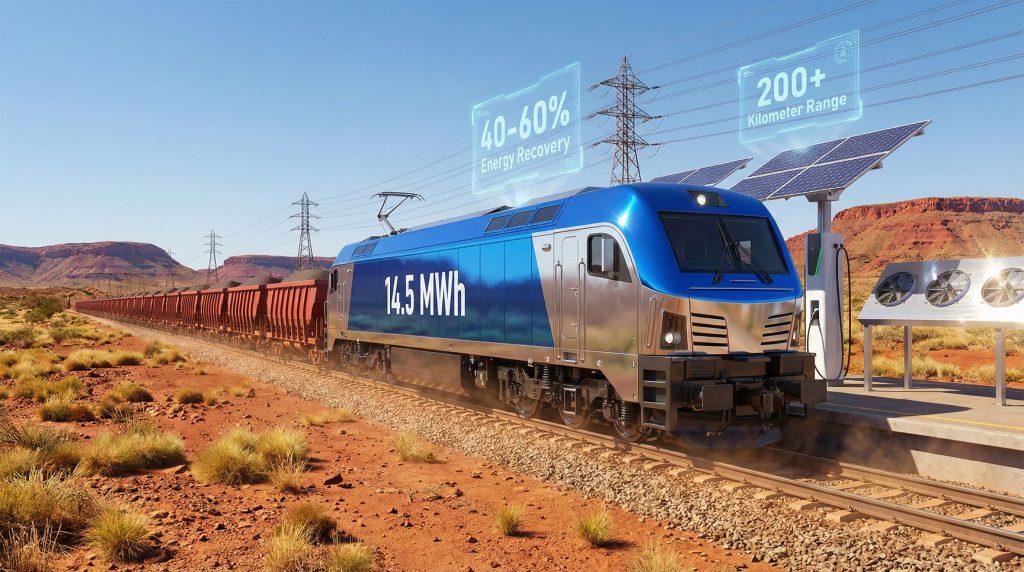
Modern mining battery-electric locomotives utilise 14.5 MWh battery banks – energy storage systems equivalent to powering 200-300 standard electric vehicles simultaneously. This massive energy density enables continuous operation across the Pilbara's extensive rail networks while maintaining the tractive force necessary for iron ore transportation.
The battery architecture employs liquid-cooled thermal management systems specifically engineered for Australia's harsh desert environment. Operating temperatures frequently exceed 40°C, requiring sophisticated cooling circuits that prevent thermal runaway while maintaining optimal charge-discharge cycles throughout extended operational periods.
Regenerative Energy Recovery Systems
The most innovative aspect of battery-electric locomotives lies in their regenerative braking capabilities. These systems convert gravitational potential energy into electrical storage during downhill portions of mine-to-port routes. In addition, the technology draws inspiration from automotive hybrid systems but operates at industrial scale, managing energy flows measured in megawatts rather than kilowatts.
Regenerative braking serves dual purposes: extending operational range while reducing mechanical brake wear. The system automatically engages when locomotive operators reduce throttle during descent phases, transforming the train's momentum into stored electrical energy rather than dissipating it as heat through friction braking.
When big ASX news breaks, our subscribers know first
Major Mining Companies Deploying Battery-Electric Rail Technology
Fortescue's Progress Rail Partnership
Fortescue has implemented two operational battery-electric locomotives manufactured by Progress Rail, a Caterpillar subsidiary. These units launched in February 2026 at Port Hedland's Thomas Rail Yard, representing the first commercial deployment of battery-electric heavy-haul technology in the Pilbara region.
The locomotives will eliminate 1 million litres of diesel consumption annually, though this represents only 1.25% of Fortescue's total 80 million litre annual fuel requirement. CEO Dino Otranto acknowledges manufacturing constraints limit rapid fleet transition, stating each locomotive requires approximately two years to manufacture, extending full fleet electrification timelines considerably.
Fortescue operates 70 diesel locomotives across its Pilbara network, making complete electrification a multi-billion dollar capital undertaking. However, the company maintains its commitment to achieving "real-zero" emissions by 2030, requiring accelerated deployment schedules and expanded manufacturing partnerships.
BHP's Wabtec Collaboration
BHP has partnered with Wabtec Corporation to develop prototype battery-electric locomotives currently undergoing commissioning trials. Vice-President of Operational Decarbonisation Daniel Heal confirmed the units are in "no-load commissioning" phase, with operational testing planned for early 2026.
BHP's approach emphasises extended validation periods before committing to large-scale deployment. The company acknowledges that diesel propulsion contributes approximately two-thirds of its operational emissions, making rail electrification critical for meeting decarbonisation targets. Nevertheless, engineering challenges have prompted BHP to extend implementation timelines and shift major capital commitments to the 2030s.
Rio Tinto's Strategic Withdrawal
Rio Tinto's decision to abandon battery-electric locomotive development represents a significant industry setback. The company initially ordered battery-electric units from Wabtec in 2022 with planned 2024 Pilbara deployment targeting 200+ diesel locomotive replacement.
Rio Tinto's official statement declared that "current battery technology is not yet viable for our Pilbara rail operations," citing unspecified technical limitations. Consequently, the decision affects potential reduction of approximately three percent of Rio Tinto's total emissions profile, delaying the company's decarbonisation timeline indefinitely.
Table: Major Battery-Electric Rail Deployments in Pilbara
| Company | Manufacturer | Status | Fleet Size | Annual Fuel Savings |
|---|---|---|---|---|
| Fortescue | Progress Rail | Operational | 2 units | 1M litres diesel |
| BHP | Wabtec | Commissioning | Prototype testing | Not disclosed |
| Rio Tinto | Wabtec (cancelled) | Shelved | 0 units | 0 litres |
Engineering Challenges in Heavy-Haul Battery Operations
Energy Density Constraints
Battery-electric locomotives face fundamental energy density limitations compared to diesel fuel systems. While diesel contains approximately 35.8 MJ/litre of energy, lithium-ion batteries provide roughly 0.5-1.0 MJ/kg, requiring massive battery banks to achieve equivalent range capabilities.
The 14.5 MWh battery systems installed in Fortescue's locomotives represent engineering compromises between energy storage capacity and locomotive weight distribution. Moreover, additional battery capacity improves range but reduces payload capacity and affects locomotive dynamics during heavy-haul operations.
Thermal Management in Desert Conditions
Pilbara operations expose battery systems to extreme thermal cycling, with ambient temperatures exceeding 45°C during summer months. Battery performance degrades significantly at elevated temperatures, while rapid temperature changes stress battery cell chemistry and reduce operational lifespan.
Cooling systems must manage heat generated internally through charge-discharge cycles while combating external thermal loads from desert conditions. Liquid cooling circuits employ glycol-based coolants circulated through battery modules, but these systems consume significant electrical energy, reducing net operational efficiency.
Charging Infrastructure Scalability
Rapid charging systems for 14.5 MWh battery banks require substantial electrical infrastructure investments. High-power DC charging stations demand grid connections capable of delivering several megawatts continuously, necessitating dedicated transmission lines to remote mining operations.
Furthermore, charging duration represents operational bottlenecks, as locomotives must remain stationary during battery replenishment periods. Unlike diesel refuelling, which completes within minutes, battery charging requires coordinated scheduling to maintain continuous mining transportation operations.
Battery vs Diesel Performance Comparison
Operational Cost Analysis
Battery-electric locomotives demonstrate substantial operational cost advantages over diesel systems across multiple performance metrics. Energy costs per kilometre average significantly lower than diesel fuel, while maintenance requirements decrease due to simplified powertrain architecture and reduced moving parts.
Performance Comparison: Battery-Electric vs Diesel Locomotives
| Metric | Battery-Electric | Diesel | Advantage |
|---|---|---|---|
| Energy Cost/km | Lower variable costs | Higher fuel costs | Battery |
| Maintenance Complexity | Simplified systems | Complex engines | Battery |
| Emissions Profile | Near-zero operational | High CO2 output | Battery |
| Initial Capital Cost | Higher upfront | Lower initial | Diesel |
| Operational Range | Limited by battery | Extended range | Diesel |
Energy Recovery Efficiency
Regenerative braking systems capture significant energy during downhill operations, effectively extending locomotive range beyond pure battery capacity. The Pilbara's undulating terrain profile creates opportunities for energy recovery, though specific efficiency percentages depend on route characteristics and load configurations.
This energy recovery capability represents fundamental advantages over diesel systems, where downhill braking energy dissipates as waste heat. Consequently, battery-electric locomotives transform gravitational potential energy into stored electrical power, reducing total energy consumption across complete transportation cycles.
Renewable Energy Integration in Mining Rail Operations
Solar Power Infrastructure
Fortescue's aggressive solar expansion programme installs more than 3,000 solar panels daily across its Pilbara operations, creating dedicated renewable energy generation for locomotive charging operations. This massive solar infrastructure development represents one of Australia's largest industrial renewable energy projects.
Solar integration enables near-zero operational emissions for battery-electric locomotives in Pilbara when powered entirely from renewable sources. The timing coordination between solar energy generation peaks and locomotive charging requirements optimises renewable energy utilisation while reducing grid electricity consumption.
Wind Power Development
The Pilbara region's wind resources complement solar generation profiles, providing renewable energy during evening and early morning periods when solar output decreases. Fortescue's inaugural wind farm construction represents mining industry leadership in renewable energy infrastructure development.
Combined solar-wind generation creates more consistent renewable energy availability, supporting continuous locomotive charging operations without fossil fuel backup power requirements. In addition, this integrated renewable approach positions battery-electric rail transportation for complete decarbonisation across all operational phases.
Manufacturing Partnerships and Technology Development
Global Technology Suppliers
Progress Rail, Caterpillar's railway division, manufactures the 14.5 MWh battery-electric locomotives currently operational in Fortescue's fleet. The company's expertise combines traditional locomotive engineering with advanced battery management systems specifically designed for mining applications.
Wabtec Corporation develops alternative battery-electric platforms for BHP trials, though specific technical specifications remain undisclosed during commissioning phases. These competing manufacturer approaches create technology diversity within the emerging battery-electric locomotive market.
Australian Industrial Capabilities
Local assembly operations reduce import dependencies while creating domestic expertise in battery-electric rail technology. Australian engineering firms contribute specialised knowledge of Pilbara operating conditions, informing thermal management system design and maintenance protocol development.
Regional service networks support remote locomotive maintenance requirements across the Pilbara's vast operational areas. This distributed maintenance capability proves essential for advanced mining operations requiring sophisticated diagnostic equipment and specialised technical expertise.
The next major ASX story will hit our subscribers first
Future Technology Development Roadmap
Battery Technology Advancement
Next-generation battery chemistry developments promise significant energy density improvements within five-year development timelines. Solid-state batteries and advanced lithium-ion formulations could increase locomotive range by 40% while reducing charging duration requirements.
Fast-charging technology innovations target sub-hour charging periods for large battery banks, potentially reducing operational downtime to levels comparable with diesel refuelling operations. However, these charging speed improvements depend on both battery recycling breakthroughs and high-power charging infrastructure development.
Industry Adoption Projections
Projected Battery-Electric Locomotive Market Penetration
| Timeline | Pilbara Fleet % | Global Mining % | Technology Status |
|---|---|---|---|
| 2026-2028 | 5-15% | 2-8% | Early deployment |
| 2028-2030 | 20-35% | 15-25% | Proven technology |
| 2030-2032 | 45-65% | 35-50% | Mainstream adoption |
Industry scaling depends on manufacturing capacity expansion, charging infrastructure development, and continued battery technology improvements. Mining companies' decarbonisation commitments drive demand, while regulatory carbon pricing mechanisms accelerate economic viability. Furthermore, innovations in electric vehicles in mining applications will likely accelerate adoption timelines.
Regulatory and Policy Support
Carbon pricing policies increasingly penalise diesel locomotive operations while incentivising renewable energy adoption. Australian government decarbonisation targets align with mining industry electrification initiatives, creating supportive regulatory environments for battery-electric technology deployment.
Infrastructure development grants and renewable energy incentives reduce capital barriers for mining companies transitioning to battery-electric rail systems. These policy mechanisms accelerate deployment timelines while improving project financial returns, particularly when combined with lithium supply innovations that support local battery manufacturing.
Conclusion
Battery-electric locomotives in Pilbara mining operations demonstrate the technical feasibility of industrial transportation electrification while highlighting the substantial engineering challenges of transitioning heavy-haul fleets. Fortescue's operational deployment proves battery-electric technology can function in Australia's harshest mining environments, though limitations in range, charging infrastructure, and manufacturing capacity constrain rapid industry adoption.
The divergent strategies among major mining companies reflect different risk tolerances and operational priorities. Fortescue pursues aggressive deployment targeting 2030 full fleet electrification, while BHP emphasises extended testing periods and Rio Tinto withdraws entirely from battery-electric development. These varied approaches will determine which companies achieve decarbonisation objectives most effectively.
Technological advancement in battery chemistry, charging systems, and renewable energy integration continues improving battery-electric locomotive viability. As energy density increases and charging speeds accelerate, the economic case for electrification strengthens significantly. The combination of operational cost savings, emissions reductions, and regulatory support positions battery-electric rail as the inevitable future of mining transportation, though the transition timeline remains dependent on continued technological progress and manufacturing scale expansion.
The success of current Pilbara trials will influence global mining industry adoption patterns, establishing Australia as a testing ground for next-generation industrial transportation technologies. These developments represent fundamental shifts toward sustainable mining operations while maintaining the productivity levels essential for Australia's resource-dependent economy.
Ready to Capitalise on the Next Mining Technology Breakthrough?
Discovery Alert's proprietary Discovery IQ model delivers real-time alerts on significant ASX mineral discoveries, including companies developing cutting-edge mining technologies like battery-electric rail systems. Understand why major mineral discoveries can lead to substantial market returns by exploring Discovery Alert's dedicated discoveries page, showcasing historic examples of exceptional outcomes, then begin your 14-day free trial today to position yourself ahead of the market.