July 15, 2026
Understanding Battery-Electric Mining Systems
The mining industry stands at a technological crossroads where traditional diesel-powered operations meet advanced electrification solutions. The world's first battery-electric mining truck in Zambia represents a fundamental shift from conventional internal combustion engines to sophisticated battery and grid-powered systems that challenge decades of established operational practices.
These ultra-large vehicles integrate complex electrical systems with proven mining durability requirements, creating engineering solutions that must withstand extreme operational demands. Furthermore, the technology encompasses not just battery storage, but comprehensive power management systems that optimise energy delivery across varying load conditions while delivering comparable performance to diesel equivalents.
Core Technical Architecture of Electric Mining Vehicles
Electric vehicles in mining utilise high-capacity lithium-ion battery systems designed specifically for industrial applications. Unlike conventional automotive batteries, mining-grade systems must deliver sustained high-power output while maintaining operational integrity in harsh environmental conditions.
The vehicles incorporate regenerative braking technology that captures kinetic energy during downhill operations. This energy recovery system significantly extends operational range and reduces overall power consumption compared to traditional friction-based braking systems.
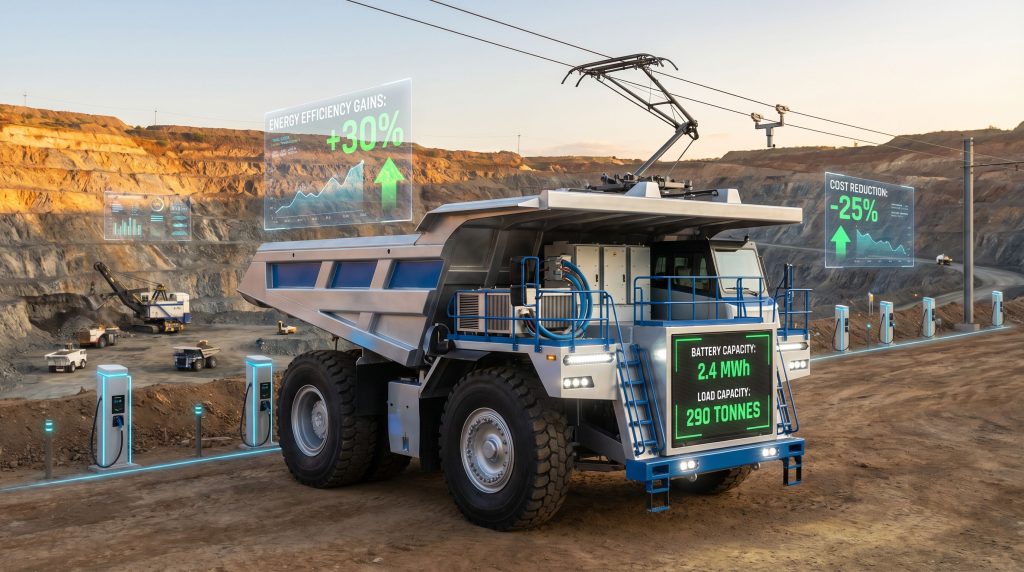
Trolley-assist integration represents a critical component where overhead power lines supplement battery power during specific route segments. This hybrid approach allows vehicles to operate extended distances while maintaining connection to grid power sources when available.
Key Technical Components:
- Advanced battery management systems monitoring cell performance and temperature
- High-torque electric motors providing instant power delivery
- Integrated cooling systems maintaining optimal operating temperatures
- Dynamic charging capabilities through pantograph collection systems
Real-World Implementation: The Kansanshi Project
First Quantum Minerals partnered with Hitachi Construction Machinery to deploy the world's first battery-electric mining truck at the Kansanshi copper and gold mine in Zambia. The Hitachi EH4000 truck was commissioned on April 16, 2026, representing years of collaborative development between the mining company and equipment manufacturer.
According to Tristan Pascall, FQM's CEO, the initiative demonstrates what can be achieved when mining companies, technology partners, and government work together to advance industry capabilities. The battery-electric truck integrates advanced battery technology with existing trolley-assist infrastructure that FQM has utilised since 2012.
Ray Kitic, VP of Hitachi's Mining Business Unit, emphasised that Zambia's renewable energy profile made it an ideal testing ground for electric mining technology. The country's grid derives approximately 85% of its power from hydroelectric sources, enabling genuine decarbonisation across operational emissions categories.
Implementation Success Factors:
- Existing trolley-assist infrastructure reducing deployment complexity
- Renewable energy grid supporting genuine emissions reduction
- Government regulatory support enabling safe technology testing
- Long-term partnership commitment between technology providers
When big ASX news breaks, our subscribers know first
Engineering Challenges in Ultra-Scale Electrification
Electric mining vehicles must overcome significant technical obstacles that don't exist in smaller industrial applications. The scale of mining operations demands continuous high-power output over extended periods, placing unprecedented stress on battery systems and electrical components.
Temperature management represents a critical challenge, as mining environments expose vehicles to extreme heat, cold, and rapid temperature fluctuations. However, battery performance degrades significantly outside optimal temperature ranges, requiring sophisticated thermal management systems that maintain consistent operating conditions.
Power System Integration Complexity
Mining trucks require seamless integration between battery power, regenerative braking, and trolley-assist systems. The vehicle's power management system must continuously optimise energy flow based on terrain, load conditions, and operational requirements whilst maintaining safety standards for high-voltage systems.
Charging infrastructure presents unique challenges in mining environments where vehicles operate in remote locations with limited grid connectivity. In addition, fast-charging capabilities must balance rapid power delivery with battery longevity, as replacement costs for large-scale battery systems significantly impact operational economics.
Critical Engineering Considerations:
- Dust and moisture ingress protection for electrical components
- Vibration resistance throughout battery mounting systems
- Emergency shutdown protocols for high-voltage systems
- Predictive maintenance algorithms for component monitoring
Operational Durability Requirements
Mining operations demand 24/7 availability with minimal scheduled downtime. Electric vehicles must match or exceed diesel truck reliability while introducing entirely new maintenance protocols and service requirements. Consequently, technician training becomes critical as high-voltage systems require specialised safety procedures and diagnostic equipment.
The Kansanshi project benefited from Zambian government support through the Mine Safety Department, which enabled safe testing of new technology within established regulatory frameworks. This regulatory collaboration demonstrates the importance of government partnership in advancing mining industry innovation deployment.
Economic Framework for Fleet Electrification
The financial case for electric mining trucks depends on multiple variables including energy costs, maintenance requirements, productivity impacts, and capital investment requirements. While electric vehicles typically require higher upfront investment, operational cost advantages can provide compelling long-term returns.
Energy cost comparisons favour electric systems in regions with stable, low-cost electricity, particularly where renewable sources dominate the grid. Zambia's hydroelectric-powered grid creates ideal conditions for electric vehicle operations, as Ray Kitic noted during the Kansanshi commissioning.
Total Cost of Ownership Analysis
Electric mining trucks eliminate diesel fuel costs, which represent significant operational expenses for large-scale mining operations. Maintenance requirements differ substantially, with electric motors requiring less frequent service than diesel engines, though battery replacement costs must be factored into long-term financial planning.
Economic Advantage Factors:
- Elimination of diesel fuel price volatility
- Reduced maintenance complexity for electric drivetrains
- Energy cost stability through long-term power purchase agreements
- Potential carbon credit revenue from emissions reduction
Productivity improvements may offset higher capital costs through reduced noise levels, improved operator comfort, and decreased maintenance downtime. For instance, electric vehicles provide instant torque delivery and smoother operation compared to diesel alternatives, potentially improving operational efficiency in demanding mining applications.
Investment Timeline and Risk Assessment
The Kansanshi project represents a significant capital commitment that required years of development before commissioning. Tristan Pascall emphasised that innovation involving extensive research, development, and close cooperation between partners requires substantial time and resource investment.
Mining companies must evaluate electric vehicle adoption against existing fleet replacement cycles and operational requirements. Early adoption involves technology risk that must be balanced against potential competitive advantages and environmental compliance benefits.
Regional Implementation Strategies
Geographic factors significantly influence electric mining truck viability, with renewable energy availability, grid stability, and regulatory environment affecting deployment success. Zambia's hydroelectric grid and government support created favourable conditions for the world's first battery-electric mining truck deployment.
Energy Infrastructure Assessment
Successful electric mining implementation requires reliable grid connectivity and sufficient power transmission capacity for industrial-scale operations. Mining sites in remote locations may require substantial infrastructure investment to support electric vehicle charging and trolley-assist systems.
Dr. Hapenga Kabeta, Permanent Secretary of Zambia's Ministry of Mines and Minerals Development, emphasised that environmental stewardship through clean energy adoption represents the future of responsible mining. Government policy support enables industry investment in innovative technology for societal benefit.
Regional Success Factors:
- Renewable energy grid composition exceeding 70%
- Government regulatory frameworks supporting industrial electrification
- Existing mining infrastructure capable of electrical system integration
- Skilled workforce availability for high-voltage system maintenance
Government Policy Alignment
The Kansanshi project demonstrates how strategic partnerships between mining companies, technology providers, and government entities enable successful innovation deployment. FQM particularly recognises Zambia's Mine Safety Department for enabling safe testing of new technology within established regulatory frameworks.
Environmental compliance requirements increasingly favour electric vehicles as governments implement stricter emissions standards for industrial operations. Mining companies adopting electric technology early may benefit from regulatory advantages as environmental policies evolve globally.
Future Technology Roadmap
Battery technology continues advancing toward higher energy density, faster charging capabilities, and extended operational lifespans. Solid-state battery development may address current limitations around charging speed and temperature sensitivity that affect mining applications, whilst battery recycling breakthrough initiatives enhance sustainability.
Autonomous operation integration represents the next frontier for electric mining vehicles, where fleet management systems optimise energy consumption through predictive routing and automated charging protocols. Self-driving capabilities combined with electric powertrains could revolutionise mining productivity and safety through data-driven operations.
Manufacturing Scale and Supply Chain Development
Commercial success requires manufacturers to scale production capacity for mining-grade electric vehicles whilst developing specialised service networks capable of high-voltage system maintenance. Hitachi's partnership with FQM dating back to 2012 provided the foundation for successful battery-electric truck development.
Technology Development Priorities:
- Advanced battery chemistries improving energy density and safety
- Fast-charging infrastructure reducing operational downtime
- Predictive maintenance systems optimising component replacement
- Autonomous fleet management reducing operational costs
Industry Collaboration Models
The success of electric mining technology depends on collaboration between equipment manufacturers, mining companies, battery suppliers, and government entities. Ray Kitic emphasised that FQM's depth of commitment to decarbonisation, extending beyond headlines to real operational impact, enabled successful technology deployment.
Mining companies like FQM, which employs approximately 96% Zambian citizens including in senior management roles, demonstrate how technology advancement can align with local development objectives and social responsibility commitments. Furthermore, battery-grade lithium refining capabilities support supply chain development globally.
The next major ASX story will hit our subscribers first
Implementation Best Practices
Mining companies considering fleet electrification should evaluate current operational patterns, electrical infrastructure capacity, and workforce training requirements before committing to large-scale deployment. Pilot programmes allow companies to test electric vehicle performance against existing diesel operations whilst minimising technology adoption risks.
The Kansanshi project's success stemmed from infrastructure availability, operational scale, and genuine commitment to technological change, according to Ray Kitic. Companies lacking these foundational elements may require additional investment in preparation before electric vehicle deployment.
Operational Integration Strategies
Mixed fleet operations during transition periods allow mining companies to maintain operational continuity whilst gradually expanding electric vehicle utilisation. Route optimisation becomes critical for electric vehicles with range limitations compared to diesel alternatives.
Implementation Checklist:
- Electrical infrastructure capacity assessment and upgrades
- Technician training programmes for high-voltage system maintenance
- Fleet management system integration for electric vehicle monitoring
- Emergency response protocols for electrical system incidents
Charging schedule coordination minimises grid demand peaks whilst ensuring vehicle availability for operational requirements. Real-time energy consumption tracking enables continuous optimisation of fleet performance and cost management.
The world's first battery-electric mining truck in Zambia represents a significant milestone in mining industry electrification, demonstrating how strategic partnerships, enabling government policies, and technological innovation can drive sustainable mining whilst delivering economic and environmental benefits.
Disclaimer: This analysis contains forward-looking statements about technology development and market trends. Actual results may differ from projections based on technological advancement, market conditions, and regulatory changes. Mining companies should conduct thorough due diligence before making capital investment decisions regarding electric vehicle fleet conversion.
Ready to Invest in the Next Mining Technology Revolution?
Discovery Alert's proprietary Discovery IQ model delivers real-time alerts on significant ASX mineral discoveries, instantly empowering subscribers to identify actionable opportunities in innovative mining companies advancing breakthrough technologies like battery-electric systems. Begin your 14-day free trial today and secure your market-leading advantage in the evolving mining sector.