
August 21, 2026
The Technology-First Exploration Thesis Reshaping How the World Hunts for Critical Minerals
For most of the twentieth century, finding a world-class mineral deposit required decades of boots-on-ground fieldwork, expensive drilling campaigns, and a considerable measure of geological intuition. The economics of exploration rewarded patience and deep pockets, which systematically excluded newer entrants from competing with established majors. That model is being dismantled. Artificial intelligence, satellite-derived geological datasets, and basin-scale computational screening are compressing exploration timelines in ways that fundamentally alter who can compete, and where. The emergence of technology-integrated exploration platforms as a distinct asset class represents one of the more consequential structural shifts in the global mining industry over the past decade, and nowhere is that shift more visible than in Latin America's critical mineral corridors.
When big ASX news breaks, our subscribers know first
Chile's Commanding Position in the Global Critical Minerals Supply Chain
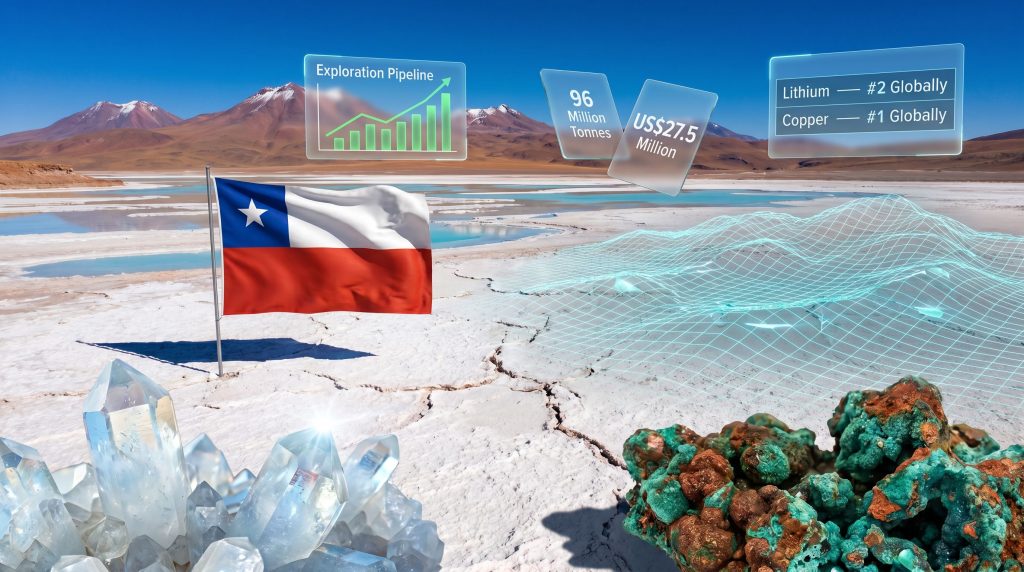
Chile's importance to the global energy transition cannot be overstated. The country is simultaneously the world's largest copper producer and the world's second-largest lithium producer, holding approximately 36% of known global lithium reserves concentrated within the Atacama and Maricunga salt flat systems. These figures alone make Chile a mandatory destination for any serious critical mineral exploration strategy oriented toward battery supply chains.
However, the country's strategic mineral inventory extends beyond lithium and copper. Chile is also the world's largest producer of rhenium, a byproduct of copper smelting with critical applications in aerospace alloys and petroleum refining catalysts. Molybdenum, another copper co-product extracted from the Andean porphyry belt, positions Chile among the top five global suppliers of that metal, which is indispensable in high-performance steel manufacturing. Furthermore, the Chile copper market outlook continues to attract significant investment attention globally.
How Chile's Critical Minerals Strategy Creates an Opening for Foreign Explorers
Chile's lithium strategy has been formalised through a National Critical Minerals Strategy that explicitly targets three structural objectives: closing geological data gaps across underexplored districts, accelerating exploration permitting timelines, and attracting qualified international partners with demonstrated technical capabilities.
What makes this policy framework consequential for foreign exploration companies is its emphasis on geological information infrastructure as a foundation for credible investment. By committing to improve baseline data quality across key mineral corridors, including the Andean Salt Flats, the Maricunga Basin, and the northern Atacama lithium zones, Chile is effectively reducing the pre-competitive risk burden that historically deterred new entrants.
Comparing Chile's regulatory posture to peer jurisdictions in the region illustrates the relative opportunity clearly:
| Jurisdiction | Mineral Endowment | Regulatory Stability | Exploration Activity | Partnership Receptivity |
|---|---|---|---|---|
| Chile | Very High | Moderate (evolving) | High | High |
| Argentina | High | Moderate | High | Moderate |
| Bolivia | Very High | Low | Low | Low |
| Peru | High | Moderate | Moderate | Moderate |
| Australia | High | High | Very High | High |
Bolivia holds extraordinary lithium endowment within the Salar de Uyuni, arguably the largest single lithium deposit on the planet, yet its state-centric governance model and historically closed investment framework have consistently prevented meaningful foreign exploration activity. Chile's willingness to engage international partners structurally separates it from Bolivia and Peru despite comparable or even superior geological endowment in some metrics. According to analysis from Columbia University's energy policy programme, Chile's regulatory openness remains a decisive competitive advantage in attracting exploration capital.
Atana Elements: A Platform-Scale Explorer Built for This Moment
Atana Elements represents a new category of exploration company, one designed around data integration and computational targeting rather than conventional geological fieldwork alone. Its methodology combines AI-assisted basin screening, large-scale geological modelling, and advanced data analytics to identify mineral targets with commercially viable characteristics before significant capital is committed to drilling. In addition, the role of AI in mineral exploration is rapidly becoming a defining competitive advantage for technology-led operators.
The scale of Atana's identified pipeline is notable by any benchmark:
| Metric | Reported Figure |
|---|---|
| Exploration basins identified | 100+ across three continents |
| Total acreage identified | Over 1.5 million acres |
| Resources identified | 96 million tonnes |
| Capital raised (recent round) | US$27.5 million |
A pipeline of 96 million tonnes of identified resources across more than 100 basins spanning three continents is not a single-asset explorer story. It is a platform story, and that distinction matters considerably in partnership negotiations. When a major mining company or battery manufacturer evaluates a joint venture, the ability to offer a multi-basin, multi-jurisdiction pipeline with optionality across multiple critical minerals is structurally more attractive than a single-project counterpart.
Why Chile Fits Atana's Basin-Identification Methodology
Atana's critical minerals exploration in Chile is not an opportunistic bet on a fashionable jurisdiction. Chile's combination of known geological endowment, improving baseline data infrastructure, and evolving policy receptivity maps directly onto the conditions under which a data-driven basin screener delivers its highest value. When geological datasets are sparse and poorly integrated, AI-assisted targeting has limited input material to work with. Chile's commitment to filling those data gaps changes that equation.
The Maricunga Salt Flat is particularly interesting from a competitive positioning standpoint. Unlike the Atacama, which is dominated by two major incumbents with decades of established tenure, Maricunga represents an emerging second-tier lithium district with lower acreage competition, improving permitting conditions, and active geological data programs. For a technology-led explorer seeking to identify high-probability targets in under-contested terrain, Maricunga offers a compelling risk-adjusted entry point.
Direct lithium extraction technology adds another dimension to Chile's attractiveness for data-driven explorers. Conventional lithium brine production relies on large evaporation ponds that consume vast surface areas and, critically, enormous volumes of freshwater — a resource under severe stress in the hyper-arid Atacama and Maricunga regions. DLE processes selectively extract lithium ions from brine solutions with a fraction of the water consumption and land footprint of traditional methods. This reduced environmental impact directly improves the permitting risk profile for new entrants and expands the viable resource universe to include lower-grade brine systems that would be uneconomic under conventional evaporation economics.
DLE's water efficiency advantage is not merely a technical footnote. In Chilean salt flat environments, water rights are a licence-to-operate constraint that has historically delayed or blocked exploration projects despite favourable geology. Technology that fundamentally reduces water consumption changes the regulatory calculus for new entrants.
The US$27.5 Million Capital Raise: Reading Between the Lines
The size and structure of Atana's recent capital raise deserves careful interpretation. A US$27.5 million raise at this stage of a 100+ basin exploration pipeline is not scaled for full project development. It is calibrated for de-risking. The purpose is to fund initial geological work programs, acquire critical data, and advance target basins to a stage where strategic partners — whether major miners, battery manufacturers, or downstream industrial buyers — can evaluate the assets with sufficient confidence to co-invest at material scale.
This is a well-established playbook in critical mineral exploration. The phases typically work as follows:
- Basin screening and identification using technology-assisted geological targeting to select high-probability targets from a large universe.
- Initial data acquisition and concession securing to establish legal tenure over priority areas.
- Pre-competitive de-risking using exploration capital to generate geological datasets that reduce perceived risk for strategic partners.
- Partnership formation with a major miner, state entity, or downstream industrial partner who co-funds development in exchange for equity or offtake rights.
- Resource advancement toward commercially defined mineral inventories under joint venture arrangements.
Atana's Chile strategy appears positioned between stages two and three, with the US$27.5 million providing the capital runway to reach the partnership formation inflection point.
Partnership Structures Being Evaluated in Chile
The partnership models available in Chile's current regulatory and commercial environment span a meaningful range of structural possibilities:
- Joint venture with a Chilean state entity: CODELCO, the state copper giant, and ENAMI, the national mining enterprise supporting small and medium miners, both represent potential co-investment counterparties, particularly given Chile's stated policy preference for partnerships that combine international technical expertise with local geological knowledge.
- Farm-in agreement with an international major: A larger mining company earns into Atana's Chilean acreage by funding defined exploration work programs, preserving Atana's upside while transferring exploration cost risk to the farming-in partner.
- Offtake-linked investment: Battery manufacturers and EV supply chain participants increasingly seek to secure upstream lithium supply through pre-production funding in exchange for forward purchase agreements. Atana's DLE-compatible brine targets in Chilean salt flat environments are structurally suited to this model.
- Public-private partnership frameworks: Chile's PPP infrastructure creates mechanisms for co-developing exploration data and enabling access to infrastructure in remote mineral districts.
The Target Mineral Hierarchy and Chile's Strategic Mineral Inventory
Understanding what Atana is likely prioritising in Chile requires mapping its exploration methodology against the country's mineral distribution:
| Mineral | Chile's Global Rank | Key Exploration Zones | Primary Demand Driver |
|---|---|---|---|
| Lithium | #2 globally | Atacama, Maricunga, Andean Salt Flats | EV batteries, grid storage |
| Copper | #1 globally | Northern porphyry belt | Grid infrastructure, EV motors |
| Molybdenum | Top 5 globally | Andean co-deposits | High-strength steel alloys |
| Rhenium | #1 globally | Copper smelting byproduct | Aerospace, catalyst refining |
Uranium is a lesser-discussed but geologically relevant dimension of Chile's northern mineral inventory. The same geological environments that host copper porphyry systems in northern Chile have, in select districts, demonstrated uranium anomalies. While uranium is not a primary exploration target for most lithium-focused explorers, companies with multi-commodity mandates and AI-assisted multi-variable screening tools may find uranium targeting a secondary value-creation avenue within otherwise lithium or copper-focused exploration programs.
Regulatory Complexity: The Non-Trivial Barriers Every Explorer Must Navigate
Chile's exploration landscape carries real operational friction that no honest analysis can overlook. The country's mining concession system distinguishes between exploration concessions, which are relatively accessible to foreign applicants, and exploitation concessions, which require more extensive environmental and community engagement processes before commercial development can proceed.
Three specific barriers deserve particular attention:
- Indigenous consultation requirements under ILO Convention 169 mandate a Free, Prior and Informed Consent (FPIC) process with indigenous communities before exploration activities begin in territories with recognised indigenous presence. The Atacama and Maricunga regions both intersect with ancestral lands of Atacameno and Aymara communities, and consultation timelines can extend exploration schedules by one to two years in contested areas.
- Water rights in arid zones represent perhaps the most structurally binding constraint. The Atacama is one of the driest environments on Earth, and water allocation systems are heavily contested between mining interests, agricultural users, and indigenous communities. New entrants must secure water rights independently of their mineral concessions, and competition for available allocations is intense.
- Constitutional and legislative evolution has introduced regulatory uncertainty in recent years, with ongoing debates about the appropriate balance between private exploration rights and state resource sovereignty adding a layer of sovereign risk that investors must price accordingly.
The geopolitical dimension adds further complexity. Chile must navigate a careful balancing act between attracting Western exploration capital, which brings technical expertise and supply chain diversification benefits, and maintaining commercial relationships with Asian offtake partners, particularly Chinese battery manufacturers who currently dominate lithium carbonate and lithium hydroxide processing capacity globally. Consequently, US-based exploration companies operating in Chile benefit from generally positive bilateral relations, but they operate within a competitive landscape where Chinese-linked entities have deep-rooted commercial relationships with Chilean mining counterparties.
The next major ASX story will hit our subscribers first
What Atana's Chile Entry Signals About the Broader Investment Landscape
The broader significance of Atana's critical minerals exploration in Chile extends beyond the company's own pipeline. It reflects a structural reallocation of US-based exploration capital back toward Latin America after a period of relative retrenchment driven by regulatory uncertainty, community opposition, and competing opportunities in more stable jurisdictions like Australia and Canada. Furthermore, the growing critical minerals demand tied to the global energy transition is accelerating this reallocation with considerable force.
The convergence of energy transition demand, improving geological data infrastructure in Chile, and the maturation of DLE technology creates a structurally different risk-return calculation for exploration investors than existed even five years ago. The barriers to entry are lower; the exit pathways through partnership are clearer.
Three investment scenarios frame the range of outcomes for Atana's Chile strategy:
- Bull case: Strategic joint venture formation with a major Chilean or international partner fast-tracks exploration across multiple salt flat targets. DLE-compatible lithium brine discoveries in the Maricunga district advance toward resource definition, and the 100+ basin platform generates multiple concurrent exploration programs funded by partner capital.
- Base case: Atana secures exploration concessions in one or two priority Chilean basins, funds initial geological work programs from its US$27.5 million raise, and reaches a data-maturity threshold sufficient to attract a farm-in partner within a two-to-three-year window.
- Bear case: Indigenous consultation timelines, water rights competition, and evolving legislation compress the capital runway before meaningful partnership formation occurs. Exploration activity is delayed rather than abandoned, but investor patience is tested.
The Net Zero Circle's assessment of Chile's exploration outlook similarly identifies the tension between Chile's extraordinary mineral endowment and the structural exploration gaps that technology-led operators are now positioned to address.
This analysis involves scenario projections and forward-looking assessments. Investors should conduct their own due diligence and consider the material risks specific to early-stage mineral exploration before making investment decisions.
FAQ: Atana Critical Minerals Exploration in Chile
What minerals is Atana targeting in Chile?
The primary focus is lithium brine systems within Chilean salt flat environments, particularly the Maricunga Basin and Andean Salt Flat zones. Secondary targets include copper and associated co-minerals consistent with Chile's northern porphyry belt geology.
How much capital has Atana raised?
Atana completed a capital raise of US$27.5 million, which is being deployed to fund exploration activity, data acquisition, and partnership formation across its global pipeline.
What makes Atana's exploration approach different from a conventional junior explorer?
Atana uses AI-assisted geological targeting and large-scale basin screening to identify mineral targets computationally before committing significant drilling capital, a methodology designed to compress the traditional exploration timeline and reduce per-unit discovery cost.
What are the main regulatory risks for foreign explorers in Chile?
The principal regulatory risks are indigenous consultation requirements under ILO Convention 169, water rights competition in hyper-arid salt flat environments, and evolving mining legislation that has introduced sovereign risk considerations into previously stable concession frameworks.
Why is the Maricunga Salt Flat attracting attention as an exploration target?
Maricunga is considered an emerging second-tier lithium district with lower competitive tenure pressure than the Atacama, improving geological data availability, and an active permitting environment. DLE technology's compatibility with the brine chemistry found in Maricunga further supports its commercial attractiveness for new entrants.
Ready to Position Yourself Ahead of the Next Major Critical Minerals Discovery?
Discovery Alert's proprietary Discovery IQ model delivers real-time alerts on significant ASX mineral discoveries — instantly transforming complex geological data into actionable investment insights for both short-term traders and long-term investors. Explore how historic discoveries have generated substantial returns on Discovery Alert's dedicated discoveries page, and begin your 14-day free trial today to secure your market-leading advantage.