May 21, 2026
Raw material cost pressures across the battery energy storage sector have intensified substantially as manufacturers confront unprecedented commodity price swings. While traditional industries developed sophisticated hedging mechanisms decades ago, energy storage system developers find themselves navigating volatile input costs with limited financial instruments and fragmented risk management approaches.
The transformation of global energy infrastructure accelerates demand for large-scale storage solutions, yet underlying cost structures remain vulnerable to raw material price shocks that can fundamentally alter project economics within weeks. Furthermore, lithium price volatility in energy storage systems creates strategic challenges requiring new approaches to supply chain management and financial risk mitigation.
Understanding Battery Energy Storage System Cost Architecture
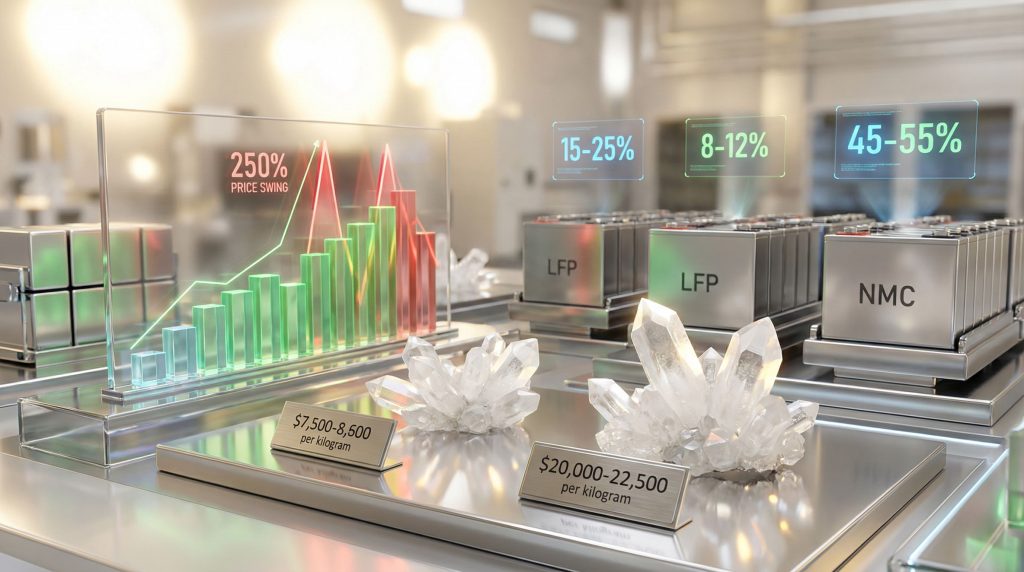
Energy storage economics operate through multiple interconnected cost layers, with material inputs representing a substantial but variable proportion of total system expenses. Raw materials typically account for 15-25% of overall system costs, though this percentage fluctuates significantly based on market conditions and technology selections.
Within battery cell manufacturing specifically, lithium carbonate represents approximately 8-12% of production expenses. This seemingly modest percentage masks the amplified impact of price volatility when commodity costs experience extreme swings exceeding 200% within annual cycles.
Comprehensive BESS Cost Structure Analysis:
- Battery cells and modules: 45-55% of total system investment
- Power conversion and inverter systems: 15-20% of project costs
- Balance of system components: 10-15% of total expenditure
- Installation and commissioning services: 8-12% of system costs
- Development and soft costs: 5-8% of project budget
Market participants report growing complexity in cost forecasting as offer validity periods compress dramatically. Where suppliers previously provided three-month pricing commitments, current market conditions have reduced commitment horizons to as little as 14 days as of January 2026, representing an 85% reduction in pricing stability.
Supply chain intelligence providers observe that vertically integrated manufacturers with substantial market share demonstrate superior capacity to absorb raw material cost increases compared to smaller market participants. This creates competitive advantages for companies with upstream processing capabilities or strategic inventory positions.
Technology Transition Cost Implications
The industry's rapid evolution from legacy LFP 314 Ah cells to next-generation LFP 587 Ah configurations introduces additional cost complexity. Market analysis suggests these high-capacity cells will become mainstream by Q3 2026, requiring manufacturers to balance inventory risks against technology advancement imperatives.
Battery cell stockpiling strategies face inherent limitations due to value degradation risks. Industry sources indicate that cell performance characteristics begin deteriorating after 3-6 months of storage, creating natural constraints on inventory-based risk management approaches.
However, companies implementing australia lithium innovations are developing advanced storage techniques and processing improvements. These technological developments could help mitigate some storage-related challenges whilst creating new opportunities for domestic supply chain resilience.
When big ASX news breaks, our subscribers know first
Raw Material Price Volatility Drivers in Energy Storage Markets
Lithium price volatility in energy storage systems stems from fundamental supply-demand imbalances exacerbated by structural market characteristics unique to the battery materials sector. Recent price movements demonstrate the extreme nature of these fluctuations, with benchmark assessments ranging from $7.50-8.60 per kilogram during market lows to $20.00-22.50 per kilogram during peak demand periods.
This represents price swings exceeding 250% within 12-month cycles, creating unprecedented challenges for energy storage project developers attempting to maintain predictable economics.
Primary Market Disruption Factors:
- Accelerated grid-scale deployment demand creating consumption spikes
- Processing capacity bottlenecks with over 75% of refining concentrated in China
- Extended mine development timelines averaging 5-7 years for new facilities
- Financial market speculation amplifying physical supply disruptions
- Seasonal demand patterns influenced by holiday production cycles
The February 2026 price movement from $17.00-19.00 per kilogram to $20.00-22.50 per kilogram within three trading days illustrates intra-week volatility potential. This specific increase occurred immediately following the Lunar New Year holiday period, suggesting seasonal demand acceleration effects compound underlying supply constraints.
Supply Chain Concentration Risks
Geographic concentration in lithium processing creates systematic vulnerability across the entire energy storage value chain. When Chinese refining capacity experiences operational disruptions or policy changes, global battery manufacturers face immediate input cost pressures with limited alternative supply sources.
Market participants report that lithium suppliers actively resist forward-purchase arrangements because committing to fixed prices creates competitive disadvantages when commodity costs subsequently decline. This rational economic behaviour at the supplier level cascades risk downstream to system integrators and project developers.
In addition, the development of battery grade lithium refinery facilities in alternative regions represents strategic attempts to diversify processing capacity. These initiatives could help reduce concentration risks whilst creating new supply chain pathways.
Global Energy Storage Demand Projections:
| Time Horizon | Projected Capacity | Annual Growth Rate |
|---|---|---|
| 2030 | Nearly 800 GWh | ~25% per year |
| 2035 | More than 1,600 GWh | Sustained acceleration |
These deployment forecasts suggest that demand pressure on raw material inputs will intensify rather than moderate, potentially creating sustained volatility conditions requiring systematic risk management responses. For instance, chile lithium resources overview initiatives will become increasingly important as global supply diversification efforts intensify.
Current Risk Management Approaches Across the Value Chain
Battery energy storage manufacturers employ fragmented approaches to raw material cost exposure, primarily due to supplier reluctance to accept forward pricing commitments and limited availability of effective hedging instruments. Traditional risk management techniques prove inadequate when applied to the unique characteristics of lithium markets.
Predominant Supply Chain Strategies:
- Compressed commitment periods: 14-day to 3-month supplier agreements
- Cost pass-through mechanisms: Contract clauses transferring price risk to customers
- Limited vertical integration: Selective upstream investment by major manufacturers
- Constrained inventory management: Balanced against cell degradation concerns
Industry sources indicate that cell manufacturers refuse forward-buy arrangements specifically because locking in current prices creates competitive exposure if lithium costs decline. This creates a structural barrier where responsible risk management becomes economically irrational at the supplier level.
Contract Architecture Evolution
Many framework agreements now incorporate automatic price adjustment triggers tied to published commodity assessments. These mechanisms enable semi-automatic cost transmission but require specific contractual parameterisation and counterparty acceptance of indexed pricing structures.
Market participants report significant variation in contract adoption patterns based on project scale and buyer power dynamics. Utility-scale developers with substantial procurement leverage can reject unfavourable hedging terms, while smaller commercial projects often accept supplier risk transfer requirements.
Risk Transfer Implementation Challenges:
- Transparency gaps: Limited visibility into actual supplier acquisition costs
- Competitive pressure: Inability to absorb hedging premiums when rivals operate unhedged
- Timing mismatches: Contract durations misaligned with project development cycles
- Organisational capability: Limited in-house expertise in commodity risk management
Supply chain intelligence indicates that pricing transparency remains severely limited throughout the battery materials value chain. Major energy storage developers report uncertainty regarding actual lithium acquisition costs paid by their suppliers, creating information asymmetries that favour upstream participants in price negotiations.
Consequently, many companies are adopting commodity hedging strategies to better manage these complex pricing relationships and reduce exposure to supplier market dynamics.
Barriers to Sophisticated Hedging Implementation
The battery energy storage sector's limited adoption of advanced risk management techniques reflects multiple structural and competitive barriers unique to this rapidly evolving industry. Unlike traditional manufacturing sectors with established commodity hedging practices, BESS companies face technological, financial, and operational constraints that inhibit effective risk mitigation.
Fundamental Implementation Obstacles:
- Rapid technological evolution creating long-term contract obsolescence risk
- Compressed profit margins insufficient to absorb hedging premium costs
- Limited derivatives market liquidity preventing efficient position establishment
- Project timeline misalignment with standard financial instrument durations
- Organisational expertise gaps in commodity risk management implementation
Financial market data shows growing but still limited activity in lithium derivatives. Chicago Mercantile Exchange lithium carbonate contracts experienced 369% volume growth from 3,106 tonnes in 2024 to 14,567 tonnes in 2025, yet remain relatively small compared to established metal futures markets.
Competitive Dynamics Preventing Hedging Adoption
Intense price competition among battery manufacturers creates race-to-the-bottom dynamics where companies cannot justify hedging costs when competitors operate without such protective mechanisms. This creates systematic underinvestment in risk management across the sector.
Cell manufacturers prefer spot market exposure to maintain competitive pricing flexibility, preventing the development of forward purchase agreements that would enable downstream hedging strategies. This supplier behaviour creates cascading risk transfer effects throughout the value chain.
Market Structure Impediments:
- Supplier refusal to accept forward pricing commitments
- Customer resistance to hedging premium absorption
- Technology transition risks making long-term contracts potentially obsolete
- Limited trading infrastructure for battery-specific materials
- Regulatory uncertainty affecting hedging instrument design
Financial Impact Assessment Across Project Categories
Lithium price volatility in energy storage systems creates differentiated financial impacts based on project scale, application type, and contract structure sophistication. Understanding these variations enables more targeted risk management strategies and appropriate hedging instrument selection.
Project-Specific Sensitivity Analysis:
| Project Category | Lithium Cost Impact | Risk Management Approach |
|---|---|---|
| Utility-scale grid storage | 10-15% total cost sensitivity | Long-term supply agreements with indexation |
| Commercial & industrial | 12-18% cost variation range | Price escalation clauses and shared risk structures |
| Residential installations | 15-20% sensitivity to raw materials | Inventory management and rapid repricing cycles |
Recent market analysis indicates that a 100% increase in lithium carbonate prices typically translates to 8-15% higher total project costs, though this varies significantly based on battery chemistry selection and system configuration complexity.
Scenario-Based Financial Modelling
Optimistic Scenario: Lithium price stabilisation at current levels enables predictable project economics with established cost baselines and manageable supply chain planning horizons.
Base Case Projection: Moderate volatility within ±50% ranges remains manageable through enhanced contract adjustment mechanisms and limited financial hedging implementation.
Stress Case Analysis: Extreme volatility exceeding 100% threatens fundamental project viability without systematic hedging approaches, potentially requiring significant contract restructuring or project delays.
Market participants report that extreme price movements create cascading effects throughout project development timelines, with procurement delays potentially extending commissioning schedules by 6-12 months in severe volatility scenarios. Furthermore, strategic partnerships such as india's lithium supply strategy initiatives are becoming critical for securing stable long-term supply arrangements.
Battery Chemistry Selection and Lithium Exposure Optimisation
Different battery chemistries present varying degrees of exposure to lithium price volatility in energy storage systems, creating strategic opportunities for developers to optimise cost sensitivity through technology selection. Understanding these chemistry-specific risk profiles enables more sophisticated procurement strategies.
Lithium Iron Phosphate Market Dominance
LFP systems maintain lower lithium content per kWh compared to alternative chemistries and dominate utility-scale applications with over 80% market share. The abundance of iron and phosphate creates more stable supply chains with reduced exposure to single-commodity price shocks.
Current market transition toward LFP 587 Ah cells promises improved energy density while maintaining the chemistry's fundamental cost stability advantages. This technology evolution is expected to reach mainstream adoption by Q3 2026, according to market analysis.
Chemistry-Specific Risk Comparison:
- LFP systems: Lower lithium content, stable supply chains, dominant in utility applications
- NMC configurations: Higher energy density but increased commodity exposure (lithium, nickel, cobalt)
- Sodium-ion alternatives: Eliminate lithium exposure entirely but with performance tradeoffs
- VRFB systems: Vanadium-based chemistry for long-duration applications
Emerging Chemistry Alternatives
Sodium-ion battery development presents potential pathways to eliminate lithium exposure entirely, though current technology limitations restrict applications to specific use cases where energy density requirements are less critical.
Solid-state battery advances may reduce lithium requirements while improving performance characteristics, though commercial viability remains several years away for utility-scale deployments.
The next major ASX story will hit our subscribers first
Available Hedging Instruments and Market Development
Financial markets have responded to growing demand for lithium risk management tools by developing increasingly sophisticated derivative instruments, though adoption remains limited due to market immaturity and liquidity constraints characteristic of emerging commodity markets.
Exchange-Traded Derivative Options:
- Chicago Mercantile Exchange: Lithium carbonate contracts settling against Fastmarkets assessments
- Singapore Exchange: Lithium hydroxide futures for Asian market participants
- London Metal Exchange: Comprehensive battery materials derivative suite
- Intercontinental Exchange: Lithium-focused trading instruments
Over-the-Counter Solutions:
- Customised forward agreements: Tailored contract terms with specific suppliers
- Commodity swap structures: Risk transfer without physical delivery obligations
- Price collar arrangements: Combined put/call option strategies limiting upside and downside
- Basis swap instruments: Managing price differentials between lithium compounds
Trading volume growth in CME lithium carbonate contracts from 3,106 tonnes in 2024 to 14,567 tonnes in 2025 indicates accelerating market acceptance despite remaining relatively modest compared to traditional industrial metal markets.
Market Infrastructure Development
Price reporting agencies provide standardised benchmark assessments that serve as settlement bases for multiple derivative contracts, creating direct mechanical linkage between physical market dynamics and financial instrument pricing.
The availability of cif China, Japan & Korea pricing assessments enables market participants to hedge specific geographic basis risks while maintaining exposure to global lithium market fundamentals. However, lithium price volatility trends suggest continued challenges ahead for risk management implementation.
Advanced Contract Design for Risk Distribution
Sophisticated contractual frameworks can effectively distribute lithium price risk across the energy storage value chain, though successful implementation requires careful consideration of counterparty capabilities and prevailing market conditions.
Supplier-Side Risk Sharing Mechanisms:
- Indexed pricing structures based on published commodity assessments
- Symmetric risk corridors sharing both upside and downside price exposure
- Volume-weighted average pricing over extended calculation periods
- Multi-supplier diversification reducing dependence on single-source pricing
Customer-Facing Adjustment Mechanisms:
- Automatic pass-through triggers for raw material cost changes exceeding thresholds
- Shared savings arrangements during favourable commodity price environments
- Long-term service agreements incorporating commodity risk premiums
- Escalation clause activation based on published index movements
Market participants report varying success with these approaches depending on project scale and negotiating leverage. Utility-scale developments with substantial buyer power can often secure favourable risk allocation terms, while smaller commercial projects frequently accept supplier-favourable arrangements.
Implementation Best Practices
Effective contract design requires explicit definition of price adjustment triggers, calculation methodologies, and dispute resolution mechanisms. Ambiguous contract language creates execution risks that can negate intended risk management benefits.
Critical Contract Elements:
- Specific index references with defined calculation periods
- Adjustment frequency parameters balancing responsiveness with administrative burden
- Force majeure provisions for extreme market conditions
- Dispute resolution frameworks for index calculation disagreements
Future Evolution of Lithium Risk Management
The battery energy storage industry's approach to managing lithium price volatility will likely undergo rapid transformation as markets mature and sophisticated financial instruments achieve broader adoption across the sector. Moreover, energy storage market growth continues accelerating, making effective risk management increasingly crucial.
Near-Term Market Development (1-2 Years):
- Enhanced adoption of existing futures contract mechanisms
- Development of industry-standard risk management practices
- Improved integration between physical and financial market pricing
- More sophisticated price discovery and transparency mechanisms
Medium-Term Structural Changes (3-5 Years):
- Emergence of specialised lithium risk management service providers
- Development of battery material index products and benchmarking systems
- Integration of hedging costs into standard project financing models
- Standardisation of contract terms across industry participants
Long-Term Market Maturation (5+ Years):
- Potential supply expansion creating more stable underlying commodity markets
- Alternative battery chemistries reducing lithium dependence systematically
- Sophisticated risk management becoming standard industry practice
- Integration with broader renewable energy risk management frameworks
Strategic Implementation Priorities
Energy storage stakeholders should develop comprehensive risk management capabilities that balance cost optimisation objectives with operational flexibility requirements, recognising that lithium price volatility represents a structural rather than cyclical challenge.
Organisational Development Recommendations:
- Establish commodity monitoring capabilities with real-time price tracking and analysis
- Develop financial market relationships with hedging instrument providers and risk management advisors
- Design flexible contract architectures enabling appropriate risk allocation across value chain participants
- Evaluate vertical integration opportunities where economically justified by scale and expertise
- Maintain strategic adaptability as market conditions and available instruments continue evolving
The intersection of lithium price volatility and energy storage system economics creates ongoing challenges requiring systematic rather than reactive approaches. Market participants who develop sophisticated risk management capabilities will achieve competitive advantages through more predictable cost structures and enhanced project bankability.
Disclaimer: This analysis contains forward-looking statements and market projections that involve inherent uncertainties. Commodity price movements, technological developments, and market conditions may vary significantly from current expectations. Readers should conduct independent analysis and consult qualified advisors before making investment or procurement decisions.
Ready to Capitalise on Critical Battery Materials Discoveries?
Discovery Alert's proprietary Discovery IQ model delivers real-time alerts on significant lithium, nickel, and other battery materials discoveries across ASX-listed companies, transforming complex mineral announcements into actionable insights for investors seeking exposure to the energy storage supply chain. With raw material costs driving 15-25% of battery system expenses and extreme price volatility creating unprecedented opportunities, subscribers gain immediate market advantages when major discoveries are announced.