May 17, 2026
Battery-grade phosphoric acid production represents a transformative opportunity within the evolving phosphate sector, where traditional mining operations are advancing into sophisticated chemical processing enterprises. While most industry participants focus exclusively on raw mineral extraction, forward-thinking companies like Arianne Phosphate are recognising that downstream value creation represents the next frontier of competitive advantage. This transformation becomes particularly significant when examining how geological advantages can translate into technological superiority in the battery metals landscape.
Technical Processing Requirements for Battery-Grade Phosphoric Acid
Battery manufacturing demands phosphoric acid that meets specifications far beyond conventional industrial applications. The chemical requirements centre on achieving purity levels exceeding 85%, with stringent controls on heavy metals including iron, aluminium, and chromium contamination. Unlike standard phosphoric acid used in fertiliser production, battery-grade material must maintain batch-to-batch consistency that ensures reliable cathode material performance.
The conversion process from phosphate concentrate to purified acid involves complex chemical engineering. Standard wet-process methodology yields approximately 90-95% theoretical conversion rates, though practical yields typically range between 80-90% depending on feedstock quality. Furthermore, each percentage point increase in concentrate grade directly impacts processing economics by reducing ore volume requirements and improving acid conversion yields.
Battery-grade phosphoric acid specifications typically require:
- Phosphorous pentoxide (P₂O₅) content: 50-54% w/w
- Iron (Fe) concentration: Below 50 ppm
- Aluminium (Al) concentration: Below 50 ppm
- Silica (SiO₂): Below 100 ppm
- Chloride and fluoride: Below 10 ppm each
The purification challenge extends beyond initial chemical conversion. Converting technical-grade phosphoric acid to battery specifications requires sophisticated removal of trace elements that can interfere with lithium-iron-phosphate cathode performance. Consequently, this purification adds significant complexity and cost compared to agricultural-grade acid production.
When big ASX news breaks, our subscribers know first
Geological Advantages of Igneous Phosphate Deposits
Arianne Phosphate's geological positioning stems from the unique characteristics of igneous apatite formations compared to sedimentary phosphate sources. The Lac à Paul deposit produces concentrate with approximately 40-42% P₂O₅ content, significantly higher than typical sedimentary sources that average 28-32% P₂O₅. This fundamental difference impacts every aspect of downstream processing economics.
Igneous apatite deposits demonstrate superior processing characteristics across multiple parameters:
- Lower silica content: Typically 1-3% versus 5-15% in sedimentary sources
- Reduced uranium levels: 20-50 ppm compared to 100-150 ppm in sedimentary deposits
- Minimal rare earth contamination: Critical for purification cost reduction
- Superior flotation response: Requires less intensive beneficiation processing
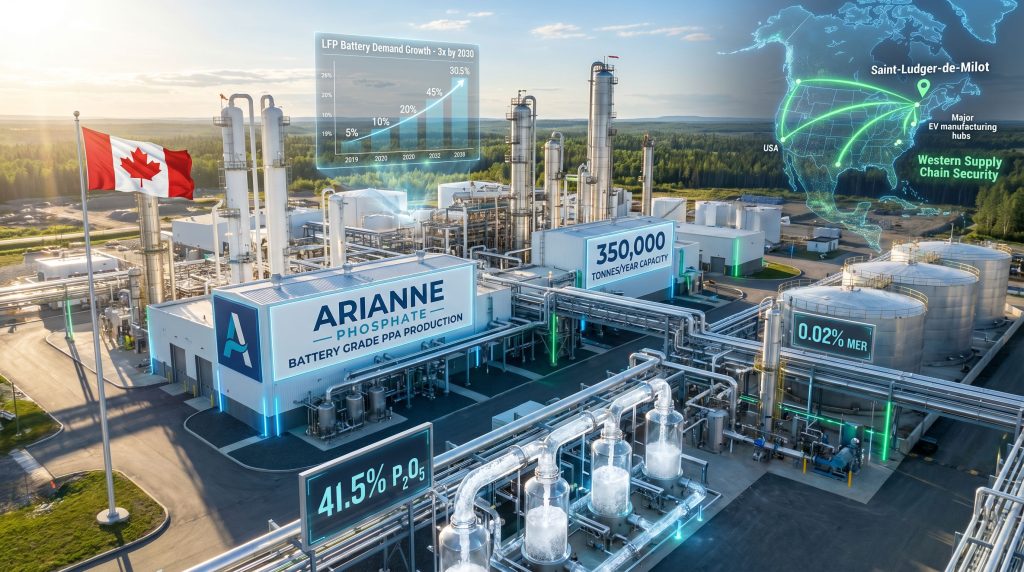
The claimed 0.02% minor element ratio would represent exceptionally low contamination levels, though this figure requires independent verification. Typical igneous phosphate deposits contain MER values of 0.15-0.5%, while sedimentary phosphates range from 0.8-2.0%. If accurate, such low contaminant levels would provide substantial advantages for Arianne Phosphate battery-grade acid production.
Comparative analysis reveals the significance of these geological advantages:
| Deposit Type | P₂O₅ Grade | Typical MER | Processing Complexity |
|---|---|---|---|
| Igneous (Arianne) | 40-42% | 0.02%* | Low purification needs |
| Morocco (OCP) | 30-32% | 0.8-1.2% | Moderate upgrading |
| Florida (Sedimentary) | 28-30% | 1.5-2.0% | Extensive purification |
*Company claim requiring verification
Travertine Technologies Process Innovation
The partnership with Travertine Technologies introduces proprietary processing methodology that differs from standard phosphoric acid production. Whilst conventional wet-process operations use sulfuric acid to convert phosphate rock into phosphoric acid and gypsum byproduct, Travertine's approach incorporates recycled sulfuric acid integration that potentially improves process economics.
Standard phosphoric acid production follows established chemistry:
Phosphate rock + H₂SO₄ → Phosphoric acid + Calcium sulfate (gypsum)
The innovation appears to focus on acid recycling and regeneration, though specific technical details remain proprietary. Laboratory-scale testing has been conducted, but results from recent trials are not yet publicly available for independent verification.
Process advantages claimed for the Travertine methodology include:
- Reduced chemical input requirements through acid recycling
- Lower operating costs via sulfuric acid regeneration
- Improved environmental profile through waste reduction
- Enhanced product consistency via process control optimisation
Energy requirements for phosphoric acid production typically demand 4-5 GJ per tonne for thermal operations and 100-150 kWh per tonne for mechanical processes. In addition, the Travertine approach may offer improvements in these energy consumption patterns, though specific performance data requires verification through independent testing.
Quebec Infrastructure and Strategic Location
The Saint-Ludger-de-Milot facility location provides multiple operational advantages within Quebec's established industrial framework. The Saguenay-Lac-Saint-Jean region offers access to hydroelectric power generation through Quebec Hydro operations, potentially providing long-term utility cost advantages compared to competing jurisdictions.
Infrastructure components supporting the demonstration plant include:
- Énergie Milot thermal energy source: Forest biomass-based thermal generation
- Industrial zoning: Existing permits for chemical processing operations
- Transportation access: Road and potential rail connections
- Utility infrastructure: Electrical, water, and communications systems
The partnership with Énergie Milot provides access to thermal energy from forest biomass, utilising Quebec's substantial forestry resources. This renewable energy source aligns with environmental considerations increasingly important for battery material supply chains.
Utility requirements for large-scale phosphoric acid production include significant cooling water volumes for condensation and process cooling, sulfuric acid supply as primary chemical input, and wastewater treatment capabilities for industrial discharge compliance. These considerations form part of broader mining industry evolution towards sustainable operations.
Production Capacity and Market Positioning
Arianne Phosphate battery-grade acid production targets 350,000 tonnes annually of battery-grade purified phosphoric acid, positioning the project as a significant supplier within the emerging market. Additional production of 200,000 tonnes of secondary acid for agricultural applications provides revenue diversification and market flexibility.
These capacity targets require substantial phosphate concentrate input. Approximately 1.8-2.0 tonnes of phosphate concentrate (40% P₂O₅) produces 1 tonne of phosphoric acid (50% P₂O₅). For instance, the 350,000 tonne PPA output would require approximately 630,000-700,000 tonnes of concentrate annually from the Lac à Paul project.
Global market context provides perspective on these production targets:
- Global phosphoric acid production: 53-55 million tonnes annually
- Battery-grade acid segment: Under 2 million tonnes (emerging market)
- Agricultural acid production: Approximately 45 million tonnes annually
The lithium-iron-phosphate battery market drives accelerating demand for purified phosphoric acid. 2023 estimated demand reached 400,000-500,000 tonnes globally, with 2025 projections indicating 800,000-1,000,000 tonnes. Industry analyses suggest 2030 demand could reach 2-3 million tonnes as electric vehicle production scales and energy storage deployment expands.
Phased development strategy allows for process optimisation and customer validation before full commercial investment. Demonstration plants typically operate at 5,000-10,000 tonnes annually, enabling:
- Process troubleshooting at commercial scale beyond laboratory testing
- Customer product validation and specification refinement
- Supply chain logistics optimisation from concentrate sourcing through product distribution
- Capital cost validation before major facility investment
Electric Vehicle and Energy Storage Market Drivers
Lithium-iron-phosphate batteries have gained significant market share within the electric vehicle sector due to their safety characteristics, thermal stability, and cost advantages. Unlike nickel-cobalt battery chemistries, LFP systems demonstrate superior performance under high-temperature conditions and reduced fire risk during charging cycles. This trend reflects broader EV transforming mining sector dynamics.
Electric vehicle production data demonstrates accelerating phosphoric acid demand:
| Year | Global EV Sales | LFP Battery Share | PPA Demand (Est.) |
|---|---|---|---|
| 2023 | 14.1 million units | 35% | 420,000 tonnes |
| 2024 | 17.8 million units* | 40% | 580,000 tonnes |
| 2025 | 21.5 million units* | 45% | 780,000 tonnes |
*Projected figures based on industry forecasting
Energy storage system expansion represents the second major demand driver for battery-grade phosphoric acid. Data centre infrastructure development, driven by artificial intelligence computing requirements, creates substantial energy storage needs for power supply reliability and grid stabilisation.
Grid-scale energy storage installations require massive battery deployments. A typical 100 MWh utility-scale storage facility using LFP technology contains approximately 150-200 tonnes of phosphoric acid within its cathode materials. Industry projections indicate 15-20 GW of annual energy storage capacity additions through 2030, translating to significant phosphoric acid consumption.
The semiconductor industry adds another dimension to purified phosphoric acid demand. Electronic component manufacturing requires ultra-high-purity chemicals for wafer processing and cleaning operations. Whilst volumes are smaller than battery applications, semiconductor-grade specifications command premium pricing that enhances overall market dynamics.
The next major ASX story will hit our subscribers first
Supply Chain Security and Geopolitical Considerations
China's dominance in lithium-iron-phosphate battery production creates strategic vulnerabilities for Western markets. Chinese manufacturers control approximately 95% of global LFP battery capacity, with integrated supply chains spanning from raw material processing through final battery assembly.
This concentration of production capacity extends to phosphoric acid supply chains. Chinese chemical companies have developed extensive infrastructure for battery-grade acid production, supported by domestic phosphate mining operations and government industrial policy coordination.
Western governments increasingly recognise these supply chain vulnerabilities as strategic risks. The United States CHIPS Act and European Battery Regulation both include provisions encouraging domestic battery material production. However, Canada's Critical Minerals Strategy specifically identifies phosphate as a priority commodity for supply chain security, aligning with energy transition strategies.
Geopolitical factors influencing phosphate supply chains include:
- Trade policy uncertainty affecting raw material flows
- Technology transfer restrictions limiting equipment access
- Environmental regulations creating competitive advantages for cleaner production
- Industrial policy coordination between government and private sector
North American phosphate production has historically focused on fertiliser applications rather than battery materials. Arianne Phosphate's positioning as the only permitted phosphate mine in Western markets provides unique strategic value for supply chain diversification initiatives.
Risk Assessment and Investment Considerations
Several technical and commercial risks require evaluation when analysing Arianne Phosphate battery-grade acid production prospects. Process technology risks centre on scaling laboratory results to commercial production volumes whilst maintaining product specifications and cost targets.
Technical risk factors include:
- Process scalability from demonstration to commercial scale
- Product specification consistency across different production batches
- Equipment reliability for continuous acid production operations
- Environmental compliance with Quebec industrial regulations
Market risks reflect the rapidly evolving battery chemistry landscape. Whilst LFP batteries currently gain market share, competing technologies including sodium-ion and solid-state batteries could alter long-term phosphoric acid demand projections.
Commercial risk considerations:
- Customer contract security for long-term offtake agreements
- Pricing volatility in battery material markets
- Competition from established Chinese suppliers
- Capital cost escalation for processing facility construction
Operational risks include dependence on the Lac à Paul project for concentrate supply, transportation logistics between mining and processing operations, and utility availability for energy-intensive acid production processes.
Regulatory and permitting risks remain significant despite Quebec's generally supportive mining framework. Environmental approvals for chemical processing operations require ongoing compliance monitoring and community engagement.
What Does the Future Hold for Battery Material Processing?
Multiple scenarios could influence Arianne Phosphate battery-grade acid production over the next decade. The base case assumes continued LFP battery market share growth driven by cost advantages and safety characteristics, supporting steady demand growth for purified phosphoric acid.
Optimistic scenario factors:
- Accelerated EV adoption exceeding current forecasts
- Grid storage deployment driven by renewable energy integration
- Supply chain localisation policies favouring Western producers
- Technology leadership in purified acid specifications
Conservative scenario considerations:
- Alternative battery chemistry adoption reducing LFP market share
- Chinese supplier competition through pricing and quality improvements
- Regulatory delays affecting facility construction timelines
- Capital market constraints limiting project financing availability
The strategic implications extend beyond individual project success to broader North American critical mineral security. Success in battery-grade acid production could establish Quebec as a hub for battery material processing, attracting additional investment in downstream chemical operations. These developments align with broader themes explored at the global innovation expo.
Long-term industry transformation may see traditional mining companies evolving into specialised chemical processors. This transition requires different technical expertise, operational capabilities, and market relationships compared to conventional mineral extraction.
This analysis contains forward-looking statements and projections that involve inherent risks and uncertainties. Actual results may differ materially from those expressed or implied. Investors should conduct independent due diligence and consider professional advice before making investment decisions.
Ready to Capitalise on Battery Materials Innovation?
Discovery Alert's proprietary Discovery IQ model delivers instant notifications on significant ASX mineral discoveries, empowering subscribers to identify actionable opportunities in emerging sectors like battery materials processing ahead of the broader market. Explore how major mineral discoveries have generated substantial returns throughout history by visiting Discovery Alert's dedicated discoveries page and begin your 14-day free trial today to position yourself at the forefront of mining innovation.