May 21, 2026
The Battery Chemistry Problem That Heavy Industry Cannot Afford to Ignore
The electrification of heavy industry is not failing because of a lack of ambition. It is struggling because the dominant battery chemistries were never designed for the conditions that define industrial work: sub-zero temperatures, relentless duty cycles, underground safety requirements, and the kind of operational uptime measured not in percentage points but in tonnes per hour. Consumer-grade lithium-ion technology, optimised for passenger vehicles and portable electronics, meets none of these specifications at an acceptable level of reliability.
This is the performance gap that makes vanadium-based anode technology strategically significant, and it is the same gap driving the Tyfast Strategic Resources Canadian battery-grade vanadium oxide MoU — a new collaboration to forge a fully domestic Canadian pathway for battery-grade vanadium oxide.
When big ASX news breaks, our subscribers know first
What Makes LVO Anode Technology Different From Conventional Battery Materials
Understanding the Electrochemical Advantage
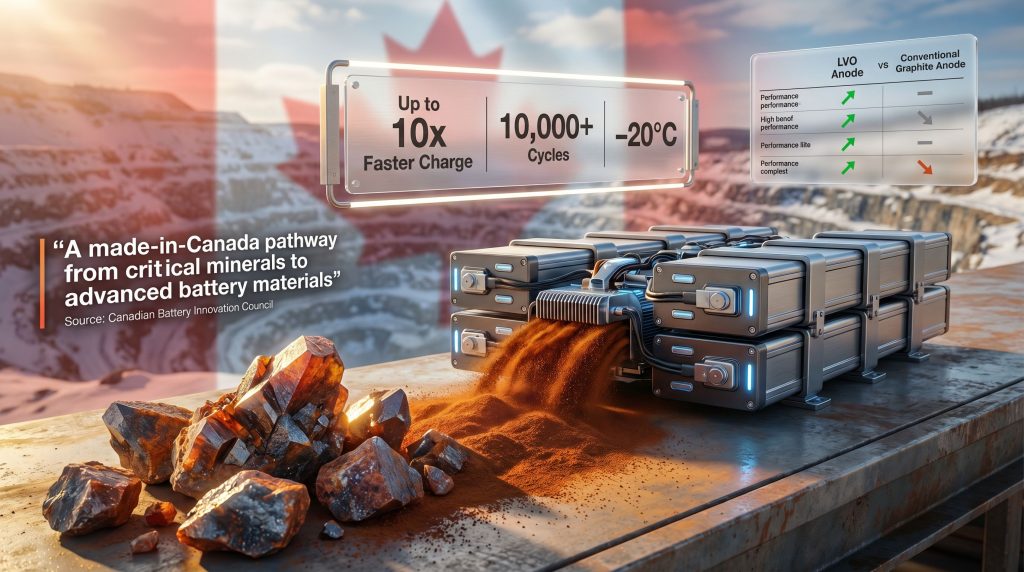
Lithium vanadium oxide, or LVO, is an advanced anode material built to replace graphite in high-performance battery systems. Where graphite anodes absorb lithium ions slowly during charging, the crystalline structure of vanadium-based materials accommodates lithium intercalation at substantially higher rates. This structural difference is what enables LVO anodes to accept charge at speeds up to ten times faster than conventional graphite baselines, according to Tyfast's published performance claims.
The implications extend beyond convenience. Faster charge acceptance directly translates to shorter equipment downtime, which in mining operations can represent the difference between meeting production targets and falling short. Furthermore, when a haul truck or underground loader can return to service in a fraction of the time required by conventional lithium-ion alternatives, the total operational economics shift materially.
The performance differentiation across key attributes is substantial:
| Performance Attribute | LVO Anode | Conventional Graphite Anode |
|---|---|---|
| Charge Speed | Up to 10x faster | Baseline |
| Cycle Life | 10,000+ charge-discharge cycles | Typically 500 to 2,000 cycles |
| Low-Temperature Operation | Functional to -20°C | Significant degradation below 0°C |
| Safety Profile | Enhanced thermal stability | Higher thermal runaway risk |
Why Graphite Falls Short in Heavy-Duty Environments
Graphite's limitations are not theoretical. In cold climates, lithium plating on graphite anodes accelerates capacity fade and can create internal short-circuit risks. In underground mining environments, where ventilation is constrained and thermal incidents carry severe consequences, graphite-based cells with elevated thermal runaway risk present a procurement liability rather than a solution.
The cycle life differential is equally consequential. A conventional lithium-ion cell degrading after 500 to 2,000 cycles requires replacement on a timeline that undermines the total-cost-of-ownership case for electrification. A system capable of 10,000 or more cycles changes the maintenance economics entirely, reducing both replacement frequency and the operational interruptions associated with battery servicing intervals. Indeed, the broader battery raw materials market is increasingly recognising these performance distinctions as decisive procurement criteria.
Battery chemistry selection in heavy-duty applications is driven by operational reliability metrics, not energy density alone. This distinction separates the industrial electrification market from the passenger vehicle segment in ways that most mainstream battery commentary fails to acknowledge.
The Tyfast and Strategic Resources MoU: Structure and Scope
What the Agreement Establishes
On April 27, 2026, Tyfast Energy Corporation and Strategic Resources Inc. formalised a Memorandum of Understanding to jointly evaluate a Canadian supply pathway for battery-grade vanadium oxide and its integration into Tyfast's proprietary LVO anode platform. The agreement is non-binding in nature, consistent with standard industry practice at this stage of development, and establishes a collaborative framework rather than committed production obligations.
The core objective is to build a vertically integrated upstream-to-downstream pathway within Canada, connecting primary mined vanadium ore to a qualified battery-grade oxide feedstock ready for advanced anode manufacturing. This structural ambition distinguishes the arrangement from conventional raw material supply agreements.
The defined workstreams under the MoU progress through three stages:
- Specification definition: Establishing target quality criteria and qualification benchmarks for battery-grade vanadium oxide derived from primary mined Canadian ore.
- Bench- and pilot-scale optimisation: Refining powder characteristics of vanadium oxide to meet the precise requirements of LVO anode manufacturing at Tyfast's level.
- Commercialisation scoping: Evaluating deployment opportunities across mining equipment, auxiliary vehicles, defence platforms, and other high-uptime industrial applications.
How Responsibilities Are Divided
The two parties bring structurally complementary capabilities to the collaboration, with clearly delineated roles:
| Party | Primary Role |
|---|---|
| Strategic Resources Inc. | Feedstock sourcing, processing pathway evaluation, mine-site development |
| Tyfast Energy Corporation | Material qualification, LVO anode development, application testing |
According to Mining Weekly's coverage, Strategic Resources CEO Sean Cleary described the partnership as a progression further up the value chain in Canada, characterising his company's contribution as vanadium resource potential and project development capability, while identifying Tyfast's downstream battery application as the complementary element needed to create a domestic pathway from critical minerals to advanced battery materials for high-value industrial markets.
Strategic Resources' BlackRock Mine: The Feedstock Foundation
Why Permitted Status Matters in Battery Material Development
Strategic Resources' BlackRock vanadium project in Canada holds permitted mine status, a distinction that carries significant weight in the context of supply-chain qualification timelines. Exploration-stage projects carry inherent regulatory uncertainty that can extend feedstock qualification programmes by years. A permitted asset removes a material layer of that uncertainty, allowing technical work under the MoU to progress against a more predictable development timeline.
The collaboration is designed to evaluate specifically how vanadium from the BlackRock mine can be upgraded into battery-grade vanadium oxide for integration into Tyfast's LVO anode platform. This processing pathway, from primary ore to a precisely specified oxide powder meeting anode manufacturing tolerances, involves multiple beneficiation and refinement steps. The bench- and pilot-scale work scoped under the MoU is intended to determine whether the ore characteristics at BlackRock are compatible with those processing requirements and what optimisation work may be needed.
Primary Ore Versus Post-Industrial Streams: A Technically Important Distinction
Tyfast's approach to vanadium feedstock is deliberately dual-sourced. The company announced a separate partnership with US Vanadium in May 2025, utilising post-industrial vanadium waste streams at a facility in Hot Springs, Arkansas. The Tyfast Strategic Resources Canadian battery-grade vanadium oxide MoU represents a structurally different feedstock model, however, drawing from primary mined ore rather than secondary processing streams.
This distinction is not merely geographic. Post-industrial vanadium streams typically originate as by-products of steel production or spent catalyst recovery, meaning their composition reflects the legacy industrial process rather than optimised mineral extraction. Primary mined ore, by contrast, provides a feedstock whose characteristics are determined by the deposit's geology and can be engineered through beneficiation design.
The two approaches introduce different processing economics, purity profiles, and qualification variables. Operating both pathways simultaneously gives Tyfast a degree of supply resilience and the ability to compare feedstock performance data across structurally different source types, which has genuine technical value in early-stage anode material development.
North American Supply Chain Dynamics and the Canadian Value-Add Opportunity
Three Converging Pressures Reshaping Battery Material Sourcing
The macro environment driving this collaboration reflects three industrial forces converging simultaneously:
- Decarbonisation mandates are compelling heavy-duty fleet operators, particularly in mining, to demonstrate credible pathways toward emissions reduction without sacrificing the operational productivity that defines their business economics.
- Supply-chain security imperatives are pushing manufacturers and governments to reduce dependence on offshore processing of battery-critical materials, with vanadium processing historically concentrated in a small number of jurisdictions outside North America.
- Industrial competitiveness policy across Canada and the broader North American region is creating structural incentives for value-added manufacturing of battery materials within national borders rather than exporting raw ore for processing elsewhere.
For Canada specifically, the intersection of domestic vanadium resource endowment with existing industrial processing infrastructure creates the conditions for a value-chain capture opportunity that the collaboration is attempting to realise. Consequently, this dynamic sits at the heart of broader critical minerals energy transition discussions taking place at a policy level across North America.
Moving Beyond Commodity Export
The conventional Canadian mineral sector model has historically centred on ore extraction and export, with higher-value processing occurring offshore. The MoU between Tyfast Energy Corporation and Strategic Resources explicitly targets the gap in that model by pursuing a pathway from mined vanadium all the way through to battery-grade oxide production and integration into an advanced anode manufacturing process.
Tyfast CEO GJ la O' articulated this ambition, stating that Canada has the mineral resources and industrial base to become a leader in next-generation battery materials for heavy-duty applications, and that qualifying battery-grade vanadium oxide from Canadian mined ore builds a more differentiated supply chain for the LVO anode platform while advancing a practical electrification pathway for mining and defence platforms. (Mining Weekly, April 28, 2026)
Commercialisation Pathways and the Total-Cost-of-Ownership Case
Target Application Categories
The MoU scopes commercialisation evaluation across three primary end-markets:
- Surface and underground mining equipment: Haul trucks, loaders, and auxiliary vehicles operating in remote, cold-climate environments where fast charging and cycle durability are operationally critical.
- Defence platforms: Military and para-military vehicles requiring fast-charge capability combined with cold-weather reliability and the safety profile appropriate for field deployment conditions.
- Off-road industrial platforms: High-uptime equipment categories across resource sectors where charging downtime has direct productivity cost consequences.
In addition, electric vehicles transforming mining operations broadly are creating pull-through demand for precisely the battery performance attributes that LVO technology is designed to deliver.
How the Economics Compare Across Platform Types
The total-cost-of-ownership comparison across competing power systems illustrates why LVO technology is positioned as a credible alternative specifically for industrial rather than passenger applications:
| Cost Driver | Diesel Baseline | Conventional Li-ion | LVO Anode Platform |
|---|---|---|---|
| Fuel/Energy Cost | High | Moderate | Lower (electricity) |
| Maintenance Frequency | High | Moderate | Reduced (fewer replacements) |
| Charging Downtime | N/A | Significant | Minimised (fast charge) |
| Cold-Climate Performance | Reliable | Degraded | Maintained to -20°C |
| Safety Risk (underground) | Combustion and emissions | Thermal runaway risk | Enhanced stability |
Note: Performance specifications and comparative claims reflect Tyfast's published technical positioning. Independent third-party verification of LVO performance at commercial scale has not been publicly confirmed at this stage of development.
The next major ASX story will hit our subscribers first
How LVO Compares to Competing Heavy-Duty Battery Technologies
The Competitive Landscape in Industrial Battery Chemistry
The heavy-duty battery market features several competing chemistries, each with structural strengths and limitations relevant to industrial applications. Furthermore, understanding where LVO sits within the broader battery metals investment landscape helps contextualise the commercial opportunity.
Lithium iron phosphate (LFP) has achieved wide commercial adoption in commercial electric vehicles due to its cycle stability and cobalt-free composition. However, its relatively limited cold-weather performance and moderate charge rate constrain its suitability for the most demanding heavy-duty applications.
Nickel manganese cobalt (NMC) offers higher energy density but carries elevated thermal risk and supply-chain exposure to cobalt, a material subject to significant geographic concentration and ethical sourcing scrutiny.
Vanadium redox flow batteries (VRFB) provide very high cycle life and are well suited to stationary grid storage applications, but their fundamental architecture, relying on liquid electrolyte tanks and pumping systems, makes them impractical for mobile heavy-duty platforms.
The comparison across key performance dimensions clarifies the positioning:
| Technology | Fast Charge | Cold Climate | Cycle Life | Mobile Application | Supply Chain Risk |
|---|---|---|---|---|---|
| LFP | Moderate | Limited | High | Yes | Low to moderate |
| NMC | Moderate | Moderate | Moderate | Yes | Cobalt exposure |
| VRFB | Low | Variable | Very High | No (stationary only) | Moderate |
| LVO (Tyfast) | Up to 10x | To -20°C | 10,000+ cycles | Yes | Building domestic |
Risk Factors Investors and Industry Observers Should Understand
What Remains Unproven at MoU Stage
It is important to contextualise the Tyfast Strategic Resources Canadian battery-grade vanadium oxide MoU within realistic development timelines and technical uncertainties. Several critical outcomes remain unconfirmed:
- Bench- and pilot-scale work must verify that BlackRock ore can be consistently processed to battery-grade vanadium oxide specifications. Geological variability within even permitted deposits can introduce unexpected processing complexity.
- The qualification pathway from pilot-scale material to commercial anode production involves multiple validation stages, each carrying its own timeline and cost uncertainty.
- Heavy-duty electrification adoption rates depend on OEM procurement cycles that operate on multi-year timelines, meaning commercialisation revenue, even in a best-case technical scenario, is not imminent.
- Maintaining consistent anode feedstock specifications across two structurally different vanadium sources — primary Canadian ore and US post-industrial streams — introduces a technical complexity that will require careful materials engineering management.
For broader context, Australia's cobalt refinery developments offer a useful parallel, demonstrating how the transition from resource extraction to battery-grade material processing involves considerable engineering and commercial development work before commercial-scale production becomes viable.
This article contains forward-looking statements and analysis of early-stage commercial developments. Nothing in this article constitutes financial or investment advice. Readers should conduct independent due diligence before making any investment or commercial decisions related to the companies, technologies, or projects discussed.
Frequently Asked Questions
What is the Tyfast and Strategic Resources MoU?
A non-binding agreement signed April 27, 2026, establishing a framework for Tyfast Energy Corporation and Strategic Resources Inc. to jointly evaluate the production of battery-grade vanadium oxide from Canadian primary mined ore for integration into Tyfast's LVO anode technology platform. Full details are available via the official announcement.
What is lithium vanadium oxide used for?
LVO is an advanced battery anode material designed for high-performance applications requiring fast charging, extended cycle life, and reliable cold-weather operation, particularly heavy-duty mining equipment, defence vehicles, and off-road industrial platforms.
What is Strategic Resources' BlackRock mine?
BlackRock is a permitted vanadium mine asset held by Strategic Resources Inc. in Canada. Under the MoU, it represents the primary feedstock source for the battery-grade vanadium oxide qualification programme.
How does this Canadian MoU differ from Tyfast's US Vanadium partnership?
Tyfast's May 2025 agreement with US Vanadium at Hot Springs, Arkansas utilises post-industrial vanadium waste streams. The Strategic Resources MoU is structurally distinct, sourcing from primary mined Canadian ore, which introduces different processing economics, purity profiles, and supply-chain sovereignty characteristics.
Why is vanadium important for battery anode materials?
Vanadium's electrochemical properties enable LVO anodes to accept charge at significantly higher rates than graphite, while maintaining structural stability across thousands of cycles and at sub-zero temperatures, making it uniquely suited to heavy-duty industrial electrification where operational reliability takes precedence over raw energy density.
What are the next steps under the MoU?
The parties will progress through specification definition, bench- and pilot-scale powder optimisation, and commercialisation scoping across target application categories including mining equipment, auxiliary vehicles, and defence platforms.
Want to Track the Next Major Mineral Discovery Before the Broader Market Does?
Discovery Alert's proprietary Discovery IQ model delivers real-time alerts on significant ASX mineral discoveries — transforming complex mineral data into actionable insights for both short-term traders and long-term investors — with a 14-day free trial available now. To understand how historic discoveries have generated substantial returns, explore Discovery Alert's dedicated discoveries page and see why being first to act on a major find can make all the difference.