June 11, 2026
The Supply Chain Imperative Driving Demand for Non-Chinese Battery Manganese
The global battery materials industry is undergoing a structural realignment that few analysts predicted with accuracy even five years ago. Electric vehicle adoption has not followed a neat, modelled curve. Instead, it has accelerated in bursts, decelerated in others, and shifted geographically in ways that have fundamentally disrupted the assumptions underpinning billions of dollars in upstream investment decisions. For manganese, a mineral long associated with steel production and traded largely as a bulk commodity, this volatility has created something unexpected: a genuine premium processing opportunity outside of China.
Understanding why that opportunity exists, and who is positioned to capture it, requires examining not just the end market, but the entire value chain from ore body to battery cell. The battery raw materials market is, consequently, reshaping how nations think about mineral sovereignty and industrial strategy.
When big ASX news breaks, our subscribers know first
Why Manganese Is Now a Battery-Critical Mineral, Not Just a Steel Input
For most of the twentieth century, manganese's commercial identity was inseparable from steelmaking. Roughly 90% of global manganese production has historically flowed into the steel industry, where it serves as a deoxidiser and alloying agent. Its role in battery chemistry, while technically established for decades, remained commercially marginal until the rapid scaling of lithium-ion battery manufacturing changed the demand equation.
The shift gathered pace as automotive original equipment manufacturers committed to electrification timelines and battery cell producers began locking in cathode active material supply chains. Three cathode chemistries now compete for market share, each with different implications for manganese intensity:
| Battery Chemistry | Manganese Role | Market Share Trend (2025) | Outlook |
|---|---|---|---|
| Lithium Iron Phosphate (LFP) | Minimal direct manganese content | ~50% of global EV battery demand | Dominant in mass-market EVs |
| Nickel-Manganese-Cobalt (NCM) | Core cathode component | Significant in premium and high-range EVs | Shifting toward high-Mn, mid-Ni formulations |
| Lithium Manganese-Rich (LMR) | Very high manganese intensity | Pre-commercial, emerging | Strong long-term demand driver |
The LFP surge was itself a forecasting failure of considerable magnitude. Industry models developed around 2020 projected LFP would represent only around 10% of the global EV battery market by 2025. The actual outcome was closer to half of all demand, driven overwhelmingly by China's domestic EV expansion. That single miscalculation cascaded through supply chain investment decisions globally.
Yet the LFP dominance does not diminish manganese's long-term strategic position. As battery manufacturers pursue higher energy density and lower cost simultaneously, high-manganese NCM formulations and the emerging LMR cathode class are attracting substantial research and development investment. LMR batteries, which require significantly higher manganese loadings than conventional NCM, represent a potential step-change in manganese demand intensity if the remaining commercialisation hurdles around voltage fade and cycle life are resolved.
What HPMSM Is and Why Purity Specifications Are Non-Negotiable
High-purity manganese sulphate monohydrate, or HPMSM, is the chemical precursor form of manganese that cathode active material producers require as a feedstock. It is produced through the chemical processing of manganese ore or, alternatively, through the dissolution and recrystallisation of electrolytic manganese metal. The resulting crystalline product must meet exacting specifications to qualify for battery-grade applications.
Battery-grade HPMSM typically requires:
- Manganese purity exceeding 99.9%
- Strict trace contaminant limits covering iron, calcium, sodium, and heavy metals
- Selenium content at or near zero, which is a critical differentiator given that conventional manganese processing often introduces selenium as a process aid
- Consistent particle size and moisture content for downstream processing compatibility
The selenium-free standard deserves particular attention. Selenium is commonly used in the production of electrolytic manganese metal as a plating additive. Its presence in downstream HPMSM is incompatible with battery cell manufacturing tolerances. Producers capable of supplying selenium-free EMM as a precursor therefore hold a structural advantage in the battery-grade processing chain. This is not a minor technical footnote. It is a market-access threshold.
South Africa's Structural Advantage in Battery Manganese Processing
South Africa hosts the Kalahari Manganese Field in the Northern Cape, which contains the largest known terrestrial manganese ore deposit, accounting for an estimated 70 to 80% of global land-based manganese reserves. This geological endowment has historically been monetised through the export of manganese ore and ferromanganese alloy, with relatively limited domestic beneficiation into higher-value chemical forms.
That equation is beginning to shift, driven partly by market forces and partly by the broader industrial policy direction of resource-rich nations seeking to capture more value from their mineral endowments before export. Furthermore, critical minerals and energy security considerations are accelerating this push toward domestic beneficiation across several resource-rich economies.
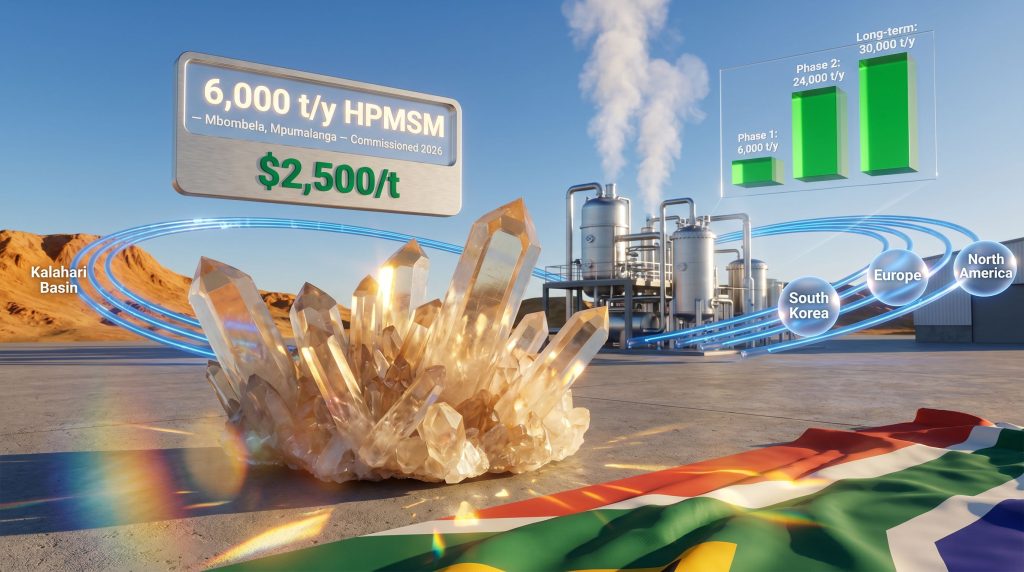
A particularly important cost consideration has emerged from technical research presented at Mintek's 90th anniversary conference. Industry analysis indicated that South Africa's cost structure allows HPMSM production at an incentive price of approximately $2,500 per tonne. This compares favourably with feasibility-stage cost estimates from newer non-Chinese projects globally, which have generally ranged from $3,500 per tonne to $5,000 per tonne. The gap reflects South Africa's combination of established manganese processing infrastructure, proximity to high-quality ore, and competitive energy and labour inputs.
"South Africa's cost advantage in HPMSM production is not theoretical. It is grounded in existing industrial infrastructure, world-class ore grades, and processing expertise accumulated over decades of EMM production."
MMC's Mbombela Plant: Seven Years From Concept to Commissioning
The Manganese Metal Company, chaired by mining industry figure Bernard Swanepoel, holds a distinction that gives its battery materials ambitions significant credibility: it is the world's only producer of electrolytic manganese metal outside China, and the largest producer of high-purity, selenium-free EMM globally. That positioning is not incidental to its HPMSM strategy. It is foundational to it.
MMC's journey from initial project conception to commissioning of its South Africa battery-grade manganese sulphate plant spans seven years, beginning in 2019 and culminating in the commissioning of a 6,000 tonne per year HPMSM facility at its Mbombela site in Mpumalanga during the first half of 2026. The timeline was shaped not by technical difficulty alone, but by significant market uncertainty that forced a reassessment of both the production route and the investment scale. You can explore the MMC HPMSM project in further detail on the company's official project page.
Phase One: The Metal-to-Crystals Approach
The production route selected for Phase One is described as metal-to-crystals, or MTX. Rather than constructing a new hydrometallurgical facility to process ore directly into sulphate, the MTX route converts a portion of MMC's existing selenium-free EMM output into battery-grade HPMSM through a controlled chemical dissolution and crystallisation process.
The logic of this approach is rooted in capital risk management. By using brownfield infrastructure, existing purification expertise, and established EMM production capacity, MMC avoids the capital intensity and construction risk of a greenfield processing plant. The trade-off is an upper capacity limit tied to available EMM feedstock, but Phase One's 6,000 t/y nameplate capacity represents a deliberate calibration to current market conditions rather than a constraint on ambition.
Key Phase One specifications include:
- Location: Mbombela, Mpumalanga, South Africa
- Phase One nameplate capacity: 6,000 tonnes per year of HPMSM
- Commissioning: H1 2026
- Production route: Metal-to-crystals (MTX) converting selenium-free EMM to battery-grade sulphate
- Feedstock: Domestically sourced Kalahari Basin manganese
- Energy strategy: Hydro energy offtake agreements secured to manage electricity cost sensitivity
Phase Two and the Long-Term Capacity Roadmap
Phase Two is already under evaluation and would add a further 18,000 tonnes per year of HPMSM capacity at the same Mbombela location, bringing cumulative output to 24,000 t/y. The long-term potential of the site has been identified at up to 30,000 t/y, subject to market conditions and investment decisions.
| Development Phase | Capacity (t/y HPMSM) | Cumulative Capacity | Status |
|---|---|---|---|
| Phase One | 6,000 | 6,000 | Commissioned H1 2026 |
| Phase Two (planned) | 18,000 | 24,000 | Under evaluation |
| Long-term potential | Up to 30,000 | 30,000 | Subject to market conditions |
The Patented Ore-to-Crystals Process: Breaking the EMM Bottleneck
Alongside the operating MTX facility, MMC has developed and patented a separate production pathway described as ore-to-crystals. This process bypasses the EMM production step entirely, converting manganese ore directly into battery-grade HPMSM through a proprietary hydrometallurgical sequence.
The strategic significance of this technology is considerable. The MTX route, while capital-efficient and operationally proven, is ultimately constrained by EMM production volumes. The ore-to-crystals route removes that ceiling, enabling expansion at a scale that is decoupled from the company's metal production capacity. Combined with South Africa's ore reserve base, this creates a theoretically uncapped processing pathway.
From an intellectual property perspective, the patent protection around this process represents a genuine competitive moat in what is otherwise becoming a contested market. As more nations seek to develop domestic HPMSM production capabilities, proprietary processing technology that delivers battery-grade purity at competitive cost structures becomes increasingly valuable.
The next major ASX story will hit our subscribers first
Geopolitical Fragmentation as a Demand-Pull Mechanism
One of the less discussed dynamics in the battery materials investment thesis is the degree to which geopolitical risk has become a structural demand driver rather than merely a contextual backdrop. Export controls, local content requirements embedded in industrial policy frameworks, and critical mineral partnership negotiations between governments are actively reshaping investment flows throughout the battery value chain.
China currently dominates not only EMM production globally but also the HPMSM processing industry. For battery manufacturers in South Korea, Japan, Europe, and North America seeking supply chain resilience, sourcing manganese sulphate from a single country represents a concentration risk that is increasingly difficult to justify from both commercial and regulatory perspectives. Indeed, China's battery supply chain dominance is a key motivator for governments and manufacturers pursuing geographic diversification.
South Korea battery expansion has emerged as a significant early offtake market for non-Chinese HPMSM, reflecting the Korean battery industry's advanced position in NCM cathode technology and its sensitivity to supply chain provenance requirements. MMC's export infrastructure benefits from access to both Durban and Maputo ports, providing competitive logistics pathways to Asian and European battery manufacturing hubs.
"The convergence of trade policy, energy security imperatives, and battery supply chain nationalism is creating durable structural demand for non-Chinese processed battery materials. First movers with established production and quality certification hold an advantage that compounds over time as customer qualification processes are completed."
Forecasting Failures and the Case for Modular Flexibility
MMC's decision in 2024 to proceed with the capital-light MTX route rather than a larger greenfield investment reflects a broader lesson the battery materials industry learned the hard way across the early 2020s. Global battery electric vehicle and plug-in hybrid vehicle sales reached more than 21 million units in 2025, more than double what leading industry forecasts had projected five years earlier. Yet the chemistry mix that drove that growth looked nothing like the models predicted.
The consequence for manganese was paradoxical. Higher-than-expected overall EV volumes should have been unambiguously positive for manganese demand. However, the dominance of LFP chemistry in China's mass-market expansion meant that cathode manganese consumption grew more slowly than total battery production would suggest. Producers who had invested in large-scale HPMSM facilities on the basis of 2020-era NCM-dominant forecasts found themselves with excess capacity in a structurally different market.
MMC's chief marketing officer, presenting at the International Manganese Institute annual conference in Rio de Janeiro in 2026, noted that "the battery market had changed dramatically since initial project studies were completed, and that flexibility and optionality had become critical operating principles for battery material developers."
This modular philosophy is increasingly recognised across the battery metals investment landscape as the appropriate response to a market defined by rapid technology change, chemistry competition, and uncertain policy trajectories.
Frequently Asked Questions
What is the MMC HPMSM plant in Mbombela and when did it start production?
The Manganese Metal Company's HPMSM plant in Mbombela, Mpumalanga is South Africa's first purpose-built South Africa battery-grade manganese sulphate plant. Phase One was commissioned in the first half of 2026, with a nameplate capacity of 6,000 tonnes per year.
What production route does MMC use at Mbombela?
Phase One uses a metal-to-crystals (MTX) process, converting MMC's existing selenium-free electrolytic manganese metal into battery-grade HPMSM through dissolution and controlled recrystallisation. A separate patented ore-to-crystals process is under development for future larger-scale production.
How does South African HPMSM pricing compare globally?
Industry research indicates South Africa can produce HPMSM at an incentive price of approximately $2,500 per tonne, compared to $3,500 to $5,000 per tonne for many newer non-Chinese projects at feasibility stage.
What is lithium manganese-rich (LMR) battery chemistry?
LMR is an emerging cathode technology that uses substantially higher proportions of manganese relative to nickel and cobalt compared to conventional NCM formulations. It offers the potential for lower cost and higher energy density, but faces commercialisation challenges around cycle life and voltage stability that the industry continues to work through.
Is MMC the only non-Chinese EMM producer?
Yes. MMC is currently the world's only producer of electrolytic manganese metal outside China, and the largest producer of high-purity selenium-free EMM globally.
What the Mbombela Plant Signals for the Global Battery Supply Chain
The commissioning of a South Africa battery-grade manganese sulphate plant at Mbombela is significant beyond its nameplate capacity. It demonstrates that the technical requirements of battery-grade HPMSM production can be met outside China's established processing ecosystem, using domestic ore, domestic expertise, and a deliberately capital-efficient process design.
Critical success factors for scaling beyond Phase One include:
- Sustained offtake demand from battery manufacturers in South Korea, Europe, and North America requiring supply chain diversification
- Successful quality certification of Phase One output by cathode active material producers
- Advancement of the ore-to-crystals process to reduce feedstock dependency on EMM volumes
- Competitive energy cost management through hydro offtake agreements and grid diversification strategies
- A Phase Two investment decision supported by HPMSM market pricing recovery above the $2,500 per tonne incentive production threshold
- The long-term commercial trajectory of LMR battery chemistry, which represents the highest potential upside scenario for manganese demand intensity
South Africa's transition from raw manganese ore exporter to processed battery materials supplier is not yet complete. But with the Mbombela facility now operational, the first chapter of that transformation has been written.
This article is intended for informational purposes only and does not constitute financial or investment advice. Forward-looking statements regarding market conditions, production capacity, pricing, and technology development are subject to risk and uncertainty. Readers should conduct their own due diligence before making any investment decisions.
Want to Track the Next Major Mineral Discovery Before the Market Does?
Discovery Alert's proprietary Discovery IQ model delivers real-time ASX alerts on significant mineral discoveries — including battery materials critical to the energy transition — translating complex data across more than 30 commodities into clear, actionable insights for investors at every level. Explore how historic discoveries have generated substantial returns and begin your 14-day free trial today to position yourself ahead of the broader market.