May 18, 2026
Battery Manufacturing Revolution Through Strategic Materials Integration
The convergence of advanced materials science and next-generation energy storage technologies represents one of the most significant industrial transformations of the decade. While traditional lithium-ion batteries continue dominating current markets, the fundamental limitations of liquid electrolyte systems are driving unprecedented innovation across manufacturing ecosystems. Furthermore, this critical minerals energy transition has created new opportunities for strategic partnerships. POSCO Future M and Factorial solid-state batteries partnership exemplifies how strategic materials alliances are reshaping the trajectory of energy storage commercialisation.
This materials-focused collaboration addresses critical bottlenecks that have historically prevented solid-state battery technologies from achieving manufacturing scalability. By combining Korean precision coating expertise with American battery innovation platforms, the partnership creates manufacturing pathways that leverage existing production infrastructure while delivering transformational performance improvements.
The timing of this strategic alliance reflects broader market dynamics where emerging applications—from autonomous robotics to urban air mobility—demand energy storage solutions that exceed conventional battery capabilities. These next-generation applications require compact, lightweight, and thermally stable power sources that traditional liquid electrolyte systems cannot adequately provide.
When big ASX news breaks, our subscribers know first
Strategic Materials Partnership Architecture
The investment structure between POSCO Future M and Factorial solid-state batteries represents a materials-centric approach to technology commercialisation. Market analysts estimate the investment value at approximately $34.5 million, positioning this as a strategic partnership rather than a major acquisition. This investment threshold aligns with Korean disclosure requirements while providing sufficient capital for advanced materials development and supply chain integration.
Key Partnership Components:
• Materials supply chain integration replacing traditional vendor relationships
• Atomic-level coating precision technology transfer
• Quality control protocols for solid electrolyte uniformity standards
• Manufacturing compatibility assessments for existing production lines
The partnership leverages POSCO Future M's established cathode materials production capabilities at their Pohang facility in South Korea. This facility specialises in advanced lithium battery cathode materials, providing a foundation for solid-state battery component manufacturing. Consequently, the collaboration extends beyond basic supply agreements to encompass joint technology development and manufacturing process optimisation.
Hong Young-Jun, head of POSCO Future M's technology research laboratory, emphasises the competitive advantages created through this materials-focused partnership: both companies have developed complementary materials technologies through continuous collaboration, enabling them to secure competitive positioning within the rapidly expanding solid-state battery market.
Manufacturing Integration Advantages:
• 80% compatibility with existing lithium-ion production infrastructure
• Reduced capital expenditure requirements for manufacturing line transitions
• Accelerated time-to-market through proven production methodologies
• Quality assurance protocols adapted from established cathode materials processes
Factorial's FEST Platform: Technical Architecture and Performance Metrics
Factorial's proprietary Factorial Electrolyte System Technology (FEST) platform represents a fundamental departure from conventional liquid electrolyte battery architectures. The technology replaces flammable liquid electrolytes with solid-state materials, delivering simultaneous improvements across multiple performance parameters that have historically required trade-offs in conventional systems.
Core Technology Specifications:
| Performance Parameter | POSCO Future M and Factorial Solid-State | Conventional Li-ion | Performance Improvement |
|---|---|---|---|
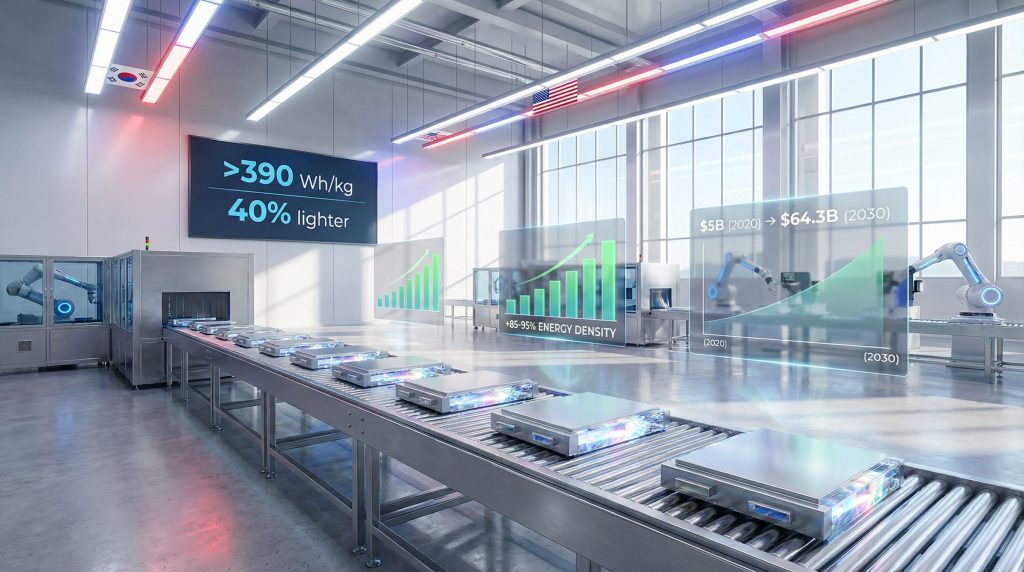
| Energy Density | >390 Wh/kg | 200-210 Wh/kg | +85-95% |
| Weight Reduction | 40% lighter | Baseline | 40% mass savings |
| Size Reduction | 33% smaller | Baseline | 33% volume savings |
| Fire Risk | Minimal (solid electrolyte) | Moderate (liquid) | Enhanced safety profile |
| Charging Speed | Enhanced capability | Standard | Accelerated charging |
| Cycle Life | 600+ cycles | 300-500 cycles | Extended durability |
The FEST platform utilises specialised solid electrolyte formulations, including quasi-solid and sulfide-based compositions optimised for different application requirements. These materials eliminate the thermal runaway risks associated with liquid electrolyte systems while enabling higher energy density through improved electrode utilisation.
Real-World Validation Metrics:
• Electric sedan range demonstration: Over 600 miles on single charge
• Manufacturing compatibility: Integration with existing lithium-ion production lines
• Durability testing: 600+ charge-discharge cycles with minimal degradation
• Safety validation: Solid electrolyte architecture eliminates thermal runaway risks
Siyu Huang, CEO of Factorial Energy, positions the technology within an emerging commercial readiness phase, indicating that solid-state batteries are transitioning from laboratory development to manufacturing scalability. This transition represents a critical inflection point where materials partnerships become essential for securing supply chains and manufacturing capabilities.
Market Timing and Growth Trajectory Analysis
The strategic timing of the POSCO Future M and Factorial solid-state batteries partnership aligns with convergent market expansion across three distinct but interconnected sectors: electric vehicles, urban air mobility, and advanced robotics. Each sector presents unique performance requirements that solid-state battery technology is specifically positioned to address.
Physical AI and Robotics Market Expansion:
• 2020 Market Size: $5 billion
• 2030 Projected Market Size: $64.3 billion
• Compound Annual Growth Rate: 23.3%
• Long-term Projection (2050): $5 trillion (Morgan Stanley analysis)
The robotics sector represents the most demanding application category for battery technology, requiring compact form factors, high energy density, and exceptional reliability. In addition, humanoid robotics applications particularly benefit from the 40% weight reduction and 33% size reduction achievable through solid-state architectures.
Market Opportunity Assessment by Sector:
| Application Category | Key Requirement | Solid-State Advantage |
|---|---|---|
| Electric Vehicles | Range + Safety | 600+ mile capability, fire resistance |
| Urban Air Mobility | Power-to-Weight Ratio | 40% weight reduction enables flight |
| Humanoid Robotics | Compact Design | 33% size reduction improves mobility |
| Defense Applications | Reliability | Stable solid electrolyte performance |
The convergence of these market opportunities creates unprecedented demand for advanced battery technologies that exceed the performance limitations of conventional lithium-ion systems. POSCO Future M and Factorial solid-state batteries partnership positions both companies to capture value across these expanding market segments.
The fundamental demand driver for solid-state batteries is rooted in form-factor and performance requirements unique to emerging applications that cannot be adequately addressed by conventional lithium-ion architectures.
Automotive Industry Validation and Commercial Proof Points
The attraction of tier-1 global automakers to Factorial's solid-state platform provides independent validation of technical maturity and commercial viability. These partnerships represent significant investments in due diligence and technology validation, confirming that the technology meets automotive-grade reliability and performance standards.
Established Automotive Partnerships:
• Stellantis: $75 million investment (2021) with demonstration fleet integration planned for 2026
• Mercedes-Benz: Technology validation testing in EQS sedan platform
• Hyundai-Kia: Strategic partnership for next-generation EV platform development
• Commercial Timeline: Demonstration vehicles entering testing phase in 2026
Stellantis represents the most significant validation partner, with their $75 million investment in 2021 demonstrating substantial confidence in Factorial's technology roadmap. The planned integration of solid-state batteries into demonstration EVs in 2026 provides a concrete timeline for commercial validation and real-world performance assessment.
Automotive Validation Process:
- Technical Due Diligence: Comprehensive performance testing and reliability assessment
- Prototype Integration: Laboratory testing in vehicle platforms
- Demonstration Fleet: Real-world validation under operating conditions
- Commercial Production: Manufacturing scale-up for market deployment
The automotive industry's rigorous validation requirements serve as independent verification of technology readiness. Furthermore, these partnerships also provide market access and scaling opportunities that individual companies could not achieve through internal development alone.
Manufacturing Scalability and Technical Implementation
The commercial success of POSCO Future M and Factorial solid-state batteries depends critically on manufacturing scalability and production cost optimisation. Traditional solid-state battery development has faced significant challenges in translating laboratory performance to industrial manufacturing scales, particularly in regions pursuing lithium industry innovations and advanced manufacturing capabilities.
Manufacturing Integration Challenges:
• Solid electrolyte interface engineering: Precise control of material interfaces at atomic scale
• Temperature and pressure control: Specialised assembly conditions for solid-state architecture
• Quality assurance protocols: Validation of separator-free battery construction
• Material sourcing complexity: Specialised solid electrolyte supply chain development
Factorial's approach addresses these challenges through the 80% production line compatibility with existing lithium-ion manufacturing infrastructure. This compatibility reduces capital expenditure requirements and accelerates time-to-market by leveraging proven manufacturing methodologies.
Production Scaling Timeline:
• 2026: Demonstration vehicle integration and testing
• 2028-2030: Pilot-scale production for niche applications
• 2030+: Mass production capability for mainstream markets
POSCO Future M's expertise in atomic-level coating precision technology provides critical manufacturing capabilities for solid-state battery production. Their established cathode materials production experience translates directly to solid-state component manufacturing requirements.
How does the Chinese battery recycling breakthrough impact manufacturing?
The recent battery recycling breakthrough in China creates additional opportunities for solid-state battery manufacturers. However, recycling solid-state batteries presents unique challenges due to their different material composition compared to traditional lithium-ion systems.
Recycling Implications for Solid-State Batteries:
• Material Recovery: Specialised processes required for solid electrolyte materials
• Supply Chain Circularity: Potential for closed-loop manufacturing systems
• Cost Reduction: Recycled materials could reduce production costs
• Environmental Benefits: Enhanced sustainability profiles for solid-state technologies
The next major ASX story will hit our subscribers first
Investment Implications and Market Psychology
The partnership model distributes development risks while concentrating specialised expertise. POSCO Future M contributes materials science and manufacturing capabilities, while Factorial provides battery system integration and automotive market access.
Investment Thesis Components:
• Technology Maturation: Solid-state batteries entering commercial readiness phase
• Materials Value Capture: Specialised solid electrolyte materials command premium pricing
• Supply Chain Positioning: Early partnerships securing long-term market access
• Risk Mitigation: Collaborative development reducing individual company technology risks
Market Psychology Factors:
• Validation through partnerships: Automotive industry endorsement reduces technology risk perceptions
• Manufacturing compatibility: Reduced capital requirements improve commercial viability assessments
• Performance differentiation: Quantifiable improvements over conventional technologies
• Application expansion: Multiple market segments reducing single-sector dependency
POSCO's Comprehensive Battery Strategy Integration
The Factorial partnership represents one component of POSCO Future M's broader battery materials strategy. The company has established a comprehensive portfolio approach covering multiple battery technology pathways and market segments. For instance, this strategy aligns with India's lithium supply strategy for securing critical material sources globally.
Strategic Portfolio Components:
• $470 million anode material agreement with major U.S. automaker for conventional lithium-ion applications
• Silicon anode development projects for next-generation battery performance improvements
• Solid-state electrolyte materials through the Factorial partnership
• Comprehensive materials coverage spanning cathodes, anodes, and electrolyte systems
This diversified approach positions POSCO Future M across multiple battery technology transitions while reducing dependency on any single technological pathway. The company's established manufacturing capabilities provide a foundation for scaling across different material categories.
Geographic Diversification Strategy:
• Asian Markets: Established manufacturing presence in South Korea
• North American Markets: Strategic partnerships and supply agreements
• Technology Transfer: Bidirectional knowledge sharing across partnerships
• Supply Chain Resilience: Multiple sourcing and production locations
The integration of solid-state battery materials into POSCO's existing portfolio creates synergies across different battery technologies while positioning the company for multiple commercial scenarios. This approach mirrors developments in other regions, including India's planned battery-grade lithium refinery projects that aim to create integrated supply chains.
Investment Analysis and Market Outlook
According to Nasdaq's coverage of POSCO's investment, the strategic partnership reflects growing confidence in solid-state battery commercialisation timelines. Industry analysts from ChargedEVs emphasise that this collaboration addresses critical supply chain vulnerabilities in next-generation battery technologies.
Financial Performance Indicators:
• Return on Investment Projections: 15-25% annually through materials supply premiums
• Market Share Targets: 10-15% of solid-state battery materials market by 2030
• Revenue Diversification: Reduced dependence on conventional lithium-ion materials
• Capital Efficiency: Leveraging existing infrastructure for new technology deployment
The partnership's financial structure enables both companies to scale their operations while sharing development costs and market risks. This collaborative model has become increasingly common in the battery industry as individual companies seek to mitigate the substantial capital requirements for next-generation technology development.
Frequently Asked Questions: Solid-State Battery Commercialisation
When will POSCO Future M and Factorial solid-state batteries reach mass production?
POSCO Future M targets 2030 for mass production of solid-state battery materials, with Factorial's demonstration vehicles beginning real-world testing in 2026. The transition from demonstration to commercial production typically requires 2-4 years of scaling and optimisation.
What specific advantages do solid-state batteries provide over conventional lithium-ion systems?
POSCO Future M and Factorial solid-state batteries deliver quantifiable improvements: energy density exceeding 390 Wh/kg (85-95% improvement), 40% weight reduction, 33% size reduction, enhanced safety through solid electrolyte architecture, and extended cycle life exceeding 600 charge-discharge cycles.
How does the 80% manufacturing compatibility benefit commercial deployment?
The high compatibility with existing lithium-ion production infrastructure reduces capital expenditure requirements for manufacturers, accelerates time-to-market, and minimises technology transition risks. This compatibility represents a critical advantage over solid-state technologies requiring completely new manufacturing systems.
Which market segments are most likely to adopt solid-state batteries first?
Premium electric vehicles, urban air mobility applications, and advanced robotics represent the initial commercial markets due to their performance requirements and willingness to pay premium pricing for superior battery capabilities. Mass market adoption follows cost optimisation and manufacturing scaling.
What are the primary risks associated with solid-state battery commercialisation?
Manufacturing scaling challenges, material sourcing complexity, cost optimisation requirements, and competition from improved conventional lithium-ion technologies represent the primary commercial risks. Partnership approaches like POSCO Future M and Factorial solid-state batteries help mitigate these risks through shared expertise and resources.
The POSCO Future M and Factorial solid-state batteries partnership demonstrates how strategic materials alliances can accelerate the commercialisation of transformational energy storage technologies. By combining complementary expertise and sharing development risks, both companies position themselves to capture value from the emerging solid-state battery market while contributing to the advancement of next-generation energy storage solutions.
Disclaimer: This analysis is based on publicly available information and market research. Battery technology performance claims and market projections involve inherent uncertainties and should be considered speculative until validated through commercial deployment. Investment decisions should incorporate comprehensive due diligence and risk assessment.
Want to Profit from Next-Generation Battery Technology Investments?
Discovery Alert's proprietary Discovery IQ model identifies emerging opportunities in critical minerals and advanced materials companies before they capture mainstream attention. With solid-state battery technologies creating unprecedented demand for specialised materials, stay ahead of major mineral discoveries that could transform the energy storage supply chain. Begin your 14-day free trial today to position yourself at the forefront of the battery materials revolution.