August 8, 2026
Understanding Battery Market Concentration: How Chinese Manufacturers Reshape Global Dynamics
The electric vehicle battery industry demonstrates unprecedented consolidation patterns that extend beyond traditional manufacturing scale advantages. Market concentration metrics reveal structural shifts where technological leadership, supply chain integration, and automotive partnership strategies create competitive moats that capital investment alone cannot replicate. This concentration dynamic fundamentally differs from historical automotive component markets, where geographic distribution and customer diversification typically prevented duopoly formations.
Contemporary market analysis shows that battery manufacturing success depends on coordinated excellence across multiple domains: raw material procurement, manufacturing automation, quality certification, and OEM relationship management. These interdependencies create barriers to entry that favour established players while limiting the effectiveness of pure capacity expansion strategies employed by newer market entrants.
Global EV Battery Market Concentration (Jan-Feb 2026)
| Market Tier | Companies | Combined Share | Strategic Position |
|---|---|---|---|
| Dominant Duo | CATL + BYD | 55.5% | Technology leadership |
| Major Players | LG Energy + CALB + Panasonic | 17.4% | Regional specialisation |
| Growth Challengers | Gotion + SK On + Svolt | 10.5% | Niche expansion |
| Market Fragments | Others | 16.6% | Innovation pipeline |
The global ev battery market share landscape during January-February 2026 reached total installations of 134.9 GWh, representing 4.4% year-over-year growth. However, this moderate market expansion masks significant competitive realignment, with Chinese manufacturers capturing market share from international competitors through technological advancement and customer relationship deepening rather than pricing competition alone.
When big ASX news breaks, our subscribers know first
Technological Leadership Drives Market Dominance Beyond Scale Economics
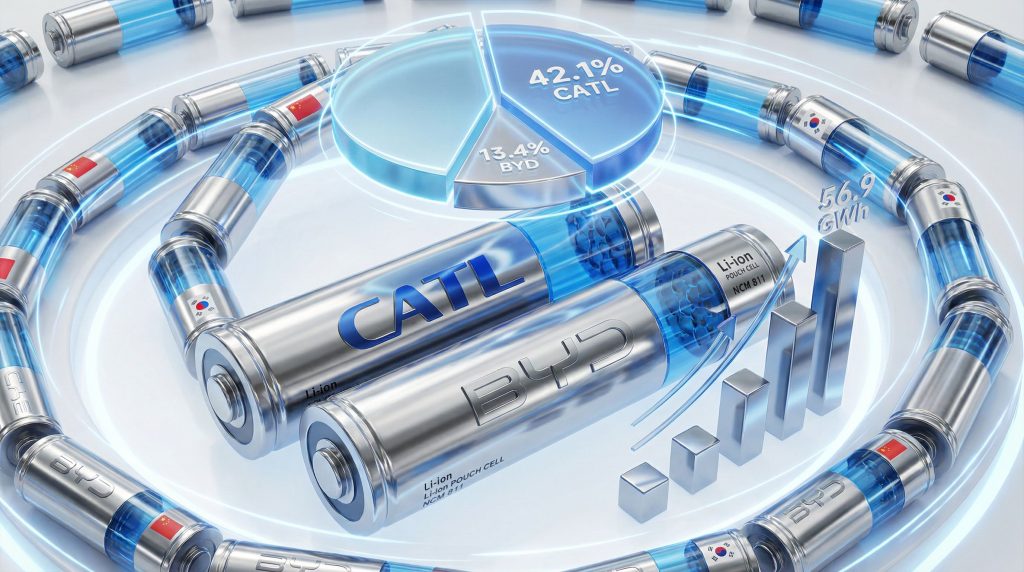
Contemporary Amperex Technology maintains its position as the world's largest battery manufacturer through strategic diversification across multiple automotive segments and technological platforms. The company's 42.1% global ev battery market share reflects sophisticated ecosystem management spanning premium and mass-market vehicle categories, with installation volumes reaching 56.9 GWh during the first two months of 2026.
Furthermore, CATL's 13.7% year-on-year growth substantially outpaced the overall market expansion of 4.4%, indicating active market share capture from competitors. This growth trajectory demonstrates the company's ability to secure new automotive partnerships whilst expanding existing customer relationships through the battery recycling breakthrough and advanced manufacturing processes.
CATL Performance Metrics (Jan-Feb 2026):
• Global market share: 42.1%
• Installation volume: 56.9 GWh
• Year-over-year growth: +13.7%
• Monthly share fluctuation: 45.2% (January) to 42.1% (combined average)
The company's technological portfolio spans multiple battery chemistry platforms, including lithium iron phosphate (LFP) and nickel cobalt manganese (NCM) formulations. This chemistry diversification enables CATL to serve different market segments with optimised cost-performance profiles, from entry-level electric vehicles requiring cost-effective LFP solutions to premium vehicles demanding high energy density NCM configurations.
Manufacturing capacity distribution across Asia, Europe, and North America provides geographic risk mitigation and regulatory compliance advantages. This global footprint enables CATL to serve automotive manufacturers with localised supply chains whilst meeting regional content requirements and trade policy specifications that increasingly influence battery sourcing decisions.
Vertical Integration Creates Competitive Advantages and Strategic Constraints
Build Your Dreams faces unique market dynamics as both battery manufacturer and automotive original equipment manufacturer, creating internal resource allocation decisions that impact external market performance. The company's 13.4% global ev battery market share represents a 2.6 percentage point decline from 16.0% in the same period of 2025, with installation volumes decreasing 12.5% year-over-year to 18.1 GWh.
This performance decline originated primarily from seasonal weakness in BYD's own-brand vehicle sales during the traditional Chinese automotive off-season in January-February 2026. Consequently, the company's dual identity as battery supplier and vehicle manufacturer creates capacity allocation conflicts where internal demand requirements compete with external market opportunities.
BYD Market Performance Analysis:
• Current market share: 13.4% (down from 16.0% in 2025)
• Installation volume: 18.1 GWh (-12.5% year-over-year)
• Seasonal impact: Chinese domestic market weakness
• International growth: Positive but insufficient to offset domestic decline
BYD's vertical integration strategy prioritises internal battery supply security for its expanding vehicle production over maximising third-party battery sales revenue. This approach provides manufacturing cost control and supply chain reliability advantages for BYD's automotive business whilst limiting the company's ability to capitalise on external battery metals investment market growth opportunities.
International market expansion efforts showed positive momentum but remained insufficient to compensate for domestic market contraction. This geographic dependence pattern highlights the strategic risk inherent in BYD's home market concentration, particularly during seasonal demand fluctuations that affect the broader Chinese automotive sector.
Regional Manufacturers Face Structural Market Pressures
South Korean battery manufacturers experienced collective market share deterioration during early 2026, with their combined global market presence declining to 15.0%. This performance reflects broader macroeconomic pressures affecting their primary customer markets rather than technological or operational disadvantages relative to Chinese competitors.
South Korean Manufacturer Performance (Jan-Feb 2026):
| Company | Market Share | Volume (GWh) | YoY Change | Global Rank |
|---|---|---|---|---|
| LG Energy Solution | 8.7% | 11.8 | -2.7% | 3rd |
| SK On | 3.8% | 5.2 | -12.9% | 7th |
| Samsung SDI | 2.5% | 3.3 | -21.9% | 10th |
LG Energy Solution maintained relative resilience with only a 2.7% year-over-year decline, preserving its third-place global ranking. The company's diversified customer portfolio across multiple automotive manufacturers and geographic markets provided better stability compared to competitors with higher customer concentration risks.
In addition, SK On experienced more significant contraction with a 12.9% installation volume decline, whilst Samsung SDI faced the steepest reduction at 21.9% year-over-year. These differential performance patterns suggest varying degrees of customer dependency and market exposure among South Korean manufacturers.
According to global EV market analysis, the decline among South Korean battery companies primarily resulted from a nearly 30% sales drop in the US electric vehicle market and reduced demand from major legacy automakers. This external demand shock demonstrates how battery manufacturer performance directly correlates with automotive market health in their primary geographic regions.
Emerging Chinese Manufacturers Drive Innovation Pipeline Development
Second-tier Chinese battery manufacturers including CALB, Gotion High-tech, and Eve Energy represent the innovation pipeline for future market evolution. These companies leverage specialised technologies and targeted market positioning to challenge established market leaders through differentiated product offerings and strategic customer partnerships.
CALB secured fourth place globally with 4.7% market share and 6.3 GWh installation volume, focusing primarily on commercial vehicle applications where different performance requirements create competitive opportunities. The company's specialisation in specific market segments enables focused resource allocation and technology development strategies alongside lithium industry innovations.
Emerging Manufacturer Positioning:
• CALB: 4.7% share, commercial vehicle focus
• Gotion High-tech: 3.9% share, LFP technology specialisation
• Eve Energy: 2.8% share, energy storage integration
• Svolt: 2.8% share, technological innovation emphasis
Gotion High-tech's 3.9% market share reflects strategic emphasis on lithium iron phosphate battery technologies, positioning the company to serve cost-sensitive market segments whilst automotive manufacturers increasingly adopt LFP solutions for entry-level and mid-range vehicles. This chemistry specialisation provides competitive advantages in specific market niches.
Furthermore, Eve Energy's 2.8% market share demonstrates the company's strategy of integrating automotive battery production with stationary energy storage applications, creating technology synergies and market diversification opportunities that reduce dependence on automotive demand cycles alone.
Market Dynamics Influence Global EV Battery Market Share Distribution
Geographic demand patterns create asymmetric competitive advantages for different manufacturers, with regional market characteristics favouring specific technology profiles, cost structures, and supply chain configurations. Chinese domestic market strength supports local manufacturers through volume scale and customer proximity advantages.
The Chinese electric vehicle market represents approximately 60% of global sales volume, providing domestic battery manufacturers with substantial home market advantages in technology development, customer relationship building, and manufacturing scale achievement. This geographic concentration enables Chinese companies to achieve critical mass before pursuing international expansion strategies.
European regulatory frameworks increasingly emphasise battery recycling, supply chain transparency, and environmental compliance standards that favour established manufacturers with comprehensive quality certification and traceability systems. These requirements create additional barriers to entry for new market participants pursuing sustainable battery recycling technologies.
Regional Market Influence Factors:
• Chinese market: Dominant volume supporting local manufacturers
• European requirements: Quality certification and sustainability standards
• North American policies: Manufacturing localisation incentives
• Emerging markets: Cost-effectiveness prioritisation
North American trade policies increasingly require battery manufacturing localisation to qualify for electric vehicle purchase incentives, creating opportunities for companies with domestic production capabilities whilst challenging imports from other regions.
The next major ASX story will hit our subscribers first
Technology Innovation Patterns Reshape Competitive Positioning
Battery chemistry evolution, manufacturing process advancement, and energy density improvements create continuous competitive realignment opportunities across the global ev battery market share landscape. Companies investing in next-generation technologies position themselves for future market share gains as automotive manufacturers adopt new performance standards.
Lithium iron phosphate technology development enables cost reduction strategies that expand electric vehicle market accessibility whilst maintaining safety and cycle life performance. This chemistry platform particularly benefits manufacturers with LFP specialisation as automotive companies increasingly adopt these solutions for cost-sensitive market segments.
Nickel cobalt manganese chemistry advancement focuses on energy density optimisation for premium vehicles requiring maximum range capabilities. Manufacturers leading NCM development maintain advantages in high-performance market segments where cost considerations are secondary to technical specifications and revolutionizing lithium batteries capabilities.
Technology Differentiation Areas:
• LFP advancement: Cost reduction and safety optimisation
• NCM development: Energy density and charging speed improvement
• Solid-state research: Next-generation performance potential
• Manufacturing automation: Quality consistency and cost control
Solid-state battery development represents the next major technology transition opportunity, with successful commercialisation potentially disrupting current market share distributions. Companies achieving solid-state technology breakthroughs first may capture significant competitive advantages.
Supply Chain Strategies Determine Long-Term Market Position
Raw material sourcing, manufacturing localisation, and supply chain resilience strategies increasingly determine competitive sustainability beyond current market position metrics. Companies with diversified supply chains and strategic resource access maintain market share advantages during disruption periods.
Lithium procurement strategies directly impact manufacturing cost structures and supply security, with companies securing long-term contracts or vertical integration achieving competitive advantages. In addition, battery manufacturers increasingly pursue upstream integration to control raw material costs and availability.
Critical Supply Chain Elements:
• Lithium sourcing: Mining partnerships and recycling integration
• Nickel procurement: Geographic diversification and price hedging
• Cobalt management: Ethical sourcing and alternative chemistry development
• Manufacturing localisation: Regional production and trade compliance
Nickel supply chain management becomes increasingly complex as automotive demand grows whilst traditional stainless steel applications maintain consumption levels. Battery manufacturers requiring nickel-rich chemistries must secure reliable procurement strategies to maintain production consistency.
Investment Framework Analysis for Battery Market Dynamics
The global ev battery market share analysis reveals distinct investment opportunity categories based on competitive positioning, technology focus, and growth trajectory characteristics. Market concentration trends, regional expansion success, and supply chain integration create different risk-return profiles across manufacturer categories.
Investment Category Framework:
• Market Leaders: Stable cash flows with moderate growth potential
• Technology Innovators: High growth opportunity with execution risks
• Regional Specialists: Geographic diversification and niche advantages
• Emerging Disruptors: Revolutionary potential with significant volatility
Market leading companies like CATL demonstrate consistent performance with global customer diversification, providing relatively stable investment profiles with steady market share maintenance capabilities. These manufacturers typically generate predictable cash flows whilst pursuing measured expansion strategies.
Technology innovation companies focusing on next-generation battery chemistry or manufacturing process advancement offer higher growth potential with correspondingly elevated execution risks. However, success in technology development can create substantial competitive advantages and market share gains.
Regional specialists maintain competitive advantages in specific geographic markets through regulatory compliance, customer relationships, or supply chain positioning. These companies provide portfolio diversification benefits whilst potentially benefiting from regional market growth acceleration.
Future Market Evolution Through 2026-2027
Projected market dynamics indicate continued Chinese manufacturer dominance with gradual market share redistribution based on technology advancement success, international expansion effectiveness, and automotive industry partnership evolution. The global ev battery market share landscape will reflect these competitive forces.
Electric vehicle adoption acceleration across developed and emerging markets creates expansion opportunities for manufacturers with scalable production capabilities and technology portfolios suited to diverse market requirements. Companies successfully addressing multiple market segments simultaneously gain competitive advantages.
Market Evolution Drivers:
• Global EV adoption rates and policy support
• Battery technology standardisation and performance improvement
• Trade regulations and manufacturing localisation requirements
• Sustainability standards and recycling infrastructure development
Technology standardisation trends may consolidate market competition around fewer chemistry platforms whilst increasing emphasis on manufacturing efficiency and cost optimisation. Furthermore, companies achieving leadership in dominant technology standards gain sustainable competitive advantages.
Trade policy evolution and manufacturing localisation requirements will increasingly influence market share distribution as governments prioritise domestic battery production capabilities for strategic security and economic development objectives. Consequently, the EV battery market trends continue to evolve rapidly.
Disclaimer: This analysis is based on publicly available market data and industry research. Battery market dynamics, company performance, and competitive positioning can change rapidly due to technological developments, regulatory changes, and macroeconomic factors. Readers should conduct independent research and consult qualified professionals before making investment decisions related to battery manufacturers or electric vehicle companies. The information presented here is for educational and informational purposes only and does not constitute investment advice or recommendations.
Looking to Capitalise on the EV Battery Boom?
Discovery Alert's proprietary Discovery IQ model delivers real-time alerts on significant battery metals and mining discoveries across the ASX, helping investors identify opportunities in the rapidly evolving supply chain that underpins global EV battery production. Stay ahead of market movements by exploring Discovery Alert's dedicated discoveries page to see how historic mineral discoveries have generated substantial returns, then begin your 14-day free trial today to position yourself at the forefront of this transformative industry.