August 9, 2026
The evolution of battery material supply chains reflects a fundamental shift from traditional commodity trading toward sophisticated partnership frameworks. As electric vehicle adoption accelerates and energy storage markets expand, manufacturers increasingly prioritise technical validation, supply security, and processing capabilities over simple cost considerations. Furthermore, this transformation has created new opportunities for companies that can demonstrate both technical competence and strategic value across multiple stages of the battery metals investment chain.
Strategic Factors Driving Battery Material Partnership Success
The emergence of structured partnerships between graphite producers and anode manufacturers represents a calculated response to supply chain vulnerabilities that have plagued the battery industry. Unlike traditional procurement relationships focused primarily on price and volume, contemporary battery material partnerships emphasise technical qualification processes, long-term supply security, and shared development of specialised materials.
Technical Qualification Requirements and Timeline Expectations
The EcoGraf Mitsubishi Chemical battery partnership exemplifies how technical qualification serves as the foundation for commercial relationships in battery materials. The framework establishes technical evaluation and product qualification as the initial phase, with progression to binding commercial agreements contingent on successful technical outcomes. This structured approach protects both parties whilst creating clear pathways for partnership development.
Technical qualification in graphite supply chains typically involves:
- Material testing protocols for specific battery applications
- Consistency verification across multiple production batches
- Performance benchmarking against established industry standards
- Scalability assessment of production processes
The non-binding nature of initial agreements allows flexibility during technical evaluation whilst maintaining commercial momentum toward potential long-term relationships.
Volume Commitments and Infrastructure Investment Justification
The scale contemplated in the EcoGraf arrangement demonstrates how volume commitments drive partnership value creation. With potential commitments of 10,000 tonnes per annum for spherical graphite products or approximately 16,500 tonnes per annum for natural flake graphite, the framework indicates substantial commercial potential rather than limited technical evaluation.
These volume levels provide several strategic advantages:
- Infrastructure investment justification for specialised processing facilities
- Economies of scale in production and logistics operations
- Market validation for investors and stakeholders
- Supply security for downstream manufacturers
Geographic Optimisation and Supply Chain Resilience
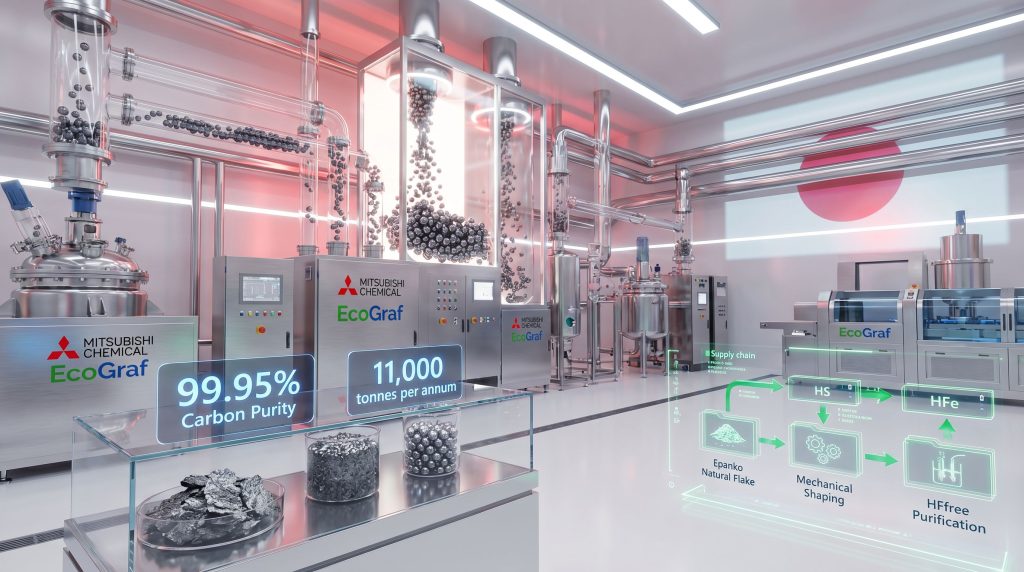
The geographic positioning of the EcoGraf Mitsubishi Chemical battery partnership reflects broader industry trends toward supply chain diversification. Mitsubishi Chemical's expansion of battery anode production facilities in Kagawa, Japan, reaching 11,000 tonnes per annum capacity, demonstrates how regional manufacturing hubs drive partnership opportunities.
Moreover, EcoGraf's planned processing facilities spanning from Tanzania through potential Japanese purification operations create geographic diversification that reduces single-point-of-failure risks whilst positioning materials closer to end-use manufacturing centres.
When big ASX news breaks, our subscribers know first
Japanese Chemical Industry's Strategic Graphite Positioning
Mitsubishi Chemical's Market Leadership and Expansion Strategy
As Japan's largest chemical corporation, Mitsubishi Chemical operates across multiple industrial segments including petrochemicals, carbon products, and battery materials. The company's position as a supplier of anode active materials to original equipment manufacturers places it at the intersection of chemical processing expertise and battery technology advancement.
The expansion of Kagawa facility capacity represents strategic investment in battery anode production amid growing global demand. Mitsubishi Chemical's worldwide production capabilities and established OEM relationships create substantial market access opportunities for qualified graphite suppliers.
Supply Chain Dependencies and Diversification Imperatives
Current graphite supply chains exhibit significant geographic concentration, with Chinese producers dominating spherical graphite processing. This concentration creates strategic vulnerabilities for non-Chinese manufacturers seeking reliable, high-quality graphite supplies for battery applications.
Japanese manufacturers face additional considerations:
- Quality specification requirements that may differ from commodity-grade materials
- Environmental compliance standards favouring cleaner processing methods
- Supply security concerns related to geopolitical factors
- Technical support capabilities from suppliers
The emphasis on HFfree purification methods in the partnership addresses environmental compliance advantages particularly relevant to developed market manufacturers operating under stringent regulatory frameworks.
Vertical Integration Advantages in Battery Material Supply
EcoGraf's Mine-to-Battery Value Chain Strategy
EcoGraf's vertical integration approach encompasses multiple processing stages designed to capture value at each step of the graphite-to-anode transformation. In addition, this integrated strategy creates substantial competitive advantages across the entire value chain.
| Processing Stage | Location | Capacity Target | Strategic Function |
|---|---|---|---|
| Natural Flake Production | Epanko, Tanzania | 73,000 tpa concentrate | Raw material foundation |
| Mechanical Shaping | Tanzania | 10,000+ tpa spherical | Value-added processing |
| HFfree Purification | Multiple locations including Japan | 99.95% carbon purity | Premium product positioning |
This integration model creates several competitive advantages:
- Cost structure optimisation through elimination of intermediary margins
- Quality control across the entire processing chain
- Supply security through owned raw material sources
- Technical differentiation via proprietary purification methods
Partnership Models and Capital Efficiency
Rather than pursuing complete vertical integration independently, EcoGraf's partnership approach with companies like Mitsubishi Chemical creates capital efficiency opportunities. Strategic partnerships enable:
- Reduced capital requirements for downstream processing facilities
- Shared technical development costs and associated risks
- Market validation before major facility investments
- Access to established customer networks and technical expertise
The partnership model allows EcoGraf to focus capital allocation on core competencies whilst accessing market opportunities through established industry participants.
Technical Specifications and Processing Technology Differentiation
Graphite Quality Requirements for Battery Applications
The specifications outlined in the EcoGraf Mitsubishi Chemical battery partnership reflect the precise technical requirements of modern battery anode manufacturing. Furthermore, these requirements align with broader critical minerals energy transition demands for high-quality materials.
Natural Flake Graphite Requirements:
- Minus 100 mesh sizing for optimal processing characteristics
- Consistent flake geometry for mechanical shaping efficiency
- Chemical purity levels suitable for further processing
Spherical Graphite Specifications:
- Mechanically shaped particles for enhanced battery performance
- Uniform particle size distribution
- Surface characteristics optimised for electrolyte interaction
Purified Spherical Graphite Standards:
- 99.95% carbon content for lithium-ion applications
- Minimal metallic impurities
- Consistent electrochemical performance characteristics
HFfree Purification Technology Advantages
EcoGraf's HFfree purification methodology represents a significant technical differentiator in graphite processing. Traditional hydrofluoric acid purification methods present several challenges:
- Environmental compliance concerns in developed markets
- Safety requirements for handling hazardous chemicals
- Waste disposal complexities and associated costs
The HFfree approach addresses these issues whilst maintaining product quality standards required for battery applications. This technology positioning becomes particularly valuable when partnering with manufacturers in regions with stringent environmental regulations.
Volume Commitments and Long-Term Partnership Structure
Potential Supply Framework Analysis
The volume commitments contemplated in the EcoGraf arrangement provide insight into how strategic partnerships structure long-term commercial relationships:
Partnership Volume Framework:
- Primary Option: Up to 10,000 tonnes annually of spherical graphite (purified or unpurified)
- Alternative Option: Approximately 16,500 tonnes annually of natural flake graphite (minus 100 mesh)
- Progression Structure: Technical qualification leading to binding commercial agreements
- Timeline: Subject to successful completion of evaluation processes
Industry Context and Competitive Benchmarking
The scale of potential commitments in the EcoGraf partnership aligns with established industry precedents. Comparable arrangements in the graphite sector, such as the NextSource-Mitsubishi partnership involving 9,000 tonnes per annum, demonstrate that volumes in the 10,000+ tonne range represent substantial commercial commitments.
These volume levels provide several strategic benefits:
- Production planning certainty for manufacturing operations
- Investment justification for specialised processing equipment
- Market positioning as a reliable supplier
- Revenue visibility for financial planning
Risk Management Through Structured Progression
The progression from non-binding memorandum of understanding to potential binding agreements creates risk management benefits for both parties. This structure allows:
- Technical validation before commercial commitments
- Market testing of products and applications
- Relationship development between technical teams
- Commercial term negotiation based on proven technical performance
Investment Implications and Market Positioning
Partnership Validation and Financing Benefits
Strategic partnerships with established industry leaders like Mitsubishi Chemical provide multiple investment thesis enhancements for companies like EcoGraf. However, the development of such partnerships requires careful attention to milestone achievement and technical validation.
Technical Validation Benefits:
- Third-party endorsement of product quality and specifications
- Reduced technical risk perception among investors
- Demonstration of commercial viability
Financial Planning Advantages:
- Long-term revenue potential visibility
- Improved project financing prospects
- Enhanced market credibility for future partnerships
Strategic Positioning Benefits:
- Access to established supply chains
- Market intelligence and customer insights
- Platform for additional partnership development
Timeline Considerations and Milestone Progression
The progression from technical evaluation to commercial agreements requires careful attention to milestone achievement and timeline management. Key considerations include:
- Technical qualification duration and success criteria definition
- Commercial term negotiation complexity and timeline expectations
- Integration with broader project development schedules and capital allocation
Success in technical qualification phases creates momentum toward binding commercial agreements, whilst also providing valuable market intelligence for broader commercial strategy development.
The next major ASX story will hit our subscribers first
Industry Comparison and Competitive Landscape Analysis
Battery Material Partnership Models and Structures
The EcoGraf Mitsubishi Chemical battery partnership represents one approach to structuring relationships between graphite producers and anode manufacturers. Alternative models in the industry include:
- Exclusive supply agreements with single customers
- Technology licensing arrangements for processing methods
- Joint venture partnerships for facility development
- Tolling arrangements for processing services
Each structure presents different risk-reward profiles and strategic implications for both suppliers and customers. Consequently, companies must carefully evaluate which model best suits their strategic objectives.
Geographic Diversification Trends in Supply Chain Development
The battery materials industry increasingly emphasises geographic diversification to reduce concentration risks. This trend creates opportunities for suppliers offering:
- Non-Chinese sourcing alternatives for critical materials
- Regional processing capabilities near manufacturing centres
- Environmentally compliant production methods meeting developed market standards
EcoGraf's positioning as a Western-domiciled company with African mining operations and potential Asian processing capabilities addresses these diversification preferences.
Technology Differentiation as Partnership Selection Criteria
As the battery materials market matures, technology differentiation becomes increasingly important in partnership selection. Factors driving selection include:
- Processing method innovation such as HFfree purification
- Quality consistency and specification achievement
- Scalability demonstration for large-volume production
- Environmental compliance and sustainability metrics
Companies demonstrating clear technical advantages gain preference in partnership evaluation processes. For instance, developments in lithium industry innovations continue to influence partnership selection criteria.
How Does Partnership Structure Impact Commercial Success?
The structure of battery material partnerships significantly influences their ultimate commercial success. Non-binding initial agreements provide flexibility during technical qualification phases whilst maintaining commercial momentum. This approach reduces risks for both parties during critical evaluation periods.
However, progression to binding agreements requires demonstrated technical competence and market validation. Companies that successfully navigate this progression gain substantial competitive advantages in market positioning and customer relationships.
What Drives Volume Commitment Levels in Battery Material Partnerships?
Volume commitments in battery material partnerships reflect multiple strategic considerations beyond simple demand forecasting. Infrastructure investment requirements drive minimum volume thresholds necessary to justify specialised processing facilities.
Furthermore, economies of scale considerations influence volume commitments, as larger volumes enable cost-effective production and logistics operations. Market positioning benefits also drive volume commitments, as substantial volumes demonstrate reliability and scalability to potential customers.
Broader Industry Implications and Future Development
Supply Chain Transformation in Battery Materials
The evolution toward structured partnerships reflects fundamental changes in battery material procurement strategies. Traditional spot market purchasing gives way to:
- Long-term relationship development with qualified suppliers
- Technical collaboration on product specification optimisation
- Supply chain integration for improved efficiency and reliability
- Risk sharing arrangements for development and commercialisation
This transformation benefits suppliers capable of providing technical expertise and reliability alongside competitive pricing. Additionally, the emergence of battery recycling breakthrough technologies influences partnership strategies.
Investment Strategy Considerations for Market Participants
The emergence of structured partnerships creates new evaluation criteria for investment in battery material companies:
Partnership Quality Assessment:
- Calibre and market position of strategic partners
- Technical validation achievement and timeline
- Commercial term attractiveness and progression potential
Market Positioning Analysis:
- Technology differentiation sustainability
- Geographic and customer diversification
- Scalability demonstration and capital efficiency
Risk Factor Evaluation:
- Technical qualification completion probability
- Partnership conversion to binding agreements
- Competitive positioning sustainability
Future Partnership Development Opportunities
Success in initial partnerships creates platforms for additional relationship development. Companies like EcoGraf can leverage proven technical capabilities and established relationships to pursue:
- Additional tier-one manufacturer partnerships in different geographic markets
- Technology licensing opportunities for proprietary processing methods
- Regional supply chain development near key battery manufacturing hubs
- Vertical integration expansion into additional value-added processing stages
The battery materials industry's continued expansion provides substantial opportunities for companies successfully navigating partnership development and technical qualification processes. Moreover, the development of battery-grade lithium refinery capabilities creates additional partnership opportunities across the broader battery supply chain.
Disclaimer: This analysis is based on publicly available information and industry research. Investment decisions should be based on comprehensive due diligence including review of company financial statements, market conditions, and individual investment objectives. Past performance does not guarantee future results, and all investments carry risk of loss.
Ready to Discover the Next Major Battery Materials Breakthrough?
Discovery Alert's proprietary Discovery IQ model delivers real-time alerts on significant ASX mineral discoveries, instantly empowering subscribers to identify actionable opportunities ahead of the broader market. Begin your 14-day free trial today and secure your market-leading advantage in the rapidly evolving battery materials sector.