July 12, 2026
Global energy infrastructure investment patterns are fundamentally reshaping battery metals investment priorities as grid modernisation requirements outpace traditional automotive electrification timelines. The convergence of artificial intelligence expansion, renewable energy integration, and industrial electrification has created unprecedented demand for stationary energy storage systems, forcing manufacturers to rapidly recalibrate production strategies and capacity allocation decisions.
This macro-economic transformation reflects broader structural shifts where energy security concerns, data center proliferation, and grid stability requirements are driving investment flows away from consumer-focused applications toward industrial-scale infrastructure projects. The resulting market dynamics have created both challenges and opportunities across the global battery manufacturing ecosystem, as the slowing US EV market hits LG Energy Solutions battery sales.
Financial Performance Under Market Pressure
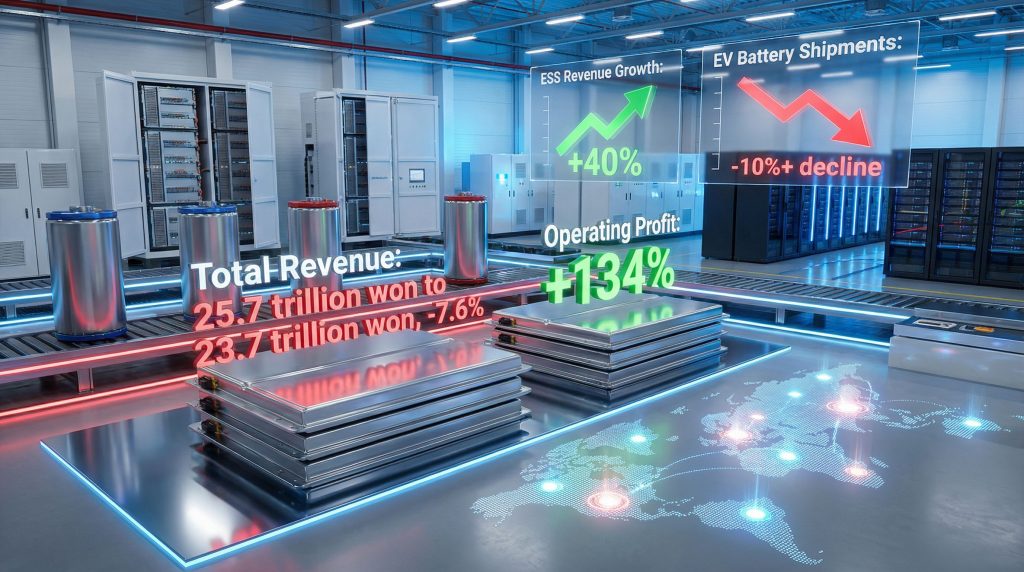
The South Korean battery manufacturing sector demonstrates how strategic portfolio diversification can generate improved profitability despite significant revenue contractions. LG Energy Solutions achieved remarkable financial restructuring during 2025, with operating profit expanding by 134% to 1.35 trillion won while total revenue declined 7.6% to 23.7 trillion won (approximately $16.6 billion USD).
LG Energy Solution Financial Performance Analysis
| Metric | 2024 | 2025 | Change |
|---|---|---|---|
| Total Revenue | 25.7 trillion won | 23.7 trillion won | -7.6% |
| Operating Profit | 598 billion won | 1.35 trillion won | +134% |
| EV Battery Shipments | Baseline | -10%+ decline | Significant drop |
| ESS Revenue Growth | N/A | +40% | Strong expansion |
This profitability paradox illustrates successful cost restructuring and higher-margin product mix optimisation. Despite automotive demand weakness, energy storage systems revenue acceleration provided crucial stabilisation, with growth rates exceeding 40% year-over-year.
Quarterly Recovery Trajectory
Operating losses contracted substantially from 226 billion won in Q4 2024 to 122 billion won in Q4 2025, representing a 46% improvement. This recovery occurred alongside Q3 2025 operating profit of 601 billion won, demonstrating sustained momentum despite market headwinds.
The improvement mechanism reflects fundamental operational restructuring effectiveness rather than temporary market conditions. Capital expenditure reductions exceeding 40% were implemented while maintaining ESS-focused investment levels, indicating strategic resource reallocation toward higher-value applications. Moreover, companies are increasingly focusing on closed-loop battery recycling to enhance sustainability and cost-effectiveness.
When big ASX news breaks, our subscribers know first
Market Forces Driving Battery Industry Restructuring
Policy Environment Disruption
Regulatory uncertainty emerged as a primary market disruptor throughout 2025, particularly in North American markets where policy changes created significant volatility in EV adoption trajectories. These developments fundamentally altered demand forecasting reliability for battery manufacturers, forcing rapid strategic pivots.
The convergence of subsidy expirations, shifting government priorities, and regulatory modifications has created an environment where traditional automotive demand patterns no longer provide dependable growth projections. This policy-driven uncertainty extends beyond immediate market impacts to influence long-term capacity planning and investment decisions. Furthermore, lithium market challenges have compounded these difficulties across the supply chain.
Demand Substitution Dynamics
Three critical macroeconomic trends are reshaping battery demand patterns:
• Data Center Proliferation: Artificial intelligence infrastructure expansion is driving industrial power demand, with global data center consumption projected to reach 4-5% of total electricity generation by 2030
• Grid Modernisation Requirements: Large-scale storage infrastructure has become essential for modern electrical grid operations, particularly for renewable energy integration
• Renewable Energy Integration: Wind and solar intermittency management requires battery storage systems for temporal load shifting and frequency regulation services
Energy storage systems are projected to grow over 40% annually through 2026, substantially exceeding automotive market expansion rates. This growth trajectory operates independently from consumer EV purchase cycles, providing manufacturers with more predictable demand patterns. Additionally, LG Energy Solution's financial challenges reflect broader industry pressures as the slowing US EV market hits LG Energy Solutions battery sales.
Operational Restructuring Strategies
Production Capacity Reallocation
Battery manufacturers are implementing systematic conversion of automotive production lines to stationary energy storage applications. LG Energy Solutions has identified over 50 GWh of existing EV capacity suitable for repurposing to ESS manufacturing, with conversions already completed in Poland and North American joint ventures.
Production Line Conversion Framework:
• Idle EV capacity repurposing: Converting automotive battery lines for ESS production
• Geographic reallocation: Shifting focus from consumer markets to industrial applications
• Technology diversification: Expanding beyond lithium-ion into alternative battery chemistries
The company's South Korean Ochang production lines represent an additional 5 GWh of potential ESS capacity, demonstrating significant scalability within existing infrastructure. Firm-wide ESS capacity targets of 60 GWh for 2026 represent nearly double 2025 levels.
Technology Adaptation Requirements
Lithium iron phosphate (LFP) chemistry deployment has emerged as a crucial component of grid storage applications, offering improved cost economics compared to traditional automotive battery formulations. LFP applications tolerate longer charge/discharge cycles and reduced energy density requirements, making them particularly suitable for stationary installations.
Manufacturing flexibility enables production line conversion within 12-18 month timeframes, reflecting fundamental similarities between battery chemistries and pack assembly processes. This adaptability allows geographic reallocation without complete facility reconstruction. In addition, lithium industry innovations are providing new pathways for cost reduction and efficiency improvements.
Regional Market Divergence Patterns
North American Market Characteristics
The United States represents approximately 50% of projected global ESS demand by volume through 2026, creating substantial opportunities for manufacturers capable of pivoting production capacity. This geographic concentration reflects both federal policy support for grid modernisation and private sector investment in data infrastructure.
Growth Vector Analysis:
• Utility-scale storage projects: Supporting renewable integration requirements
• Commercial and industrial applications: Driven by energy cost management needs
• Grid stability services: Addressing infrastructure modernisation requirements
Global Manufacturing Hub Adaptations
South Korean and Chinese battery manufacturers are implementing parallel strategic pivots, suggesting industry-wide recognition that automotive electrification timelines have extended beyond previous projections. This convergence indicates structural rather than cyclical market adjustments, with EV market slowdown affecting industry leaders across multiple regions.
Investment Implications and Strategic Outlook
Sector Rotation Opportunities
The battery industry's transition toward energy storage creates distinct investment themes operating under different demand dynamics, pricing models, and competitive landscapes compared to traditional automotive applications.
Risk Assessment Framework:
• Policy dependency: ESS growth remains tied to government infrastructure spending
• Technology transition: Rapid evolution in battery chemistry and performance capabilities
• Supply chain complexity: Raw material availability across different applications
Long-term Market Structure Evolution
Battery manufacturers are positioning for a bifurcated market structure where automotive and stationary storage applications operate as distinct sectors with minimal overlap in demand drivers or competitive dynamics. Consequently, companies must carefully balance their portfolios to navigate this evolving landscape effectively.
Raw Material Demand Restructuring
Lithium Consumption Pattern Shifts
Lithium Demand Analysis by Application:
• Automotive applications: Declining growth trajectory due to slowing US EV market adoption
• Grid storage applications: Accelerating consumption patterns driven by infrastructure requirements
• Industrial applications: Emerging as stability factor across multiple end-use sectors
Energy storage systems require different lithium compounds and processing specifications compared to automotive applications, creating distinct supply chain requirements and sourcing strategies. However, decarbonisation economic benefits continue to drive long-term demand fundamentals.
Market Concentration Dynamics
The slowdown in EV demand is accelerating consolidation within the battery manufacturing sector, as companies with diversified portfolios gain competitive advantages over pure-play automotive suppliers. This concentration trend is likely to intensify as market differentiation becomes more pronounced, particularly as the slowing US EV market hits LG Energy Solutions battery sales and other major manufacturers.
The next major ASX story will hit our subscribers first
Future Market Structure Projections
2026-2028 Industry Evolution
Battery manufacturers capable of successfully navigating this transition will likely emerge as dominant players in the next phase of global energy infrastructure development. The bifurcated market structure requires distinct capabilities in manufacturing, supply chain management, and customer relationships.
The successful execution of this strategic pivot will determine competitive positioning as global energy infrastructure evolves toward greater electrification and renewable integration requirements. Companies maintaining operational flexibility while building specialised capabilities in both automotive and stationary storage applications are positioned to capture value across multiple growth vectors.
"Disclaimer: The financial projections and market forecasts presented in this analysis are based on current industry data and company disclosures. Actual results may vary significantly due to market volatility, policy changes, technological developments, and other factors beyond current visibility. Investors should conduct independent research and consider multiple scenarios when making investment decisions."
Note: This analysis incorporates data from multiple industry sources and company disclosures. Market participants seeking comprehensive coverage of battery industry dynamics should consult specialised industry publications and research services for additional market intelligence on this rapidly evolving sector.
Ready to Invest in the Next Major Battery Metals Discovery?
Discovery Alert instantly alerts investors to significant ASX mineral discoveries using its proprietary Discovery IQ model, turning complex mineral data into actionable insights for the evolving battery metals sector. Understand why historic discoveries can generate substantial returns by exploring the dedicated discoveries page and begin your 14-day free trial today to position yourself ahead of the market.