June 12, 2026
The transition to sustainable mining operations has accelerated dramatically as the industry confronts mounting pressure to reduce carbon emissions while maintaining operational efficiency. Battery-powered mining trucks represent a pivotal technology in this transformation, offering viable alternatives to diesel-powered equipment across diverse mining applications. Furthermore, the integration of electric vehicles transforming mining operations demonstrates the sector's commitment to technological innovation and environmental stewardship.
Industrial electrification technologies have reached sufficient maturity to challenge conventional assumptions about heavy-duty vehicle performance in extreme environments. Advanced battery systems, sophisticated power management architectures, and high-efficiency electric drivetrains now offer viable alternatives to internal combustion engines across multiple mining applications. The convergence of these technologies with autonomous vehicle systems creates unprecedented opportunities for operational transformation.
Core Technology Architecture Transforming Mining Vehicle Design
Battery-powered mining trucks operate through fundamentally different engineering principles compared to diesel counterparts. Electric drivetrain systems integrate high-capacity lithium-ion battery packs ranging from 500 kWh in compact underground vehicles to over 2,000 kWh in large surface haulers. These systems deliver instantaneous torque across the complete speed spectrum, enabling superior performance characteristics on steep gradients and under maximum payload conditions.
Power distribution systems within electric mining trucks utilise sophisticated battery management protocols that continuously monitor individual cell temperatures, voltage differentials, and charge distribution patterns across thousands of battery cells. Regenerative braking technology captures kinetic energy during descent operations, converting mechanical energy back into stored electrical power. This capability proves particularly valuable in open-pit operations where loaded trucks regularly descend from elevated mining benches.
The charging infrastructure for battery-powered mining trucks employs two primary strategies: high-power stationary charging stations delivering between 2-8 MW of electrical power, and rapid battery exchange systems capable of swapping depleted battery packs within 8-12 minutes. Advanced fast-charging protocols can restore 85% battery capacity within 25-40 minutes, while extended overnight charging cycles provide complete capacity restoration.
Power Management and Energy Recovery Systems
Electric mining trucks integrate advanced power electronics that optimise energy consumption across varying operational demands. These systems automatically adjust power delivery based on load conditions, terrain characteristics, and operational requirements. During loaded uphill climbs, the system maximises motor output while preserving battery thermal management.
Consequently, during empty return trips, power delivery adjusts to optimise energy efficiency. Regenerative braking systems in battery-powered mining trucks can recover 15-25% of energy consumption during typical haul cycles. This recovered energy directly extends operational range while reducing wear on traditional friction braking components.
When big ASX news breaks, our subscribers know first
Economic Drivers Accelerating Electric Fleet Adoption
Global mining corporations face unprecedented pressure to achieve net-zero operational emissions, with major operators including Rio Tinto and BHP committing to complete carbon neutrality by 2050. These commitments translate into immediate operational changes, with electric vehicle deployment representing a primary decarbonisation strategy. The International Council on Mining and Metals reports that mining and metals production generated 11% of global greenhouse gas emissions in 2024.
Market research indicates the global electric mining equipment sector was valued at $1.70 billion in 2024 and projects growth to $5.26 billion by 2035, representing a compound annual growth rate of 10.82%. This expansion reflects accelerating adoption beyond experimental programs into commercial deployment across multiple mining operations, alongside insights from energy transition drivers shaping industry priorities.
Cost Analysis Comparison: Electric vs. Diesel Mining Trucks
| Performance Metric | Diesel Trucks | Battery-Electric Trucks |
|---|---|---|
| Energy Conversion Efficiency | 28-32% | 88-92% |
| Operational Cost per Kilometre | $3.20-$4.10 | $1.10-$1.80 |
| Scheduled Maintenance Intervals | 300-600 operating hours | 1,200-2,500 operating hours |
| Powertrain Service Life | 18,000-28,000 hours | 55,000+ operating hours |
| Fuel/Energy Cost Volatility | High (commodity-linked) | Moderate (regional electricity) |
Underground mining operations achieve particularly significant cost advantages through electric fleet deployment. Research from Swedish mining operations demonstrates that eliminating diesel exhaust reduces underground ventilation requirements by up to 86.7%. Since ventilation systems typically consume 30-45% of underground mine electricity, this reduction generates substantial operational savings.
Regional Economic Variations in Electric Truck Deployment
The economic viability of battery-powered mining trucks varies significantly based on regional electricity costs and grid composition. Mining operations with access to renewable energy sources achieve the lowest operational costs, while operations dependent on coal-fired electricity may experience minimal cost advantages. For instance, Zambia's hydroelectric-dominated grid enabled zero operational emissions during Hitachi's trial at the Kansanshi copper mine.
Mining operations in Australia, where BHP and Rio Tinto launched joint trials at Jimblebar iron ore mine in December 2025, benefit from abundant solar resources and declining renewable energy costs. These conditions create favourable economics for electric fleet deployment, particularly when combined with on-site renewable generation capacity.
Advanced Performance Capabilities of Modern Electric Mining Trucks
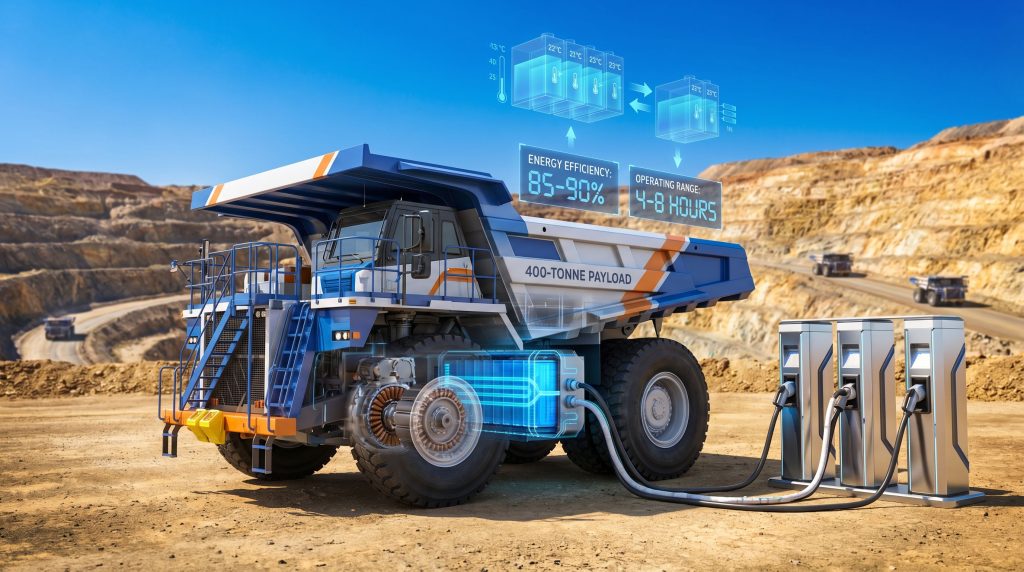
Contemporary battery-powered mining trucks handle payload capacities from 65 tonnes in underground applications to 450 tonnes in large-scale surface operations. Maximum operational speeds reach 65-70 km/h under full load conditions, matching or exceeding comparable diesel vehicles. Acceleration performance significantly surpasses traditional trucks due to instantaneous electric motor torque characteristics.
Operational range varies substantially based on specific operating conditions and terrain characteristics:
• Surface mining operations: 5-10 hours continuous operation per charge cycle
• Underground mining applications: 8-14 hours operational capacity
• Mixed terrain operations: 4-8 hours depending on elevation changes
• Extreme cold conditions: 3-6 hours with thermal management systems active
Integration with Autonomous Operating Systems
Electric mining trucks demonstrate superior compatibility with autonomous vehicle technologies due to precise electronic control over all vehicle functions. Digital communication protocols enable real-time coordination with centralised fleet management systems, optimising route planning, charging schedules, and maintenance intervals. The elimination of engine noise and vibration improves sensor accuracy and extends equipment service life.
Moreover, autonomous electric trucks can optimise energy consumption through predictive route planning, coordinating with other vehicles to minimise traffic congestion, and automatically adjusting charging schedules based on operational demand. These capabilities enable fleet-wide efficiency improvements that compound individual vehicle advantages within the broader mining industry evolution.
Battery Technology Variations and Performance Implications
Lithium Iron Phosphate (LFP) battery systems dominate current battery-powered mining trucks applications due to exceptional thermal stability and cycle life exceeding 10,000 charge-discharge cycles. These systems maintain operational reliability across temperature ranges from -25°C to +65°C, accommodating most global mining environments. LFP chemistry demonstrates superior safety characteristics with minimal thermal runaway risk under extreme operating conditions.
High-energy density battery technologies under development promise 45-70% higher energy storage capacity while reducing overall system weight. Solid-state battery architectures eliminate liquid electrolyte thermal runaway risks entirely while enabling faster charging rates and extended service life. These technologies could extend operational range to 12-18 hours per charge cycle within the next decade.
Battery Degradation Management in Mining Applications
Battery-powered mining trucks experience accelerated battery degradation due to high discharge rates, extreme temperature variations, and continuous heavy-duty operation. Advanced battery management systems implement sophisticated cell balancing, thermal regulation, and charging optimisation protocols to maximise service life. Predictive maintenance algorithms monitor battery health indicators to schedule replacement before performance degradation impacts operations.
Modern battery systems retain 75-85% of original capacity after 8-10 years of mining service, depending on operating conditions and maintenance protocols. End-of-life mining batteries typically maintain sufficient capacity for secondary applications including stationary energy storage systems, supporting broader renewable energy solutions integration.
Infrastructure Development Challenges and Solutions
Large-scale electric mining fleet deployment requires substantial electrical infrastructure upgrades. A 25-truck electric fleet may demand 75-120 MW of additional electrical capacity, equivalent to powering a mid-sized industrial facility. Grid connection upgrades, transformer installations, and distribution system modifications represent significant capital investments that must be integrated into mine development planning.
Surface Mining Charging Infrastructure Requirements:
• Weather-resistant charging equipment rated for extreme environmental conditions
• High-power delivery systems (2-8 MW per charging station)
• Multiple charging positions to accommodate fleet scheduling requirements
• Integration with existing mine power distribution networks
• Emergency power isolation and safety shutdown systems
Underground Mining Infrastructure Specifications:
• Explosion-proof electrical equipment meeting international safety standards
• Ventilation system integration for battery thermal management
• Space-optimised installation within confined underground areas
• Emergency evacuation compatibility and safety protocols
• High-voltage safety training and equipment for maintenance personnel
Maintenance Facility Modernisation Requirements
Electric truck maintenance demands specialised equipment, training programmes, and safety protocols significantly different from diesel vehicle servicing. High-voltage safety procedures, battery handling systems, and diagnostic equipment represent substantial capital investments for mining operations. Maintenance technicians require extensive retraining on electrical systems, battery technology, and safety protocols specific to high-voltage mobile equipment.
Emergency response procedures for battery fires and electrical accidents require specialised firefighting equipment and trained response teams. Underground operations face particular challenges due to confined spaces and limited evacuation routes during electrical emergencies.
Comprehensive Operating Cost Analysis
While battery-powered mining trucks require 60-110% higher initial capital investment compared to diesel equivalents, operational cost advantages can offset this premium within 4-6 years under high-utilisation conditions. Total cost of ownership calculations must consider electricity costs, maintenance savings, battery replacement expenses, and potential carbon credit revenues.
Critical Economic Insight: Mining operations with access to renewable electricity sources achieve the most favourable economics, while operations dependent on expensive grid electricity may experience minimal cost advantages during initial deployment phases.
Energy costs demonstrate significant regional variation based on local electricity markets and renewable energy availability. Mining operations with on-site solar or wind generation achieve the lowest operational costs, while grid-dependent operations in regions with expensive electricity may see limited immediate savings. Time-of-use electricity pricing can further impact operational economics depending on charging schedule flexibility.
Long-Term Financial Considerations
Electric motor maintenance requirements differ substantially from diesel engines, with fewer moving components and longer service intervals. However, battery replacement costs typically occur after 10-15 years and represent significant expense not present in diesel operations. Residual value considerations must account for battery degradation and technological obsolescence when calculating total ownership costs.
Carbon pricing mechanisms and emissions regulations increasingly influence the financial attractiveness of electric fleet deployment. Mining operations in jurisdictions with carbon taxes or cap-and-trade systems face immediate economic incentives for electrification beyond operational cost considerations.
The next major ASX story will hit our subscribers first
Safety Protocols for High-Voltage Mining Equipment
Battery-powered mining trucks incorporate multiple safety systems to prevent thermal runaway and electrical hazards. Modern battery architectures include cell-level fusing, pack-level disconnect systems, and sophisticated thermal management to maintain safe operating temperatures. Specialised fire suppression systems utilise agents specifically effective against lithium-ion battery fires, which behave differently from conventional hydrocarbon fires.
High-voltage safety protocols require comprehensive workforce retraining covering arc flash protection, lockout/tagout procedures, and emergency response protocols. Mining operations must implement electrical safety equipment including insulated tools, personal protective equipment rated for electrical hazards, and specialised testing equipment for high-voltage systems.
Underground Fire Risk Management
Battery fires in confined underground spaces present unique safety challenges requiring specialised emergency procedures. Underground ventilation systems must accommodate potential battery fire scenarios, with emergency ventilation protocols to manage toxic gas evacuation. Emergency evacuation procedures, specialised firefighting equipment, and enhanced communication systems become critical safety infrastructure components.
Training programmes for underground electric vehicle operations must address electrical safety, battery fire response, and emergency evacuation procedures specific to confined spaces. Regular emergency drills and safety equipment testing ensure workforce preparedness for electrical incidents in underground environments.
Industry Leaders Driving Electric Truck Adoption
Major mining corporations have established strategic partnerships with equipment manufacturers to validate electric truck performance across diverse operational conditions. These collaboration programmes extend beyond simple equipment trials to comprehensive evaluation of operational integration, maintenance requirements, and economic performance under real-world conditions.
Verified Commercial Deployment Programmes:
• Hitachi Construction Machinery: Completed 15-month trial at Kansanshi copper mine in Zambia, demonstrating 4,000 kilometres of operation with zero operational emissions
• BHP and Rio Tinto: Joint trials at Jimblebar iron ore mine featuring Caterpillar electric trucks
• First Quantum Minerals: Operational partnership demonstrating electric truck integration in African mining operations
• Multiple Nordic Operations: Early adoption programmes leveraging abundant renewable energy sources
Regional Adoption Patterns and Market Development
Electric truck adoption demonstrates significant geographic variation based on electricity costs, environmental regulations, and grid reliability. Nordic countries lead global adoption due to abundant renewable energy resources and stringent emissions standards. African operations benefit from hydroelectric power availability, while Australian operations integrate with expanding renewable energy infrastructure.
North American adoption remains limited by electricity costs and grid reliability concerns, though operations with access to renewable energy sources demonstrate increasing interest. Asian markets show growing adoption driven by air quality regulations and government electrification incentives, often incorporating battery-grade lithium insights into their strategic planning.
Technological Roadmap for Next-Generation Mining Electrification
Future developments in battery-powered mining trucks include wireless charging systems enabling continuous operation without charging interruptions, hydrogen fuel cell hybrid powertrains for extended range applications, and advanced autonomous capabilities leveraging electric vehicle precision control systems. Vehicle-to-grid integration could enable mining trucks to provide grid stabilisation services during off-shift periods.
Technology Development Timeline:
• 2026-2028: Commercial deployment of current battery technologies
• 2029-2031: Next-generation battery chemistries with 50%+ improved energy density
• 2032-2035: Wireless charging and vehicle-to-grid integration
• 2035+: Hydrogen hybrid systems and fully autonomous electric fleets
Advanced battery technologies under development promise dramatic improvements in energy density, charging speed, and service life. Solid-state batteries could eliminate thermal runaway risks while enabling 10-minute charging for full operational range. These improvements could make electric trucks economically attractive across all mining applications regardless of local electricity costs.
Regulatory Framework Evolution
Increasingly stringent emissions regulations and carbon pricing mechanisms accelerate electric truck adoption timelines. Mining operations in jurisdictions with aggressive decarbonisation targets face regulatory requirements that make electric fleet deployment economically necessary rather than optional. International climate agreements and supply chain sustainability requirements further drive adoption across global mining operations.
Future regulations may mandate electric vehicle deployment in underground operations due to air quality concerns, while carbon border adjustments could impact the economics of mining operations without aggressive electrification programmes.
The transformation of mining operations through battery-powered mining trucks represents a fundamental shift in heavy-duty mobile equipment technology. While initial capital investments remain elevated, the convergence of operational efficiency improvements, environmental benefits, and regulatory requirements drives accelerating industry adoption. Success in electric fleet deployment requires comprehensive infrastructure planning, workforce development, and integration with broader mine electrification strategies.
Early-adopting mining operations gain competitive advantages through reduced operational costs, improved environmental performance, and enhanced operational flexibility. As battery technology continues advancing and charging infrastructure matures, electric mining trucks will likely become the industry standard across most applications within the next decade, fundamentally reshaping mining operations worldwide.
Want to capitalise on the mining electrification boom?
Discovery Alert's proprietary Discovery IQ model delivers instant notifications when mining companies announce breakthrough developments in electric vehicle technology and sustainable operations, helping you identify actionable investment opportunities before the broader market reacts. Start your 14-day free trial today to position yourself ahead of the electrification transformation reshaping the entire mining sector.