June 27, 2026
Global energy markets stand at a transformative juncture as manufacturing overcapacity and technological shifts fundamentally restructure the economics of power storage systems. The convergence of industrial scale production, chemistry innovations, and competitive pressures has created unprecedented cost dynamics that extend far beyond traditional supply and demand mechanisms.
What's Driving the Historic Battery Price Collapse to $108/kWh?
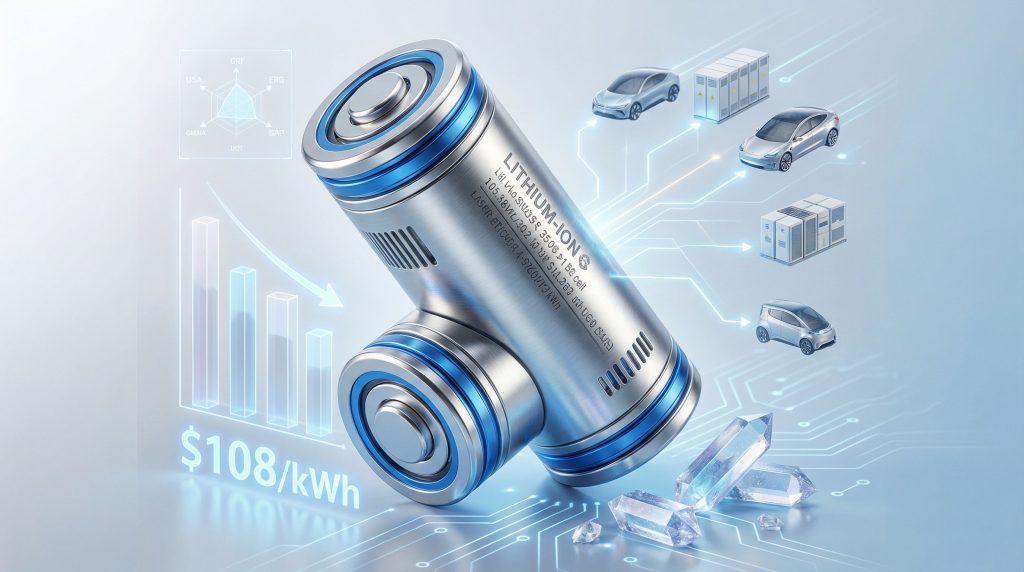
Lithium-ion battery prices fall 2025 has emerged as a defining trend, with pack costs reaching a record low of $108/kWh despite rising raw material expenses. This 8% annual decline represents a 93% reduction from 2010 levels, fundamentally altering the economics of energy storage across multiple applications.
Manufacturing Overcapacity Creates Unprecedented Cost Pressure
Chinese manufacturing facilities have generated substantial production surplus, driving intense price competition throughout global markets. China achieved the steepest regional price reduction at $84/kWh in 2025, representing a 13% real-terms decline from 2024 levels. This oversupply condition has created cut-throat competition that overwhelms traditional cost structures.
The facility utilization dynamics reveal how excess capacity translates into aggressive pricing strategies. Chinese manufacturers maintain production volumes despite margin compression, prioritising market share retention and meeting annual sales targets over short-term profitability.
Regional capacity distribution demonstrates significant concentration:
• China: Dominant production capacity with aggressive export strategies
• North America: Higher cost structures with 44% price premiums
• Europe: Import dependency driving 56% price premiums
Market dynamics show that manufacturing overcapacity has become the primary price determinant, overriding raw material cost fluctuations that would typically drive pricing increases.
Chemistry Shift Accelerates Cost Reduction Beyond Raw Materials
The widespread adoption of lithium iron phosphate (LFP) technology has created substantial cost advantages across all market segments. LFP battery packs averaged $81/kWh while nickel manganese cobalt (NMC) systems cost $128/kWh, establishing a $47/kWh differential that drives strategic chemistry selection.
Cost differential analysis reveals strategic implications:
| Chemistry Type | Average Price | Cost Advantage | Market Penetration |
|---|---|---|---|
| LFP Technology | $81/kWh | 37% lower cost | Expanding rapidly |
| NMC Technology | $128/kWh | Premium pricing | Specialty applications |
| Industry Average | $108/kWh | Benchmark | All segments |
Performance trade-offs have become increasingly favourable for LFP applications. Grid-scale storage and many automotive applications can accommodate the lower energy density of LFP chemistry while capturing significant cost benefits. China's dominance in LFP production has enabled nearly universal global supply, facilitating rapid market adoption.
Supply Chain Hedging Strategies Neutralise Commodity Volatility
Long-term contract structures have effectively insulated battery manufacturers from spot price volatility in critical materials. Despite rising lithium and cobalt costs due to supply constraints and new export quotas from the Democratic Republic of Congo, these increases did not translate into higher pack prices.
Financial hedging mechanisms enable manufacturers to stabilise input costs across multi-year periods. Vertical integration benefits throughout the value chain have allowed companies to absorb raw material cost increases while maintaining competitive pricing pressure on finished battery packs.
The industry deployed three primary mechanisms to offset higher metal costs: expanded LFP adoption, long-term procurement contracts, and sophisticated financial hedging strategies. Furthermore, the development of spodumene lithium extraction processes has helped improve supply chain efficiency.
When big ASX news breaks, our subscribers know first
Which Market Segments Are Experiencing the Steepest Price Declines?
Stationary Storage Achieves Lowest-Cost Position at $70/kWh
Battery pack prices for stationary storage applications reached $70/kWh in 2025, representing a dramatic 45% year-over-year reduction. This segment experienced the steepest decline among all lithium-ion battery applications and became the lowest-priced category for the first time.
The 45% price reduction transforms grid-scale deployment economics by crossing critical viability thresholds for multiple applications. Energy arbitrage opportunities, peak shaving strategies, and renewable integration projects now achieve economic returns without policy subsidies in many markets.
Grid-scale systems benefit from minimal space constraints, enabling wholesale adoption of lower-cost LFP chemistry without performance compromises. The cost structure at $70/kWh supports 4-hour energy storage systems at approximately $280/kW total cost, creating compelling economics for utility-scale deployments.
Competitive positioning analysis against alternative technologies:
• Pumped hydro storage: Geographic limitations but lower long-term costs
• Compressed air systems: Site-specific requirements with moderate costs
• Flow batteries: Higher upfront costs but extended duration capabilities
• Lithium-ion (stationary): Broad applicability with rapidly declining costs
Electric Vehicle Batteries Maintain Sub-$100 Threshold
Battery-electric vehicle packs reached $99/kWh in 2025, marking the second consecutive year below the critical $100/kWh adoption benchmark. This sustained positioning indicates market maturation and increasing competitive pressure in automotive applications.
The sub-$100/kWh threshold represents a psychological and economic milestone for consumer EV adoption. Battery cost contribution to total vehicle pricing continues declining, improving affordability relative to internal combustion engine alternatives when total cost of ownership calculations include fuel and maintenance differentials.
Regional market penetration correlates strongly with battery cost levels. Markets achieving the lowest battery costs demonstrate accelerated EV adoption rates, while regions with higher battery prices experience slower electrification progress. According to recent analysis, lithium-ion battery price predictions suggest continued downward trajectory.
EV battery pricing impact on market segments:
| Vehicle Category | Battery Size | Cost Impact | Market Response |
|---|---|---|---|
| Compact EVs | 40-50 kWh | $3,960-4,950 | Mass market entry |
| Mid-range EVs | 60-75 kWh | $5,940-7,425 | Mainstream adoption |
| Luxury EVs | 85-100 kWh | $8,415-9,900 | Performance focus |
Consumer price impact accelerates as battery costs represent approximately 30-35% of mid-range vehicle total costs, compared to 40-50% when batteries cost $120-150/kWh. This structural shift enables competitive positioning against comparable internal combustion vehicles across multiple market segments.
How Are Regional Price Dynamics Reshaping Global Competition?
China's $84/kWh Benchmark Sets Global Competitive Floor
Chinese battery pack prices established the global competitive baseline at $84/kWh, reflecting optimal manufacturing costs and scale economies. This pricing represents a 13% real-terms reduction from 2024 and demonstrates the intensity of domestic competition within Chinese markets.
Manufacturing cost advantages stem from vertically integrated supply chains spanning mining, refining, cell production, and pack assembly. Chinese companies benefit from concentrated industrial ecosystems that minimise logistics costs and enable rapid technology transfer across value chain participants.
Scale economics provide decisive cost advantages as Chinese facilities operate at utilisation rates that drive down fixed cost allocation per unit. Export strategy implications focus on maintaining global market share through aggressive pricing rather than maximising per-unit margins.
Technology transfer and localisation pressures create strategic considerations:
• Intellectual property protection versus market access trade-offs
• Local content requirements driving investment decisions in target markets
• Government policy responses to Chinese competitive advantages
• Supply chain security concerns influencing purchasing decisions
North American and European Premium Persists Despite Convergence
North American battery pack prices averaged approximately $121/kWh, representing a 44% premium over Chinese levels despite a 4% year-over-year decline. European markets experienced $131/kWh pricing with a 56% premium over China, though prices fell 8% from 2024.
Tariff impact analysis reveals complex cost structure evolution as trade barriers influence pricing through multiple mechanisms. Import duties directly increase landed costs, while local content requirements force higher-cost domestic sourcing for battery components and materials.
Regional premium breakdown by contributing factors:
| Cost Component | North America | Europe | China Baseline |
|---|---|---|---|
| Labour costs | +15-20% | +20-25% | Reference |
| Supply chain | +10-15% | +12-18% | Integrated |
| Import duties | +8-12% | +5-8% | Domestic |
| Facility costs | +5-8% | +8-12% | Optimised |
Local content requirements drive investment decisions as manufacturers balance compliance costs against market access benefits. In addition, developments in australia lithium industry innovations are helping to diversify global supply chains. These regulations create structural cost increases while fostering domestic supply chain development and technology transfer.
Trade Flow Redirection Intensifies European Competition
Chinese manufacturer export strategies pivoted toward European markets in response to shifting US trade policies and increased tariff barriers. This strategic redirection intensified competitive pressure in European markets, contributing to the 8% price decline compared to North America's 4% reduction.
Aggressive pricing tactics maintain volume targets as Chinese companies prioritise market share retention over margin optimisation. Export volume redirection created oversupply conditions in European markets, forcing domestic and other international suppliers to reduce pricing to maintain competitiveness.
Market share battles in high-value European segments demonstrate how trade policy indirectly influences regional pricing through supply flow modifications. The concentration of Chinese exports in Europe creates pricing pressure that exceeds what would occur through organic market competition alone.
Trade flow impact on market dynamics:
• Increased Chinese export volume to Europe following US policy changes
• Aggressive pricing to maintain global sales targets despite regional barriers
• European market oversupply creating competitive pressure on all suppliers
• Price convergence acceleration between Chinese and European markets
What Economic Thresholds Are Being Crossed in 2025?
Grid-Scale Storage Achieves Economic Viability Across Applications
The $70/kWh stationary storage price point crosses critical economic thresholds that enable unsubsidised deployment across multiple grid applications. Energy arbitrage strategies become profitable in markets with sufficient price spreads between off-peak and peak electricity pricing, typically requiring $40-80/MWh differentials.
Renewable energy integration benefits from cost-effective storage that smooths intermittent generation and provides grid services. Peak shaving applications achieve attractive returns as storage systems reduce demand charges for commercial and industrial customers while providing backup power capabilities.
Grid-scale deployment acceleration metrics:
• 4-hour storage systems: $280/kW total cost enables merchant revenue models
• Energy arbitrage: 10-15 year payback periods in competitive electricity markets
• Peak shaving: 7-12 year returns for commercial demand charge reduction
• Grid services: Additional revenue streams from frequency regulation and reserves
Utility-scale deployment acceleration reflects improved project economics as storage systems achieve competitive positioning against alternative grid infrastructure investments. Return calculations support storage deployment without requiring policy subsidies in most developed electricity markets.
Electric Vehicle Total Cost of Ownership Parity Approaches
Battery cost contribution to vehicle pricing evolution approaches levels that enable TCO parity with internal combustion engine vehicles across multiple segments. Consumer adoption curve inflection points emerge as upfront cost premiums diminish while operating cost advantages become more pronounced.
Fleet electrification economic triggers activate as commercial operators recognise favourable TCO economics. The combination of lower battery costs, reduced maintenance requirements, and fuel cost savings creates compelling business cases for fleet conversion across delivery, transit, and corporate vehicle applications.
EV adoption economic analysis:
| Vehicle Segment | Battery Cost Impact | TCO Comparison | Market Response |
|---|---|---|---|
| Compact vehicles | 25-30% of cost | Near parity | Rapid adoption |
| Mid-size vehicles | 30-35% of cost | Slight premium | Accelerating sales |
| Commercial fleets | 35-40% of cost | Favourable TCO | Fleet conversions |
The sustained $99/kWh pricing for the second consecutive year indicates market stabilisation at levels that support mass market adoption. Further cost reductions will likely require technological innovations rather than simple manufacturing scale improvements.
However, market participants must consider lithium market downturn insights which could impact future supply dynamics and pricing stability.
Battery cost reductions create transformative opportunities across the energy sector. Record-low pricing enables accelerated EV adoption while supporting grid-scale storage deployment for renewable energy integration worldwide. The industry has reached a critical inflection point where storage economics support widespread deployment without policy dependencies.
Which Technological Innovations Will Drive Future Cost Reductions?
Next-Generation Chemistry Developments
Silicon and lithium-metal anode advancement represents the next frontier for energy density improvements that could further reduce costs per unit of energy storage capacity. These technologies promise 20-40% capacity increases compared to conventional graphite anodes while maintaining manufacturing compatibility with existing production infrastructure.
Solid-state electrolyte commercialisation pathways offer enhanced safety characteristics and potential cost reductions through simplified thermal management systems. Leading manufacturers expect commercial deployment within 3-5 years for premium applications, with broader adoption following as production scales.
Advanced cathode material development focuses on:
• High-nickel NMC formulations reducing cobalt content and costs
• Manganese-rich compositions eliminating expensive materials entirely
• Sodium-ion alternatives for cost-sensitive stationary applications
• Recycled material integration reducing primary material dependencies
Manufacturing Process Evolution
Automated production line efficiency improvements continue reducing labour costs while improving quality consistency. Advanced manufacturing techniques including dry electrode processing and continuous production methods promise 10-20% cost reductions compared to traditional wet processing approaches.
Quality control technology integration reduces waste and rework through real-time monitoring and predictive maintenance systems. Energy consumption optimisation in cell manufacturing addresses one of the largest variable cost components in battery production.
Process innovation priorities:
• Dry electrode coating technology reducing energy consumption
• Continuous manufacturing processes improving throughput efficiency
• AI-driven quality control minimising defect rates and waste
• Modular production systems enabling rapid capacity scaling
Supply Chain Maturation Benefits
Raw material processing efficiency gains emerge from specialised facilities optimised for battery-grade material production. For instance, the development of a battery-grade lithium refinery in India represents significant progress in regional supply chain capabilities. Logistics optimisation reduces transportation costs through strategic facility placement and improved container utilisation.
Recycling infrastructure development creates secondary material sources that reduce primary mining dependencies while providing cost-competitive inputs for new battery production. Closed-loop supply chains become economically viable as recycled material quality and availability improve.
The maturation of specialised supply chain participants creates competitive pressure throughout the value chain, driving cost reductions that complement manufacturing efficiency improvements. Furthermore, chinese battery recycling breakthrough technologies are establishing new standards for material recovery.
How Will 2026 Market Dynamics Differ from Current Trends?
Raw Material Cost Pressures vs. Technology Gains
Lithium carbonate price recovery poses the primary cost pressure risk for 2026, as current oversupply conditions may normalise while demand growth continues. However, technology gains through improved chemistry and manufacturing efficiency are expected to offset moderate raw material price increases.
Cobalt supply constraints from new Democratic Republic of Congo export quotas create particular challenges for NMC battery applications. This pressure accelerates the industry shift toward cobalt-free chemistries including LFP and emerging alternatives.
Alternative material development priorities:
• Sodium-ion battery commercialisation for cost-sensitive applications
• Iron-based cathode materials reducing critical mineral dependencies
• Recycled material integration improving supply security
• Synthetic material alternatives to mined inputs
Competitive Landscape Evolution
Market consolidation pressures intensify as smaller manufacturers struggle with margin compression and capital requirements for next-generation technology development. Economies of scale become increasingly important for competitive survival in commodity-like market segments.
Technology licensing and partnership strategies emerge as alternatives to internal R&D for companies lacking scale to support comprehensive innovation programmes. Vertical integration trends continue as successful companies seek to control critical supply chain elements.
The competitive landscape favours companies with substantial production scale, advanced technology capabilities, and integrated supply chain positions. Mid-tier manufacturers face pressure to specialise in niche applications or consolidate with larger players.
Demand Growth Sustainability Analysis
Electric vehicle adoption curve projections indicate continued strong demand growth through 2026, though growth rates may moderate as early adopter markets approach saturation. Commercial vehicle electrification represents a significant growth opportunity with favourable economics.
Grid storage deployment pipeline evaluation suggests accelerating installations as renewable energy capacity additions require increasing storage integration. Utility procurement strategies increasingly incorporate storage as standard infrastructure rather than experimental technology.
Second-life battery market development creates additional demand for recycling and refurbishment services while providing cost-competitive storage options for less demanding applications. This emerging market segment could absorb substantial volumes of retired EV batteries.
The next major ASX story will hit our subscribers first
What Investment Implications Emerge from Battery Cost Deflation?
Energy Storage Project Economics Transformation
IRR improvements across utility-scale developments create attractive investment opportunities as storage projects achieve competitive returns without subsidy support. The combination of declining battery costs and improving market mechanisms for storage revenue creates compelling investment cases.
Financing cost reduction for storage infrastructure reflects improved risk assessment as technology performance data accumulates and revenue models mature. Lenders increasingly recognise storage projects as established technology rather than experimental deployments.
Investment risk profile changes include:
• Technology risk: Reduced due to proven performance and reliability data
• Market risk: Improved through diversified revenue stream development
• Regulatory risk: Decreased as supportive policies establish stable frameworks
• Financial risk: Lower through standardised project structures and financing
Automotive Industry Margin Pressure and Opportunity
OEM cost structure benefits from battery price reductions enable competitive pricing strategies while maintaining margins. Automotive manufacturers gain flexibility to invest in additional features, performance improvements, or marketing while keeping vehicle prices attractive.
Competitive positioning shifts in EV market segments favour companies with strong battery supply relationships and efficient manufacturing. Supply chain investment strategies focus on securing long-term battery supply at competitive pricing through partnerships or vertical integration.
The automotive industry experiences both opportunity and pressure as battery cost reductions enable market expansion while intensifying competition among manufacturers seeking to capitalise on improving economics.
Frequently Asked Questions About 2025 Battery Price Trends
Will Battery Prices Continue Falling Beyond 2025?
Technology roadmap analysis indicates continued cost reduction potential through next-generation chemistry development and manufacturing process improvements. However, the rate of decline may moderate as the industry approaches physical and economic limits for conventional lithium-ion technologies.
Market maturation impacts suggest that future price reductions will require substantial innovation rather than simple scale improvements. Raw material availability constraints may provide upward cost pressure that partially offsets technological gains.
Long-term cost reduction drivers include:
• Solid-state battery commercialisation improving energy density
• Manufacturing automation reducing labour cost components
• Recycling infrastructure creating secondary material sources
• Alternative chemistry development reducing expensive materials
How Do Regional Policies Affect Battery Cost Competitiveness?
Subsidy impacts create effective pricing advantages for end users while supporting domestic industry development. Electric vehicle purchase incentives, storage deployment rebates, and manufacturing tax credits all influence market competitiveness beyond pure technology costs.
Trade policy implications for global cost convergence depend on the balance between import protection and supply chain efficiency. Local content requirements may increase short-term costs while building long-term competitive capabilities.
Regional policy effectiveness varies based on market maturity and industrial base capabilities. Successful policies balance market development with realistic timelines for domestic supply chain establishment.
What Role Do Alternative Battery Technologies Play?
Sodium-ion battery cost comparison shows potential advantages for cost-sensitive stationary storage applications, though energy density limitations restrict automotive applications. Commercial deployment accelerates for grid-scale projects where space constraints are minimal.
Flow battery economics remain competitive for long-duration storage applications exceeding 8-12 hours, where their extended cycle life and duration capabilities provide advantages over lithium-ion systems.
Emerging chemistry competitive timeline:
| Technology | Commercial Availability | Primary Applications | Cost Position |
|---|---|---|---|
| Sodium-ion | 2025-2027 | Stationary storage | Lower cost |
| Solid-state | 2027-2030 | Premium automotive | Higher performance |
| Flow batteries | Currently available | Long-duration storage | Duration advantage |
Strategic Implications for Energy Market Participants
Utility Investment Strategy Adjustments
Grid modernisation priorities increasingly emphasise storage integration as costs reach levels that support multiple revenue streams. Utility procurement strategies expand beyond traditional capacity planning to include storage as flexible infrastructure that provides generation, transmission, and distribution benefits.
Renewable energy project development economics improve substantially with cost-effective storage integration. Solar and wind projects paired with storage achieve higher capacity factors and provide dispatchable generation that commands premium pricing in many markets.
Peak demand management strategies evolve as storage costs enable economic peak shaving across residential, commercial, and industrial customer segments. Utilities develop new rate structures and programmes that optimise storage deployment while managing grid costs.
Industrial Energy User Opportunities
Behind-the-meter storage deployment accelerates as system costs support multiple value propositions including demand charge reduction, backup power, and energy arbitrage. Industrial energy users increasingly view storage as standard infrastructure rather than experimental technology.
Energy cost management strategy evolution incorporates storage as a tool for managing electricity procurement, power quality, and operational resilience. Large energy users develop sophisticated energy management systems that optimise storage operations across multiple objectives.
Grid services revenue opportunities enable industrial storage owners to monetise excess capacity through participation in wholesale electricity markets. This additional revenue stream improves project economics while supporting grid reliability.
Consequently, the continued trend of lithium-ion battery prices fall 2025 represents more than a simple cost reduction phenomenon. It marks a fundamental transformation in energy economics that enables widespread adoption of clean technologies across transportation, grid infrastructure, and industrial applications.
Recent forecasts from global battery market analysis suggest these trends will continue shaping global energy markets throughout the decade.
Disclaimer: This analysis is based on industry data and market trends current as of December 2025. Battery price projections and market forecasts involve inherent uncertainties related to technological developments, raw material costs, trade policies, and demand growth patterns. Investment decisions should consider these risk factors and consult current market data and professional analysis.
Battery cost trends will continue evolving as technology advances, market conditions change, and policy frameworks develop. Market participants should monitor ongoing developments in battery chemistry, manufacturing processes, and regulatory environments that could impact future cost trajectories and competitive dynamics.
Looking to Capitalise on Energy Storage Investment Opportunities?
Discovery Alert's proprietary Discovery IQ model provides real-time alerts on significant ASX mineral discoveries, including critical battery minerals driving the energy transition. As lithium-ion battery prices reach historic lows, understanding which companies are positioned to benefit from this transformation becomes essential for both short-term traders and long-term investors seeking exposure to the evolving energy storage market.