June 17, 2026
The Hidden Economics of Battery Recycling: Why Regulation Creates Markets Before It Stabilises Them
When a regulatory system displaces an entrenched informal economy, the transition rarely unfolds cleanly. Supply chains built around compliance avoidance do not dissolve overnight. Instead, they liquidate. They offload inventory. They flood the market with material at prices that legitimate operators cannot match, at least not immediately. This is precisely the dynamic now playing out across China's battery recycling sector, and understanding the full scope of China battery recycling regulation black mass cobalt sulfate dynamics requires looking beyond the policy announcement itself.
When big ASX news breaks, our subscribers know first
China's 2026 Battery Recycling Framework: More Than a Compliance Update
The regulatory framework that took effect on April 1, 2026 represents a generational upgrade to China's battery recycling governance architecture. Formally titled the Interim Measures for the Management of Recycling and Comprehensive Utilization of Waste Power Batteries for New Energy Vehicles, the rules were jointly issued by the Ministry of Industry and Information Technology (MIIT) alongside five additional ministries, elevating the regulatory weight of the framework well beyond anything the sector had previously operated under.
The 2018 interim rules that preceded this framework established collection and producer responsibility concepts but lacked the enforcement infrastructure to make them binding in practice. The 2026 version closes that gap through several interlocking mechanisms. Furthermore, the battery recycling process in China has been fundamentally restructured by these changes, reshaping how operators source, process, and report material.
| Regulatory Requirement | Specification Under 2026 Framework |
|---|---|
| Lithium recovery target | ≥90% (upgraded from 85%) |
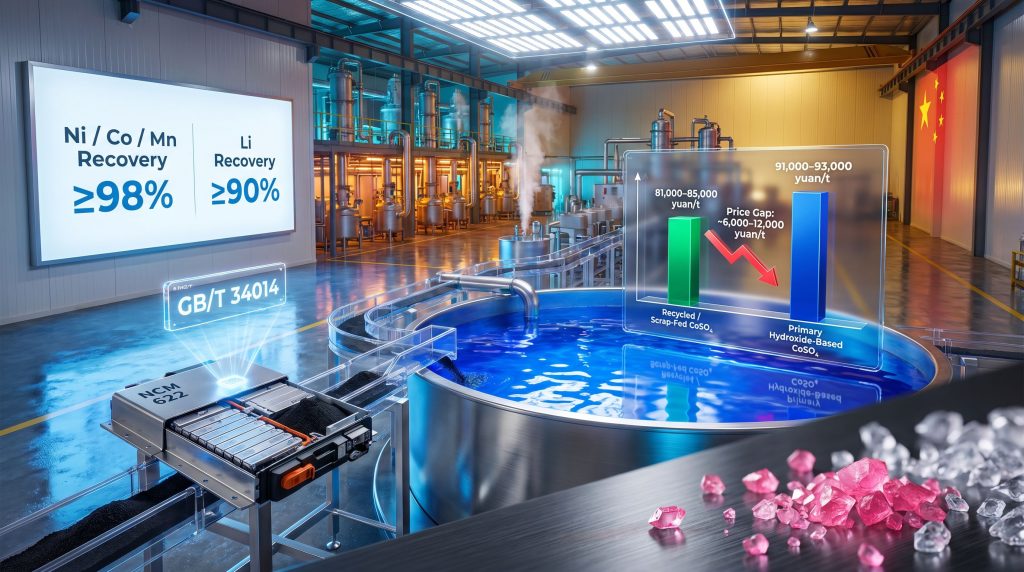
| Nickel, cobalt and manganese recovery | ≥98% (leading operators reporting 99.6%) |
| Advanced lithium recovery demonstrated | Up to 96.5% by leading processors |
| Battery traceability standard | Mandatory national digital battery ID (GB/T 34014) |
| Producer responsibility | OEMs and cell makers must establish proportional recycling networks |
| Cascade utilization classification | Removed; uniform quality standards now apply across all reused battery products |
| Prohibited applications | Recycled batteries banned from electric bicycles and other high-risk end uses |
| Informal disposal | Explicitly banned from April 1, 2026 |
One structural feature of the framework that often goes underappreciated is the removal of cascade utilisation as a standalone classification. Previously, operators could route batteries into secondary use applications under a lower regulatory tier. The 2026 rules eliminate this pathway, forcing all recovered battery products to meet the same quality benchmarks regardless of intended use.
The national traceability platform operating under standard GB/T 34014 creates a digital lifecycle record for every battery sold in China, tracking it from vehicle production through to end-of-life processing. This places China among the most advanced battery monitoring regimes globally, alongside the European Union's forthcoming battery passport mandate scheduled for 2027.
The Informal Sector Problem: Why China Had a 400,000-Tonne Market Operating at 20-30% Utilisation
To understand the current price disruption, it helps to understand exactly why licensed processors were structurally marginalised before this regulation came into force.
Informal battery shredding workshops in China operated with a competitive advantage that had nothing to do with technical efficiency and everything to do with regulatory arbitrage. By avoiding safety, environmental, and compliance overhead, these operators could simultaneously offer above-market collection prices for spent batteries and sell the resulting black mass below market rates. Licensed hydrometallurgical processors, burdened with legitimate compliance costs, found themselves unable to compete on either side of the transaction.
As one battery recycling industry source noted in commentary reported by Fastmarkets, informal workshops could operate far more efficiently than larger-scale companies precisely because they faced no compliance requirements when shredding batteries. The result was a sector paradox: China processed more than 400,000 tonnes of spent power batteries in 2025, representing approximately a 33% year-on-year increase according to data from the China Automotive Technology and Research Center (CATARC), yet licensed processing facilities operated at just 20-30% utilisation rates.
Structural Paradox: A rapidly expanding raw material base combined with chronically underutilised licensed capacity is not a supply problem. It is a competitive distortion created by regulatory non-enforcement. The 2026 crackdown is designed to correct this distortion, but the correction itself generates short-term market dislocations.
The growth trajectory only amplifies this dynamic. CATARC projections suggest that by 2030, annual battery retirements in China will exceed 1 million tonnes, with more than 2.8 million NEVs reaching end-of-life in that year alone. The feedstock base is not the constraint. The question is which operators will be positioned to process it.
Black Mass: The Critical Intermediate Connecting Spent Batteries to Battery-Grade Chemicals
What exactly is black mass?
For readers less familiar with the technical supply chain, black mass sits at the centre of the recycling value chain as the key intermediate material. When spent lithium-ion batteries are mechanically shredded, the electrode powders are separated out to produce a dark, fine material collectively called black mass. It contains recoverable concentrations of cobalt, nickel, manganese, and lithium in proportions that vary depending on the original battery chemistry.
For NCM (nickel-cobalt-manganese) chemistry batteries, which dominate the premium electric vehicle segment, black mass serves as the primary feedstock for producing battery-grade sulfate salts. The processing pathway typically follows this sequence:
- Spent EV batteries are discharged and mechanically shredded.
- Electrode powder (black mass) is separated from other battery components including casing, current collectors, and electrolyte residues.
- Black mass undergoes hydrometallurgical leaching, typically using sulfuric acid (H₂SO₄), to dissolve the target metals.
- Selective precipitation and purification processes separate individual metal streams.
- The outputs include cobalt sulfate (CoSO₄), nickel sulfate (NiSO₄), manganese sulfate (MnSO₄), and lithium carbonate or lithium sulfate.
- These refined sulfate chemicals feed directly into cathode precursor manufacturing for new battery production.
The payable rate structure for black mass reflects what percentage of the reference price for each contained metal a seller actually receives. When NCM black mass payables sit at 74-75% DDP China for nickel, cobalt, and lithium, as assessed by Fastmarkets for the week ending June 11, 2026, that means sellers are receiving roughly three-quarters of the value implied by current battery metal prices after accounting for processing margins, logistics, and market risk. In addition, the broader picture of China's black mass market reveals how deeply intertwined informal trading practices had become with domestic pricing structures.
How Enforcement Fear Became a Supply Catalyst
The mechanics of the current oversupply episode are worth examining carefully because they differ from conventional commodity supply surges driven by new production capacity.
As enforcement signals intensified ahead of and following the April 1 implementation date, informal shredding operators faced a binary decision: normalise operations or liquidate. Many chose the latter. By clearing black mass inventories quickly, these operators reduced their regulatory exposure while converting physical stock into cash before enforcement actions could constrain their operations.
This pre-emptive liquidation injected additional spot supply into a market that was already contending with weak downstream demand and cautious buyer sentiment. According to multiple market participants cited by Fastmarkets, offers for NCM black mass visibly increased in the weeks following the enforcement date, placing immediate downward pressure on payable rates.
| Metric | Prior Week Assessment | Week Ending June 11, 2026 |
|---|---|---|
| NCM black mass nickel payable | 74-76% DDP China | 74-75% DDP China |
| NCM black mass cobalt payable | 74-76% DDP China | 74-75% DDP China |
| NCM black mass lithium payable | 74-76% DDP China | 74-75% DDP China |
| Reported bid ceiling | 76% | 74% |
The narrowing of both the upper and lower bounds of the payable range reflects not just lower prices but reduced price discovery confidence. When buyers believe prices will continue falling, they anchor bids to the floor rather than the midpoint of any assessed range.
Recycled Cobalt Sulfate: A New Price Floor That Primary Producers Cannot Ignore
The most consequential market development emerging from the China battery recycling regulation black mass cobalt sulfate crackdown is not the black mass payable compression. It is the emergence of a structurally cheaper cobalt sulfate product derived from recycled feedstocks that is effectively displacing hydroxide-based material from spot market activity.
Scrap-fed cobalt sulfate was offered in the range of 84,000-85,000 yuan per tonne (approximately $12,397-$12,545/tonne) in the week ending June 12, 2026, with some smaller lots transacting as low as 81,000 yuan per tonne. Against this, Fastmarkets assessed primary hydroxide-based cobalt sulfate at 91,000-93,000 yuan per tonne for the same period.
| Cobalt Sulfate Source | Price Range (Yuan/t) | Approximate USD Equivalent |
|---|---|---|
| Scrap-fed / recycled origin | 81,000-85,000 | ~$11,956-$12,545/t |
| Primary hydroxide-based (Fastmarkets assessed) | 91,000-93,000 | ~$13,426-$13,721/t |
| Price gap | 6,000-12,000 yuan/t | ~$885-$1,765/t |
A price differential of this magnitude is not a temporary aberration. It is sufficient to systematically exclude hydroxide-derived cobalt sulfate from competitive spot activity. Market sources confirmed to Fastmarkets that hydroxide-fed cobalt sulfate had become largely absent from active spot circulation as of mid-June 2026.
What makes this particularly significant is the context in which it is occurring. The DRC cobalt export ban has constrained hydroxide supply at the primary production level, which would ordinarily support prices for hydroxide-derived downstream products. Instead, the availability of cheaper recycled units has absorbed that demand, preventing the supply constraint from translating into price support.
Key Market Insight: The DRC export suspension has tightened cobalt hydroxide supply without benefiting hydroxide-based cobalt sulfate producers. Recycled cobalt sulfate has effectively captured the marginal demand that would otherwise have supported primary-feedstock processing margins.
The next major ASX story will hit our subscribers first
Buyer Psychology in a Falling Market: The Self-Reinforcing Spiral
Understanding the current market requires engaging with the psychology of procurement decision-making under price uncertainty. When buyers observe a consistent pattern of cheaper material entering the market each week, their rational response is to defer purchases and wait for the next downward increment. This behaviour, repeated across the buyer base, removes the demand support that would otherwise arrest price declines.
Multiple market sources reported to Fastmarkets that buying interest for cobalt sulfate had become heavily concentrated on the lowest-priced available material, and that many participants were actively waiting to see whether prices would fall further before committing to purchases. Hydrometallurgical processors acknowledged that they were only purchasing black mass when prices reached levels sufficiently attractive to justify feedstock acquisition given prevailing finished product prices.
This dynamic produces a self-reinforcing downward trajectory:
- Increased recycled supply enters spot markets at discounted prices.
- Buyers anchor target prices to the lowest available offers.
- Hydroxide-based producers cannot attract buying interest at viable margins.
- Processors accumulate finished product inventory they cannot clear.
- Demand for new black mass feedstock weakens further.
- Sellers facing regulatory or financial pressure discount further to move material.
Is This Oversupply Structural or a Transitional Disruption?
Market participants hold divergent views on the durability of current conditions, and both perspectives have analytical merit.
The case for a temporary supply surge
- The current wave of cheap recycled material was partly generated by one-time inventory liquidation from informal operators facing enforcement pressure.
- Inventory levels held by some recycling producers are not reported to be particularly elevated, suggesting the immediate flush of material may be finite.
- As the informal sector exits or formalises, the structural cost advantage of non-compliant operators diminishes, narrowing the price wedge between recycled and primary-feedstock cobalt sulfate.
The case for a durable market reset
- China's retired battery volumes are on a steep structural growth trajectory toward 1 million tonnes annually by 2030.
- Even at sub-optimal utilisation rates, licensed processors will handle increasing absolute black mass volumes as the feedstock pool expands year on year.
- The formalisation of the sector through national traceability, EPR obligations, and recovery rate mandates creates a permanent, scalable recycled cobalt sulfate supply base that did not exist in its current form before 2026.
| Scenario | Core Assumption | Cobalt Sulfate Price Trajectory |
|---|---|---|
| Rapid Formalization | Informal sector exits promptly; compliance costs normalise pricing dynamics | Gradual recovery toward hydroxide-based parity |
| Prolonged Transition | Informal operators adapt, relocate, or evade enforcement unevenly | Extended price suppression; hydroxide producers remain marginalised |
| Demand Recovery | EV production expansion absorbs both recycled and primary supply simultaneously | Price convergence driven by demand pull rather than supply discipline |
How China's Framework Compares to Global Battery Recycling Standards
China's 2026 framework is notable not only for its recovery rate targets but for its explicit focus on eliminating informal sector participation, a dimension less relevant in Western markets but central to China's structural challenge. The Chinese battery recycling breakthrough in recovery rate performance — with leading operators now demonstrating 99.6% nickel, cobalt, and manganese recovery — underscores how far technical standards have advanced ahead of international benchmarks.
| Regulatory Dimension | China (2026) | EU Battery Regulation (2023-2027 phased) | United States (Emerging) |
|---|---|---|---|
| Lithium recovery target | ≥90% | ≥80% by 2031 | No federal mandate |
| Co/Ni/Mn recovery target | ≥98% | ≥95% by 2031 | No federal mandate |
| Traceability requirement | National digital battery ID (GB/T 34014) | Battery passport mandatory by 2027 | Voluntary or state-level |
| Producer responsibility | Full EPR for OEMs and cell makers | EPR framework under Battery Regulation | Fragmented, no federal EPR |
| Informal sector prohibition | Explicitly banned from April 1, 2026 | Not directly applicable | Not directly applicable |
China's recovery rate requirements for nickel, cobalt, and manganese at 98% minimum already exceed what the EU mandates for 2031. The national traceability platform represents one of the most comprehensive battery lifecycle monitoring systems currently in operation globally. Furthermore, global cobalt production trends suggest that the balance between mined supply and recycled output will shift considerably as China's formalised recycling capacity scales. According to S&P Global, whether enforcement infrastructure can match regulatory ambition will determine how quickly the informal sector premium disappears from spot pricing.
FAQ: China Battery Recycling Regulation, Black Mass, and Cobalt Sulfate
What does China's April 2026 battery recycling regulation actually require?
The framework mandates full lifecycle battery traceability via a national digital ID system, extended producer responsibility for OEMs and battery manufacturers, strict recovery rate minimums, and an outright ban on informal battery disposal. Cascade utilisation as a standalone category has been eliminated.
Why are NCM black mass payables falling in mid-2026?
Regulatory-driven inventory liquidation by informal shredding operators, weak downstream demand from hydrometallurgical processors, and elevated uncertainty in underlying battery metal prices have combined to increase spot supply while suppressing buyer appetite, pushing NCM black mass payables to 74-75% DDP China as of June 11, 2026.
What is the price gap between recycled and primary cobalt sulfate?
Scrap-fed cobalt sulfate was offered at 81,000-85,000 yuan per tonne in mid-June 2026, compared to Fastmarkets' assessment of primary hydroxide-based cobalt sulfate at 91,000-93,000 yuan per tonne, representing a gap of approximately 6,000-12,000 yuan per tonne.
Will the DRC cobalt export suspension push cobalt sulfate prices higher?
Not currently. Despite constraining hydroxide supply, the DRC suspension has been unable to support hydroxide-based cobalt sulfate prices because cheaper recycled units have captured marginal spot demand, preventing the supply tightness from translating into price support for primary-feedstock processors.
Is the oversupply in recycled cobalt sulfate permanent?
The current intensity of the oversupply is likely partially transitional, driven by one-time informal sector inventory liquidation. However, the structural growth in China's retired battery volumes ensures that China battery recycling regulation black mass cobalt sulfate dynamics will remain a significant and growing portion of total cobalt sulfate supply well into the 2030s. As Benchmark Mineral Intelligence notes, the long-term trajectory of lithium-ion battery recycling points firmly toward greater integration with primary supply chains.
Disclaimer: This article contains forward-looking statements, price projections, and market scenario analyses based on publicly available data and industry commentary. These should not be construed as investment advice. Commodity markets are subject to significant volatility, and actual outcomes may differ materially from projections. Readers should conduct independent research before making commercial or investment decisions.
Want to Track the Next Major Battery Metals Discovery Before the Market Does?
Discovery Alert's proprietary Discovery IQ model delivers real-time alerts on significant ASX mineral discoveries across cobalt, nickel, lithium, and the full battery metals complex — instantly translating complex geological announcements into actionable insights for both traders and long-term investors. Explore historic discovery returns on Discovery Alert's discoveries page and begin a 14-day free trial to position ahead of the next major find.