July 28, 2026
The Infrastructure Bet Nobody Saw Coming: How Battery Storage Became the World's Fastest-Growing Power Technology
There is a pattern that repeats across energy transitions: a technology spends decades on the periphery, treated as experimental or niche, until a convergence of cost curves, policy alignment, and demand pressure collapses its timeline to relevance. That pattern is now playing out with battery energy storage at a velocity that is surprising even the analysts who study it most closely.
Global battery storage capacity growth is no longer a forecast story. It is a deployment story, and the numbers behind it are reshaping how grid planners, investors, and policymakers think about electricity infrastructure at a fundamental level. Furthermore, the forces driving this expansion are deeply intertwined with critical minerals demand and evolving supply chains across the globe.
When big ASX news breaks, our subscribers know first
From Backup Device to Grid Backbone: The Structural Shift Underway
For most of the past two decades, battery storage sat at the edge of electricity systems, handling ancillary services like frequency regulation and providing short-duration backup for critical facilities. The primary constraint was cost: lithium-ion cells were too expensive to justify large-scale deployment purely for energy arbitrage or capacity firming.
That constraint has steadily dissolved. Lithium iron phosphate (LFP) cell prices have fallen by more than 90% over the past decade, driven in large part by China's massive manufacturing scale-up. The result is a technology that has crossed the threshold from useful-but-expensive to economically competitive with peaking gas turbines across an expanding range of grid applications.
The structural forces now propelling deployment are not cyclical. They reflect three simultaneous and reinforcing demand signals:
- Renewable integration pressure: Solar and wind capacity is growing globally, but both generate power on schedules that do not match demand peaks. Storage is the mechanism that bridges this mismatch.
- Electrification of industry and transport: Rising baseload demand from electric vehicles, industrial heating, and manufacturing processes is adding new stresses to grids designed for a different consumption profile.
- Digital infrastructure growth: Hyperscale data centres, particularly those supporting AI workloads, require guaranteed uptime and dispatchable backup power that battery systems are uniquely suited to provide.
The Numbers Behind the Surge: Global Battery Storage Capacity Growth at a Glance
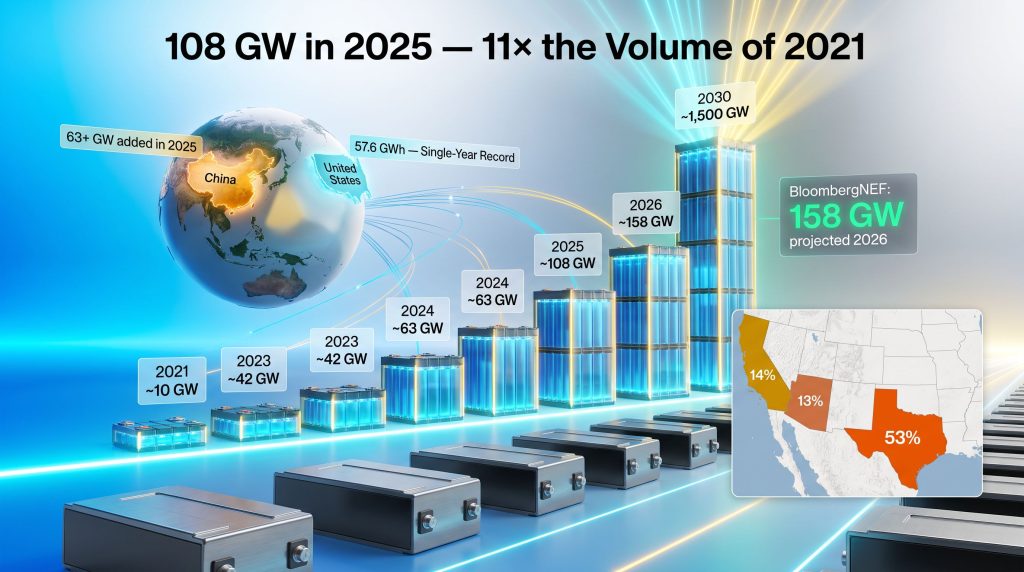
The scale of the build-out over the past four years is difficult to overstate. According to data from the IEA and BloombergNEF, annual battery storage additions have grown approximately 11 times between 2021 and 2025. This rapid expansion is closely linked to battery storage expansion trends that have been building momentum for several years.
Key data point: Global battery storage capacity additions reached approximately 108 GW in 2025, roughly 40% higher than 2024 levels. BloombergNEF projects annual additions could reach 158 GW by 2026, while the IEA's net-zero pathway requires cumulative global energy storage capacity to hit 1,500 GW by 2030.
The table below summarises the trajectory from baseline to projection:
| Year | Annual Additions (GW) | Cumulative Installed (Approx.) | Key Milestone |
|---|---|---|---|
| 2021 | ~10 GW | ~30 GW | Baseline reference year |
| 2023 | ~42 GW | ~75 GW | Fastest-growing power technology (IEA) |
| 2024 | ~63 GW | ~124 GW | Utility-scale expansion accelerates |
| 2025 | ~108–112 GW | ~232 GW | Record year; 40% growth over 2024 |
| 2026 (proj.) | ~158 GW | ~390 GW | BloombergNEF projection |
| 2030 (target) | — | ~1,500 GW | IEA net-zero pathway requirement |
Sources: IEA, BloombergNEF, GlobalData (2026)
A 42% compound annual growth rate (CAGR) sustained over a five-year period is extraordinary for any physical infrastructure category. For context, wind power, which was itself considered a rapid-growth technology in the 2010s, grew at roughly half that pace during its fastest deployment decade.
What the CAGR figure does not fully capture is the compounding nature of the underlying demand: each percentage point of additional renewable penetration on a grid increases the marginal value of storage, creating a self-reinforcing deployment loop. The gap between current trajectory and the IEA's 1,500 GW net-zero requirement remains significant, and reaching that target by 2030 would require the world to deploy more storage capacity over the next five years than it has built across all of recorded history.
Where Is Battery Storage Growing Fastest? A Regional Breakdown
China: Manufacturing Scale Driving Global Cost Compression
China accounted for more than half of global annual storage additions in several recent reporting periods, with an estimated 63+ GW of new capacity deployed in 2025 alone. The country's dominance is not simply a function of domestic demand, though that demand is substantial. China's role as the world's primary manufacturer of LFP cells means that its production volumes set the global price floor.
Every reduction in Chinese cell costs flows through to project economics in Texas, Bavaria, and New South Wales. Consequently, innovations in Chinese battery recycling are also beginning to reshape end-of-life economics in ways that will influence project viability across multiple markets.
This dynamic creates an underappreciated interdependency: Western markets are simultaneously competing with Chinese storage developers and relying on Chinese manufacturing to make their own projects financially viable. That tension is increasingly visible in trade policy discussions, though its resolution remains unresolved.
The United States: Record Deployments and a Concentrated Build-Out
The US closed 2025 with 57.6 GWh of new storage additions, a single-year record, bringing cumulative grid-scale capacity to 137 GWh. Momentum carried into 2026, with Q1 installations reaching 9.7 GWh, a 32% year-over-year increase and the largest first quarter on record for the domestic sector.
Front-of-meter, utility-scale projects represented more than 75% of domestic volume, with developers adding 7.8 GWh in the first quarter of 2026 alone. The US Energy Information Administration projects 24 GW of utility-scale batteries coming online in 2026.
Geographic concentration within the US market is striking:
| State | Share of 2026 Utility-Scale Pipeline |
|---|---|
| Texas | 53% |
| California | 14% |
| Arizona | 13% |
| All Others | 20% |
Source: US Energy Information Administration, 2026 projections
Texas dominates for reasons that go beyond available land. The state's deregulated ERCOT market structure creates strong price arbitrage signals, and its solar irradiance profile generates exactly the kind of midday generation surplus that storage assets can monetise. The concentration also reflects interconnection availability: states with congested grid queues are seeing pipeline slippage even where demand signals are favourable.
Europe and Emerging Markets
Europe's storage growth is increasingly policy-shaped. Germany's Federal Network Agency launched its first 4.5 GW capacity auction under the StromVKG framework in mid-2026, explicitly including long-duration storage as a qualifying technology alongside dispatchable generation. The Netherlands allocated €100 million specifically for battery storage co-located with solar projects, framing the subsidy as a grid congestion relief mechanism.
Australia, the Middle East, and parts of Southeast Asia represent the next wave. Australian projects are being driven by the retirement of coal baseload capacity and the need to firm up high penetrations of rooftop solar. Middle Eastern markets are contracting multi-hour storage specifically to make evening solar generation dispatchable, addressing a structural challenge unique to their demand profiles.
The Duration Revolution: Why Four-Hour Systems Are Replacing Two-Hour Designs
One of the least-discussed but most consequential shifts in battery storage deployment is the move from two-hour to four-hour discharge systems. Understanding why this is happening requires a grasp of how solar power creates specific grid stress patterns.
Technical context: A two-hour battery system charged during a solar generation peak at noon can discharge its stored energy by 2 pm, well before the evening demand peak that typically occurs between 6 pm and 9 pm in most markets. A four-hour system bridges that gap entirely, making it far more valuable for grid operators managing renewable-heavy networks.
The California Public Utilities Commission has effectively established four-hour storage as the minimum standard for capacity credit qualification under its resource adequacy programmes. This regulatory signal matters enormously because capacity credit eligibility determines whether a storage project can access the revenue streams that make it bankable.
Similar regulatory evolution is visible in other markets:
- In the United Kingdom, storage projects that previously focused on fast-frequency response services are migrating toward longer-duration energy shifting as the revenue stack for sub-second services compresses under competition.
- Middle Eastern procurement tenders are now explicitly specifying multi-hour storage to firm up solar output for evening demand, reflecting grid architectures where solar peaks sharply but demand continues well into the night.
- Germany's capacity auction framework under StromVKG includes long-duration storage as a qualifying category, creating a financial incentive for developers to design systems beyond the two-hour threshold.
Energy shifting has emerged as the dominant value proposition for battery storage, displacing the frequency regulation and spinning reserve applications that initially justified early deployments.
How Battery Technologies Compare in Large-Scale Deployment
Lithium iron phosphate dominates current utility-scale deployment, however, the technology landscape is more competitive than it appears at the headline level.
| Technology | Typical Duration | Cycle Life | Best Use Case | Relative Cost |
|---|---|---|---|---|
| Lithium Iron Phosphate (LFP) | 2–6 hours | High | Grid-scale energy shifting | Declining rapidly |
| Vanadium Flow Battery | 4–12+ hours | Very High | Long-duration, daily cycling | Higher upfront |
| Sodium-Ion | 2–4 hours | Moderate-High | Emerging grid applications | Competitive |
| Solid-State (emerging) | 2–6 hours | Very High | Next-generation; pre-commercial | Premium |
Vanadium flow batteries are gaining particular attention for applications requiring eight or more hours of discharge. A proposed 864 MWh vanadium flow battery at an Australian coal mine site by Idemitsu illustrates the technology's appeal for long-duration, high-cycle applications where LFP's calendar degradation becomes a meaningful limitation.
Sodium-ion chemistry is advancing faster than many market observers anticipated. Because sodium is geographically abundant and does not carry the supply concentration risks associated with lithium or cobalt, sodium-ion batteries may eventually offer both cost and supply chain resilience advantages. In addition, direct lithium extraction technologies are simultaneously improving the economics of lithium supply, which remains critical to near-term deployment at scale.
Second-life batteries represent an underappreciated capacity multiplier. Electric vehicle battery packs typically retain 70–80% of their original capacity at end-of-vehicle-life, making them viable for stationary storage applications. As EV fleets age through the late 2020s, second-life battery supply will expand substantially, potentially adding low-cost capacity to markets where new-build economics remain challenging.
The next major ASX story will hit our subscribers first
What This Means for Energy Markets and Investors
Revenue Model Evolution and Market Design
The rapid scaling of battery storage is beginning to alter the market dynamics it was originally designed to exploit. As storage penetration rises in high-penetration markets like California and Texas, the price arbitrage windows that justified early projects are compressing. Battery operators are consequently adapting by stacking multiple revenue streams: capacity market payments, ancillary services, and energy arbitrage in combination.
Grid operators are increasingly treating large-scale battery energy storage systems (BESS) as dispatchable capacity equivalent to gas peakers, qualifying them for capacity market payments that previously required thermal generation. Furthermore, battery raw materials pricing remains a key variable influencing project economics across all these revenue models.
Co-located solar-plus-storage projects have emerged as the dominant development model. Sharing a single grid interconnection point reduces connection costs, shortens development timelines, and allows developers to optimise the combined asset for maximum revenue capture. According to BloombergNEF's global storage analysis, this co-location trend is expected to accelerate significantly through 2030 as interconnection queues become increasingly congested.
The Data Centre Demand Signal
The intersection of battery storage and data centre growth is an underappreciated demand catalyst. Hyperscale AI and cloud infrastructure operators require uninterruptible, dispatchable power with availability standards that utility grids cannot always guarantee, creating a distinct category of behind-the-meter industrial storage demand that is attracting significant capital from technology companies.
This demand signal is durable because it is driven by the economics of downtime rather than by electricity price arbitrage, which means the revenue justification survives in markets where arbitrage margins are thin.
Five Strategic Conclusions for the 2025–2030 Window
- The growth trajectory is structural, not cyclical. Converging demand signals from renewable integration, industrial electrification, and digital infrastructure create a self-reinforcing deployment dynamic unlikely to reverse without a fundamental change in energy policy globally.
- China's manufacturing dominance is a global cost-reduction mechanism. LFP cell price compression benefits deployment everywhere, but it also creates supply chain concentration risk that Western procurement frameworks are only beginning to address.
- Duration is the defining frontier. The shift toward four-hour and longer systems signals storage's transition from grid ancillary to primary dispatchable capacity, with profound implications for both project economics and market design.
- Policy frameworks are becoming the critical deployment variable. Capacity market design, interconnection queue management, and subsidy structures now determine deployment pace more decisively than technology readiness or capital availability.
- The 1,500 GW target is directionally achievable but not guaranteed. Sustained delivery requires simultaneous progress on supply chains, permitting regimes, grid infrastructure investment, and workforce capacity, all of which face their own independent constraints.
Disclaimer: This article contains forward-looking projections from third-party research organisations including the IEA, BloombergNEF, GlobalData, and the US Energy Information Administration. These projections are subject to revision and do not constitute financial advice. Readers should conduct their own due diligence before making investment decisions based on any of the figures or trends discussed above.
Want to Invest in the Minerals Powering the Battery Storage Revolution?
Discovery Alert's proprietary Discovery IQ model delivers real-time alerts on significant ASX mineral discoveries — instantly identifying the critical minerals driving the global battery storage build-out before the broader market catches on. Explore historic discoveries and their returns to understand the opportunity, then begin your 14-day free trial at Discovery Alert to position yourself ahead of the next major find.