July 28, 2026
When Sector Returns Disguise Very Different Stock Realities
Experienced resources investors understand a pattern that repeats across every major mining cycle: a rising sector tide lifts all boats temporarily, but when the water recedes, the quality of each vessel becomes undeniably clear. The materials sector's extraordinary FY26 performance created exactly this dynamic on the ASX, where aggregate index returns masked a wide dispersion of individual stock outcomes, risk profiles, and forward-looking value propositions.
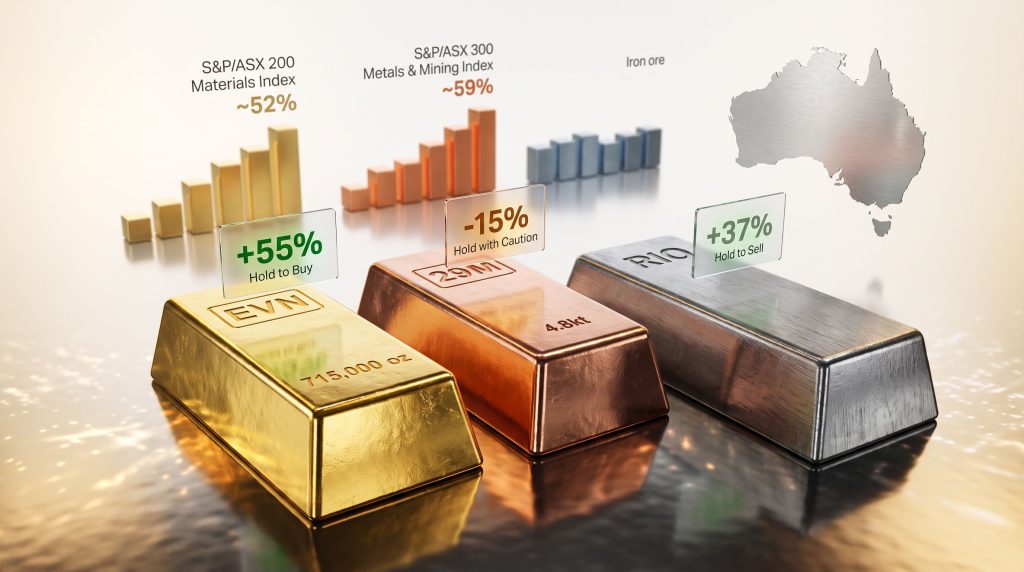
The S&P/ASX 200 Materials Index (ASX: XMJ) produced a total return of approximately 52% across FY26, while the broader S&P/ASX 300 Metals & Mining Index (ASX: XMM) outperformed with a total return of approximately 59%. These figures represent the strongest sector performance on the Australian sharemarket for the year. However, averages obscure the full picture. Within those returns sit wildly divergent stories: a gold producer that nearly doubled, a copper junior that shed 15%, and a diversified titan that rallied strongly but may now be approaching a valuation ceiling.
Deciding whether to buy, hold, or sell Evolution Mining, 29Metals, and Rio Tinto shares entering FY27 requires understanding not just what drove FY26 gains, but what commodity dynamics, balance sheet realities, and project execution risks will determine who wins and who stalls in the year ahead.
When big ASX news breaks, our subscribers know first
What Macro Forces Powered ASX Mining in FY26?
Several intersecting tailwinds converged to supercharge the materials sector across the financial year:
- The gold price impact on mining equities was profound, as sustained historically elevated levels expanded margins dramatically for unhedged or lightly-hedged producers
- Copper supply crunch trends accelerated demand on the back of electrification and grid infrastructure investment globally
- Iron ore demand prospects proved more resilient than many forecasts anticipated, despite ongoing caution around Chinese steel demand
- A softer Australian dollar amplified commodity revenues when converted to AUD, a structural advantage for Australian-listed resource exporters
- Lithium prices began stabilising after a prolonged and painful correction that had weighed heavily on the sector in FY25
Understanding whether these forces remain intact or are fading is critical context for any FY27 investment framework applied to buy, hold, or sell Evolution Mining, 29Metals, and Rio Tinto shares.
Evolution Mining (ASX: EVN): Full Gold Price Exposure in an Unhedged World
FY26 Operational Metrics: A Record Year by Multiple Measures
Evolution Mining's FY26 results demonstrated the power of combining operational consistency with rising commodity prices. The company delivered full-year gold production of 715,000 ounces and copper output of 66,000 tonnes, meeting both its production and cost guidance targets. This consistency is not a minor achievement in an industry where geological surprises, weather events, and supply chain disruptions routinely derail forecasts.
| Metric | FY26 Result |
|---|---|
| Full-Year Gold Production | 715,000 oz |
| Full-Year Copper Production | 66,000 t |
| Q4 FY26 Gold Production | 180,000 oz |
| Q4 FY26 Copper Production | 19,000 t |
| Gold AISC | AU$1,717/oz |
| Operating Mine Cash Flow | AU$3,394 million (record) |
| Net Mine Cash Flow | AU$2,079 million |
| Cash Balance | AU$1,347 million |
The record operating mine cash flow of AU$3,394 million reflects the exceptional leverage gold producers carry when spot prices are running well above cost bases. With Australian gold prices trading substantially above AU$4,000 per ounce through much of FY26, Evolution's AISC of AU$1,717 per ounce implies cash margins exceeding AU$2,200 per ounce produced, a level that transformed financial outcomes across the business.
Understanding AISC: Why This Metric Is the Cornerstone of Gold Investment Analysis
All-In Sustaining Cost is the most comprehensive cost metric in gold mining. Unlike cash costs, which only capture direct production expenses, AISC incorporates sustaining capital expenditure, mine-site administration, royalties, and exploration costs required to maintain existing production levels. It reflects the true economic cost of delivering an ounce of gold to market.
For investors, the gap between AISC and the prevailing gold spot price is the margin that determines whether a gold miner generates genuine wealth or merely covers its costs. A wider margin means more cash generation per ounce, stronger balance sheets, and greater capacity to fund growth without diluting shareholders.
At AU$1,717/oz AISC against a gold price environment well above AU$4,000/oz, Evolution operates with a margin buffer that is both substantial and meaningful for risk management purposes.
The Strategic Significance of Being Fully Unhedged
One of the most consequential decisions a gold miner can make is whether to hedge its future production through forward sales contracts. Hedging provides revenue certainty but sacrifices upside exposure when prices rise. Evolution Mining entered FY27 in a fully unhedged position, meaning every ounce of gold it produces is sold at prevailing spot market prices with no forward contracts limiting the upside.
This is a high-conviction strategic call by management. It signals confidence in a sustained gold price environment and aligns shareholder returns directly with gold market movements. However, it also means that a material correction in gold prices flows through to revenue and margins without any contractual buffer.
For investors evaluating whether to buy, hold, or sell Evolution Mining shares, the unhedged position is the single most important factor shaping the risk-reward equation entering FY27.
Broker Positioning and Valuation Context
JP Morgan maintained a Buy rating on Evolution Mining shares following the quarterly review, adjusting its 12-month price target modestly from AU$14.30 to AU$14.10. At a recent trading price of approximately AU$11.24, this implies potential upside of approximately 25% over a 12-month horizon.
Broader broker consensus across multiple research houses shows approximately 8 Buy, 6 Hold, and 3 Sell recommendations, with an average consensus price target of approximately AU$13.22. Furthermore, for a detailed independent view, Motley Fool's buy, hold, sell analysis on Evolution Mining provides additional broker perspective worth considering alongside these figures.
| Signal | Assessment |
|---|---|
| Broker Consensus | Lean Buy (majority Buy and Hold) |
| JP Morgan Target | AU$14.10 (25% implied upside) |
| Balance Sheet | Net cash, AU$1,347 million |
| Hedge Book | Fully unhedged |
| Growth Projects | On schedule and within budget |
| Primary Risk | Gold price correction; AISC discipline |
Verdict: Hold to Buy for investors with a constructive view on gold prices and a 12-month or longer horizon. The organic growth pipeline advancing on schedule provides an additional valuation catalyst beyond pure gold price leverage. The net cash position eliminates refinancing risk and provides funding flexibility without requiring equity dilution.
29Metals (ASX: 29M): Copper Optionality Wrapped in Execution Risk
Operational Context: Two Assets, One Uncertain Recovery Path
29Metals operates two primary mining assets: Golden Grove in Western Australia, a polymetallic mine producing copper, zinc, gold, and silver; and Capricorn Copper in Queensland, which remains suspended pending regulatory approvals and a feasibility study. The combination creates a company where near-term production metrics are modest but medium-term optionality is significant, provided execution proceeds on schedule.
For the June quarter, Golden Grove produced 4.8kt of copper and 3.1kt of zinc. While copper volumes came in below analyst forecasts, stronger copper sales realisation combined with better-than-expected zinc, gold, and silver output produced a revenue outcome approximately 30% ahead of analyst estimates. This is a nuanced result: volume underperformance masked by price and product mix factors.
| Metric | June Quarter Result |
|---|---|
| Copper Production (Golden Grove) | 4.8 kt |
| Zinc Production (Golden Grove) | 3.1 kt |
| Revenue vs. Analyst Forecast | ~30% beat |
| Share Price (recent) | ~AU$0.25 |
| 12-Month Share Price Change | -15% |
| Morgans 12-Month Target | AU$0.26 |
Gossan Hill and Oizon: What the Drilling Data Actually Means
Within the Gossan Hill area at Golden Grove sits Oizon, a high-grade copper ore reserve currently under development. First ore delivery from Oizon is targeted before the end of calendar 2026. Simultaneously, ongoing drilling results continue to indicate that the existing Mineral Resource Estimate (MRE) may be materially expanded, which could underpin a longer production life and improved mine planning flexibility.
In the mining industry, a distinction exists between an Inferred Resource (geological confidence is lowest), an Indicated Resource (moderate confidence), and a Measured Resource (highest confidence, suitable for detailed mine planning). Drill results that suggest MRE expansion are positive but remain at the exploration end of this spectrum until converted into higher-confidence categories through additional drilling and resource estimation work.
Resource expansion potential improves long-term asset value but does not resolve near-term production shortfalls. Investors should treat MRE expansion signals as an optionality value rather than a near-term earnings catalyst.
The Capricorn Copper Restart: A Binary Value Event
Capricorn Copper represents 29Metals' most significant medium-term growth lever. Management has described it as a pathway to more than doubling the company's annual copper production at relatively low capital intensity, a compelling proposition in a copper market where new supply is chronically constrained by long development timelines.
Two specific milestones must be achieved before a restart can proceed:
- Regulatory approval for a new Tailings Storage Facility (TSF) from Queensland authorities
- Completion of the Restart definitive feasibility study (DFS), targeted by the end of calendar 2026
Water management constraints that previously represented a physical impediment to the restart have been resolved, which removes one layer of uncertainty. However, TSF approvals involve environmental assessments and community consultation processes that operate on timelines outside management's direct control.
A Tailings Storage Facility is the engineered structure used to store the fine-grained residue left after mineral processing. TSF design, approval, and management have become increasingly scrutinised following high-profile failures globally, making regulatory approval timelines inherently uncertain and process-intensive.
Analyst Consensus: A Market Divided on 29Metals
| Broker Stance | Count |
|---|---|
| Buy | 2 |
| Hold | 3 |
| Sell | 3 |
Morgans reiterated a Hold rating with a 12-month target of AU$0.26, implying the stock is essentially at fair value at current levels of approximately AU$0.25. The median analyst price target across all research houses sits at approximately AU$0.30, suggesting limited near-term upside even in more optimistic scenarios.
Verdict: Hold with Caution. The Capricorn Copper restart option provides genuine upside for patient investors with higher risk tolerance. However, the combination of below-forecast copper production, regulatory binary risk on the TSF approval, and a share price already near the median analyst target leaves little margin of safety. Conservative investors should monitor regulatory developments before increasing exposure.
Rio Tinto (ASX: RIO): Operational Excellence Meets Valuation Headwinds
H1 FY26 Production: Genuine Commodity Diversification at Scale
Rio Tinto's operational update for the first half of FY26 demonstrated the advantages of genuine commodity and geographic diversification that few companies can match:
| Commodity | H1 FY26 Change (Year-on-Year) |
|---|---|
| Copper Production | +3% |
| Lithium Production | +20% |
| Iron Ore Sales | +5% |
The simultaneous growth across three strategically important commodities reflects a company with the capital base, operational expertise, and project pipeline to execute on multiple fronts concurrently. The 20% lift in lithium production is particularly notable given the broader industry context of supply rationalisation during 2024 and 2025.
The Iron Ore Dependency Question: Structural Risk in a Single Market
Despite meaningful copper and lithium growth, iron ore remains Rio Tinto's dominant earnings driver by a substantial margin. This concentration creates a structural sensitivity to:
- Chinese steel production volumes and evolving policy direction
- The ongoing restructuring of China's property sector, which historically consumed large quantities of steel-intensive construction materials
- Seaborne supply dynamics from Brazilian and Australian competitors, particularly Vale's production trajectory
- Global infrastructure spending cycles that can partially offset property sector weakness
The property sector restructuring in China is not a short-term disruption; it represents a multi-year adjustment of a sector that had grown to represent an outsized share of the economy. Steel demand from construction may find partial offsets in manufacturing, renewable energy infrastructure, and government-directed investment, but the structural shift is real and cannot be fully discounted in any serious iron ore analysis.
Lithium Growth: Long-Term Significance, Near-Term Earnings Modesty
The Rincon lithium project in Argentina represents Rio Tinto's most significant lithium growth asset. A 20% year-on-year production increase is operationally meaningful, but the absolute earnings contribution of lithium remains modest relative to iron ore at this stage of asset development.
As Rincon scales toward its intended production capacity over a 3-to-5-year horizon, the lithium segment's contribution to group earnings could increase materially. For long-term investors, this provides a genuine optionality component embedded within Rio Tinto's valuation that is not always fully articulated in near-term broker models.
Why Morgan Stanley's Sell Rating Is a Valuation Argument, Not an Operations Critique
Morgan Stanley maintained a Sell rating on Rio Tinto shares with a 12-month price target of AU$147.50, implying approximately 8% downside from recent trading levels near AU$159.83. This is an important distinction for investors to understand.
The sell thesis is not premised on operational concerns. Rio Tinto's production growth, balance sheet strength, and supply chain sophistication are broadly recognised as industry-leading. The argument is that the market has already priced in much of the good news following a 37% price appreciation over 12 months, leaving limited room for further re-rating without a new positive catalyst. Consequently, investors can track Rio Tinto's current share price directly to monitor how the stock is trading relative to these broker targets.
| Signal | Assessment |
|---|---|
| Morgan Stanley Rating | Sell (target: AU$147.50) |
| Implied Downside | ~8% from recent price |
| 12-Month Price Appreciation | ~37% |
| Copper Production | +3% YoY |
| Lithium Production | +20% YoY |
| Iron Ore Sales | +5% YoY |
| Iron Ore Risk | China demand uncertainty |
Verdict: Hold to Sell. At current valuations, the asymmetry of returns has shifted unfavourably. Existing holders may be best served maintaining rather than adding, given the valuation premium already embedded in the share price. New investors should weigh the 37% prior-year appreciation carefully before establishing a position.
Side-by-Side Comparison: EVN, 29M, and RIO
| Metric | Evolution Mining (EVN) | 29Metals (29M) | Rio Tinto (RIO) |
|---|---|---|---|
| Primary Commodity | Gold and Copper | Copper and Zinc | Iron Ore, Copper, Lithium |
| 12-Month Price Change | +55% | -15% | +37% |
| Broker Consensus | Lean Buy | Hold to Sell | Hold to Sell |
| Key Upside Catalyst | Unhedged gold exposure | Capricorn Copper restart | Lithium growth; copper expansion |
| Key Downside Risk | Gold price correction | TSF regulatory delay | Iron ore demand; stretched valuation |
| Balance Sheet | Net cash | Adequate liquidity | Investment grade; strong |
| Investment Verdict | Hold to Buy | Hold with Caution | Hold to Sell |
The next major ASX story will hit our subscribers first
Broader Commodity Themes Shaping ASX Mining in FY27
Gold: Structural Demand Floor or Cyclical Peak?
Central bank gold buying has provided a structurally important demand floor that differentiates the current gold cycle from historical precedents. Sovereign wealth diversification away from USD-denominated assets, combined with persistent geopolitical uncertainty, has supported elevated gold valuations beyond what interest rate dynamics alone would predict. Real interest rate movements remain a key swing factor, but the central bank buying trend adds a layer of demand resilience that supports the bull case for gold producers like Evolution Mining.
Copper: The Supply Deficit Nobody Has Solved
Long-cycle copper supply deficits are widely forecast across major research institutions, driven by the fundamental reality that discovering, permitting, building, and commissioning a major copper mine now takes between 10 and 15 years. This extended lead time means that even with strong demand signals today, new supply cannot respond quickly enough to close the gap. Electrification of transport networks and electricity grid upgrades represent structural demand drivers that are measured in decades, not quarters. For copper-exposed stocks including 29Metals and Rio Tinto's copper division, this creates a supportive medium-term pricing environment despite near-term volatility.
Iron Ore: The China Premium That Markets Keep Debating
Iron ore pricing has defied numerous bearish forecasts over the past five years, repeatedly finding support from Chinese infrastructure and manufacturing stimulus programmes. However, the property sector recalibration introduces a different quality of demand headwind than previous cycles. Infrastructure spending can absorb some steel demand displacement from construction, but the scale of the property sector's former iron ore consumption is difficult to fully replace through other channels. This creates genuine uncertainty for Rio Tinto's earnings trajectory over the next 12 to 24 months.
Frequently Asked Questions
What is the broker consensus on Evolution Mining shares for FY27?
Approximately 8 Buy ratings, 6 Hold ratings, and 3 Sell ratings from research houses covering the stock, with JP Morgan's 12-month target of AU$14.10 implying roughly 25% upside from recent trading levels near AU$11.24.
Why is 29Metals rated a Hold rather than a Buy by most analysts?
The combination of below-forecast copper production volumes, a share price already trading near the median analyst target of AU$0.30, and material regulatory uncertainty around the Capricorn Copper TSF approval creates a risk-reward profile that most analysts consider insufficiently attractive for a Buy recommendation at current levels.
What is Morgan Stanley's price target for Rio Tinto shares?
Morgan Stanley's current 12-month price target is AU$147.50, implying approximately 8% downside from recent trading near AU$159.83. The sell thesis is driven by valuation rather than operational performance concerns.
Which of these three stocks offers the most implied upside based on broker targets?
Based on broker price targets relative to current trading levels, Evolution Mining offers the largest implied upside at approximately 25% to JP Morgan's target of AU$14.10, contingent on sustained gold prices and continued execution on the organic growth pipeline.
What does fully unhedged mean for an ASX gold producer like Evolution Mining?
A fully unhedged position means the company has no forward-selling contracts in place, so 100% of gold production is sold at prevailing spot market prices. This maximises upside exposure when gold prices are elevated but also means that any material gold price correction flows directly and fully into revenue and margin outcomes without any contractual protection. For investors assessing the broader question of buy, hold, or sell Evolution Mining, 29Metals, and Rio Tinto shares, understanding hedging policy is therefore an essential part of the analysis.
This article contains general information only and does not constitute personal financial advice. All figures are based on publicly available data and broker reports current at the time of writing. Past performance is not indicative of future results. Investors should consider their own financial circumstances and objectives before making investment decisions, and seek professional advice where appropriate.
Want to Know When the Next Major ASX Mining Discovery Hits?
Discovery Alert's proprietary Discovery IQ model delivers real-time alerts the moment significant mineral discoveries are announced on the ASX, cutting through the noise across more than 30 commodities to surface actionable opportunities — whether you're trading the short-term momentum of a gold surge or positioning early in copper ahead of the next supply squeeze. Explore how historic ASX mineral discoveries have generated extraordinary returns and begin your 14-day free trial today to ensure you're never the last to know.