July 28, 2026
Why the World's Most Energy-Hungry Machines Are Being Unplugged
The economics of large-scale mining have always been governed by one unavoidable reality: moving enormous volumes of rock requires enormous quantities of energy. For decades, that energy came almost exclusively from diesel, and the industry built itself around that assumption. Fuel logistics, supply contracts, maintenance schedules, and capital planning all orbited around the diesel engine as an immovable constant.
That assumption is now cracking. Across the African continent, a combination of fuel price volatility, tightening institutional lending standards, and the maturing economics of electric heavy equipment is forcing mine operators to reassess the foundations of their cost models. The Moatize mine electrification project in Mozambique represents one of the most ambitious responses to this shift anywhere in the world.
When big ASX news breaks, our subscribers know first
The Diesel Dependency Problem at Industrial Scale
To understand the financial logic driving the Moatize mine electrification programme, it helps to understand just how much diesel a large open-pit mine actually consumes. According to Fuel Management Africa, cited by Mining Next in June 2025, a single heavy mining truck burns between 300 and 500 litres of diesel per hour under operational load. That figure is not exceptional — it is the baseline for the ultra-class haul trucks that form the backbone of any large open-pit operation.
When dozens of these machines run continuously across multiple shifts, the aggregate fuel demand becomes one of the most significant and least controllable cost centres in the business. Industry benchmarks consistently place fuel expenditure at between 20% and 40% of total mine operating costs, a range that widens further when global oil markets turn volatile.
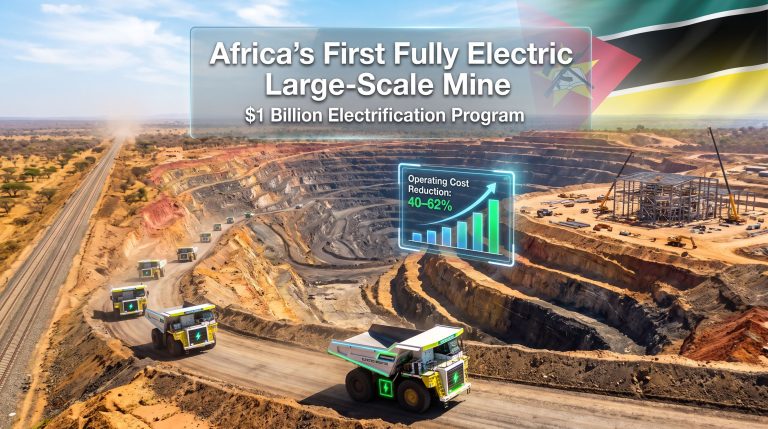
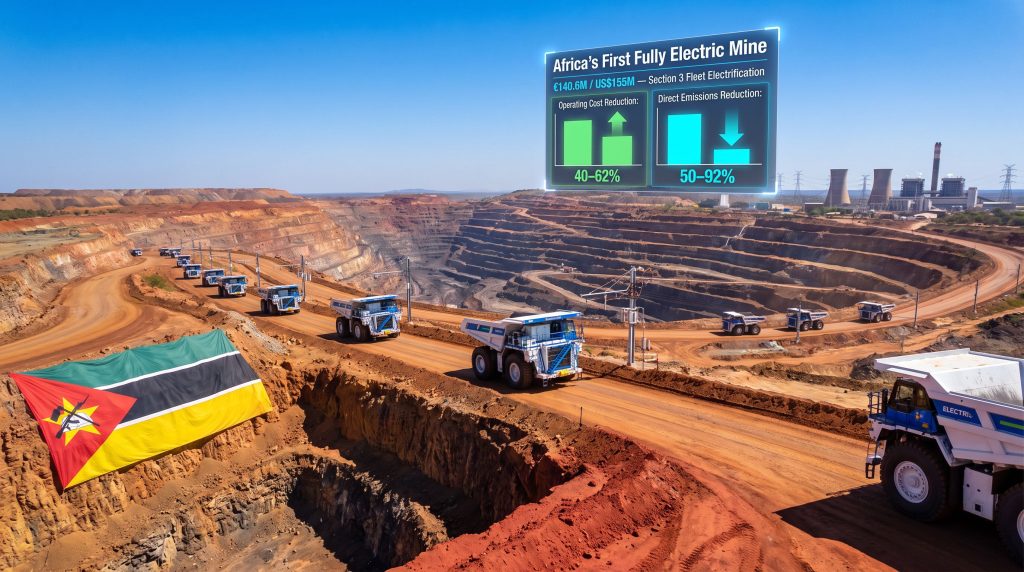
The financial argument for electrification, therefore, is not primarily philosophical — it is arithmetical. A study published in ScienceDirect in April 2025 found that transitioning to electric mining equipment can reduce operating costs by 40% to 62% while cutting direct operational emissions by 50% to 92%. For a mine operating at the scale of Moatize, those percentages translate into savings that could comfortably reach the tens of millions of dollars annually.
| Metric | Diesel Operations | Electric Operations |
|---|---|---|
| Fuel cost as % of total opex | 20–40% | Significantly reduced |
| Operating cost reduction potential | Baseline | 40–62% lower |
| Direct emissions reduction | Baseline | 50–92% lower |
| ESG-aligned financing access | Increasingly restricted | Improved |
What the Moatize Mine Electrification Project Actually Involves
The Moatize mine electrification project is Vulcan Mozambique's programme to convert the Moatize open-pit coal complex in Tete Province, northwestern Mozambique into what the company has described as Africa's first fully electric mine. Some sources have characterised it more specifically as Mozambique's first 100% electric mining operation, marking a landmark moment for the African extractive sector.
The immediate scope centres on Section 3 of the Moatize complex, where all diesel-powered haul trucks and heavy equipment are to be replaced with electric equivalents. This is not a pilot programme or a partial retrofit — the stated objective is complete replacement of the diesel haulage fleet across that operational zone.
The capital commitment behind this transition is substantial. Vulcan has committed approximately €140.6 million, equivalent to roughly US$155 to $160 million, to the electrification programme. The investment covers:
- Full electric fleet conversion across Section 3 operations
- Integration with a 300 MW on-site power system supplying both mining and coal processing infrastructure
- Capacity to export surplus electricity to Mozambique's national grid
This mine-level commitment forms part of a far broader corporate electrification strategy. Africa Outlook Magazine has reported that Vulcan's full programme carries a price tag approaching $1 billion, encompassing not just the mine itself but the entire logistics chain connecting it to international export markets.
How a Fully Electric Open-Pit Mine Is Engineered
From Diesel to Battery: The Technical Architecture
Conventional open-pit operations depend on diesel-powered ultra-class haul trucks that operate in continuous cycles across extended shift patterns. Converting these operations to electric traction requires more than simply swapping vehicle types. The transition involves installing a comprehensive charging and power distribution infrastructure across the mine's operational footprint, procuring battery-electric or trolley-assist vehicles suited to the specific gradients and haul distances of the site, and building energy management systems capable of balancing load demand across a large and dynamic fleet.
Furthermore, the broader mining electrification trends emerging globally in 2025 indicate that Moatize is not operating in isolation — it is part of a sector-wide structural shift. At Moatize, the critical enabling infrastructure is the 300 MW on-site thermal power plant currently under construction. This facility is designed to run on coal waste and processing by-products generated by the mine itself, converting what would otherwise be a disposal liability into the primary energy source for electric operations. Construction commenced in July 2024, and as of April 2026, the plant remained under active development according to Global Energy Monitor.
The Waste-Coal Power Model: A Closed-Loop Energy Concept
The decision to fuel the power plant with coal processing waste rather than purchased fuel or grid electricity is strategically significant for several reasons. It eliminates the external fuel dependency that makes diesel operations financially vulnerable, anchors the mine's energy costs to internal production economics rather than global commodity markets, and converts a waste stream into a productive asset.
Once operational, the 300 MW facility will supply power to:
- Heavy equipment across the electrified mine sections
- Coal processing and preparation plant operations
- Rail electrification systems along the logistics corridor
- The Mozambican national electricity grid via surplus capacity export
The integration of waste-coal power generation with electric mining operations represents a closed-loop industrial model with few precedents at this scale in Africa. The mine essentially becomes its own power utility, reducing exposure to both diesel price volatility and grid reliability risks simultaneously.
The Moatize Complex: Scale, Reserves, and Strategic Weight
The Moatize coal deposit is not simply large by African standards — it is significant in a global context. The complex spans approximately 300 square kilometres in Tete Province and holds estimated metallurgical coal reserves of between 2 and 3 billion metric tonnes, according to Vulcan CEO Mukesh Kumar as reported by Business Focus Magazine in April 2026.
That reserve scale matters for understanding the investment thesis behind the electrification programme. A multi-billion-tonne reserve base justifies substantial upfront capital expenditure on operational infrastructure, because the asset has a sufficiently long productive life to generate returns on that investment over many decades.
Moatize produces metallurgical coal rather than thermal coal. This distinction carries meaningful implications for how the project is assessed by ESG-oriented investors and lenders. Metallurgical coal is the primary carbon reductant in steelmaking through the blast furnace route, and while green steel technologies are advancing, the global steel industry remains heavily dependent on metallurgical coal for primary production. This differentiates Moatize from thermal coal operations that supply power generation — a sector facing much more direct regulatory and financing pressure in most institutional frameworks.
Vulcan's Ownership Timeline and Production Growth
- December 2021: Vulcan Mozambique acquires the Moatize complex from Brazilian mining giant Vale
- At acquisition: Annual production capacity stood at 22 million metric tonnes per year
- Current capacity: 45 million metric tonnes per year, more than double the inherited baseline
- Timeline to double capacity: Approximately four years
- Corporate status: Recognised as Mozambique's largest mining company by operational scale
The pace of that production ramp-up is notable. Doubling throughput capacity within four years of acquisition at a complex of this size requires sustained capital deployment and operational execution. The electrification programme can consequently be read as the next phase of a deliberate expansion strategy, not a reactive response to external pressure.
The $1 Billion Strategy: Mine to Port Electrification
Why Rail Electrification Is the Logical Next Step
The Moatize mine electrification initiative does not stand alone. It is the most visible component of a strategy that Vulcan has articulated as extending across nearly 1,000 kilometres of rail logistics infrastructure connecting the mine to the deep-water Port of Nacala on Mozambique's northern coast. In addition, the role of renewable energy in mining continues to grow as operators seek to reduce reliance on fossil fuels across entire value chains.
| Programme Component | Approximate Investment | Current Status |
|---|---|---|
| Section 3 fleet electrification | Announced / In progress | |
| 300 MW waste-coal power plant | Part of broader capex | Under construction since July 2024 |
| Rail corridor electrification (~912–1,000 km) | Part of ~$1B programme | Planned |
| National grid surplus power supply | Integrated into power plant design | Planned |
The 912-kilometre dedicated rail corridor to Nacala is currently a diesel-dependent logistics artery. At the volumes Moatize operates, the fuel and maintenance costs associated with diesel locomotive traction over that distance represent a recurring and substantial operational expense. Electrifying the corridor would require significant investment in overhead contact systems, substations at regular intervals, and compatible electric locomotive procurement — but the long-run operating cost reduction potential mirrors the mine-level electrification economics.
Critically, the 300 MW power plant's surplus capacity creates a potential energy supply pathway for rail operations, establishing an integrated energy ecosystem from extraction point to export terminal. This is an unusual and strategically elegant configuration — the mine's waste stream powers the mine's transport chain.
The next major ASX story will hit our subscribers first
ESG Financing Dynamics and the Electric Coal Mine Paradox
Why Institutional Capital Is Reshaping Mine Design Decisions
Development finance institutions and institutional lenders have progressively tightened environmental governance requirements for resource sector borrowers throughout the first half of this decade. For large-scale operations that require continuous capital reinvestment to sustain production growth, maintaining access to these financing channels is a strategic imperative that directly influences operational design choices.
Vulcan's stated objective of satisfying the environmental benchmarks demanded by environmentally focused lenders and development finance institutions — as reported by The Rio Times — reflects this reality. The electrification programme is partly a cost optimisation exercise and partly a financing access strategy. The well-documented mining decarbonisation benefits now extend beyond environmental performance to encompass measurable improvements in financing eligibility, as demonstrated by Moatize's approach.
The Critical Analytical Distinction: Operational vs. Lifecycle Emissions
A nuance that sophisticated investors and climate analysts are increasingly attentive to is the distinction between different emissions scopes in the context of a coal mine electrification project.
Electrifying mine haulage and processing operations reduces Scope 1 direct emissions from combustion on-site and improves Scope 2 emissions associated with purchased energy. It does not alter Scope 3 emissions, which arise from the combustion of the coal itself by end-users in steelmaking furnaces.
This is not a criticism of the programme — it is an accurate framing of what it achieves. The Moatize mine electrification project is best understood as an operational decarbonisation initiative that delivers genuine and measurable reductions in the environmental footprint of extraction and logistics, while leaving the downstream emissions profile of the product unchanged. For metallurgical coal specifically, this is a distinction that most major institutional frameworks currently accommodate, given the absence of commercially scalable alternatives to coal-based steelmaking at global production volumes.
Quantifying the Projected Benefits
Operating Cost Reduction: The Compounding Advantage
Applying the 40–62% operating cost reduction range identified in peer-reviewed research to a mine of Moatize's scale produces compelling numbers. With fuel representing up to 40% of total operating costs across a mine producing 45 million metric tonnes annually, the potential annual savings from electrification are substantial. These savings are not one-off — they compound year over year across what is effectively a multi-decade asset life, improving the mine's long-run economics and return on invested capital.
Emissions Performance at the Operational Level
- Replacing diesel combustion across the haulage fleet eliminates the primary source of Scope 1 direct emissions from mine operations
- Sourcing electricity from dedicated on-site generation rather than grid supply or diesel backup improves Scope 2 emissions relative to conventional configurations
- The 50–92% direct emissions reduction range identified in electrification research represents a meaningful and auditable improvement relevant to lender ESG assessments
However, it is worth noting that the broader mining energy transition occurring globally means Moatize is entering a competitive landscape where operational decarbonisation is becoming an industry baseline expectation rather than a differentiator.
Energy Sovereignty and National Grid Contribution
Perhaps one of the least-discussed dimensions of the Moatize electrification programme is its potential contribution to Mozambique's domestic energy security. The 300 MW power plant is sized to exceed the mine's internal consumption requirements. Surplus electricity exported to the national grid positions Vulcan as a net energy contributor in a country where electricity access remains constrained for large portions of the population. This dynamic strengthens the company's social licence to operate and creates a constructive relationship with the Mozambican state that extends beyond the mine gate.
Frequently Asked Questions: Moatize Mine Electrification
What is the Moatize mine electrification project?
The Moatize mine electrification project is Vulcan Mozambique's programme to replace all diesel-powered heavy equipment at the Moatize open-pit coal complex in Tete Province with electric machinery. The initiative is supported by a 300 MW on-site power plant running on coal processing waste, and forms part of a broader approximately $1 billion electrification strategy covering rail logistics conversion.
How much is Vulcan investing specifically in mine electrification?
Vulcan has committed approximately €140.6 million (US$155–160 million) to the fleet electrification component at Section 3 of the Moatize complex. The total programme, including rail and power infrastructure, is reported by Africa Outlook Magazine to total approximately $1 billion.
What makes this different from other African mine electrification efforts?
Most electrification initiatives across African mining to date have targeted auxiliary systems such as ventilation, lighting, and processing plant operations. The Moatize programme targets primary haulage fleet conversion — the highest energy-consuming activity in the mine — and integrates dedicated on-site power generation with plans for rail corridor electrification. The combined scope is without precedent on the continent. Furthermore, the adoption of electric mining transport at this scale sets a new benchmark for what is achievable across African resource operations.
Does electrifying a coal mine make it carbon neutral?
No. Operational electrification reduces Scope 1 and Scope 2 emissions from mining, haulage, and processing activities. Scope 3 emissions arising from the combustion of Moatize's metallurgical coal in steelmaking furnaces are unaffected. The programme represents genuine operational decarbonisation, not lifecycle carbon neutrality.
What are Moatize's coal reserves?
According to Vulcan CEO Mukesh Kumar as reported by Business Focus Magazine in April 2026, the Moatize complex holds an estimated 2 to 3 billion metric tonnes of metallurgical coal reserves across its approximately 300-square-kilometre operational area.
How does Moatize coal reach export markets?
Coal from Moatize is transported via a 912-kilometre dedicated rail corridor to the deep-water Port of Nacala on Mozambique's northern coast, from where it is shipped to international steel markets in Asia and elsewhere.
Key Takeaways
- The $155 million fleet electrification commitment at Section 3 is the centrepiece of a ~$1 billion programme targeting full mine-to-port decarbonisation of operations
- Peer-reviewed evidence supports 40–62% operating cost reductions and 50–92% direct emissions cuts from mining fleet electrification — making the business case commercially rather than merely ethically driven
- A 300 MW on-site power plant fuelled by coal processing waste will provide the energy backbone, with surplus capacity directed to Mozambique's national electricity grid
- The broader strategy includes electrifying nearly 1,000 kilometres of rail logistics, which would complete a low-diesel value chain from extraction to seaborne export
- The project improves Vulcan's access to ESG-aligned institutional financing by demonstrably reducing Scope 1 and Scope 2 emissions at the operational level
- The critical analytical caveat: operational electrification does not alter the downstream carbon profile of metallurgical coal combustion, a distinction that remains central to any comprehensive ESG assessment of the project
Further coverage of African mining sector developments, energy transition trends, and infrastructure investment across the continent is available via Ecofin Agency, which provides ongoing reporting on mining, energy, and resource sector developments in Africa. In addition, Vulcan International offers further insight into the equipment and services driving large-scale mining electrification programmes such as this one.
Want to Stay Ahead of the Next Major Mining Discovery?
Discovery Alert's proprietary Discovery IQ model scans ASX announcements in real time, instantly identifying significant mineral discoveries and translating complex data into actionable investment insights — ideal for both traders and long-term investors navigating the rapidly evolving mining sector. Explore historic discoveries and their remarkable returns, then begin your 14-day free trial to position yourself ahead of the broader market.