August 14, 2026
Battery Supply Chain Vulnerabilities in the Global Energy Transition
The shift towards electrified transportation has exposed critical vulnerabilities in how advanced economies secure essential battery materials. Modern electric vehicle manufacturing faces unprecedented challenges as automakers navigate increasingly complex supply chains for critical battery materials. The Syrah Resources Tesla graphite supply deal illustrates these broader systemic challenges, as Tesla's pursuit of non-Chinese graphite processing capabilities has encountered repeated technical delays.
Furthermore, this transition from fossil fuel dependence to electrified transportation has highlighted fundamental weaknesses in sourcing, processing, and securing access to essential minerals. Among these materials, graphite represents a particularly acute bottleneck, with processing capabilities concentrated in regions that may not align with strategic interests of major automotive markets. This case study reveals critical insights about supply chain diversification, technical specification challenges, and the intersection of industrial policy with private sector risk management.
When big ASX news breaks, our subscribers know first
Understanding Graphite's Critical Role in Battery Manufacturing
Natural graphite serves as the foundation for lithium-ion battery anode production, comprising approximately 90-95% of anode material by weight in most commercial battery designs. This proportion makes graphite the largest single component in battery cells, yet it receives significantly less attention than lithium, cobalt, or nickel in public discussions about critical minerals energy transition strategies.
The transformation from raw graphite flakes to battery-ready active anode material (AAM) requires sophisticated processing capabilities that few facilities outside China currently possess. Consequently, the conversion process involves several critical steps that demonstrate the complexity of establishing alternative supply chains.
The conversion process involves:
- Spherical shaping: Raw graphite flakes must be mechanically processed into spherical particles
- Purification: Achieving battery-grade purity levels above 99.95% carbon content
- Coating application: Surface treatments to improve electrochemical performance
- Size classification: Precise particle size distribution control for optimal battery performance
Battery-grade graphite specifications differ substantially from industrial applications. Automotive battery cells require consistent particle sizes typically ranging from 10-25 micrometers, with strict controls on impurity levels, surface area characteristics, and electrochemical properties. The Tesla 4680 battery cells demand particularly stringent specifications due to their larger format and higher energy density requirements.
However, processing yields from raw graphite to finished AAM typically range from 75-85%, meaning substantial material losses occur during qualification. These technical requirements explain why establishing new AAM production capabilities outside established supply chains presents such formidable challenges.
Chinese Market Concentration and Strategic Implications
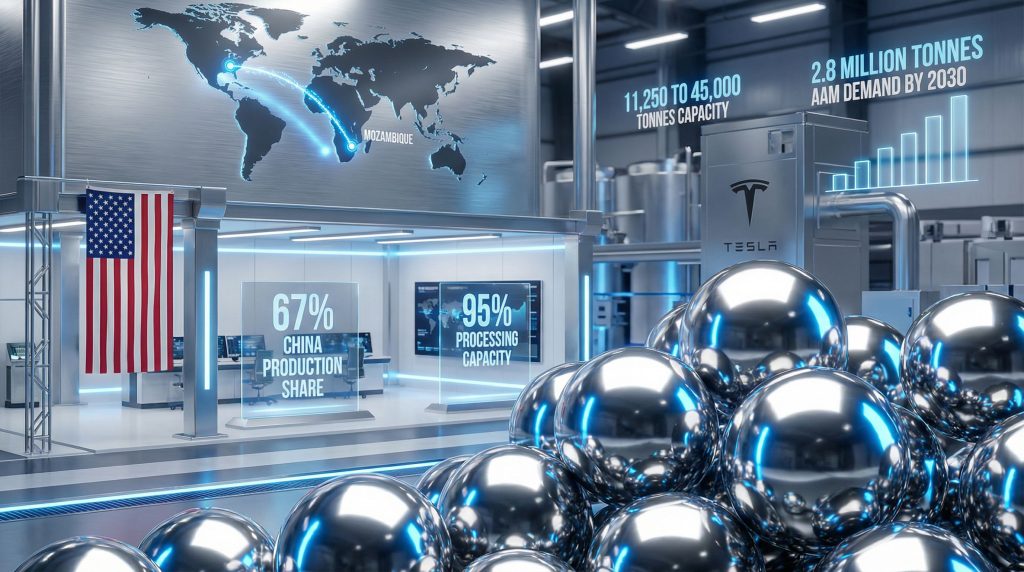
China's dominance in graphite processing stems from decades of industrial development combined with access to both domestic and imported raw materials. Chinese companies control an estimated 65-70% of global natural graphite production and approximately 90-95% of spherical graphite manufacturing capacity worldwide.
In addition, this concentration creates multiple vulnerability points for Western automotive manufacturers. Supply security risks include trade policy disruptions affecting graphite exports, quality control challenges with distant suppliers, currency fluctuations impacting long-term pricing, and potential export restrictions on strategic materials.
Technical Integration Challenges
- Limited visibility into Chinese processing methods
- Difficulty customising specifications for specific battery chemistries
- Intellectual property concerns around advanced coating technologies
- Quality consistency variations between different Chinese suppliers
The Syrah Resources Tesla graphite supply deal represents one of the most significant attempts to establish large-scale AAM production outside Chinese control. Syrah's Vidalia facility integrates raw material from the company's Mozambique mining operations with processing capabilities designed to serve North American automotive markets.
However, the repeated deadline extensions in this partnership illustrate the technical complexity of replicating established Chinese processing capabilities. Tesla issued its first default notice in July 2025, citing failures to deliver conforming AAM samples. Subsequent deadline extensions to November 2025, January 2026, and now March 2026 demonstrate the challenges involved in achieving automotive-grade specifications.
Technical Specification Challenges and Quality Control
The ongoing difficulties between Tesla and Syrah Resources highlight fundamental challenges in AAM production that extend beyond simple manufacturing scale-up. Automotive battery specifications require precise control over multiple technical parameters that affect both performance and safety.
What Are the Key Electrochemical Performance Standards?
Battery-grade graphite must demonstrate consistent performance across multiple test protocols. Furthermore, these standards represent critical benchmarks that distinguish automotive-grade materials from consumer electronics applications.
- Coulombic efficiency: First-cycle efficiency typically above 92%
- Cycling stability: Capacity retention over 1,000+ charge cycles
- Rate capability: Performance at various charging speeds
- Thermal stability: Safe operation across temperature ranges
- SEI formation: Predictable solid electrolyte interface development
Particle Engineering Requirements
The conversion to spherical graphite requires precise control over multiple technical parameters. For instance, size distribution must maintain narrow particle size ranges for consistent packing, while surface morphology requires smooth surfaces for optimal electrolyte contact.
- Tap density: Achieving target volumetric energy density
- BET surface area: Controlling reactive surface area for safety
Syrah's challenges in meeting Tesla's specifications likely relate to one or more of these technical parameters. The company does not accept it is in default under the offtake agreement, suggesting disagreement about whether specification failures represent fundamental process deficiencies or addressable quality control issues.
The collaborative approach described in recent statements indicates both parties view the technical challenges as solvable rather than representing fundamental incompatibility. Tesla retains termination rights through February 9, 2026, providing additional pressure for resolution while maintaining the partnership framework.
Financial Structure and Risk Allocation in Battery Supply Agreements
The Tesla-Syrah agreement structure reflects broader trends in how automotive companies approach critical material sourcing. The four-year commitment for 8,000 tonnes annually provides Syrah with demand certainty while giving Tesla access to non-Chinese AAM production capacity.
Offtake Agreement Mechanics
| Component | Details | Risk Allocation |
|---|---|---|
| Volume Commitment | 8,000 tonnes/year (32,000 total) | Tesla demand risk |
| Duration | Four years from first delivery | Long-term price stability |
| Quality Standards | Automotive-grade AAM specifications | Syrah technical risk |
| Termination Rights | Performance-based with cure periods | Shared resolution incentive |
This structure differs from traditional commodity purchasing through spot markets or short-term contracts. The long-term commitment provides capital investment justification for Syrah while ensuring Tesla access to strategic materials outside Chinese supply chains.
Pricing mechanisms in such agreements typically include escalation clauses tied to inflation, energy costs, or raw material input prices. The specific pricing structure between Tesla and Syrah remains undisclosed, but likely includes provisions for cost adjustments given the volatile nature of battery metals investment markets.
Performance-Based Risk Management
The multiple deadline extensions reveal sophisticated risk management approaches in battery supply agreements. Rather than immediate termination upon specification failures, the partnership structure includes several collaborative elements.
- Cure periods: Opportunities to address technical deficiencies
- Collaborative resolution: Joint problem-solving rather than adversarial enforcement
- Regulatory coordination: DOE approval requirements for modifications
- Termination triggers: Clear performance deadlines with exit options
Government Support and Industrial Policy Integration
The Syrah Vidalia project benefits from substantial federal support designed to establish domestic battery material supply chains. The U.S. Department of Energy has provided comprehensive financial backing including loans, grants, and tax credits totalling approximately $487 million across the project lifecycle.
Federal Funding Structure
- DOE Loan Program: $102 million in debt financing
- Grant Funding: $220 million for facility construction
- Tax Credits: $165 million through various federal programmes
This level of government support reflects recognition that battery recycling breakthrough developments and supply chain establishment require coordination between public and private sector investments. The Inflation Reduction Act provides additional policy framework supporting domestic battery manufacturing through production tax credits and supply chain requirements.
Strategic Mineral Classification
Graphite's designation as a critical mineral under various federal frameworks enables this level of support. The classification recognises that supply chain concentration creates national security vulnerabilities, private sector investment alone may be insufficient to establish alternative suppliers, and coordination with allied nations requires compatible supply chain infrastructure.
The DOE involvement in contract modifications between Tesla and Syrah demonstrates how government support creates additional stakeholders in private commercial relationships. Approval requirements for deadline extensions reflect federal interest in ensuring taxpayer-supported projects achieve intended strategic objectives.
The next major ASX story will hit our subscribers first
Production Scaling and Industrial Benchmarking
Syrah's operational timeline illustrates the complexity of establishing new AAM production capabilities from greenfield development through commercial qualification. However, establishing Australia's strategic minerals reserve requires similar coordination between private sector capabilities and government strategic objectives.
Development Milestones
| Phase | Timeline | Achievement | Next Steps |
|---|---|---|---|
| Construction | 2022-2023 | Facility completion | Equipment commissioning |
| Initial Production | Q4 2023 | Unpurified spherical graphite | Process optimisation |
| AAM Production | Q1 2024 | Active anode material output | Quality qualification |
| Commercial Validation | 2024-2025 | Customer specification trials | Volume scaling |
The facility's current capacity of 11,250 tonnes annually positions it as a significant supplier in North American markets. Furthermore, expansion potential to 45,000 tonnes represents meaningful competition to Chinese imports.
Industry Benchmarking
Established AAM producers typically require 18-24 months for customer qualification cycles, making Syrah's extended timeline, while challenging, not unprecedented in the industry. Processing efficiency targets of 85-90% represent standard expectations for mature operations.
Automotive specifications generally require higher consistency than consumer electronics applications, explaining the extended validation periods compared to other battery market segments. The distinction between automotive and consumer-grade materials creates different market segments with varying price premiums and specification requirements.
Alternative Supply Chain Scenarios and Market Implications
The outcome of the Syrah Resources Tesla graphite supply deal will influence broader industry approaches to battery supply chain diversification. Several scenarios could reshape market dynamics depending on technical resolution success or partnership dissolution.
Success Scenario: Technical Validation Achievement
If Syrah meets Tesla's specifications by the March 2026 deadline, several market impacts become likely. Proof of concept demonstration that non-Chinese AAM production can achieve automotive specifications would provide volume scaling pathways to full 8,000 tonne annual production capacity.
Additional partnerships with other automotive manufacturers may pursue similar agreements, while investment replication could encourage similar projects from competitors. These developments would occur alongside broader US‑China trade impacts on global supply chain strategies.
Risk Scenario: Partnership Dissolution
Partnership termination would create different market dynamics. Tesla would need to accelerate relationships with other graphite suppliers, while Syrah would focus on consumer electronics and energy storage markets.
Consequently, the investment community would reassess non-Chinese supply chain development risks, potentially leading to revision of federal support strategies. These outcomes would influence policy implications for future critical mineral development initiatives.
Competitive Landscape Evolution
Regardless of immediate outcomes, the partnership has already influenced industry development. Other graphite projects have attracted increased investor interest in North American graphite development, while technology advancement continues improving yields and reducing costs.
Strategic partnerships see more automotive companies exploring long-term supply agreements, while geopolitical considerations drive government support for supply chain diversification initiatives.
Investment Framework for Critical Mineral Supply Chains
The Syrah-Tesla partnership provides insights for investors evaluating critical mineral supply chain opportunities across multiple commodities and processing stages. In addition, successful investment requires comprehensive evaluation across multiple technical and market dimensions.
Due Diligence Considerations
Successful investment in battery material supply chains requires evaluation across multiple dimensions. Technical capabilities include processing expertise and yield optimisation potential, quality control systems for automotive specifications, scalability of production processes, and intellectual property considerations.
Market Positioning
- Customer validation and automotive qualifications
- Geographic diversification benefits
- Cost competitiveness versus established suppliers
- Long-term contract security and pricing mechanisms
Policy Alignment
- Government support availability and sustainability
- Regulatory compliance and environmental standards
- National security considerations and strategic mineral classification
- International cooperation frameworks and trade policy consistency
Financial Structure Analysis
Investment evaluation must consider the extended development timelines characteristic of battery material projects. Capital intensity involves high upfront investments with extended payback periods, while cash flow timing depends on customer qualification completion.
Government support serves as risk mitigation versus market price subsidies, however, exit strategies remain limited during development phases. These factors require careful consideration when evaluating investment opportunities in the sector.
Regulatory Framework Evolution and Market Development
Federal policy development continues shaping market conditions for domestic battery material production through multiple regulatory channels. Recent policy developments create institutional support for supply chain diversification across various frameworks.
Critical Minerals Security Frameworks
Recent policy developments create institutional support for supply chain diversification. The Defense Production Act offers potential applications to graphite processing capacity, while trade policy coordination affects tariff structures on Chinese graphite imports.
Environmental regulations may favour domestic production, while technology transfer enables international cooperation agreements with allied nations. These frameworks indicate sustained government commitment to reducing import dependence for critical battery materials.
Investment Incentive Structures
The Inflation Reduction Act and related legislation create financial incentives for domestic battery supply chain development. Production tax credits provide incentives based on qualifying material output, while investment tax credits support capital expenditure for facility development.
Grant programmes offer direct federal funding for strategic projects, while loan guarantees provide risk sharing for large-scale industrial investments. However, effectiveness depends on successful private sector execution, as demonstrated by the ongoing Syrah Resources Tesla graphite supply deal technical challenges.
Strategic Implications for Industry Evolution
The Syrah Resources Tesla graphite supply deal represents more than a bilateral commercial relationship; it serves as a critical test case for broader supply chain transformation strategies across the battery materials sector.
The extended timeline for technical qualification demonstrates that establishing alternative supply chains requires sustained commitment from both commercial partners and supporting government institutions. Success or failure will influence industry confidence in pursuing similar diversification strategies across other critical materials including lithium hydroxide, battery-grade nickel sulfate, and high-purity cobalt compounds.
Market development beyond Chinese supply chains ultimately depends on achieving cost competitiveness while maintaining quality standards. The Syrah project's outcomes will provide crucial data on whether non-Chinese production can achieve these dual objectives at commercial scale.
Furthermore, the partnership's resolution will establish precedents for similar agreements across the battery materials sector. Successful technical validation would encourage broader industry investment in alternative supply chains, while partnership dissolution might prompt reassessment of diversification strategies and government support mechanisms.
Investment Disclaimer: This analysis contains forward-looking statements and speculative assessments about market developments, technical capabilities, and commercial outcomes. Battery material supply chain investments involve significant risks including technical failure, regulatory changes, and market volatility. Past performance of similar projects does not guarantee future results. Investors should conduct independent due diligence and consider consulting qualified financial advisors before making investment decisions.
Ready to Navigate the Next Wave of Battery Materials Investment Opportunities?
Discovery Alert's proprietary Discovery IQ model provides instant notifications on significant ASX mineral discoveries, including critical battery materials like graphite, lithium, and rare earths that are reshaping global supply chains. With major discoveries in the battery materials sector generating substantial returns, subscribers receive real-time alerts that transform complex mineral announcements into actionable investment insights ahead of the broader market. Begin your 30-day free trial today to position yourself at the forefront of the critical minerals revolution.