June 8, 2026
Revolutionary Battery Swapping Infrastructure Transforms Heavy Transport Operations
China's CATL and Jianlong truck electrification initiative represents a pivotal moment in industrial transformation, as environmental regulations and operational costs drive unprecedented changes across global manufacturing sectors. Traditional diesel-powered logistics operations encounter increasing scrutiny as carbon pricing mechanisms expand and fuel price volatility creates unpredictable operational expenses. Furthermore, battery technology development has reached critical thresholds where energy density, charging speeds, and lifecycle economics now support heavy-duty applications previously dominated by internal combustion engines.
Contemporary Amperex Technology Co. Limited (CATL) and Jianlong Steel Group signed a strategic cooperation agreement on April 10, 2026, establishing a comprehensive framework for industrial transport electrification. This partnership represents a convergence of China's largest battery manufacturer with established steel industry logistics expertise, creating integrated pathways for emissions reduction across heavy industry sectors.
The collaboration targets deployment of more than 3,000 electric heavy trucks during China's 15th Five-Year Plan period (2026-2030), alongside battery-swapping infrastructure across 16 logistics hub routes and construction of 100 battery-swapping stations. The partnership extends beyond vehicle electrification to encompass renewable energy deployment, using Jianlong's industrial parks as pilot sites for integrated decarbonisation models.
Key strategic elements include:
- Electrification of steel industry operations
- Development of green and intelligent mining systems
- Comprehensive logistics network electrification
- Centralised and distributed wind and solar project integration
- Creation of replicable templates for industrial decarbonisation
When big ASX news breaks, our subscribers know first
Advanced Battery Technology Addresses Commercial Vehicle Limitations
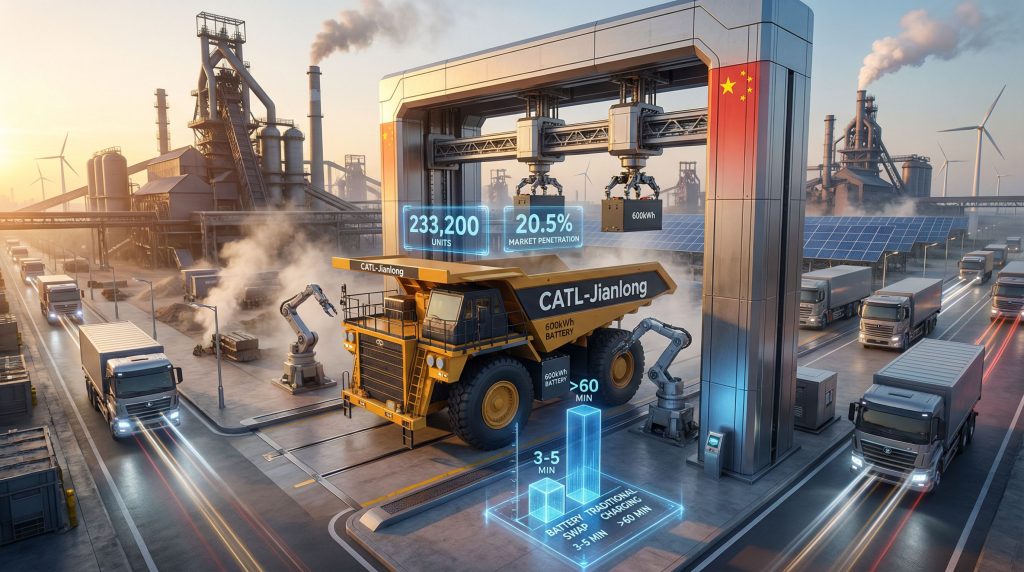
CATL's Tianxing series batteries, released in November 2024, deliver breakthrough performance specifications that address traditional heavy truck operational constraints. The technology enables 70% energy recovery within 15 minutes, supporting high-utilisation industrial applications where downtime directly impacts productivity.
| Performance Metric | CATL Tianxing Specification | Operational Impact |
|---|---|---|
| Energy Capacity | 600 kWh maximum | Up to 500km driving range |
| Charging Speed | 70% recovery in 15 minutes | Minimal operational disruption |
| Lifecycle Rating | 1.2 million kilometres | Extended asset utilisation |
| Application Focus | Short-haul industrial transport | Mining, construction materials |
Battery swapping technology fundamentally transforms energy replenishment strategies for commercial fleets. Traditional charging approaches require extended vehicle downtime that disrupts logistics scheduling, while battery swapping enables continuous operation through rapid energy replacement cycles.
The standardised battery block design facilitates cross-fleet compatibility, reducing infrastructure investment requirements and enabling shared utilisation across multiple operators. This approach particularly benefits industrial applications where vehicles operate on predictable routes with defined energy consumption patterns.
Technical advantages include:
- Reduced mechanical complexity compared to diesel powertrains
- Predictable energy costs independent of fuel price volatility
- Enhanced maintenance scheduling through integrated fleet management systems
- Scalable infrastructure deployment using existing industrial facilities
Market Dynamics Drive Accelerated Electric Truck Adoption
China's electric heavy truck market demonstrated remarkable growth momentum in 2025, with sales reaching 233,200 units representing nearly triple the previous year's volume. This expansion continued through early 2026, with sustained growth reinforcing pressure on domestic diesel demand.
Market penetration reached significant thresholds as electric alternatives achieved economic parity with conventional powertrains in specific applications. Consequently, the convergence of battery cost reductions, charging infrastructure expansion, and regulatory support created favourable conditions for fleet operator transitions, particularly where electric vehicles transforming mining applications demonstrate clear operational advantages.
Economic drivers supporting adoption include:
- Operational cost advantages through reduced fuel and maintenance expenses
- Regulatory compliance with emissions reduction requirements
- Infrastructure investment supporting distributed energy systems
- Technology maturation enabling reliable commercial deployment
The timing coincides with diesel price surges in March 2026, highlighting the economic vulnerability of conventional fuel-dependent operations. However, electric alternatives provide cost predictability and operational independence from volatile commodity markets.
Strategic Logistics Network Development Reshapes Freight Transportation
The partnership's 16-route logistics network represents systematic infrastructure deployment across China's major economic corridors. The 100 battery-swapping stations create distributed energy replenishment capabilities that support long-distance freight operations while maintaining operational flexibility.
Network development priorities focus on:
- High-volume freight corridors connecting industrial centres
- Strategic commodity transport routes supporting steel industry operations
- Integration with renewable energy generation at industrial locations
- Standardised infrastructure enabling cross-operator compatibility
The approach addresses traditional range limitations through strategically positioned swapping stations that align with existing logistics patterns. This infrastructure model reduces capital requirements compared to comprehensive charging networks while providing superior operational flexibility.
Geographic distribution across major economic zones enables economies of scale in both infrastructure deployment and operational management. In addition, the concentrated approach facilitates maintenance, standardisation, and technology upgrades across the network.
Steel Industry Integration Creates Comprehensive Decarbonisation Model
Jianlong Steel Group's participation brings established industrial logistics expertise and operational scale to the electrification initiative. Steel industry operations present ideal applications for battery-electric technology due to cyclical transport patterns, defined routes, and existing infrastructure that supports charging integration.
Mining transport applications particularly benefit from electric powertrains:
- Short-haul operations with predictable energy requirements
- Return-to-base logistics enabling scheduled charging cycles
- Controlled environments reducing operational complexity
- High-utilisation patterns maximising technology benefits
The partnership addresses both direct emissions from transport operations and indirect emissions through renewable energy integration. Furthermore, industrial park locations provide suitable sites for solar and wind installations that can support both manufacturing operations and vehicle charging requirements, aligning with broader mining industry evolution trends.
Construction material mixing and transport operations represent additional applications where electric technology delivers operational advantages. The controlled nature of these applications enables optimised battery management and charging scheduling that aligns with production cycles.
Policy Framework Supports Industrial Transformation Goals
The China's CATL and Jianlong truck electrification partnership aligns with China's broader industrial carbon intensity reduction objectives during the 15th Five-Year Plan period. The initiative demonstrates integrated pathways for emissions reduction that extend beyond individual sectors to encompass comprehensive supply chain transformation.
Strategic policy alignment includes:
- Demonstration of scalable decarbonisation models applicable across industries
- Technology integration combining vehicle electrification with renewable energy
- Infrastructure development supporting broader transportation electrification
- Industrial park optimisation creating replicable efficiency frameworks
The partnership creates operational benchmarks for heavy industry electrification that inform policy development and regulatory frameworks. Consequently, success metrics from pilot implementations provide data for broader industrial transformation planning, supporting energy transition and security objectives.
"The two companies aim to build a full-chain, zero-carbon model covering mining, transportation, energy and materials, creating a replicable template for industrial decarbonisation."
The next major ASX story will hit our subscribers first
Technical Implementation Addresses Infrastructure Standardisation
Large-scale electrification requires comprehensive standardisation across battery specifications, charging protocols, and fleet management systems. The partnership addresses these requirements through integrated technology development that encompasses both hardware and software components.
Critical technical considerations include:
- Battery interoperability across different vehicle manufacturers
- Grid integration capabilities for high-power charging infrastructure
- Fleet coordination systems managing mixed electric and conventional operations
- Maintenance networks supporting specialised equipment requirements
The standardised approach enables technology scaling beyond the initial partnership participants. Common specifications facilitate equipment sharing, reduce training requirements, and enable more efficient supply chain management.
Operational coordination complexities arise from integrating new technology with established logistics patterns. However, the partnership addresses these challenges through pilot implementations that test integration approaches before broader deployment.
What are the key innovations in battery recycling supporting this transition?
Advanced battery recycling breakthrough technologies enable closed-loop material recovery that supports sustainable scaling of electric vehicle deployment. These innovations reduce dependence on primary mineral extraction whilst ensuring continuous material supply for battery manufacturing.
The recycling integration addresses both economic and environmental sustainability concerns that previously limited large-scale electrification initiatives. Furthermore, recovered materials maintain performance characteristics that support high-demand industrial applications.
Global Market Implications and Technology Transfer Potential
The China's CATL and Jianlong truck electrification model demonstrates viable alternatives to diesel-dependent freight systems that extend beyond Chinese domestic applications. The integrated approach combining battery technology leadership with industrial expertise creates export opportunities for complete electrification solutions.
International market implications include:
- Technology demonstration for global heavy transport electrification
- Competitive pressure on traditional automotive and logistics industries
- Export potential for integrated technology solutions
- Alternative development pathways for emerging market applications
The partnership accelerates technology development through real-world implementation that generates operational data and performance metrics. This information supports continuous improvement and optimisation that benefits global technology deployment.
Advanced battery chemistry optimisation for heavy-duty applications creates competitive advantages that extend beyond transport to stationary energy storage and grid stabilisation applications. In addition, the integrated approach demonstrates technology versatility that supports multiple market applications.
Investment Strategies and Market Development Opportunities
The partnership creates multiple investment opportunities across infrastructure development, technology licensing, and operational services. Capital deployment strategies encompass both direct infrastructure investment and technology development that supports broader market expansion.
Investment considerations include:
- Infrastructure capital requirements for battery-swapping networks
- Technology licensing opportunities for international markets
- Service integration for industrial decarbonisation projects
- Financing model development for industrial fleet transitions
Market development potential extends beyond steel industry applications to encompass other heavy manufacturing sectors with similar logistics patterns. The replicable framework enables rapid scaling across multiple industries and geographic regions, particularly where battery metals investment supports strategic resource security.
Specialised financing models for industrial fleet transitions address capital intensity concerns that traditionally limit electric vehicle adoption. The partnership's integrated approach demonstrates economic viability that supports investment decision-making.
The China's CATL and Jianlong truck electrification collaboration establishes a systematic framework for industrial decarbonisation that addresses technological, operational, and economic challenges simultaneously. By combining battery technology leadership with established logistics expertise, the partnership creates scalable solutions that extend beyond traditional automotive applications.
This integrated approach provides a template for similar collaborations worldwide, particularly in sectors where short-haul, high-utilisation transport patterns align with battery-electric advantages. As China continues advancing both battery technology development and industrial-scale implementation, this partnership model demonstrates practical pathways for comprehensive supply chain electrification that supports global industrial transformation objectives.
Moreover, Chinese steel manufacturers are increasingly recognising the strategic importance of electrification for maintaining competitive advantages in global markets where environmental performance directly impacts market access and pricing.
Disclaimer: This analysis includes forward-looking statements and market projections that involve uncertainties and assumptions. Actual results may differ materially from those projected. Investment decisions should consider comprehensive risk assessments and professional financial advice.
Seeking Opportunities in Electric Vehicle Supply Chain Companies?
Discovery Alert's proprietary Discovery IQ model delivers real-time notifications on significant ASX mineral discoveries, including critical battery metals and rare earth elements that power the electric vehicle revolution. Understand why major mineral discoveries can lead to exceptional market returns by exploring historic examples and begin your 14-day free trial today to position yourself ahead of the market.