June 18, 2026
Battery Technology Evolution Drives Mining Equipment Transformation
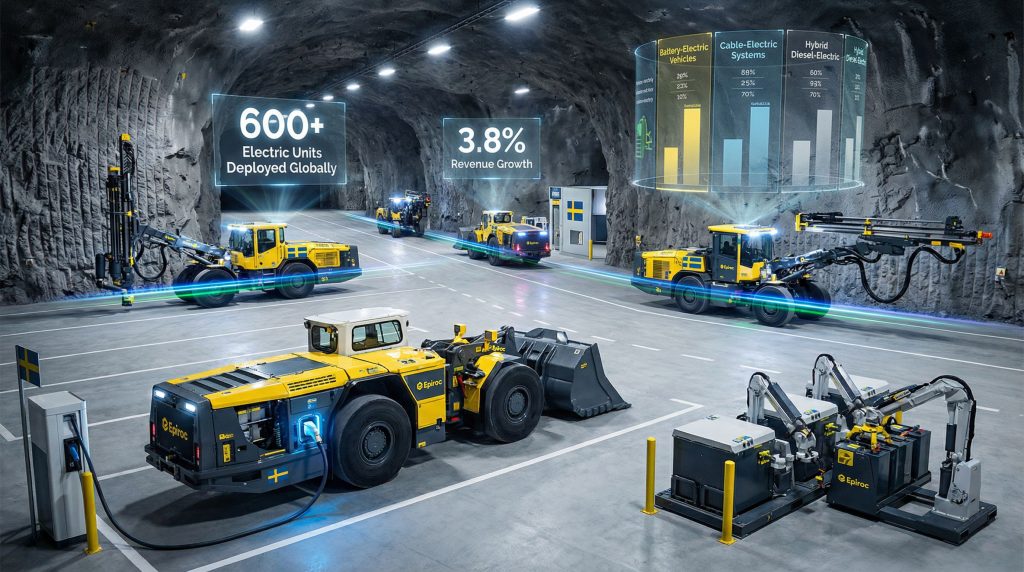
The mining equipment sector stands at the intersection of multiple technological forces reshaping underground and surface operations. Epiroc automation and electrification in mining now represent a revolutionary approach that extends far beyond pilot programs into full-scale commercial implementation, with battery-electric vehicles (BEVs) representing over 600 deployed units globally.
This technological shift reflects deeper market dynamics as mining operations grapple with emissions regulations, operational cost pressures, and safety requirements in increasingly challenging extraction environments. The integration of autonomous systems with electric powertrains creates operational possibilities that traditional diesel-powered equipment cannot match.
When big ASX news breaks, our subscribers know first
Revolutionary Autonomous Systems Transform Underground Operations
Mining automation technology has evolved from simple remote control systems to sophisticated fleet coordination platforms managing thousands of machines across global operations. The deployment of over 3,900 autonomous mining machines represents a 13% year-over-year increase, demonstrating accelerating adoption rates across diverse mining environments.
Furthermore, the integration of AI in mining operations enables sophisticated decision-making capabilities that traditional systems cannot achieve.
Integrated Fleet Coordination Capabilities
Modern automation systems orchestrate complex underground operations through multi-equipment coordination protocols. These platforms manage:
• Real-time traffic management preventing equipment collisions in narrow underground passages
• Dynamic route optimization adjusting pathways based on operational conditions and maintenance schedules
• Load balancing algorithms distributing work across available equipment to maximize throughput
• Predictive maintenance scheduling coordinating equipment servicing to minimize operational disruptions
The technical sophistication extends to mixed-fleet operations where autonomous systems coordinate equipment from multiple manufacturers. Consequently, this creates unified operational ecosystems rather than isolated automated machines.
Remote Operation Centers Enable Safety Advancement
Advanced remote operation capabilities allow mining personnel to control equipment from secure locations during hazardous activities. These systems provide:
• Blast sequence management enabling equipment operation during explosive activities
• Emergency response protocols allowing immediate equipment shutdown and evacuation procedures
• Shift transition management maintaining continuous operations during personnel changes
• Environmental monitoring integration automatically adjusting operations based on air quality and safety sensors
Remote operation centers process real-time data from underground sensors, cameras, and equipment telemetry. In addition, they provide operators with comprehensive situational awareness equivalent to on-site presence while eliminating exposure to underground hazards.
Electric Mining Equipment Market Penetration Accelerates
The transition to electric mining equipment reflects both technological maturity and economic viability across diverse operational environments. Current deployment statistics reveal significant momentum building across the sector, particularly as mining companies focus on securing lithium supply for their electrification initiatives.
Market Penetration Analysis
| Metric | Current Status | Growth Indicators |
|---|---|---|
| Global Electric Fleet Size | 600+ units deployed | 13% annual growth rate |
| Operational Mine Sites | 40+ locations with BEV equipment | 40%+ repeat order rate |
| Revenue Contribution | 3.8% of major manufacturers ($257M) | Expanding aftermarket services |
| Fleet Electrification | 43% available in emission-free options | 100% target by 2030 |
The repeat order rate of over 40% indicates strong operational satisfaction among mining companies that have implemented electric equipment. This suggests the technology delivers promised performance improvements and cost benefits.
Battery-as-a-Service Models Transform Capital Requirements
Mining companies increasingly adopt service-based models for electric equipment that shift battery ownership risk away from operators. However, the success of these models depends partly on advances in battery recycling breakthrough technologies. These arrangements include:
• Extended warranty programs covering battery performance and replacement costs
• Performance guarantees ensuring productivity equivalence with diesel equipment
• Maintenance integration combining equipment and battery servicing into comprehensive packages
• Technology upgrade pathways allowing battery system improvements without capital replacement
Service contracts accompany all battery-electric vehicle deliveries, with many including premium offerings that eliminate battery-related capital risks. Furthermore, these contracts ensure continuous technological advancement for mining operators.
Comprehensive Electrification Implementation Strategies
Mining companies pursuing Epiroc automation and electrification in mining must address infrastructure development, operational transition planning, and workforce adaptation simultaneously. Successful implementations require coordinated approaches addressing multiple operational dimensions.
Infrastructure Development Components
Electric mining operations require substantial supporting infrastructure beyond the equipment itself:
Power Distribution Systems:
• High-capacity charging stations positioned strategically across mining sites
• Underground power distribution networks supporting continuous operations
• Grid connection upgrades accommodating increased electrical demand
• Backup power systems ensuring operational continuity during outages
Battery Management Infrastructure:
• Climate-controlled storage facilities protecting battery systems
• Swapping stations enabling rapid battery replacement during shifts
• Diagnostic equipment monitoring battery health and performance
• Recycling facilities managing end-of-life battery disposal
Operational Conversion Methodologies
Mining operations implement electrification through phased approaches balancing operational continuity with technological advancement:
- Pilot Program Development – Testing electric equipment in specific operational areas
- Infrastructure Scaling – Expanding charging and maintenance capabilities
- Fleet Integration – Gradually replacing diesel equipment with electric alternatives
- Full System Integration – Achieving complete electrification with autonomous coordination
The phased approach allows mining companies to validate performance benefits whilst developing operational expertise. Consequently, this builds infrastructure capabilities necessary for full-scale implementation.
Operational Benefits Drive Investment Decisions
Mining companies evaluate electrification investments based on quantifiable operational improvements rather than purely environmental considerations. Performance metrics demonstrate clear advantages across multiple operational dimensions, particularly when combined with data-driven operations approaches.
Safety Enhancement Metrics
Electric and autonomous equipment combinations significantly improve mining safety through:
• Reduced personnel exposure to underground hazardous environments during routine operations
• Elimination of diesel exhaust improving air quality and reducing ventilation requirements
• Remote operation capabilities during dangerous activities like blasting and emergency situations
• Predictive safety systems using real-time monitoring to prevent equipment-related incidents
Underground operations particularly benefit from electric equipment as elimination of diesel exhaust reduces ventilation costs. Moreover, this improvement enhances working conditions for personnel who must access underground areas.
Productivity and Efficiency Analysis
Operational data from electric mining equipment deployments demonstrates measurable productivity improvements:
24/7 Operational Capacity: Autonomous electric systems operate continuously without operator shift changes or rest requirements. This increases equipment utilisation rates by 20-30% compared to manually operated diesel equipment.
Precision Performance: Electric motors provide precise speed and torque control enabling more accurate drilling, loading, and hauling operations. For instance, this reduces waste and improves extraction efficiency.
Predictive Maintenance: Electric powertrains generate comprehensive operational data enabling predictive maintenance scheduling. This reduces unplanned downtime by up to 15% compared to reactive diesel equipment maintenance.
Environmental Application Optimisation
Different mining environments present unique challenges and opportunities for electric and autonomous equipment implementation. Surface and underground operations require distinct technological approaches and infrastructure solutions, including the integration of electric vehicles in mining.
Underground Mining Electrification Benefits
Underground operations realise the greatest benefits from electric equipment due to confined space constraints and ventilation requirements:
Ventilation Cost Reduction: Electric equipment eliminates diesel exhaust, reducing ventilation fan power consumption by 30-50% in deep underground operations. However, air circulation represents significant operational costs in these environments.
Space Utilisation: Electric motors' compact design enables equipment operation in confined underground areas where diesel equipment cannot function effectively. Consequently, this expands accessible ore reserves.
Continuous Operation: Electric equipment operates during shift changes and maintenance windows when diesel equipment typically remains idle. This improves overall extraction rates significantly.
Surface Mining Implementation Strategies
Surface mining operations benefit from electric equipment through different operational advantages:
| Application Area | Electric Equipment Benefits | Infrastructure Requirements |
|---|---|---|
| Blasthole Drilling | Precise positioning, consistent power delivery | Charging stations, power distribution |
| Material Hauling | Reduced fuel costs, lower maintenance | Route optimisation, charging infrastructure |
| Loading Operations | Precise control, reduced emissions | Power connections, maintenance facilities |
| Auxiliary Equipment | Operational flexibility, cost reduction | Integrated power systems |
Surface operations accommodate larger charging infrastructure whilst providing greater flexibility for equipment deployment. Furthermore, they offer better maintenance access compared to underground environments.
The next major ASX story will hit our subscribers first
Investment Analysis Framework for Mining Electrification
Mining companies evaluate electrification investments through comprehensive financial analysis incorporating capital costs, operational savings, and regulatory compliance considerations. The investment framework extends beyond simple equipment replacement to include infrastructure development and operational transformation costs.
Capital Investment Comparison
| Investment Category | Diesel Equipment | Electric Equipment | Differential Impact |
|---|---|---|---|
| Initial Equipment Cost | Baseline | 15-25% premium | Higher upfront capital requirement |
| Infrastructure Development | Minimal | Substantial | One-time investment supporting fleet expansion |
| Operational Costs | Fuel, maintenance, emissions | Electricity, specialised maintenance | 20-30% reduction over equipment lifetime |
| Residual Value | Declining with emissions regulations | Increasing with technology adoption | Improved asset value retention |
The total cost of ownership analysis typically demonstrates positive returns within 3-5 years for electric equipment. This occurs despite higher initial capital requirements, primarily through operational cost reductions and regulatory compliance benefits.
Service Contract Innovation Impact
Equipment manufacturers increasingly offer service-based models that modify the investment equation for mining companies:
• Battery-as-a-Service eliminates battery replacement capital requirements whilst ensuring access to advancing battery technology
• Performance guarantees provide operational assurance during technology transition periods
• Extended warranties cover specialised electric components reducing maintenance cost uncertainty
• Training programmes ensure workforce capability development without separate investment
These service innovations reduce adoption risk whilst enabling mining companies to access advanced electrification technology. Moreover, they eliminate the need to assume full technological obsolescence risk.
Global Market Response to Mining Technology Evolution
Mining equipment electrification adoption varies significantly across global markets based on regulatory environments, energy costs, and operational requirements. Regional analysis reveals distinct adoption patterns and driving factors for Epiroc automation and electrification in mining solutions.
Regional Implementation Patterns
European Markets: Regulatory compliance drives rapid adoption with government emissions standards creating mandatory transition timelines for mining operations. Underground coal and metal mining operations lead implementation due to strict air quality requirements.
Australian Operations: Remote site applications emphasise electric equipment for reduced logistics complexity and operational cost reduction. Furthermore, large-scale iron ore and coal operations implement electric equipment to reduce fuel transportation costs.
North American Mining: Productivity and safety benefits drive adoption with electric equipment enabling operations in previously inaccessible deposits. In addition, this technology makes economically marginal deposits viable through reduced operational costs.
African Projects: Infrastructure development opportunities enable electric equipment implementation as mining companies develop integrated power generation and mining operations. Consequently, this reduces overall project costs significantly.
Technology Standardisation Initiatives
Industry-wide collaboration accelerates electric mining equipment adoption through standardisation efforts:
• Charging system compatibility enabling multi-manufacturer equipment integration
• Communication protocols allowing seamless autonomous system coordination
• Safety standards establishing consistent operational parameters across equipment types
• Training certification creating transferable workforce skills across operations
Future Technology Integration Roadmap
The convergence of multiple advanced technologies will further transform mining operations beyond current electric and autonomous capabilities. Emerging technology integration presents opportunities for comprehensive operational transformation in Epiroc automation and electrification in mining systems.
Advanced Technology Convergence
Artificial Intelligence Integration: Machine learning algorithms will enhance autonomous decision-making capabilities enabling real-time operational optimisation. This will be based on geological conditions, equipment performance, and market demands.
5G Connectivity Deployment: Ultra-low latency communications will enable real-time remote operation from global locations. Additionally, this supports massive data collection and analysis for operational optimisation.
Advanced Battery Technologies: Solid-state batteries and alternative energy storage systems will extend operational range whilst reducing charging time. Furthermore, they improve performance in extreme environmental conditions.
Renewable Energy Integration: On-site renewable power generation will create fully sustainable mining operations. However, this also reduces operational costs and regulatory compliance requirements.
Implementation Timeline Projections
2026-2028 Period: Mixed electric-diesel fleets will become standard across most mining operations as infrastructure development supports broader electrification implementation.
2028-2030 Transition: Fully autonomous electric underground operations will become industry standard. For instance, surface operations will achieve similar capabilities for routine extraction activities.
2030+ Evolution: Complete emission-free mining equipment ecosystems will operate with integrated renewable power generation. Moreover, these will include closed-loop battery recycling systems.
What Are The Main Industry Transformation Challenges?
Several significant challenges must be addressed to achieve comprehensive mining electrification:
Grid Infrastructure Limitations: Many remote mining locations lack electrical grid capacity requiring substantial infrastructure investment. Consequently, this necessitates on-site power generation development.
Skilled Workforce Development: Electric and autonomous equipment requires specialised maintenance and operation skills. This necessitates comprehensive training programme development across the industry.
Technology Standardisation: Equipment interoperability across manufacturers requires continued collaboration on technical standards. Furthermore, communication protocols need ongoing development and refinement.
Economic Transition Support: Mining companies require flexible financing options and service models to manage capital requirements. This is particularly important during technology transition periods.
Strategic Implementation Considerations
The transformation of mining operations through mining automation and electrification solutions requires strategic planning addressing technological, operational, and financial dimensions simultaneously. Success depends on coordinated implementation approaches that balance immediate operational requirements with long-term technological evolution.
Mining companies must evaluate electrification within broader operational transformation frameworks rather than isolated equipment replacement decisions. The integration of autonomous systems with electric powertrains creates operational capabilities that extend far beyond simple emission reductions or automation benefits alone.
The current deployment of over 600 electric mining units across 40+ mine sites with 40%+ repeat order rates demonstrates market acceptance and operational viability. However, achieving industry-wide transformation requires continued infrastructure development, workforce training, and technology standardisation efforts.
"Investment Disclaimer: This analysis contains forward-looking statements and projections based on current market trends and technological developments. Mining equipment investments involve significant capital requirements and operational risks. Companies should conduct comprehensive due diligence and consult qualified advisors before making investment decisions regarding mining automation and electrification technologies."
Looking to Capitalise on the Mining Technology Revolution?
Discovery Alert's proprietary Discovery IQ model delivers real-time notifications about significant ASX mineral discoveries, helping investors identify companies at the forefront of mining innovation and automation before broader market recognition. Begin your 14-day free trial today and position yourself ahead of the technological transformation reshaping the mining sector.