
May 12, 2026
The Chemistry of Competitive Advantage: Why Bauxite Grade Determines Everything in Aluminium Supply Chains
Before a single ingot of aluminium is smelted, before an alumina refinery processes its first tonne of ore, the economics of the entire value chain are largely determined by one number: the reactive silica content of the bauxite being fed into the system. This is not a secondary specification. It is the variable that separates profitable refinery operations from marginal ones, and it is the reason that a relatively unknown deposit in central Cameroon is attracting serious attention from aluminium producers searching for supply chain diversification.
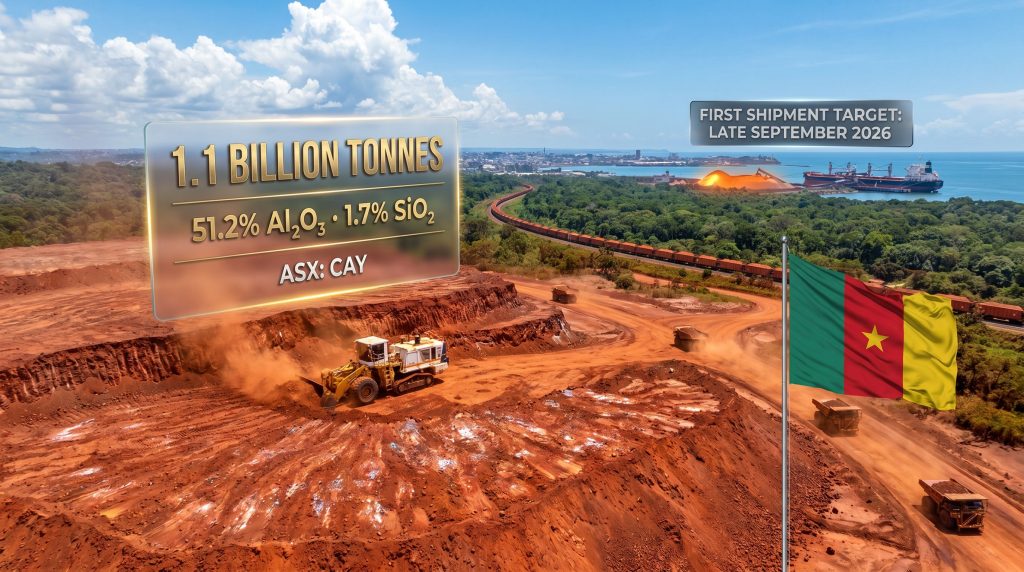
The Minim Martap bauxite project in Cameroon sits approximately 800 kilometres inland from the Atlantic coast in the country's Adamawa Region. Developed by Australian-listed Canyon Resources Limited (ASX: CAY) through its Cameroonian subsidiary Camalco, this deposit is not simply large by conventional measures. Its chemical profile places it in a category that refinery procurement teams actively seek and rarely find available in undeveloped form.
Understanding what makes this project strategically significant requires working backwards from the refinery floor, through the chemistry of alumina extraction, and into the geology of the deposit itself.
When big ASX news breaks, our subscribers know first
Why Reactive Silica Is the Hidden Cost Driver in Bauxite Refining
The Bayer process, the dominant method for refining bauxite into aluminium oxide, uses caustic soda (sodium hydroxide) to dissolve aluminium-bearing minerals from raw ore under elevated temperatures and pressures. The chemistry is straightforward in concept but expensive in practice, and reactive silica is the compound that makes it significantly more expensive.
Reactive silica combines with caustic soda during the digestion phase to form desilication products, effectively consuming reagent that would otherwise be recovering aluminium. The greater the reactive silica content in the feed ore, the more caustic soda must be purchased, processed, and replenished. For a refinery handling millions of tonnes of ore annually, this differential compounds into substantial operating cost differences across contract cycles.
Minim Martap's confirmed ore reserve grades at approximately 51.2% Al₂O₃ and 1.7% SiO₂, according to project disclosures. That reactive silica figure sits materially below what is typically encountered in much of West Africa's established producing regions. Consequently, refineries processing Minim Martap ore would require less caustic soda per tonne of alumina produced, improving unit economics and justifying a price premium relative to standard-grade bauxite.
This technical reality underpins the commercial logic of the entire project. It also explains why Canyon Resources is structuring its initial offtake approach around post-shipment quality verification rather than pre-production contract commitments. Independent confirmation of ore specifications at commercial scale creates a stronger negotiating position than pre-production assurances alone.
The Scale Argument: Resource Size in Context
The total mineral resource at Minim Martap is estimated at 1.1 billion tonnes at 45.3% Al₂O₃, with a confirmed ore reserve of 144 million tonnes grading 51.2% Al₂O₃. The confirmed reserve represents approximately 13% of the total resource, which is not unusual for a project at this stage of development. Most large-scale mining operations begin production on a fraction of their identified resource, converting additional tonnage to reserve status as ongoing drilling and feasibility work progresses.
The initial mine life is projected at 20 years. Full operational production capacity is targeted at 4 to 5 million tonnes per annum of direct shipping ore.
What gives the resource additional credibility is the upgrade trajectory. Earlier assessments from 2020 placed the deposit at 832 to 892 million tonnes at 45.1% Al₂O₃. Subsequent drilling materially increased both tonnage and grade, a progression that suggests the deposit's full extent and quality profile had not been fully defined at the earlier stage. For investors evaluating resource risk, this upgrade direction is generally more reassuring than a plateau or downgrade pattern.
How Minim Martap's Ore Profile Compares to Established Supply Sources
| Quality Metric | Minim Martap | Typical West African Benchmark | Typical Australian DSO |
|---|---|---|---|
| Alumina Content (Al₂O₃) | ~51% | ~40-45% | ~50-55% |
| Reactive Silica (SiO₂) | ~1.7-2% | ~3-5% | ~1-3% |
| Refinery Compatibility | Low and high temperature | Primarily high temperature | Broad compatibility |
| Commercial Premium Potential | Above standard benchmark | Baseline reference | Variable by region |
The comparison above illustrates that while Australian ore from mature operations can match or exceed Minim Martap's grade profile in some cases, West African supply sources at comparable grades with low silica content are considerably rarer. Guinea, which accounts for more than half of global bauxite production in seaborne trade, produces ore that typically requires high-temperature processing configurations due to its silica characteristics.
"A lower reactive silica content is not merely a quality metric. It is a direct subsidy to every alumina refinery that processes the ore, reducing input costs per tonne of alumina produced. This structural cost advantage is what drives pricing premiums in bauxite supply negotiations and what differentiates offtake discussions for high-specification ore from standard-grade transactions."
Building the Corridor: Infrastructure as the Critical Variable
Ore quality establishes the commercial case. Infrastructure determines whether that case ever reaches a ship. For a deposit located 800 kilometres from its export port, the logistics architecture is not a supporting element of the project. It is the project.
Canyon Resources has pursued a notably direct approach to this challenge. Rather than relying on third-party logistics providers under service contracts, the company has taken equity stakes in the two most critical infrastructure nodes along the export corridor. Furthermore, this approach closely mirrors the mine-to-port logistics strategy that Canyon has publicly outlined for the project.
Camrail Equity Stake: Securing Rail Capacity
Camalco, Canyon's Cameroonian operating entity, increased its shareholding in Camrail, the country's primary rail operator, from 9.1% to 26.9%. The transaction involved a payment of XAF 9.852 billion (approximately USD 17.66 million). Administrative registration of the increased stake is expected to complete during Q2 2026.
The significance of this move extends beyond simple transport cost management. As an equity holder at this level, Camalco gains meaningful participation in decisions relating to the PQ2 rail upgrade programme, which is the infrastructure improvement critical to supporting commercial-scale bauxite haulage from the inland mine site to port. Coordination on rail scheduling, maintenance windows, and capacity allocation becomes an internal discussion rather than a contract negotiation with an external counterparty.
Canyon had previously signalled its intention to raise the Camrail stake above 20%, making the execution of this transaction a demonstration of management's ability to convert strategic commitments into completed actions.
Port of Douala: The Export Gateway Secured
The company acquired a 42.8% stake in Terminal Bois du Port de Douala S.A., the operating entity for the Port of Douala, for approximately AUD 0.8 million (USD 579,000). The modest acquisition cost relative to the strategic importance of the asset reflects the specific nature of the terminal's existing infrastructure, which requires dedicated bulk earthworks and stockpile construction to support bauxite handling.
Bulk earthworks at the port are already underway. Bauxite stockpile construction is planned at three distinct points in the logistics chain: the mine site itself, the Inland Rail Facility where ore transfers from haul road to rail, and the Port of Douala ahead of vessel loading.
This three-node stockpiling strategy is not accidental. It creates buffer capacity at each transition point in the logistics chain, reducing the vulnerability of shipment schedules to delays at any single location. If road conditions, rail scheduling, or vessel arrival timing create short-term mismatches, stockpile buffers absorb that variability without halting operations.
Equipment Deployment Timeline
| Asset | Expected Arrival | Operational Purpose |
|---|---|---|
| First 7 Locomotives | Late Q2 2026 at Port of Douala | Rail haulage from IRF to port |
| Rail Wagons | July 2026 | Bulk ore transport across 800km corridor |
| First Bauxite Shipment | Late September 2026 (targeted) | Commercial export milestone |
Track laying at the Inland Rail Facility has already commenced, and surface mining equipment was relocated to the Daniel Plateau area during April 2026. Trial mining is scheduled to begin in mid-Q2 2026. For further context on how equipment and operational benchmarks compare across major operations, it is worth examining some of the leading bauxite mines globally and their development timelines.
Financial Structure Supporting the Path to First Production
Stage 1 capital requirements, covering all expenditure through to the first ore shipment, are supported by a combination of existing cash reserves and a USD 140 million debt facility provided by AFG Bank Cameroon. Earlier project disclosures indicated approximately USD 40 million in available cash alongside approximately USD 95 million in undrawn debt capacity, providing what the company has characterised as a fully funded pathway to initial production.
The combined logistics investments, totalling approximately USD 18.24 million across the Camrail stake and port acquisition, represent a capital-efficient mechanism for controlling the most strategically sensitive elements of the export value chain without requiring major infrastructure construction from greenfield.
The Offtake Sequencing Logic
One of the more strategically nuanced elements of Canyon's commercial approach is the deliberate decision to finalise formal offtake agreements after initial shipments have been completed rather than before.
This sequencing reflects a specific market dynamic: alumina refineries paying a premium for high-grade, low-silica ore require independent verification of ore specifications at commercial scale before committing to long-term supply contracts. Laboratory assays and desktop resource estimates are insufficient for procurement teams managing refinery input costs at scale. A completed commercial shipment, independently tested and verified, provides the evidentiary basis for offtake pricing that pre-production assurances cannot replicate.
From a producer's perspective, the same logic applies in reverse. Confirming ore quality through actual shipment rather than through advance offtake negotiations preserves the ability to command full market pricing once the specification premium is independently validated. Indeed, shifts in the bauxite and alumina market have increasingly rewarded producers that can demonstrate verified ore quality over those relying solely on resource estimates.
"Finalising offtake agreements after the first shipment is not a sign of commercial weakness. It reflects an understanding that premium pricing for high-specification bauxite is earned through demonstrated performance, not projected specifications. Buyers who pay above benchmark have every right to verify before committing."
Risk Landscape: Four Dimensions Investors Should Monitor
No pre-production mining project operates without execution risk, and the Minim Martap bauxite project in Cameroon carries a defined set of variables that will determine whether the late September 2026 first shipment target is achieved on schedule.
| Risk Category | Specific Variable | Current Mitigation |
|---|---|---|
| Logistics Execution | Rail and port readiness by Q3 2026 | Equity stakes in Camrail and Port of Douala operator |
| Regulatory and Administrative | Camrail stake registration delays | Q2 2026 completion target with administrative buffer |
| Commercial | Offtake agreement timing | Post-shipment quality confirmation strategy |
| Funding and Drawdown | Debt facility utilisation | USD 140M facility with AFG Bank Cameroon in place |
Beyond these operational variables, Canyon also disclosed the resignation of CEO Peter Secker and Non-Executive Director Scott Phegan in April 2026. Leadership transitions during a final pre-production ramp-up phase introduce governance uncertainty at a time when project coordination demands are at their peak. Investors and logistics partners will be monitoring how management continuity is maintained through this transition.
The Alumina Refinery Option: A Second-Stage Value Multiplier
A feasibility study for a potential on-site alumina refinery is currently underway, with completion targeted for Q3 2026. If pursued, a refinery would fundamentally transform the project's commercial profile, shifting Minim Martap from a direct shipping ore operation into a vertically integrated alumina producer capable of capturing significantly higher value per tonne within Cameroon.
This represents a strategic option rather than a near-term capital commitment. The study's completion will determine whether the economics of Cameroon-based alumina production are viable relative to the alternative of exporting raw ore and capturing DSO margins only. In addition, comparable emerging-stage projects such as the Niagara bauxite project illustrate how developers are increasingly weighing downstream processing options at an early stage.
The next major ASX story will hit our subscribers first
Cameroon's Entry Into the Global Bauxite Export Market
Minim Martap is expected to become the first large-scale bauxite mining operation in Cameroon, establishing the country as a new participant in global seaborne bauxite trade. The significance of this extends beyond the project itself.
Guinea currently accounts for more than 50% of global seaborne bauxite trade. This concentration creates supply chain exposure for alumina refineries that have become heavily dependent on a single geographic source. The combination of political risk, logistical concentration, and export policy variability associated with such dependence has motivated procurement teams at major alumina producers to actively seek alternative supply origins. According to Canyon Resources, securing long-term strategic infrastructure ownership is central to the project's competitive positioning in this shifting supply landscape.
Supply Source Comparison
| Supply Origin | Key Strength | Key Constraint |
|---|---|---|
| Guinea | Established infrastructure, large scale | Political risk, market concentration |
| Indonesia | Proximity to Asian refineries | Export policy uncertainty, grade variability |
| Australia | Stable jurisdiction, mature operations | Declining grades at some operations, higher cost base |
| Minim Martap, Cameroon | High grade, low silica, long mine life | Inland location requiring logistics build-out |
Minim Martap's ore chemistry positions it as a credible alternative for refineries seeking to diversify away from Guinea dependence. Its 51% Al₂O₃ grade and sub-2% reactive silica place it in a specification tier where demand exceeds available supply. Furthermore, as reported by Small Caps, successful commissioning would represent a meaningful addition to the global high-grade bauxite supply pool.
Key Facts: Minim Martap at a Glance
- Location: Adamawa Region, Cameroon, approximately 800km from Port of Douala
- Total Mineral Resource: 1.1 billion tonnes at 45.3% Al₂O₃
- Confirmed Ore Reserve: 144 million tonnes at 51.2% Al₂O₃ and 1.7% SiO₂
- Planned Production Rate: 4 to 5 million tonnes per annum (DSO)
- Initial Mine Life: 20 years (based on confirmed reserves)
- Targeted First Shipment: Late September 2026
- Rail Operator Stake: 26.9% of Camrail (increased from 9.1%)
- Port Stake: 42.8% of Terminal Bois du Port de Douala S.A.
- Stage 1 Financing: USD 140M debt facility with AFG Bank Cameroon plus existing cash
- Operator: Canyon Resources Limited (ASX: CAY) via subsidiary Camalco
Disclaimer: This article is intended for informational purposes only and does not constitute financial advice. All forward-looking statements, project timelines, production targets, and financial projections referenced herein are based on company disclosures and public sources and are subject to material uncertainty. Readers should conduct their own due diligence and consult a qualified financial adviser before making investment decisions. Past resource estimates and project milestones are not guarantees of future performance.
Want to Catch the Next Major Mineral Discovery Before the Market Does?
Discovery Alert's proprietary Discovery IQ model scans ASX announcements in real time, instantly identifying significant mineral discoveries and turning complex data into actionable investment opportunities — explore the historic returns major discoveries have generated to understand what's possible, then begin your 14-day free trial at Discovery Alert to position yourself ahead of the broader market.