July 23, 2026
Ukrainian bauxite imports Ukraine 2026 patterns reveal complex interactions between emergency industrial requirements, supplier concentration risks, and evolving trade relationships that extend far beyond peacetime market dynamics. Industrial metals markets face unprecedented disruption patterns during periods of geopolitical instability, with commodity flows reshaping according to logistical constraints rather than traditional economic fundamentals. The global bauxite trade exemplifies these dynamics, where established supply chains fragment and reconstitute around available transportation corridors and political relationships.
Understanding these market mechanics requires examination of how industrial demand persists despite infrastructure damage, currency volatility, and supply chain interruptions that would typically halt production entirely. Ukraine's metallurgical sector demonstrates remarkable adaptation to crisis conditions, maintaining bauxite procurement despite facing severe operational constraints.
Strategic Supply Chain Fundamentals in Crisis Metallurgy
Ukraine's bauxite procurement requirements stem from the critical role this aluminum ore plays across multiple metallurgical applications beyond primary aluminum production. Bauxite imports Ukraine 2026 data indicates that domestic industrial capacity continues operating despite widespread infrastructure damage, requiring consistent raw material inputs to maintain steel production and aluminum processing capabilities.
Furthermore, the metallurgical applications extend significantly beyond aluminum smelting operations. Bauxite functions as an essential flux material in ferrous metallurgy, where its alumina content helps remove impurities during steel production processes. This dual-demand pattern creates resilient import requirements that persist even when aluminum-specific industrial capacity faces constraints.
Industrial Demand Persistence Under Wartime Conditions
January 2026 import volumes of 97 tonnes represent emergency procurement levels that maintain minimal industrial operations despite severe logistics constraints. This figure contrasts sharply with December 2025's 5,556 tonnes, demonstrating the extreme month-to-month volatility that characterises crisis-period commodity procurement.
Moreover, the year-over-year comparison reveals underlying demand strength despite operational challenges:
- January 2025: 31 tonnes imported
- January 2026: 97 tonnes imported
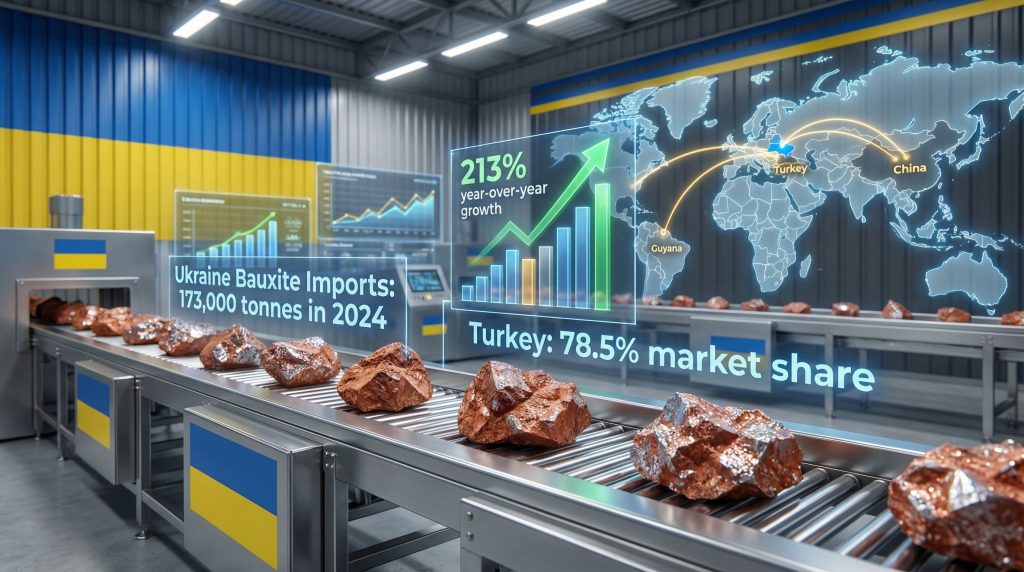
- Growth rate: 213% year-over-year increase
- Financial value increase: USD 27,000 to USD 83,000
This growth trajectory indicates that Ukrainian metallurgical operations maintain expansion capacity even under wartime conditions. Consequently, domestic steel production and aluminum processing continue serving both local reconstruction needs and export markets.
Domestic Production Infrastructure Constraints
The shutdown of the Mykolaiv Alumina Plant represents a critical shift in Ukraine's bauxite processing landscape, forcing increased reliance on raw material imports rather than domestic refining operations. This infrastructure disruption fundamentally altered the country's position in the global aluminum value chain, transforming Ukraine from a potential aluminum producer into a bauxite import-dependent market.
In addition, import volume escalation compensates directly for lost domestic processing capacity. The 39.4% surge in early 2025, reaching 27.22 thousand tonnes by September, reflects industrial adaptation to supply infrastructure damage. For instance, the Julimar West bauxite project demonstrates how global bauxite development initiatives influence supply availability for markets facing domestic production constraints.
When big ASX news breaks, our subscribers know first
Supplier Concentration and Geographic Risk Evolution
Ukraine's bauxite sourcing strategy demonstrates increasing rather than decreasing concentration risk across recent years, with Turkish suppliers dominating import flows and creating potential strategic vulnerabilities. This concentration pattern contradicts typical supply chain diversification objectives but reflects practical constraints imposed by wartime logistics and payment systems.
However, the mining industry evolution presents opportunities for enhanced supplier diversification through technological advances and improved global connectivity. These developments could reduce dependency on single-source suppliers whilst maintaining operational efficiency.
Dramatic Supplier Consolidation Patterns
The evolution of Ukraine's bauxite supplier portfolio reveals fundamental shifts in global trade relationships:
| Supplier Country | 2024 Market Share | 2025 Market Share | Volume Trend |
|---|---|---|---|
| Turkey | 78.48% | 81.84% | Increasing dominance |
| China | 19.48% | ~16.0% | Declining share |
| Spain | 1.6% | Minimal presence | Discontinued |
| Guyana | Not present | 2.2% | New entrant |
Turkey's increasing dominance from 78.48% to 81.84% between 2024 and 2025 creates significant concentration risk. Consequently, over four-fifths of Ukrainian bauxite imports depend on a single supplier country. This concentration intensified rather than diversified during the crisis period, suggesting that reliability and logistics capacity outweighed diversification concerns in procurement decisions.
Historical Supply Chain Transformation
The 2022-2024 period witnessed complete restructuring of Ukraine's bauxite import portfolio. In 2022, the country imported 945.4 million tonnes from diversified sources including:
- Guinea: 59% market share
- Brazil: 27.2% market share
- Ghana: 7.5% market share
- Total value: USD 48.2 million
This diversified portfolio collapsed entirely by 2024, replaced by the current Turkey-China duopoly. Furthermore, according to industry analyses from Ukraine's bauxite imports, the transition demonstrates how crisis conditions force rapid supply chain reconfiguration, with geographic proximity and established trade relationships becoming primary selection criteria.
Emerging South American Supply Relationships
Guyana's emergence as a bauxite supplier in 2025, capturing 2.2% market share, represents the most concrete evidence of diversification efforts toward non-European sources. However, this minimal share indicates that diversification remains nascent rather than representing fundamental strategic shifts.
The reintroduction of South American suppliers suggests Ukrainian procurement teams actively seek alternatives to European and Chinese sources. This may be driven by payment system constraints or long-term strategic planning considerations. Guyana's bauxite reserves rank among the world's largest, providing potential for expanded supply relationships as logistics networks develop.
Volume Dynamics and Financial Impact Analysis
Ukrainian bauxite imports Ukraine 2026 demonstrate extraordinary volatility patterns that reflect crisis-period procurement challenges rather than steady-state industrial consumption. Monthly volume fluctuations exceed typical commodity import variations by several orders of magnitude, indicating procurement occurs through episodic logistics windows rather than continuous supply arrangements.
Additionally, tariffs impact on investments and trade war market impact factors influence procurement timing and supplier selection decisions for Ukrainian importers navigating complex international trade environments.
Monthly Import Volatility Throughout 2025
The 2025 monthly import pattern reveals extreme fluctuations driven by logistical constraints and procurement opportunities:
- January 2025: 31.25 tonnes
- February-April 2025: ~4,000 tonnes monthly average
- May 2025: 70.5 tonnes
- June 2025: 42.5 tonnes
- July 2025: 63.75 tonnes
- August 2025: 10.3 thousand tonnes (peak month)
- December 2025: 5,556 tonnes
August's 10.3 thousand tonne peak demonstrates Ukrainian supply chains retain capacity for large-volume procurement when favourable logistics conditions emerge. This volume represents over 300 times the July import level, illustrating how wartime procurement operates through opportunistic bulk purchasing rather than steady monthly deliveries.
Multi-Year Growth Trajectory Analysis
Despite monthly volatility, aggregate annual trends demonstrate consistent growth in Ukrainian bauxite import requirements:
Ukraine's bauxite import volumes increased 77.4% in 2024, reaching 173 thousand tonnes compared to the previous year, with financial value growing 74% to USD 4.12 million.
The 2025 performance continued this expansion trajectory:
- Volume increase: 23.7% to 43.5 thousand tonnes
- Financial increase: 15.8% to USD 4.7 million
- Average unit price: Approximately USD 108 per tonne
This growth pattern indicates that Ukrainian metallurgical demand expansion exceeds the constraints imposed by wartime logistics disruptions. Consequently, it suggests robust underlying industrial activity despite infrastructure challenges.
Pricing Dynamics and Currency Impact Assessment
Ukrainian bauxite import pricing demonstrates extreme volatility that extends far beyond typical commodity price fluctuations. This reflects currency depreciation, emergency procurement premiums, and supply chain disruption costs. The pricing trajectory from 2024 through early 2026 illustrates how crisis conditions amplify commodity cost pressures across multiple dimensions.
Moreover, commodity price volatility effects create additional complexity for procurement planning and budget management in uncertain operating environments.
Extraordinary Price Escalation Patterns
The unit price evolution reveals dramatic cost increases across the analysis period:
- 2024 average: ~USD 24 per tonne
- 2025 average: ~USD 108 per tonne (350% increase)
- January 2026: USD 856 per tonne (3,567% increase from 2024)
The January 2026 pricing of USD 856 per tonne represents an extreme anomaly that suggests emergency procurement conditions or severe supply constraints. This price level exceeds typical bauxite market rates by factors of 10-15, indicating that January 2026 imports occurred under exceptional circumstances requiring premium payment for urgent delivery.
Currency Depreciation and Payment System Constraints
Ukraine's currency depreciation against the USD throughout the conflict period requires increasingly larger hryvnia expenditures to purchase the same dollar value of imports. This currency impact compounds commodity price inflation, creating double-pressure on Ukrainian industrial costs.
The relationship between volume growth and value growth provides insight into underlying price trends:
- 2024-2025 volume growth: 23.7%
- 2024-2025 value growth: 15.8%
- Implication: Slight unit price deflation despite January 2026 spike
This relationship suggests that the January 2026 price spike represents temporary emergency conditions rather than sustained market inflation. Furthermore, average 2025 pricing remained relatively controlled compared to volume expansion.
Transportation and Logistics Cost Components
Wartime logistics constraints create additional cost layers beyond commodity base prices. Transportation route diversions, security screening requirements, and insurance premiums for conflict-zone deliveries inflate total delivered costs substantially above pre-war levels.
Emergency procurement through intermediary trading arrangements rather than direct supplier relationships likely contributes additional markup to final import costs. Small-volume purchases (such as January 2026's 97 tonnes) prevent economies of scale that reduce per-unit transportation and handling expenses.
Wartime Operational Adaptations and Strategic Responses
Ukrainian metallurgical operations demonstrate sophisticated adaptation mechanisms that maintain industrial capacity despite infrastructure damage and supply chain disruptions. These adaptations extend beyond simple procurement adjustments to encompass fundamental changes in operational timing, inventory management, and supplier relationship structures.
Alternative Logistics Network Development
The extreme monthly volume variations suggest Ukrainian importers operate through episodic logistics windows rather than continuous supply arrangements. August 2025's 10.3 thousand tonne peak followed by dramatic declines indicates procurement teams accumulate inventory during favourable transport conditions to sustain operations during constrained periods.
Transportation route diversions away from traditional Black Sea corridors likely require alternative logistics arrangements through Western Ukrainian border crossings or international transshipment points. These alternative routes impose additional time delays and cost premiums but maintain supply chain functionality despite regional conflicts.
Strategic Inventory Buffer Management
The procurement pattern of large monthly volumes followed by minimal imports suggests Ukrainian facilities implement strategic stockpiling to manage supply uncertainty. December 2025's 5,556 tonnes likely represents inventory accumulation preceding anticipated January logistics constraints that materialised as the 97 tonne minimal import month.
This buffer strategy requires substantial working capital investment and storage capacity allocation but provides operational continuity during supply disruptions. Industrial facilities must balance inventory carrying costs against supply security benefits under uncertain conditions.
Emergency Procurement Protocol Implementation
The January 2026 pricing of USD 856 per tonne suggests Ukrainian importers maintain emergency procurement capabilities for critical supply shortages. They accept substantial cost premiums to prevent production interruptions. These emergency protocols likely involve expedited shipping, premium supplier relationships, and accelerated customs processing arrangements.
Emergency procurement volumes remain minimal (97 tonnes in January 2026) compared to normal operations. This indicates these protocols serve as supply chain insurance rather than primary procurement mechanisms. The capability to execute emergency purchases maintains industrial operational continuity even under severe constraint conditions.
Industrial Applications and Metallurgical Demand Drivers
Ukrainian bauxite consumption extends across multiple metallurgical applications that create resilient demand patterns despite industrial capacity constraints. Understanding these applications explains why bauxite imports Ukraine 2026 persist at substantial volumes even when traditional aluminum production faces operational challenges.
Steel Industry Flux Requirements
Bauxite serves critical functions in ferrous metallurgy beyond its primary aluminum ore applications. As a flux material in steel production, bauxite's alumina content helps remove sulfur and phosphorus impurities during steelmaking processes, improving final product quality and production efficiency.
Ukrainian steel production continues operating despite wartime constraints, serving both domestic reconstruction demand and export markets. The country's position as a major global steel producer creates consistent bauxite demand for flux applications that operates independently of aluminum sector requirements.
The technical specifications for metallurgical-grade bauxite differ from aluminum production requirements. Steel industry applications accept lower-grade ores that meet flux chemistry needs rather than alumina extraction standards. This flexibility expands potential supplier options and reduces procurement constraints.
Reconstruction and Infrastructure Applications
Post-conflict reconstruction activities drive sustained demand for both aluminum and steel products, creating downstream pressure on bauxite import requirements. Infrastructure rebuilding programmes require substantial metal inputs for construction applications, transportation networks, and industrial facility restoration.
The reconstruction demand pattern differs from typical industrial consumption cycles. Project-driven requirements create periodic volume surges rather than steady consumption patterns. This demand profile contributes to the extreme monthly volume variations observed in Ukrainian bauxite import data.
Export-Oriented Production Continuity
Ukrainian metallurgical facilities maintain export production capabilities despite domestic constraints. They require consistent raw material inputs to serve international markets. Export revenues provide foreign currency earnings essential for continued raw material procurement and facility operations.
The persistence of bauxite imports despite domestic challenges suggests Ukrainian metallurgical exporters retain competitive positions in global markets. This justifies continued investment in raw material procurement. Export production provides economic rationale for maintaining industrial capacity even under difficult operational conditions.
The next major ASX story will hit our subscribers first
Global Market Integration and Competitive Dynamics
Ukrainian bauxite imports Ukraine 2026 patterns reflect broader global bauxite market dynamics that extend beyond regional crisis conditions. Understanding these global integration effects explains pricing trends, supplier availability, and competitive pressures that influence Ukrainian procurement strategies.
International Price Benchmark Relationships
Global bauxite pricing typically follows benchmark indices established by major producing regions. Ukraine's import prices reflect international market conditions modified by logistics premiums and supplier relationship factors. The extreme pricing variations in Ukrainian data suggest disconnect from normal benchmark relationships during crisis periods.
International aluminum demand cycles influence global bauxite availability and pricing, with strong aluminum markets creating competition among importers for limited bauxite supplies. Ukrainian importers compete with major consuming countries including China, India, and other European aluminum producers for available supplies.
As detailed in reports from Ukraine trade analysis, the disruption has fundamentally altered global bauxite trade routes and competitive dynamics, forcing market participants to develop new supply chain strategies.
Supply Competition with European Markets
Ukraine competes with other European bauxite importers for available supplies from Turkish and other regional producers. This competition intensifies during periods of supply constraint, potentially explaining the concentration of Ukrainian imports from Turkish sources that serve multiple European markets.
European Union trade relationships and regulatory frameworks influence supplier selection options for Ukrainian importers. EU-compliant suppliers potentially offer advantages for future market integration objectives. Long-term strategic planning must consider potential EU membership implications for trade relationship development.
Global Aluminum Market Influence
Worldwide aluminum demand growth drives competition for bauxite resources, with major consuming markets influencing global supply allocation patterns. Strong aluminum prices incentivise bauxite production expansion but also increase procurement costs for importing countries like Ukraine.
The global shift toward sustainable aluminum production creates demand for bauxite from environmentally compliant sources. This potentially influences Ukrainian supplier selection as environmental standards become market requirements rather than preferences.
Strategic Optimisation and Future Planning Considerations
Ukrainian bauxite procurement strategy requires fundamental reassessment to address concentration risks, cost optimisation opportunities, and long-term supply security objectives. The current supplier concentration and pricing volatility patterns indicate substantial improvement potential through strategic relationship development and procurement process refinement.
Supplier Diversification Implementation Framework
Reducing dependence on Turkish suppliers from the current 81.84% market share requires systematic development of alternative supply relationships with verified reliable sources. Potential diversification targets include Australian, Brazilian, and West African producers with established international export capabilities.
Geographic diversification must balance supply security benefits against logistics complexity and cost implications. Alternative suppliers may require different transportation routes, payment arrangements, or quality specifications that complicate operational procedures while providing strategic benefits.
Quality assurance protocols for new suppliers must ensure metallurgical specifications meet Ukrainian industrial requirements across both aluminum and steel applications. Technical evaluation processes should assess alumina content, impurity levels, and consistency metrics before establishing commercial relationships.
Cost Optimisation Through Strategic Relationships
Direct supplier relationships eliminating intermediary trading arrangements could reduce per-unit costs while improving supply reliability and communication channels. Long-term contract negotiations provide price stability benefits and volume commitment advantages for both parties.
Bulk purchasing strategies consolidating periodic requirements into larger shipments achieve economies of scale in transportation and handling costs. However, bulk strategies require adequate storage capacity and working capital availability to manage larger inventory investments.
Joint purchasing arrangements with other regional importers could leverage combined volumes for improved pricing negotiations and shared logistics costs. Regional cooperation frameworks might develop around shared transportation infrastructure and supplier relationship management.
Technology Integration and Digital Supply Chain Management
Advanced procurement planning systems utilising predictive analytics could optimise purchasing timing and volume decisions based on industrial demand forecasting and logistics capacity analysis. Digital platforms enable better supplier relationship management and performance tracking across multiple supply sources.
Automated monitoring systems for global bauxite market conditions and pricing trends provide decision support for optimal procurement timing and supplier selection. Real-time market intelligence improves negotiation positions and identifies supply opportunity windows.
Blockchain-based documentation systems could enhance supply chain transparency and traceability requirements that become increasingly important for international trade compliance and quality assurance objectives.
Long-Term Strategic Outlook and Market Development Scenarios
Ukrainian bauxite import requirements will likely evolve significantly as post-conflict reconstruction activities accelerate and domestic industrial capacity rebuilds. Planning for these future scenarios requires understanding potential demand trajectories, supplier market developments, and global trade relationship changes that will influence long-term procurement strategies.
Reconstruction-Driven Demand Expansion Projections
Infrastructure rebuilding programmes spanning multiple years will create sustained demand growth for metallurgical inputs. This could potentially double or triple current bauxite imports Ukraine 2026 requirements during peak reconstruction periods. This demand expansion requires supply relationship scaling and logistics capacity development to manage substantially larger volumes.
Industrial facility reconstruction may restore domestic aluminum processing capabilities, potentially reducing raw bauxite import requirements whilst increasing demand for higher-grade ores suitable for domestic refining operations. The balance between raw material imports and domestic processing capacity will determine long-term procurement strategies.
Global Supply Market Evolution Implications
International bauxite market development includes production capacity expansion in emerging markets and potential supply disruptions in traditional producing regions due to environmental regulations or political instability. These global changes create both opportunities and risks for Ukrainian procurement planning.
Climate change regulations increasingly influence global bauxite production and transportation patterns, with carbon footprint considerations becoming procurement selection criteria. Ukrainian importers may need to prioritise environmentally sustainable supply sources to maintain competitiveness in international markets.
Strategic Partnership Development Opportunities
Long-term bilateral trade agreements with major bauxite producing countries could provide supply security and pricing stability advantages over spot market procurement approaches. Strategic partnerships might include technology transfer arrangements, investment cooperation, or integrated supply chain development projects.
Regional cooperation frameworks within Europe could develop shared bauxite procurement and processing capabilities that provide economies of scale whilst reducing individual country supply risks. Multilateral arrangements could leverage combined European demand for improved global supplier negotiations.
This analysis is based on publicly available trade data and industry reports as of February 2026. Projections and strategic recommendations reflect current market conditions and may require adjustment as circumstances evolve. Readers should conduct independent verification of specific data points and consult qualified professionals for investment or business decisions.
Looking to Capitalise on Crisis-Driven Commodity Market Opportunities?
Discovery Alert's proprietary Discovery IQ model instantly identifies high-potential mineral discoveries across volatile markets, delivering real-time insights that help investors navigate commodity disruptions like Ukraine's evolving bauxite trade dynamics. Explore major historical discoveries that generated exceptional returns during market uncertainty, then start your 14-day free trial to position yourself ahead of rapid market movements.