July 9, 2026
When Weather Becomes a Supply Chain Crisis: The Bauxite Dimension of Super Typhoon Bavi
Every few years, a weather event forces commodity markets to confront a structural truth that gets overlooked during stable periods: the global supply chain for industrial raw materials is far more geographically concentrated than diversification narratives suggest. For the aluminium industry, that reality is now unfolding in real time as Super Typhoon Bavi bears down on the eastern coastline of China and Taiwan, placing one of the world's most critical raw material import corridors directly in the path of a Category 5 storm system.
The implications extend well beyond temporary port closures. Super Typhoon Bavi bauxite trade disruption in China and Taiwan represents a stress test for a logistics architecture that connects mines in West Africa, Australia, and Southeast Asia with the refining heartland of the world's largest aluminium producer. Understanding how that stress propagates through the supply chain requires looking beyond the meteorology.
When big ASX news breaks, our subscribers know first
The Storm System and Its Geographic Significance
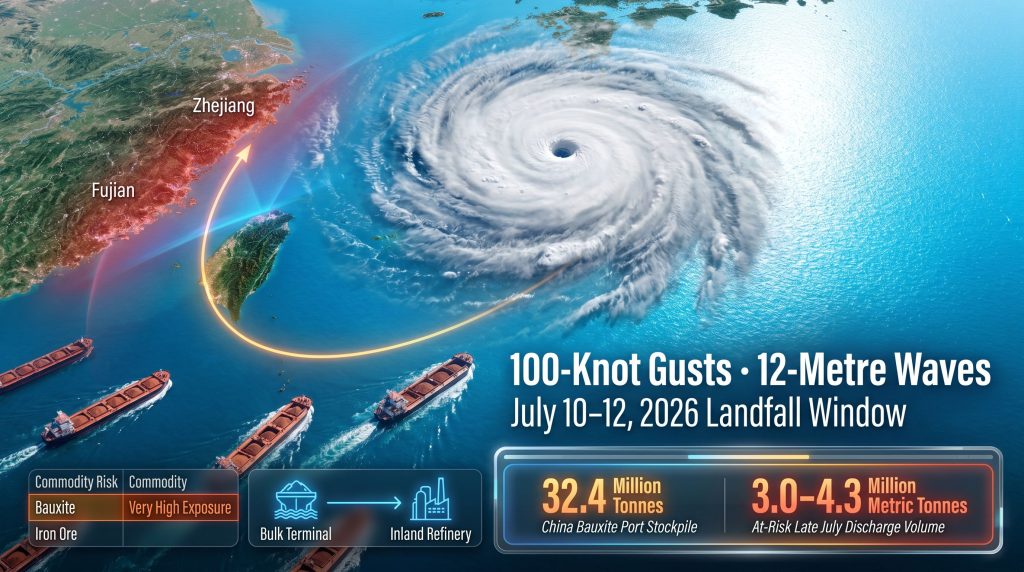
Super Typhoon Bavi has been classified as a Category 5 system by the European Centre for Medium-Range Weather Forecasts, with forecast wind gusts reaching 100 knots and wave heights approaching 12 metres. Its projected trajectory takes it through Taiwan before tracking toward China's eastern coastline, with landfall anticipated around July 10 to 12, 2026.
What makes this trajectory particularly consequential from a trade perspective is not just the storm's intensity but its geography. The path cuts directly across one of the Asia-Pacific's highest-density maritime corridors, a zone where dry bulk carriers, container vessels, tankers, and gas carriers operate in concentrated proximity. Provinces of Zhejiang and Fujian sit within the operational impact zone, and these are not peripheral ports. They represent critical discharge terminals for some of the highest-volume commodities flowing into China's industrial economy.
According to maritime intelligence monitoring by The Signal Group, vessels had already begun route alterations before the storm made landfall, a clear signal that the shipping industry had absorbed the severity of Bavi's forecast profile and was acting accordingly.
Which Commodities Face the Sharpest Exposure
Not all commodities moving through eastern Chinese ports carry equal vulnerability to a disruption event of this scale. The combination of discharge volume, port concentration, and downstream inelasticity determines how damaging a temporary closure becomes.
| Commodity | Exposure Level | Primary Risk Factor |
|---|---|---|
| Bauxite | Very High | High-volume discharge through eastern Chinese ports |
| Iron Ore | Very High | Bulk terminal dependency in Zhejiang and Fujian |
| Thermal Coal | High | Port-side stockpile vulnerability |
| Coking Coal | High | Time-sensitive steel sector supply chains |
| Soybeans | Moderate to High | Seasonal import volumes |
| Nickel Ore | Moderate | Concentrated discharge points |
Bauxite occupies a structurally distinct position at the top of this risk hierarchy. An estimated 3.0 to 4.3 million metric tonnes of bauxite cargo were scheduled for discharge in the late July window, a volume that cannot be absorbed by alternative terminals without significant logistical strain. Unlike the global iron ore market, which has established discharge pathways across China's northern ports, bauxite imports are disproportionately channelled through eastern and southern coastal terminals before being transported inland to alumina refineries.
The primary vulnerability in bauxite supply chains during a typhoon event is not at the mine face. Bauxite extraction operations in Guinea, Australia, and Indonesia are entirely unaffected by a western Pacific storm system. The concentration of risk sits within the maritime logistics layer, specifically at the point where cargo meets port infrastructure.
China's Structural Dependence on Imported Bauxite
To appreciate why Bavi's trajectory matters so much for the aluminium sector, it helps to understand the raw scale of China's reliance on imported bauxite. China operates as the world's largest alumina producer, and its domestic bauxite reserves, while substantial in aggregate, have been progressively depleted of high-grade ore. The country's alumina refining industry increasingly depends on imports from Guinea, Australia, and Indonesia to sustain throughput at competitive cost levels.
This dependency is not a short-term phenomenon. Guinea alone has emerged as the dominant marginal supplier of bauxite globally, and the bauxite production leaders connecting West African loading terminals to eastern Chinese discharge ports represent one of the longest and most logistically complex raw material supply routes in the commodities world. Voyage durations from Guinea to eastern China regularly exceed 25 days, meaning that any disruption to the discharge end of the pipeline cannot be quickly compensated by accelerating upstream loading operations.
The bulk density and vessel size requirements for bauxite cargoes add another layer of operational complexity. Bauxite is typically transported on large bulk carriers, and the limited number of terminals capable of efficiently handling these vessels in China means that rerouting to alternative ports is not a frictionless option. Each alternative discharge point introduces additional voyage extension costs, congestion risks, and scheduling conflicts with other cargo streams.
Port Disruption Mechanics: How a Typhoon Propagates Through the Supply Chain
What Are the Three Phases of Disruption?
The direct effect of a Category 5 storm on port operations is the most visible element of the disruption, but it is rarely the most economically significant. Three sequential disruption phases tend to compound the impact of major typhoon events on commodity import logistics:
-
Terminal closure phase involves ports reducing or fully suspending cargo operations as wind speeds and wave heights breach safety thresholds. For Zhejiang and Fujian terminals, this phase is expected to begin as Bavi approaches and may persist for two to seven days depending on storm track and intensity.
-
Vessel bunching phase begins as the storm clears. Ships that have been holding at anchorage or diverting to avoid the storm's path converge on reopened terminals simultaneously. Discharge queues extend, berth occupancy rates spike, and the efficiency gains that elevated stockpile levels were supposed to provide begin to erode.
-
Freight rate pressure phase develops as the combination of reduced available tonnage during rerouting and post-storm congestion creates temporary vessel scarcity. Historically, Category 4 to 5 typhoon events affecting major Chinese discharge zones have generated spot freight rate increases of 8 to 20 percent in the immediate aftermath, depending on the duration of port closures.
The total impact window across all three phases can extend to three weeks or more in a severe scenario, well beyond the physical duration of the storm itself.
China's Stockpile Position: A Buffer With Limits
China's imported bauxite port stocks reached 32.4 million tonnes ahead of the storm's approach, representing a 24 percent year-on-year increase and the highest inventory level recorded since 2022. On a surface reading, this elevated stockpile position appears to provide meaningful insulation against short-term supply disruption.
The reality is, however, more nuanced. Stockpile levels determine physical availability, but they do not govern price formation or procurement psychology.
| Disruption Duration | Stockpile Adequacy | Expected Market Response |
|---|---|---|
| 3 to 5 days (minor closure) | Adequate | Minimal price movement; freight rate uptick |
| 7 to 14 days (extended congestion) | Partially adequate | Spot bauxite and alumina price volatility |
| 15 or more days (compound disruption) | Insufficient | Refinery throughput adjustments; procurement urgency |
Even when physical inventories are running well above historical averages, the anticipation of delivery delays is sufficient to trigger spot price movements in bauxite and alumina markets. Procurement teams at alumina refineries operate on scheduling assumptions that elevated port stocks do not fully protect. When those schedules are disrupted, purchasing behaviour changes before physical shortages appear.
This is the psychological dimension of commodity supply chain risk that elevated stockpile narratives tend to understate. Markets price anticipated scarcity, not only actual scarcity, and a Category 5 typhoon making landfall across major import terminals is precisely the kind of catalyst that shifts procurement sentiment. Furthermore, China's bulk commodity imports face compounding pressure when port infrastructure is simultaneously strained across multiple commodity streams.
The next major ASX story will hit our subscribers first
Taiwan's Role in the Regional Trade Network
Taiwan's position in the bauxite and aluminium supply chain is secondary to mainland China's, but the storm's passage through Taiwanese territorial waters introduces a meaningful additional layer of regional trade friction. Passenger ferry services to Taiwan's offshore islands were suspended ahead of Bavi's approach, with the Keelung to Matsu maritime route scheduled for closure from Thursday through Saturday. Commercial aviation faced rebooking waivers as flight disruptions were anticipated across the affected window.
Taiwan's aluminium and alumina sector maintains active import relationships with Pacific bauxite suppliers, and disruption to Taiwanese port operations during the storm's passage adds further complexity to regional vessel scheduling. Recovery timelines for Taiwanese port operations are expected to align with the storm's July 11 passage window, positioning the island as a short-duration disruption node rather than a sustained vulnerability point.
The Broader Seasonal Risk Framework for 2026
Is This an Isolated Event or a Sign of Things to Come?
Bavi arriving as a Category 5 system in early July carries a significance that extends beyond the immediate disruption it creates. The Pacific typhoon season typically runs from June through November, with peak intensity concentrated in the August to October window. An early-season event of this magnitude suggests that the 2026 typhoon season may deliver above-average intensity systems across its entire duration.
For alumina refiners and bauxite importers, this framing transforms Super Typhoon Bavi bauxite trade disruption in China and Taiwan from an isolated weather event into the opening episode of a structurally challenging logistical period. Supply chain planners who have been operating on lean inventory strategies face elevated exposure throughout the remainder of the season, and several strategic adjustments are likely to emerge in response:
- Safety stock levels at inland alumina refineries may be reassessed upward to create buffers against repeated port disruption events.
- Procurement teams sourcing from Guinea, Australia, and Indonesia may seek to build forward inventory positions before the August to October peak risk window.
- Commodity hedging strategies and demurrage insurance products are likely to see increased demand from commodity trading desks managing bauxite and alumina cargo exposure.
- Vessel routing protocols may be updated to incorporate more conservative storm avoidance thresholds given the early-season intensity signal from Bavi.
The intersection of elevated typhoon risk, record port stockpile levels, and Guinea's rapidly expanding bauxite export volumes creates a genuinely complex operating environment for the aluminium raw material sector in the second half of 2026. Disruption events that would have been absorbed more quietly during periods of moderate supply are now occurring against a backdrop of significant cargo volumes in transit and compressed discharge windows at affected terminals. Consequently, the largest bauxite mines supplying China face indirect scheduling pressure even when their physical operations remain entirely unaffected.
FAQ: Super Typhoon Bavi and Bauxite Trade Disruption
Will Bauxite Mining in Guinea, Australia, or Indonesia Be Affected by Typhoon Bavi?
No. The storm is confined to the western Pacific, placing it far from all major bauxite-producing regions. Supply risk is concentrated in the maritime transport and port discharge phases of the supply chain, not at the extraction level.
How Long Could Port Disruptions Last at Zhejiang and Fujian Terminals?
Based on comparable typhoon events, terminal closures typically span two to seven days, with post-storm vessel congestion extending operational disruption for an additional one to two weeks. The total impact window could reach three weeks in a severe scenario.
Does China's 32.4 Million Tonne Stockpile Eliminate Supply Risk?
Elevated port inventories reduce the risk of immediate physical shortages for alumina refiners but do not prevent freight rate increases, spot price volatility, or delivery timing disruptions that affect refinery scheduling.
Which Chinese Ports Face the Highest Operational Risk From Bavi?
Ports in Zhejiang province, including Ningbo, and Fujian province are identified as the highest-risk terminals based on Bavi's projected landfall track.
What Happens to Vessels Carrying Bauxite Cargo When a Typhoon Approaches?
Vessel operators receive routing advisories from maritime intelligence services and typically alter course to avoid the storm's projected path. This extends voyage duration, delays scheduled discharge windows, and contributes to vessel scarcity in the affected region once the storm passes. In this way, the Super Typhoon Bavi bauxite trade disruption in China and Taiwan reaches well beyond any single port closure.
Disclaimer: This article contains forward-looking analysis, scenario projections, and commodity market assessments that are subject to significant uncertainty. Actual storm trajectories, port closure durations, freight rate movements, and price outcomes may differ materially from scenarios discussed. This content is intended for informational purposes only and does not constitute financial or investment advice. Readers should conduct independent research before making any commercial or investment decisions.
Could Supply Chain Disruptions Like Typhoon Bavi Signal the Next Major Commodity Opportunity?
Events like Super Typhoon Bavi demonstrate how rapidly commodity supply chains can shift, creating fleeting windows where informed investors can act before the broader market catches up. Discovery Alert's proprietary Discovery IQ model monitors significant ASX mineral discoveries in real time, delivering instant alerts on high-potential opportunities across bauxite, alumina, and more than 30 other commodities — start your 14-day free trial today, or explore how historic mineral discoveries have generated substantial returns for those who moved early.