
August 24, 2026
The Structural Forces Quietly Reshaping One of America's Oldest Commodity Markets
Recycled metal markets rarely attract the kind of attention given to lithium, copper, or rare earth elements. Yet beneath the surface of the US ferrous scrap sector lies one of the most consequential material transitions in modern industrial history. Understanding the US ferrous scrap market outlook requires appreciating how the shift from blast furnace to electric arc furnace steelmaking is quietly repositioning ferrous scrap from a low-margin byproduct into a strategic industrial input.
Furthermore, the economics of that transition will define pricing, consolidation, and investment opportunity across the next decade. Separating the noise of short-term sentiment from the structural forces operating across a much longer timeframe is essential for any serious market participant.
When big ASX news breaks, our subscribers know first
Defining the Market: What Ferrous Scrap Actually Is and Why It Matters
Ferrous scrap is any iron or steel-based recyclable material sourced from end-of-life vehicles, demolished buildings, industrial manufacturing offcuts, and discarded consumer goods. Unlike virgin iron ore, which must be smelted through energy-intensive blast furnace processes, ferrous scrap can be remelted and reformed through electric arc furnaces at significantly lower energy cost and carbon intensity.
The market is not monolithic. Key commercial grades include:
- #1 Heavy Melt – large-gauge structural steel, beams, and plate, typically sourced from demolition
- #1 Busheling – clean industrial offcuts from manufacturing, favoured for its low residual contamination
- Shredded Scrap – processed material from auto shredding operations, varying in residual content
- Obsolete grades – mixed consumer and industrial material with more variable chemistry
Each grade commands distinct pricing and demand characteristics. Mills with tight melt chemistry requirements, particularly those producing flat-rolled products for automotive use, will pay meaningful premiums for low-residual grades like Busheling. Commodity grades, however, face broader price ranges depending on export market conditions and mill specifications.
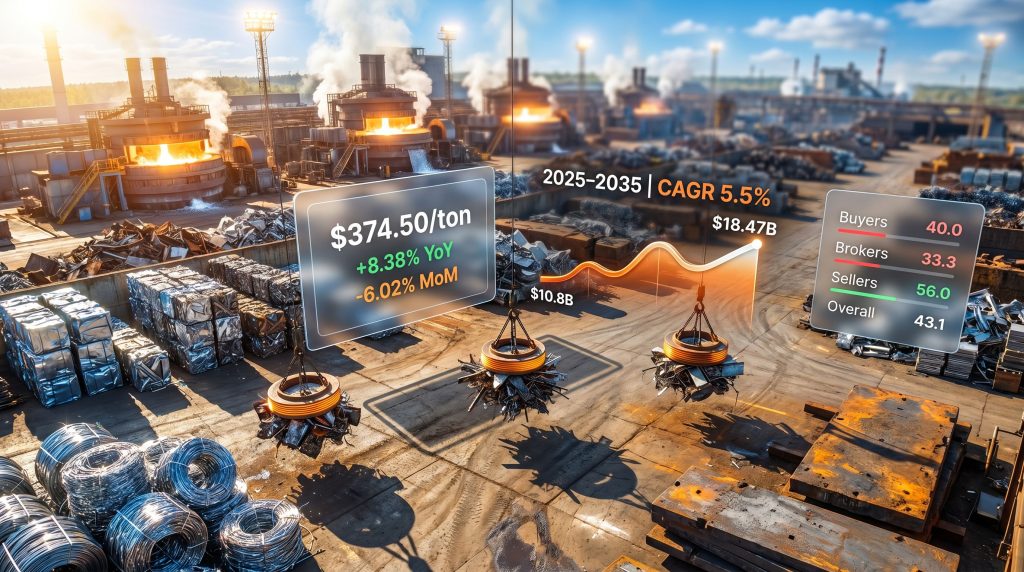
Ferrous scrap currently accounts for approximately 78.76% of the total US scrap metal recycling market by value as of 2026, making it the commanding segment in a sector estimated at $10.8 billion in 2025. According to industry research on the ferrous scrap recycling market, that figure is projected to reach $18.47 billion by 2035, implying a compound annual growth rate of 5.5% over the decade.
Where Prices Stand in Mid-2026: A Market in Temporary Equilibrium
As of July 7, 2026, scrap steel spot prices were recorded at approximately $374.50 per ton, representing a month-on-month decline of roughly 6% but remaining about 8.4% above year-ago levels. This places the market in an interesting position: technically in recovery on an annual basis, yet softening on a shorter timeframe.
| Metric | Value |
|---|---|
| US Scrap Metal Market Size (2025 est.) | $10.8 billion |
| Projected Market Size (2035) | $18.47 billion |
| CAGR (2025–2035) | 5.5% |
| Ferrous Scrap Market Share (2026) | ~78.76% |
| Scrap Steel Spot Price (July 7, 2026) | $374.50/ton |
| Month-on-Month Price Change | -6.02% |
| Year-on-Year Price Change | +8.38% |
For context, ferrous scrap approached approximately $400 per ton during the post-pandemic supply chain disruption period of 2021. Light iron grades spent much of 2025 trading in the $120 to $140 per ton range, setting a historically subdued base from which the current partial recovery has emerged. The current pricing environment reflects a market in temporary equilibrium rather than directional stress — a distinction that carries significant strategic implications. The US ferrous scrap outlook suggests this equilibrium phase may persist into late 2026.
What July 2026 Sentiment Data Reveals About Market Psychology
Industry sentiment surveys provide a revealing window into participant behaviour that price data alone cannot capture. The July 2026 Trend Indicator, which aggregates expectations from active buyers, sellers, and brokers across the US ferrous scrap market, moved into bearish territory at 43.1, where any reading below 50 signals an expectation of weaker pricing in the period ahead.
The breakdown by participant type is particularly instructive:
| Participant Group | Trend Indicator Score | Sentiment Interpretation |
|---|---|---|
| Overall Market | 43.1 | Bearish – price weakness expected |
| Buyers | 40.0 | Strongly bearish – cautious purchasing posture |
| Brokers | 33.3 | Most bearish – significant downside concern |
| Sellers | 56.0 | Mildly bullish – holding firm on pricing |
| Inventory Level | 50.6 | Neutral – broadly average stocking conditions |
| Market Consensus | 69% | Relatively high agreement among participants |
The spread between buyer sentiment at 40.0 and seller sentiment at 56.0 signals a classic bid-ask standoff. Buyers are reluctant to commit at current prices while sellers are resisting discounts. This is not unusual during summer months, but the depth of broker pessimism at 33.3 is worth noting.
Brokers absorb bid-ask spread risk as intermediaries, making them particularly sensitive to price discovery breakdown. When brokers are the most bearish cohort, it typically signals that transaction volumes are declining and market liquidity is thinning.
High consensus at 69% tells us that while the directional view is broadly shared, disagreement persists around magnitude. The market largely agrees on where it is heading, but participants are not uniformly confident in how far it will travel.
Perhaps the most strategically revealing data point is the most commonly cited market driver: All Unchanged. This signals no single dominant force is reshaping conditions. Equilibrium markets of this type are deceptively dangerous — they are highly sensitive to exogenous shocks, and any unexpected demand surge or supply disruption can trigger outsized price moves with very little warning.
Three Converging Forces Suppressing Near-Term Demand
The summer softness of mid-2026 is not random. Three compounding seasonal dynamics are systematically suppressing ferrous scrap demand:
- Scheduled mill maintenance outages – steelmakers regularly take EAF facilities offline during summer months for planned servicing, reducing scrap purchasing volumes in a predictable but material way
- Extreme heat events – elevated temperatures disrupt scrap yard operations, reduce collection efficiency, and create safety constraints that limit processing throughput
- Power curtailments – grid stress during peak summer cooling demand can restrict EAF operating hours, directly reducing the volume of scrap consumed per week
These three forces do not operate independently. When all three converge simultaneously, as appears to be the case in July 2026, the cumulative effect on demand is considerably larger than any single factor would suggest. Mills become comfortable with existing material flow, buying interest evaporates, and sellers face the unwelcome choice of holding inventory at carrying cost or discounting into a thin market.
Importantly, the quantitative prediction model used by Fastmarkets projects a modest 1.9% month-on-month price increase despite the bearish sentiment reading. This divergence between qualitative sentiment and quantitative modelling suggests mechanical price support factors may partially offset sentiment-driven weakness — a distinction worth understanding for market participants making near-term positioning decisions. Furthermore, latest US scrap trends from Fastmarkets reinforce that cost floors and minimum supply constraints remain active buffers in the current environment.
The Long-Term Structural Case: Why EAF Expansion Changes Everything
Short-term softness should not obscure the profound structural shift reorienting the US ferrous scrap market outlook across a decade-long horizon. Electric arc furnace technology has become the dominant mode of new steelmaking capacity in the United States, and that technological preference creates a direct, scalable, and durable linkage between EAF expansion and ferrous scrap demand.
Each new EAF facility commissioned in the US consumes approximately one ton of scrap per ton of steel produced. Unlike blast furnace capacity, EAFs are essentially scrap-dependent by design. New facilities therefore represent not just capital investment but structural, multi-decade demand commitments for domestic scrap supply.
How Is Capital Commitment Reshaping the Sector?
The Hybar example is instructive. With its first rebar mill in Osceola, Arkansas, operating for fewer than nine months, the company announced the raising of $1.1 billion to construct a second rebar expansion mill adjacent to the existing facility. This type of capital commitment, made during a period of soft sentiment, reflects the long-term confidence that EAF-focused producers have in the scrap supply chain.
Decarbonisation is accelerating this structural shift. In addition to lower energy costs, EAF steelmaking produces substantially lower CO2 emissions per ton of finished steel compared to blast furnace routes. Emerging low-carbon ironmaking technologies are further intensifying pressure on traditional steelmakers to adapt, which in turn bolsters the case for scrap-based production pathways.
As industrial buyers across automotive and construction increasingly demand low-carbon certified steel, EAF producers using high-quality scrap gain a product differentiation advantage. This creates the conditions for a tiered pricing structure to emerge, where clean, traceable, low-residual scrap commands a sustainability premium above commodity grades. The evolution of green steel pricing dynamics will play a central role in determining how that premium develops over time.
Scrap processors capable of certifying material provenance and carbon intensity may access premium pricing channels that remain entirely unavailable to conventional commodity suppliers — an underappreciated structural opportunity that has not yet been fully priced into industry valuations.
The next major ASX story will hit our subscribers first
Section 232 Tariffs, Trade Dynamics, and the Hidden Risks of Overcapacity
US steel tariffs have materially altered the competitive dynamics between imported steel and domestically produced EAF steel. Higher import barriers increase the cost competitiveness of domestic producers, which in turn strengthens the fundamental demand case for US-sourced ferrous scrap.
However, there is a less discussed risk embedded in this dynamic. If tariff protection incentivises domestic steelmaking capacity additions that outpace demand recovery, the resulting oversupply in finished steel could compress mill margins significantly. The paradox is real: higher tariff-driven EAF capacity could simultaneously increase scrap consumption volumes while reducing the price that mills are willing to pay per ton.
Export market dynamics add another layer of complexity. US ferrous scrap exports flow primarily to Turkey, South Korea, India, and other major buying nations. The competitiveness of those export flows depends on freight cost movements, currency dynamics, and the relative strength of domestic versus international steel demand. Geopolitical disruptions are increasing operational costs for scrap collection, processing, and transportation, compressing margins particularly for smaller operators without hedging capacity.
Broader steel decarbonisation trends in Europe are also reshaping global scrap flows, as European mills compete more aggressively for high-quality feedstock to meet tightening emissions standards.
Three Scenarios for the US Ferrous Scrap Market Through 2035
Scenario 1: Accelerated EAF Expansion (Bull Case)
Sustained infrastructure investment, rapid automotive manufacturing reshoring, and deepening decarbonisation policy implementation drive scrap demand beyond available domestic supply. Prices recover toward the $420 to $450 per ton range by 2028, and market growth exceeds the baseline 5.5% CAGR, potentially reaching 7 to 8% annually through 2030.
Scenario 2: Managed Equilibrium (Base Case)
Moderate infrastructure activity, steady EAF additions offset by capacity discipline, and stable trade policy produce a market that grows in line with the $10.8 billion to $18.47 billion trajectory. Ferrous scrap prices oscillate between $350 and $400 per ton through 2027 with gradual upward drift toward $430 per ton by 2030.
Scenario 3: Prolonged Softness (Bear Case)
A US construction slowdown, automotive sector weakness, steel overcapacity, or escalating trade tensions combine to retest $320 to $340 per ton on scrap steel. Long-term CAGR falls to the 3.5 to 4% range, and recovery would require a major infrastructure stimulus event or accelerated EV adoption.
Disclaimer: Scenario projections are illustrative frameworks based on available market data and structural analysis. They do not constitute financial advice. Commodity markets involve substantial uncertainty and actual outcomes may differ materially from any projected range.
How Market Participants Should Position Themselves
For buyers, the rational near-term strategy in a soft sentiment environment is to maintain lean inventory and delay non-essential purchasing commitments. However, the All Unchanged signal warns against complacency. Establishing forward purchase agreements for Q4, when seasonal demand typically recovers, offers a practical hedge against timing risk.
For sellers, the current posture of price discipline reflected in the 56.0 Trend Indicator reading is sustainable while inventory levels remain near average. If summer mill outages extend beyond their scheduled windows, however, yard accumulation will build carrying costs that eventually force price concessions into a thin market.
For brokers, periods of market stasis create value for those who can identify and connect motivated parties on both sides of the equilibrium. The most bearish cohort in the July survey also has the most to gain from restoring transaction volume through creative deal structuring.
For longer-term investors and consolidators, the combination of price volatility, rising operational costs, and capital intensity is accelerating industry rationalisation. Well-capitalised operators acquiring mid-sized processors during soft pricing periods are building market share at discounted entry points that may not persist once the structural demand tailwinds from EAF expansion fully materialise.
Frequently Asked Questions: US Ferrous Scrap Market
What is the current US ferrous scrap price?
As of July 7, 2026, scrap steel prices were recorded at approximately $374.50 per ton, reflecting a month-on-month decline of around 6% but remaining approximately 8.4% above year-ago levels.
What is driving long-term growth in the US ferrous scrap market?
The primary structural drivers are the accelerating adoption of EAF steelmaking, rising industrial decarbonisation pressure, and growing steel demand from automotive, construction, and infrastructure sectors. The US ferrous scrap market outlook points to growth from approximately $10.8 billion in 2025 to $18.47 billion by 2035 at a 5.5% CAGR.
Why is the ferrous scrap market soft in mid-2026?
Scheduled summer mill maintenance outages, extreme heat disrupting collection and processing operations, power curtailments limiting EAF operating hours, and a broadly cautious buyer posture are converging to suppress near-term demand.
How do Section 232 tariffs affect ferrous scrap pricing?
Section 232 tariffs increase the competitiveness of domestic EAF producers relative to imported steel, structurally supporting scrap demand. However, if tariff-driven capacity additions outpace demand recovery, domestic steel oversupply could compress mill margins and reduce scrap purchasing budgets even as volumes grow.
Which ferrous scrap grades are most valuable?
High-quality, low-residual grades such as #1 Busheling and clean Shredded Scrap command the strongest premiums from EAF mills requiring consistent melt chemistry. As sustainability certification gains commercial traction, traceable, low-carbon material may command additional premiums above current commodity benchmarks.
Want to Track the Next Major ASX Mineral Discovery Before the Market Does?
While structural commodity shifts like the US ferrous scrap transition unfold over decades, some of the most significant investment opportunities emerge in seconds — the moment a major mineral discovery hits the ASX. Discovery Alert's proprietary Discovery IQ model delivers real-time alerts on significant ASX mineral discoveries, translating complex geological data into actionable insights for both short-term traders and long-term investors. Explore historic discoveries and their exceptional market returns, then begin your 14-day free trial to position yourself ahead of the broader market.