July 9, 2026
When Trade Policy Meets a War Economy: Ukraine's Steel Sector Under Compounding Pressure
Global steel trade has always been shaped by political calculus as much as market forces. Quota systems, tariff arrangements, and preferential trade agreements have long determined which producers thrive and which contract, regardless of underlying operational efficiency. However, when a trade policy designed to address one problem — specifically Chinese-driven global overcapacity — is applied uniformly to a conflict-affected ally operating under active wartime constraints, the results can be structurally damaging in ways that extend far beyond the steel sector itself. Ukraine's steel output at risk over new EU trade regulations is precisely the situation now unfolding in 2026.
When big ASX news breaks, our subscribers know first
Ukraine's Steel Sector: Wartime Realities Before Any New Policy
Understanding the current threat to Ukraine's steel output requires appreciating how severely the industry was already stressed before the EU's new tariff rate quota (TRQ) framework entered the picture. Ukraine's steelmaking industry, historically one of the most significant in Eastern Europe, has been operating under extraordinary duress since the full-scale conflict began. Logistics chains have been disrupted, energy infrastructure repeatedly damaged, and grid reliability has deteriorated to the point where industrial facilities face frequent unplanned outages.
The EU's Carbon Border Adjustment Mechanism (CBAM) added another layer of cost complexity to an already strained operating environment. CBAM, designed to prevent carbon leakage by pricing embedded emissions in imported goods, imposes additional financial burdens on steel producers in countries where grid electricity carries high carbon intensity. For Ukrainian steelmakers relying on a war-damaged and often fossil-fuel-dependent energy grid, this translates into elevated compliance costs at precisely the moment when operational margins are thinnest.
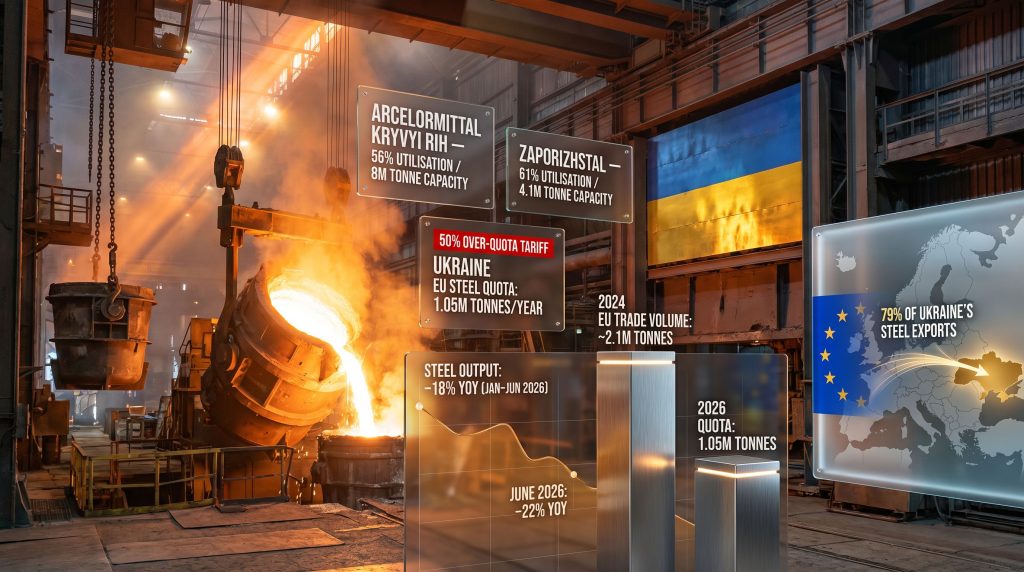
Furthermore, the combined effect of these pressures has pushed Ukraine's steel sector well below theoretical capacity even before the TRQ came into force. Satellite-based production monitoring data for the first half of 2026 shows Ukraine's steel output tracking 18% lower year-on-year for the January through June period, with June 2026 recording an especially sharp 22% year-on-year decline in crude steel production.
Facility-Level Utilisation: The Numbers Behind the Headlines
The operational picture at Ukraine's two flagship steelmaking facilities illustrates the depth of the challenge:
| Facility | Rated Annual Capacity | Estimated Utilisation Rate (Mid-2026) |
|---|---|---|
| ArcelorMittal Kryvyi Rih | 8 million tonnes/year | ~56% |
| Zaporizhstal Iron and Steel Works | 4.1 million tonnes/year | ~61% |
| Combined rated capacity | 12.1 million tonnes/year | ~58% blended average |
Both plants continue to produce despite frequent electrical grid outages, a fact that speaks to the resilience of Ukraine's industrial workforce and management under extreme conditions. However, sustaining even this reduced level of output requires continuous navigation of energy shortfalls, supply chain bottlenecks, and personnel challenges inherent to wartime operations.
Understanding the EU TRQ: What the System Does and Why It Was Built
The Tariff Rate Quota mechanism is a trade instrument that establishes an annual ceiling on how much steel can enter the EU market tariff-free across covered product categories. Once that ceiling is reached, additional imports face a punishing tariff, effectively pricing out most producers who cannot absorb that cost increment.
The 2026 framework sets the EU's total TRQ ceiling at 18.3 million tonnes per year, representing a 47% reduction from the 2024 reference volume. The policy's core logic targets global steel overcapacity, a structural market distortion largely attributable to the China steel market and its state-subsidised industrial expansion, which has flooded international markets with cheap steel for years. The EU's concern is legitimate in the abstract: unrestricted low-cost steel imports can devastate domestic producers and erode strategic manufacturing capacity.
The problem is that the TRQ applies this overcapacity rationale uniformly, without meaningfully differentiating between producers who are contributing to global oversupply and those, like Ukraine, who have experienced dramatic capacity destruction and are demonstrably reducing output under duress. Consequently, the policy's blunt application raises serious questions about its fitness for purpose in the current geopolitical environment.
Country-Specific Quotas: Ukraine's Allocation in Context
Under the TRQ architecture, the European Commission allocates country-specific quotas. Ukraine's allocation stands at 1.05 million tonnes per year, a figure that sits uncomfortably against the reality of Ukraine's recent trade volumes:
| Metric | Figure |
|---|---|
| EU TRQ total annual ceiling (2026) | 18.3 million tonnes |
| Reduction from 2024 reference volume | 47% |
| Ukraine's country-specific quota | 1.05 million tonnes/year |
| Ukraine's 2024 EU steel trade volume | ~2.1+ million tonnes |
| Quota coverage of 2024 trade flows | Less than 50% |
| Over-quota tariff rate | 50% |
| EU share of Ukraine's total steel exports | ~79% |
The gap between the 1.05 million tonne quota and Ukraine's actual 2024 trade flows of more than 2.1 million tonnes means that, under the new regime, roughly half of what Ukraine was shipping to the EU in the prior year would immediately face a 50% tariff if production were maintained at equivalent levels. For producers already absorbing wartime cost premiums, that tariff is commercially prohibitive. According to reporting from Reuters, Interpipe's CEO has warned directly that EU import cuts threaten Ukraine's battered steel sector.
An important framing dispute has emerged between EU officials and Ukrainian industry representatives. Some European Commission spokespeople have characterised the quota as covering approximately 70% of Ukraine's steel trade with the EU, a figure derived from longer-term historical averages that predate the elevated trade volumes of more recent years. Ukrainian producers and industry bodies contest this framing, arguing that current and recent trade flows are the commercially relevant baseline, not multi-year historical averages that include periods of severely constrained wartime production.
The Preferential Access Removal: More Than a Technicality
Prior to the TRQ framework, Ukraine's steel exports to the EU benefited from specific preferential arrangements connected to the EU-Ukraine Association Agreement and related trade frameworks. These arrangements provided Ukrainian producers with a degree of certainty about market access that underpinned long-term commercial and investment decisions.
The new TRQ system materially changes that dynamic. Rather than operating under guaranteed preferential treatment, Ukraine's quota allocation is now subject to discretionary consideration by the European Commission during the annual allocation process. In addition, this transition from rule-based entitlement to discretionary consideration introduces a layer of commercial uncertainty that complicates production planning, financing, and capital allocation for Ukrainian steelmakers who must make investment decisions months in advance.
For an industry already operating on compressed margins under wartime conditions, that uncertainty carries real cost. Banks and investors factor regulatory risk into financing terms. Equipment suppliers and logistics partners require commercial confidence to commit to long-term agreements. The shift to discretionary treatment erodes the foundations on which such confidence is built. The EU Council's own press release acknowledges the intent to support Ukraine's economy, yet the quota structure tells a different story in practice.
The 79% Dependency Problem: No Alternative Market Exists at Scale
The strategic vulnerability exposed by the TRQ becomes acute when considered alongside Ukraine's export market concentration. The EU absorbs approximately 79% of Ukraine's total steel exports, a dependency that reflects both the geographic logic of Ukraine's location and the decades-long commercial relationships built with European buyers.
There is no realistic short-term alternative. Redirecting steel volumes to Asian markets would require navigating wartime Black Sea shipping constraints, establishing new commercial relationships with buyers who have existing long-term supply agreements, and competing on price against well-established regional producers. Overland logistics alternatives are capacity-constrained and expensive. The Middle East and North Africa markets, while potentially accessible, cannot absorb the volume that a 50% over-quota tariff would displace from European trade flows.
Three Scenarios for Ukraine's Steel Producers in 2026
Scenario A: Quota exhaustion in the first half of the calendar year
- Ukraine's 1.05 million tonne tariff-free allocation fills before mid-year
- Remaining production either faces the 50% tariff or must be curtailed
- Utilisation rates at ArcelorMittal Kryvyi Rih and Zaporizhstal, already at 56% and 61% respectively, face further downward pressure
- Revenue losses accelerate workforce reductions and deferred maintenance
Scenario B: Producers self-ration output to match quota entitlement
- Steelmakers voluntarily cap production at quota-aligned volumes to avoid tariff exposure
- Output stabilises at structurally depressed levels, limiting both revenue and employment
- Post-war reconstruction investment becomes financially inaccessible as cash flow shrinks
- Equipment degradation accelerates due to reduced throughput and cash-constrained maintenance
Scenario C: European Commission intervenes with quota review or adjustment
- Political pressure from MEPs, Ukrainian government agencies, and industry bodies triggers a formal quota reconsideration
- Partial restoration of preferential access or a quota uplift is negotiated through EU institutional processes
- Outcome remains uncertain and subject to member state consensus, with no guaranteed timeline
How Geospatial Intelligence Is Reshaping Industrial Monitoring
One of the less widely understood dimensions of this story involves how production data for Ukraine's steel sector is being collected and verified. In a conflict zone, conventional data collection mechanisms — government statistical agencies, industry self-reporting, and on-site audits — are either disrupted, unreliable, or inaccessible to external observers.
Geospatial intelligence platforms that use thermal and optical satellite imagery to monitor industrial smelter activity have emerged as a credible alternative evidence base in precisely this context. By analysing heat signatures, emission plumes, and plant activity patterns from orbital sensors, these platforms can produce near-real-time estimates of steel production activity that are independent of any government or corporate reporting.
The satellite-derived data confirming that both ArcelorMittal Kryvyi Rih and Zaporizhstal remain operational, despite grid outages and wartime disruption, provides an independently verifiable foundation for policy discussions. It also introduces an important nuance: the decline in Ukrainian steel output is not a binary story of facilities shutting down. It is a more complex picture of sustained but reduced operations, where commercial and regulatory headwinds are layering onto physical wartime constraints in ways that threaten gradual rather than sudden collapse.
The next major ASX story will hit our subscribers first
Steel as Infrastructure for Post-War Recovery
The implications of the TRQ for Ukraine extend well beyond the immediate commercial interests of individual steelmakers. Ukraine's steel industry serves as a critical source of foreign currency earnings that underpin the country's wartime fiscal position. Every tonne of steel that cannot reach European markets at competitive terms represents a direct reduction in the hard currency available to fund essential government functions, wages, and services.
Beyond the immediate fiscal dimension, there is a structural argument about post-war reconstruction that deserves serious weight. Rebuilding Ukraine's physical infrastructure after the conflict will require enormous quantities of structural steel: for bridges, buildings, railways, energy facilities, and urban housing. Preserving domestic steel production capacity during the conflict is directly connected to Ukraine's ability to supply its own reconstruction needs.
Plants operating at sustained low utilisation face accelerated equipment wear, workforce attrition as skilled workers seek more stable employment, and growing backlogs of deferred capital maintenance. If key facilities are forced to curtail operations due to loss of EU market access, the capital required to restart them post-war will be substantially higher than the cost of maintaining them through the current period. The window for preserving operational continuity is narrow, and the decisions made in 2026 will echo through the industry's structural capacity for years beyond the conflict. Efforts around green steel pricing and decarbonisation add yet another long-term cost dimension to consider.
The EU's Policy Coherence Question
There is a broader strategic tension that analysts and policymakers have begun to articulate more explicitly. The EU has committed substantial financial resources to supporting Ukraine's wartime economy and post-war recovery prospects. Simultaneously constraining Ukraine's primary export revenue stream through a quota system creates a policy coherence challenge: financial transfers on one hand, and trade restrictions that reduce the revenue base those transfers are intended to supplement on the other.
The design logic of the TRQ — targeting global overcapacity driven by Chinese industrial policy — does not align well with Ukraine's situation as a conflict-affected producer with structurally declining, not expanding, output. Applying the same framework to both Chinese overproduction and Ukrainian wartime steel exports conflates two very different market dynamics. The broader context of trade wars and supply chains further complicates the EU's capacity to carve out nuanced, country-specific exemptions without triggering wider political disputes.
Furthermore, the steel and aluminium tariffs already reshaping global trade flows are adding external pressure to European steel policy deliberations, making a coherent and equitable resolution harder to achieve. Ongoing work on steel decarbonisation partnership models also demonstrates how complex and interconnected the future of steel production has become.
Whether the European Commission moves to address this misalignment through a quota review, a special carve-out, or a broader reconsideration of how Ukraine is classified within the TRQ framework remains to be seen. What is clear is that the current trajectory places Ukraine's steel output at risk over new EU trade regulations at a moment when the industry can least afford additional commercial headwinds, and when the strategic cost of getting this policy wrong extends far beyond the steel sector itself.
Frequently Asked Questions: Ukraine Steel Output and EU Trade Policy
What is the EU Tariff Rate Quota (TRQ) and when did the current framework take effect?
The TRQ is a mechanism that limits the volume of steel that can enter the EU tariff-free each year. The current framework, which reduced the annual tariff-free ceiling by 47% from the 2024 reference volume to 18.3 million tonnes, took effect on 1 July 2026.
What is Ukraine's country-specific quota under the new TRQ system?
Ukraine's allocated quota stands at 1.05 million tonnes per year, covering less than half of the volume Ukraine traded into the EU in 2024.
What tariff applies to Ukrainian steel that exceeds the quota threshold?
Steel volumes exceeding Ukraine's allocated quota face a 50% import tariff on entry into the EU market, a cost burden that wartime-affected producers cannot commercially absorb.
Why is the EU market so critical for Ukraine's steel industry?
The EU accounts for approximately 79% of Ukraine's total steel exports. No alternative market can absorb displaced volumes at comparable scale given current wartime logistics constraints on Black Sea shipping and overland transport.
Are Ukraine's steel plants still operating?
Yes. Satellite-based industrial monitoring confirms that both ArcelorMittal Kryvyi Rih and Zaporizhstal Iron and Steel Works remain operationally active, producing at approximately 56% and 61% of rated capacity respectively despite grid outages and wartime disruption.
How has Ukraine's steel production trended in 2026?
Output tracked 18% lower year-on-year for the January to June 2026 period, with June alone recording a 22% year-on-year decline in crude steel production. This ongoing decline underscores why Ukraine's steel output at risk over new EU trade regulations represents such a critical policy challenge for both Kyiv and Brussels.
Disclaimer: This article contains forward-looking analysis, scenario projections, and commentary on evolving trade policy frameworks. Figures cited reflect data available as of early July 2026 and may be subject to revision. Nothing in this article constitutes financial or investment advice. Readers should conduct independent research and seek professional advice before making decisions based on the information presented here.
Want to Stay Ahead of Major Commodity and Resource Developments?
Discovery Alert's proprietary Discovery IQ model delivers real-time alerts on significant ASX mineral discoveries, transforming complex resource data into actionable investment insights — explore historic discoveries and their exceptional market returns to understand the opportunity, then begin your 14-day free trial at Discovery Alert and position yourself ahead of the broader market.